Thahbib Rahman
Research Analyst
Strong institutional demand has helped underpin a close to 12% rally in BTC’s spot price month-to-date, while derivative markets continue to fade the rally. Spot Bitcoin ETFs saw their longest consecutive inflow streak since the 10/10 liquidation event, vacuuming more than $2.1B worth of bitcoins. Meanwhile, Strategy and BitMine have continued to showcase their insatiable appetite for bitcoin and ether, respectively: Strategy made its largest purchase since November 2024 earlier this month; BitMine recently purchased over 100,000 Ether. April is also on track to break 5 straight months of Spot Ethereum ETF outflows.

Strong institutional demand has helped underpin a close to 12% rally in BTC’s spot price month-to-date, while derivative markets continue to fade the rally.
Spot Bitcoin ETFs saw their longest consecutive inflow streak since the 10/10 liquidation event, vacuuming more than $2.1B worth of bitcoins.
Meanwhile, Strategy and BitMine have continued to showcase their insatiable appetite for bitcoin and ether, respectively:
April is also on track to break 5 straight months of Spot Ethereum ETF outflows.
Despite the bullish sentiment in spot markets however, derivative markets have so far failed to echo the same enthusiasm.
Funding rates in perpetual futures contracts have mostly traded negative, open interest in perp contracts shows little interest in opening new positions, and in options markets, put-call skew is still tilted towards put options.
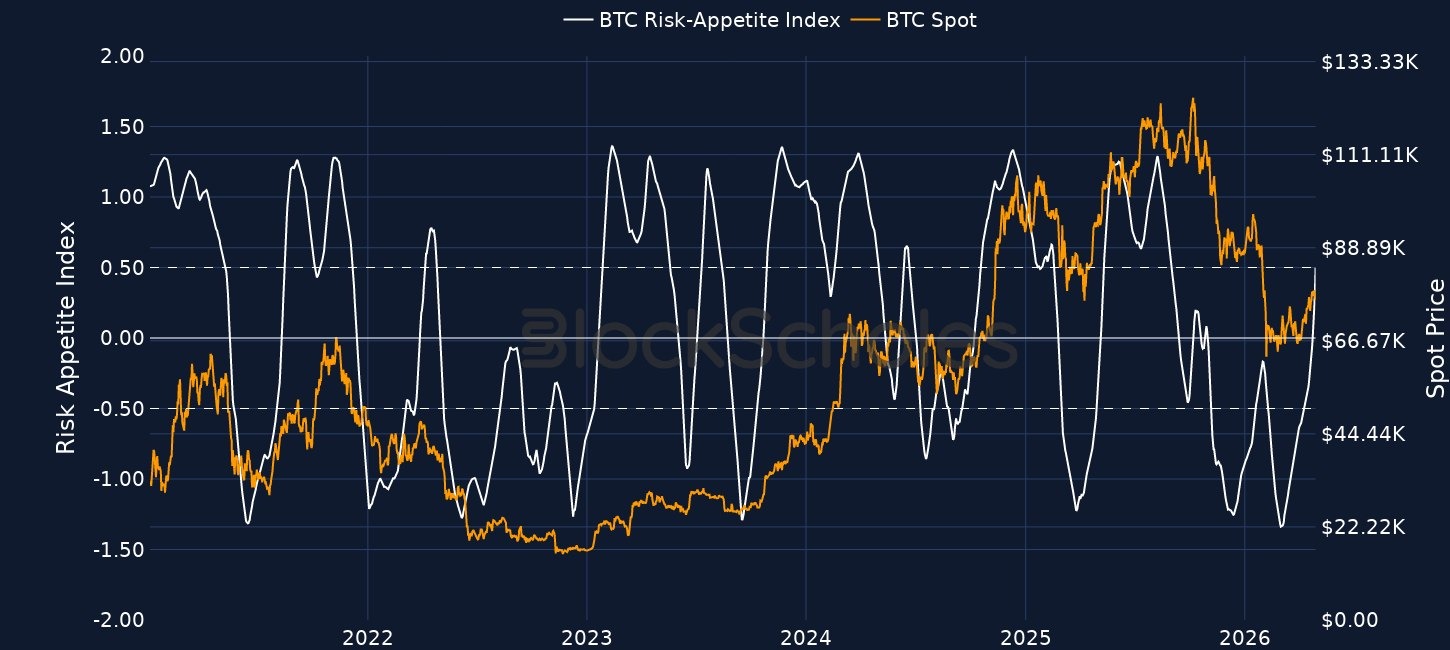
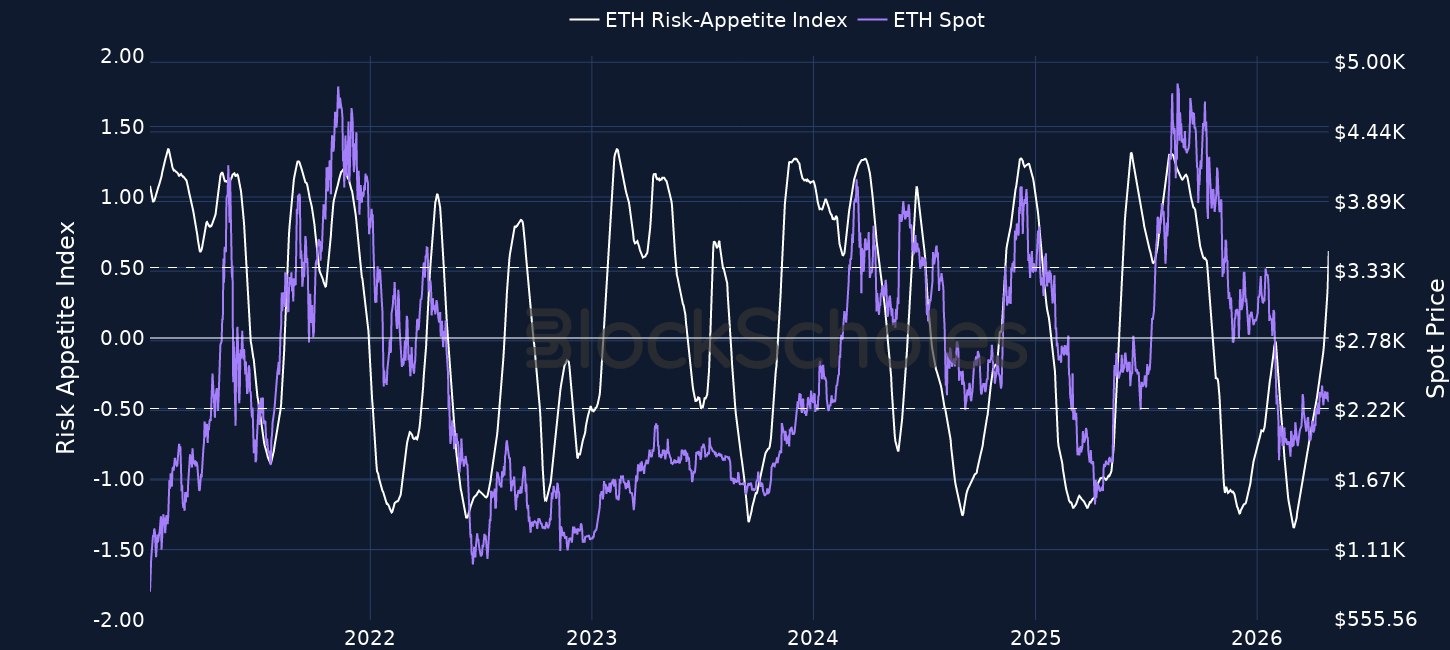
A near 12% rally month-to-date has put BTC on track for its best month since April 2025.
Risk-appetite in crypto spot prices rose earlier in the week, coinciding with record highs in US equities after Iran offered the US a new peace deal. That deal proposed a full reopening of the Strait of Hormuz, with nuclear negotiations postponed for a later date after both sides lifted their blockades in the vital waterway.
BTC rallied to as much as $79,500 – a twelve-week high, before meeting a sharp wall of resistance just below $80K. Since then, the spot price has lingered around $76K after it was reported that President Trump rejected Tehran’s peace proposal and told his White House aides to potentially prepare for an extended naval blockade of the Hormuz Strait, with plans for further military action reportedly in the pipeline
The slow, steady (and almost stealth-like) recovery in BTC over the month of April has not, however, been driven by leverage or exuberance in perpetual futures markets.

Open interest in BTC perp contracts, for example, has been steady over the course of the month, below $4B, while total open interest across several blue-chip tokens has mostly ranged between $6-7B. That suggests that despite a three-month high in spot price, traders on Bybit are yet to rush into leveraged perp positions in the hope of capturing further upside in spot price.
We can also look at funding rates to gauge whether traders expect the rally to continue.
DECODE: A consistently positive funding rate indicates that traders are willing to pay a fee for the leveraged long exposure perpetual swap contracts offer – a sign of bullish sentiment and trader expectation of a further rally in spot price.

Much of the spot rally in April has not been accompanied by positive funding rates in BTC or ETH perp contracts, suggesting a lack of conviction from perp traders. For comparison, see below how the early 2026 spot move towards $100K was backed by a more prolonged period of positive funding rates.
While BTC’s recovery rally in April may not have been driven by speculative leverage position building, it has, however, coincided with strong institutional interest.
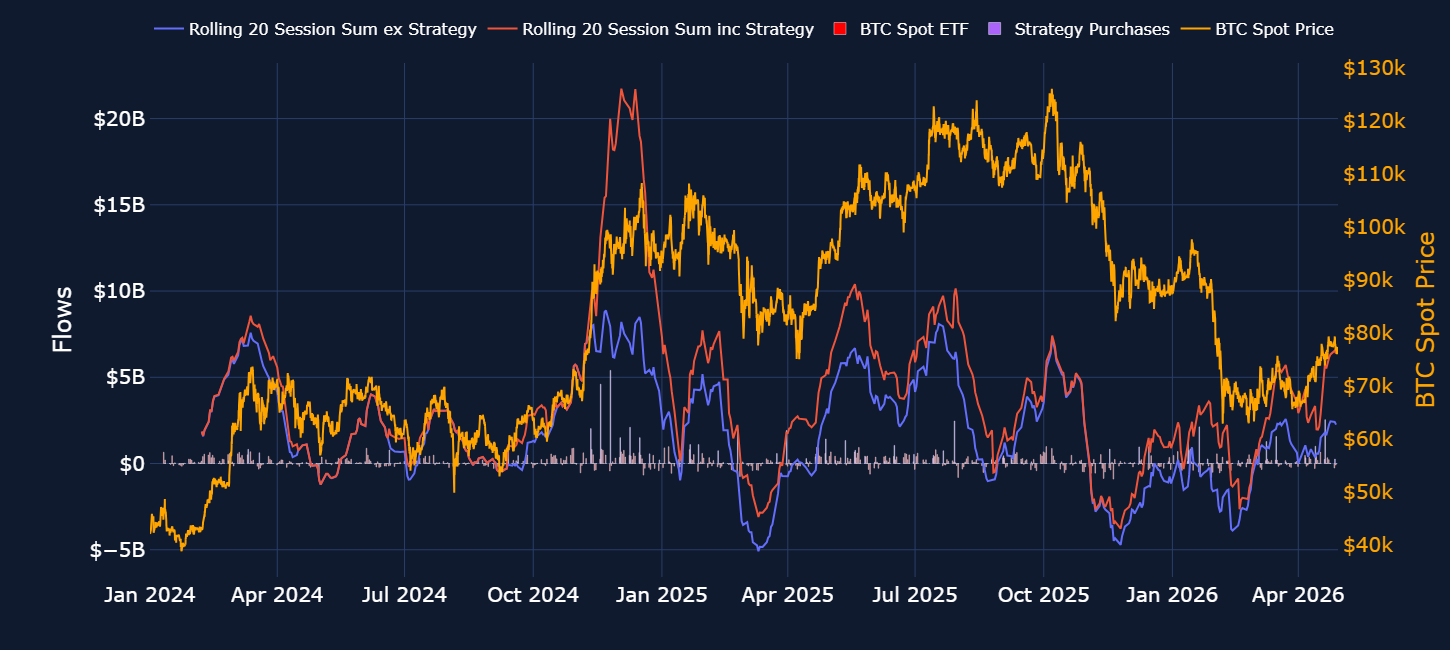
Between April 14 and April 24, Spot Bitcoin ETFs had a straight run of 9 consecutive inflow days, purchasing more than $2.1B worth of bitcoins. The last time Spot Bitcoin ETFs had such a long inflow streak was between Sept 29 and Oct 9, 2025 – just before the historic October 10 liquidation event. While the past two days have seen outflows, April is still on track to be the strongest month for Spot Bitcoin ETF net flows since October 2025.

Institutional interest has not, however, been limited to just Spot ETFs.
Strategy, the largest Bitcoin digital asset treasury and the largest institutional holder of BTC, has purchased $4.1B worth of Bitcoin over the course of April. On April 20, 2026 for example, the firm made its largest purchase since November 2024, acquiring 34,164 bitcoin at a total cost of $2.5B.
The rolling 20-day sum of Spot Bitcoin ETFs and Strategy purchases has more than doubled from $2.9B at the start of April to over $6.5B, and is currently at its highest since October last year.
We see a similar story in Ethereum, too.
ETH spot price is up more than 10% this month, with April on track to break 5 straight months of Spot Ethereum ETF outflows. Ethereum digital asset treasury firm BitMine recently purchased 101,901 Ethereum, bringing the firm’s total ETH holdings to 4.21% of the total circulated supply. That also marked the firm’s largest purchase since mid-December 2025.

Similar to perpetual futures markets, we continue to see skepticism from options markets around the longevity of the rally.
Despite spot price trading close to its highest since the US-Iran conflict began 2 months ago, excluding a very brief call-premium in mid-April, the 25-delta put-call skew continues to tilt towards put options.
As we highlighted in a previous edition, the large premium with which put options traded at earlier in the year has subsided in line with the spot price recovery – however, while traders may not have the same urgency to hedge against downside spot moves, they also show signs of limited conviction to chase upside moves.

We also continue to observe a selloff in implied volatility.
Across the entirety of the curve, forward-looking volatility expectations have steadily compressed lower. 7-day ATM IV now trades 10 vol points lower than before the conflict began and has touched a zone which has historically acted as strong support for IV over the past year. The steady drop in volatility expectations has occurred despite considerable macro uncertainty around a US-Iran peace deal and little sign of a reopening of the Strait of Hormuz in the near term.

Fluent Network is an Ethereum-based Layer 2 built around the idea of “blended execution”. Instead of supporting only Ethereum’s EVM, Fluent is designed to bring together multiple execution environments — including the EVM, Solana’s SVM and Wasm — within a single L2. Its native token is BLEND.
The aim is to make cross-ecosystem development easier.
Today, developers usually have to build around the specific tools, languages and constraints of one blockchain environment: Ethereum applications run on the EVM, Solana applications use the SVM, and some newer blockchain systems rely on Wasm.
Fluent wants to reduce these boundaries by allowing developers to use familiar tooling while building applications that can interact across environments.
The technical layer behind this is rWasm, Fluent’s main execution environment.
Rather than forcing all smart contracts into an EVM-compatible format, rWasm is intended to help run and connect code from different virtual machines. This is what underpins Fluent’s claim to offer blended execution, to provide broader compatibility rather than simply cheaper or faster Ethereum transactions.
This makes Fluent different from a standard Ethereum L2.
Most L2s focus primarily on scaling Ethereum-style applications through lower fees, faster settlement and higher throughput. Fluent is trying to make the execution layer itself more flexible, potentially enabling applications that combine Ethereum-style smart contracts, Solana-style execution and Wasm-based logic without requiring developers to rebuild everything for one environment.
BLEND is the native token of Fluent Network and is expected to sit at the centre of its economic design. Within the ecosystem, BLEND is intended to support network incentives, ecosystem participation and liquidity formation as Fluent attempts to attract developers and applications to its blended execution model.
Bybit listed BLEND on the Spot trading platform on Apr 24, 2026.
Open interest and trading volume data are sourced “as is” from the Bybit exchange platform API exclusively, and as such do not represent a comprehensive picture of the sum of trading activity across all derivatives markets or exchanges. The data visualized in this report consists of hourly and daily snapshots, recorded over the previous 30 days. Daily (hourly) snapshots of trade volume record the total sum of the notional value of trades recorded in the 24H (1 hour) period, beginning with the snapshot timestamp.
If not explicitly labeled as derived from another exchange, the input instrument prices to all derivatives analytics metrics in this report are sourced from the appropriate endpoints of Bybit’s public exchange platform API. In the event that data is labeled or referred to as representing the market on another exchange source, that data is sourced from the appropriate endpoint of each respective exchange’s public API.
Macroeconomic charts and data are sourced “as is” from the Bloomberg Terminal. Exchange data is sourced “as is” from publicly available exchange APIs. Block Scholes makes no claims about the veracity of public third-party data.
After acquisition of underlying-denominated raw data for open interest and trading volume on the Bybit exchange platform from Bybit’s API endpoint, equivalent dollar-denominated figures are calculated using the concurrent value of Block Scholes’s Spot Index for the relevant underlying asset.
Block Scholes’s Spot Index represents the aggregate Spot mid-price for a given currency across the top five CEXs by volume (with USD-quoted markets). It considers the proportion of total volume in the instrument on the exchange, as well as the deviation of a data point from those on other exchanges.
Futures prices are used for Block Scholes’s futures-implied yields calculation services in order to derive the constant-tenor annualized yields displayed in the Futures section of this report.
Options prices are used for Block Scholes’s implied volatility calculation services in order to calibrate volatility surfaces, from which all derivatives volatility analytics displayed in the BTC Options and ETH Options sections of this report are calculated. Volatility smiles are constructed by calibrating to mid-market prices observed in Bybit options markets. As part of the calibration process, prices go through rigorous filtration and cleaning steps, which ensures that the resulting volatility surface is arbitrage-free and has exceptional fit to the market observables.