Thahbib Rahman
Research Analyst
With the conflict in the Middle East now in its second week and BTC trading around $70K, Block Scholes’ Risk Appetite Index indicates tentative signs of panic bottoming out. In fact, since the US strikes on Iran began, BTC has outperformed both the S&P 500 index and gold, and even the currently preferred safe-haven: the US dollar. Options markets have (for the most part) revealed a willingness from traders to fade the geopolitical risk, with implied volatility levels still relatively low, and skew now in a normalization period following the peak panic that was priced in during the month of February. Nonetheless, that does not mean options traders have switched bullish just yet – volatility smiles remain tilted towards put contracts, though they trade with lower premiums than observed earlier in the year.

With the conflict in the Middle East now in its second week and BTC trading around $70K, Block Scholes’ Risk Appetite Index indicates tentative signs of panic bottoming out. In fact, since the US strikes on Iran began, BTC has outperformed both the S&P 500 index and gold, and even the currently preferred safe-haven: the US dollar.
Options markets have (for the most part) revealed a willingness from traders to fade the geopolitical risk, with implied volatility levels still relatively low, and skew now in a normalization period following the peak panic that was priced in during the month of February. Nonetheless, that does not mean options traders have switched bullish just yet – volatility smiles remain tilted towards put contracts, though they trade with lower premiums than observed earlier in the year.
Separately, with the Strait of Hormuz effectively at a standstill and subsequent volatility in markets, crude oil has become one of the most talked about assets over the past two weeks. Prices have soared from $67 to nearly $120 before tumbling back lower for the time being. Despite moving upward alongside oil in Trump’s first-term interactions with Iran, BTC has shown a far less sensitive reaction to 2026's flare-up in energy supply chains.
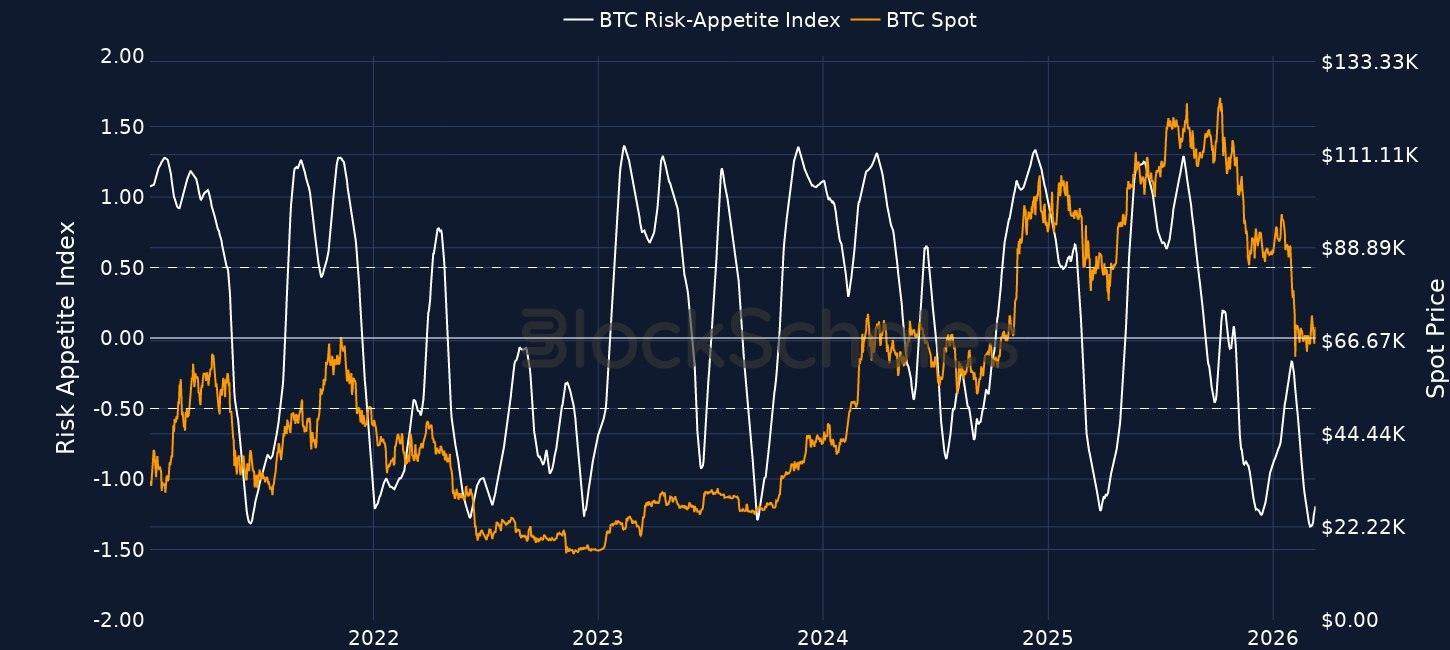
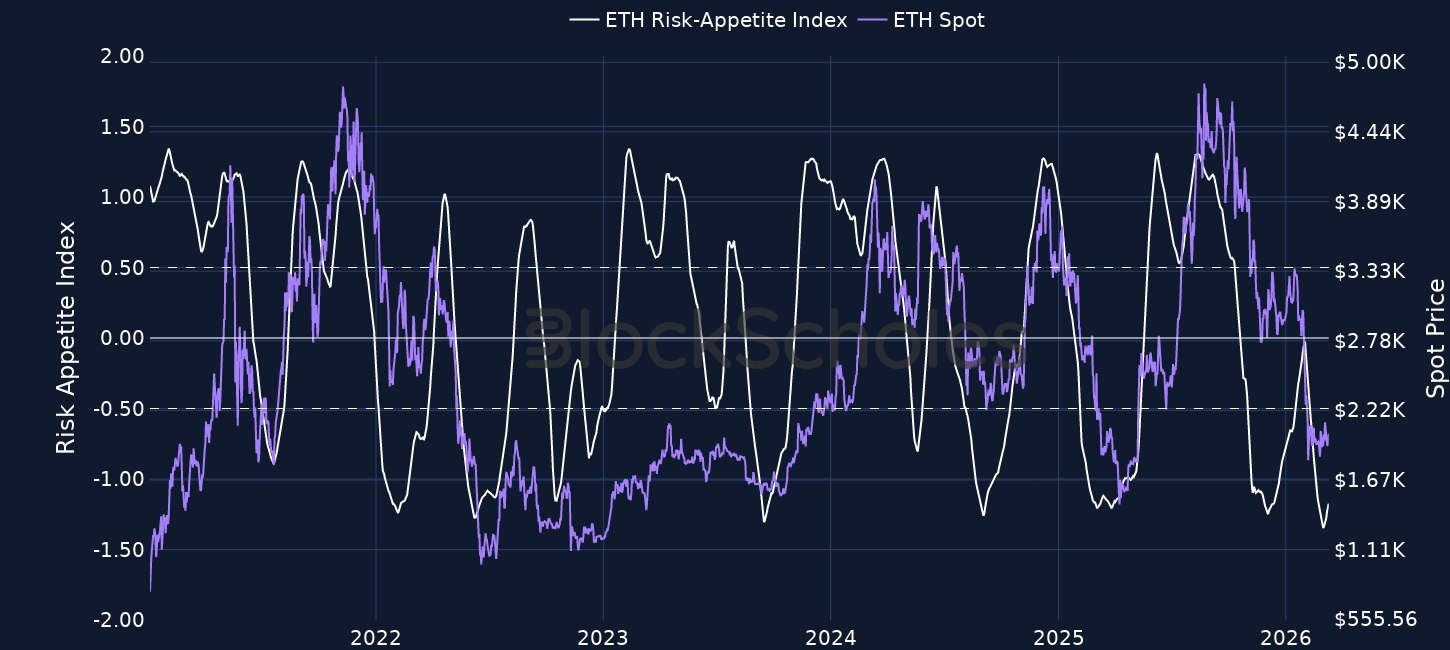
Block Scholes’ Risk Appetite Index measures the level of euphoria (above 1) or panic (below -1) in the spot market. Momentum in this index shows a strong relationship to spot returns.
With the war in the Middle East now in its second week, BTC has continued to remain resilient, holding up above its pre-war levels. On Monday (March 9th), President Trump indicated that “the war is very complete, pretty much” and that the US’s military operation was ahead of schedule.
Trump’s message contrasts more recent signals from senior White House officials who appear more willing to engage in further efforts in the Middle East, though it was enough to spark a rebound in risk sentiment at the start of the week. US equities reversed their intraday slide to finish higher on Monday, while crude oil prices plunged from $120 down below $90. Since then, BTC has continued to hover at $70K, while US equities continued to modestly sell off.
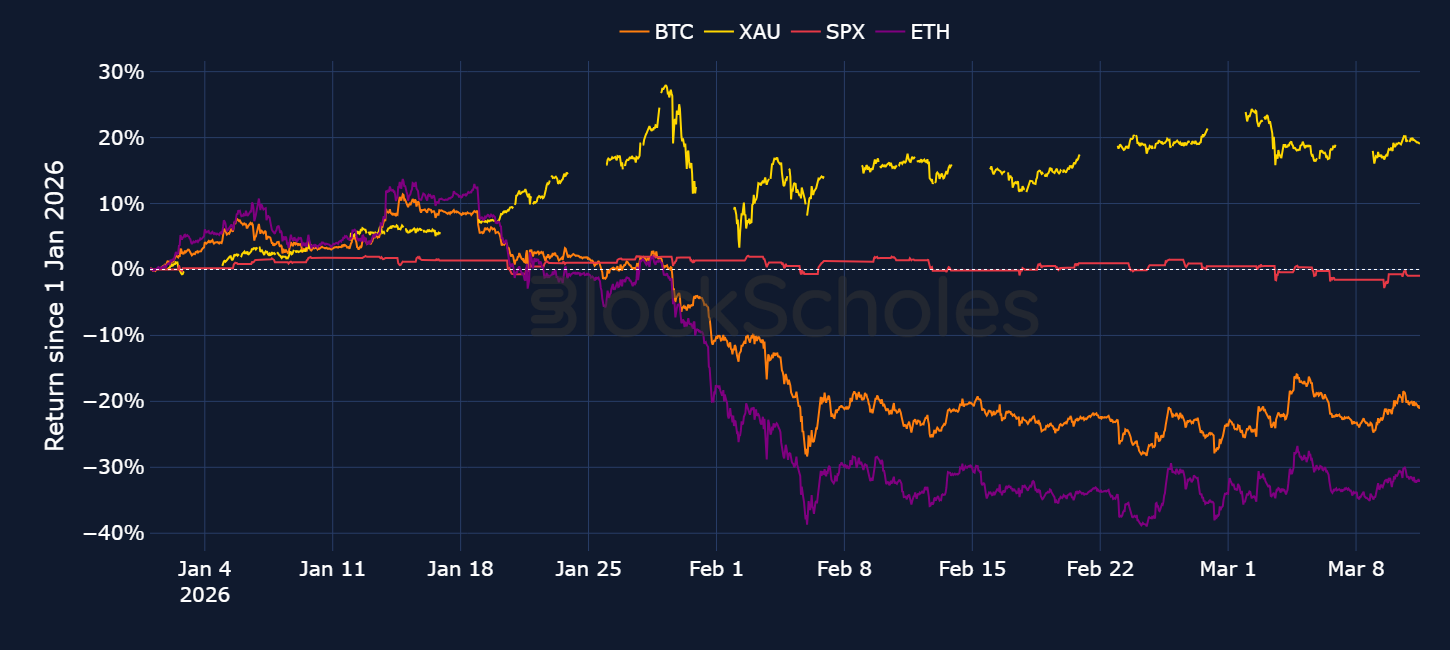
In fact, since markets opened on the Monday after the initial strikes, BTC has actually outperformed the S&P 500 and traditional safe-havens - gold and the US dollar.
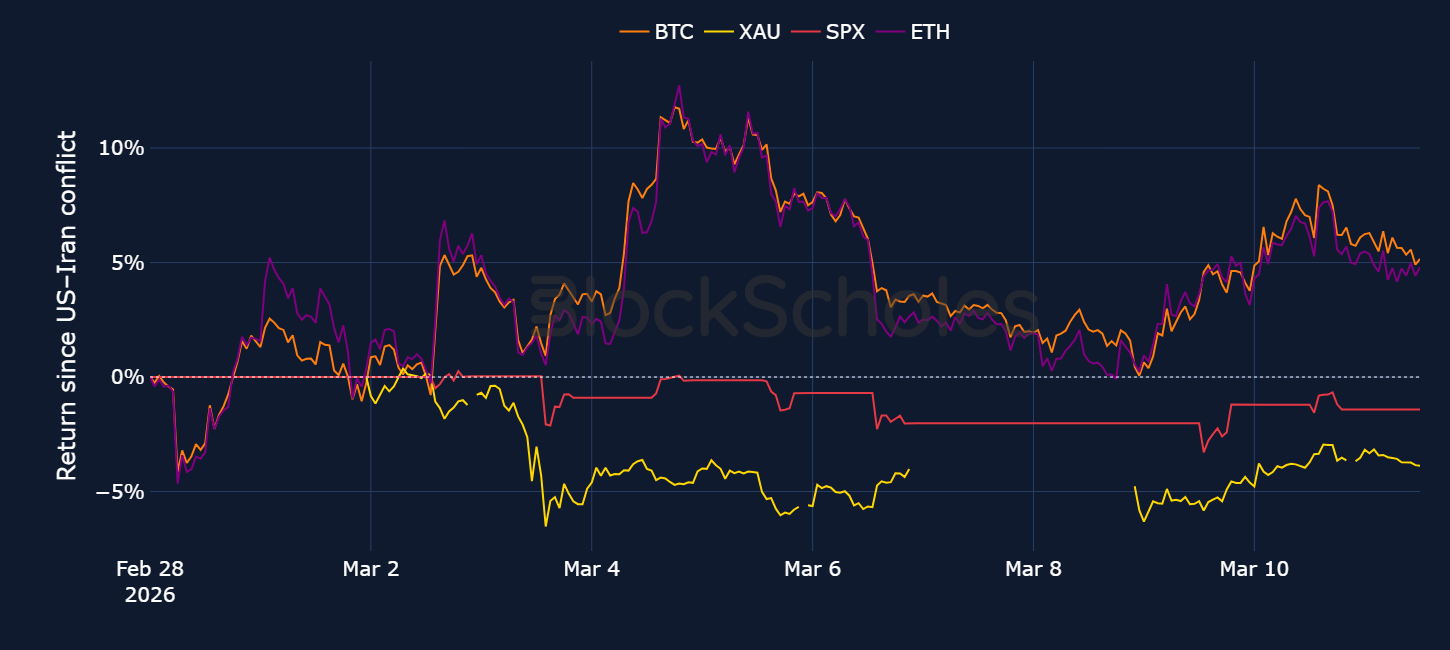
We do note, however, that the outperformance has occurred over a short window only, and when we zoom out, and look at year-to-date performance for example, it is still crypto assets that are lagging behind US equities, precious metals, and the greenback:
(year-to-date performances, as of March 12th, 2026)
As such, BTC’s current outperformance amidst the geopolitical backdrop could just be a reflection of the fact that crypto assets have sold off far stronger relative to US equities and precious metals over the past six months.
The sharper selloff in BTC has massively eschewed the previously strong linear relationship that we had observed between BTC and the S&P 500 index since 2024, and may therefore be providing BTC some space to rally harder whenever risk-appetite modestly rebounds.
After rising to the highest level since 2022, short-dated implied volatility settled around 50% in mid-February before jumping 20 percentage points during the start of the Middle East conflict. In absolute terms, however, implied volatility (IV) remained far lower than the panic levels that were priced in during February’s peak when BTC fell towards $60K. Since then, IV has once more returned back towards the same 50% floor and the term structure has compressed.
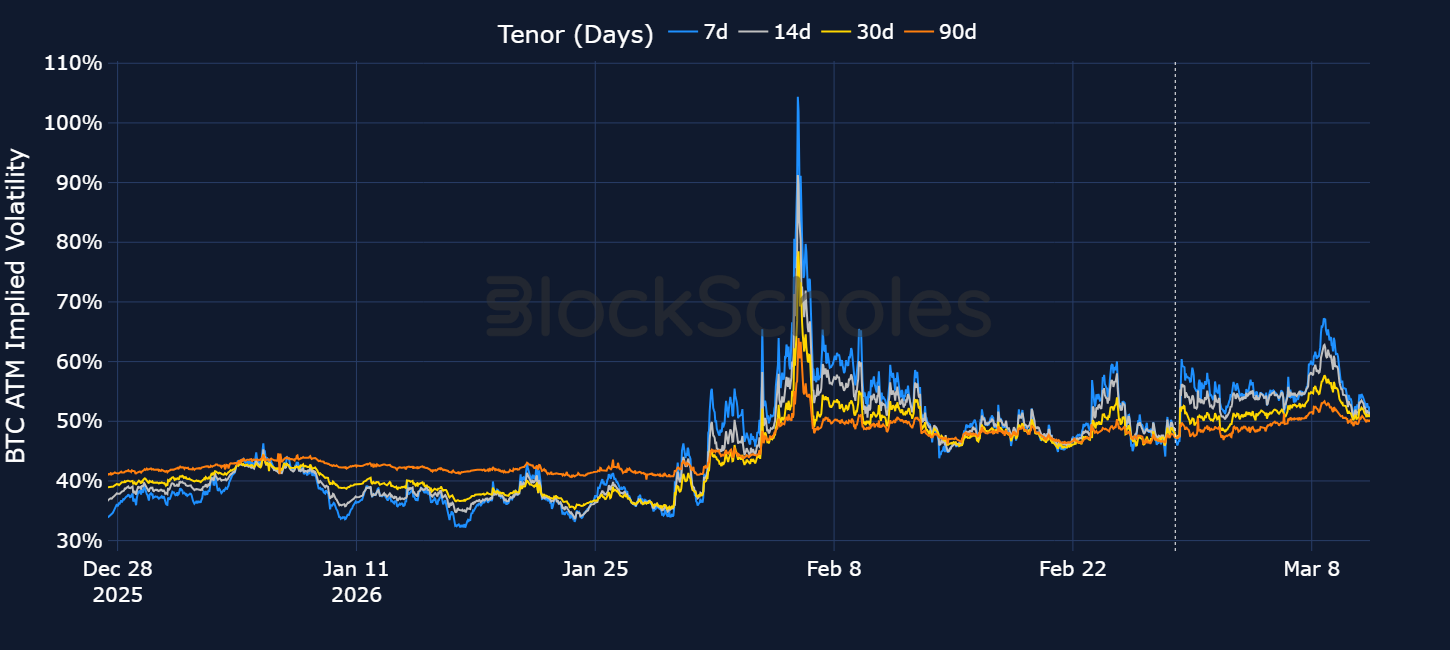
That suggests two things:
Perhaps it is President Trump’s reputation of TACO (‘Trump Always Chickens Out') that has traders pricing in a more optimistic base case for the length and economic impact of the conflict?
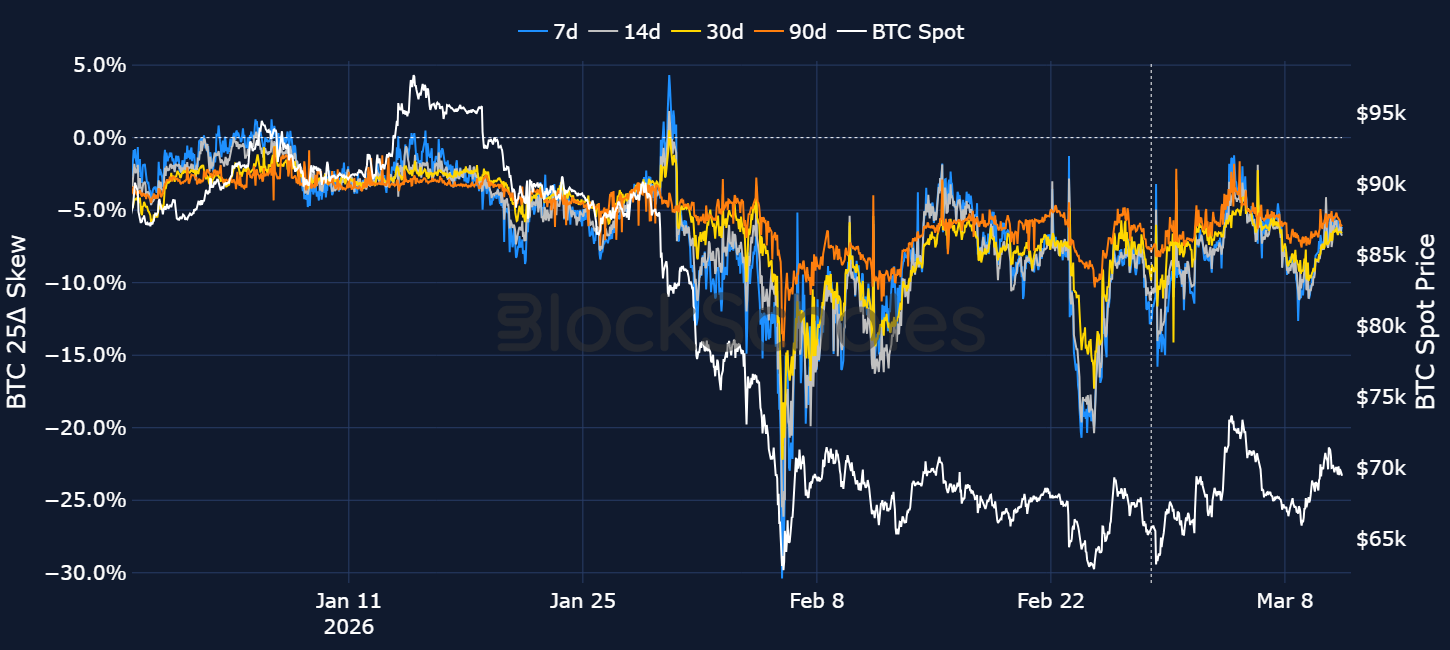
We see a similar normalization away from the peak panic that was seen in the February sell-off when looking at BTC’s volatility smiles. As we mentioned last week, options traders are still skewing premia higher for bearish put options. Additionally, the past two weekends have seen put-demand spike up as escalations tempered suggesting some increased demand for downside hedging during less liquid trading hours. However, the 30 vol point premium that put contracts traded with in February has now compressed to a much smaller 6%.
The rapid price swings in energy markets have pushed oil’s volatility profile sharply higher, in one of its sharpest reactions to geopolitical developments since Russia’s invasion of Ukraine in February 2022.
In contrast, BTC’s realised volatility has not spiked – the most recent spike in the chart below is largely a result of the repeated sell-offs that occurred before the US’s strikes on Iran.
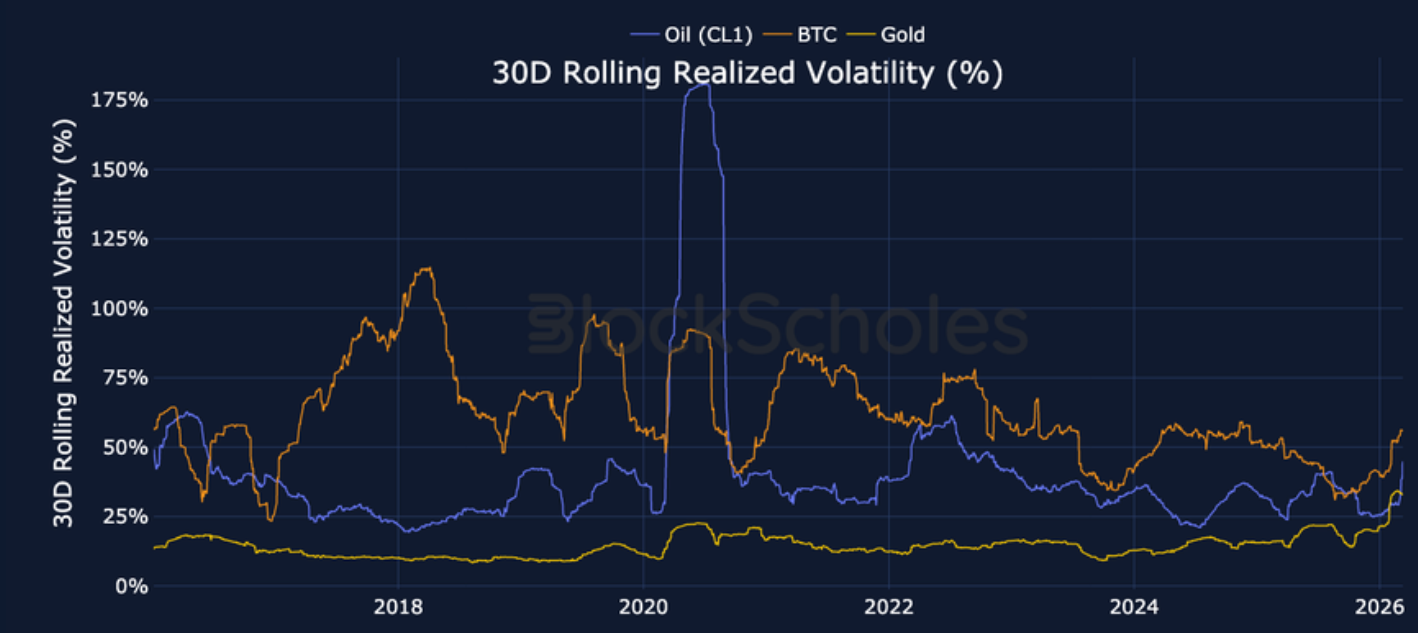
The onset of the Iran-US conflict created a step up in 7D Rolling Realized Volatility across oil, precious metals and the (more stable) US equity indices, yet BTC realised volatility has been climbing higher far earlier
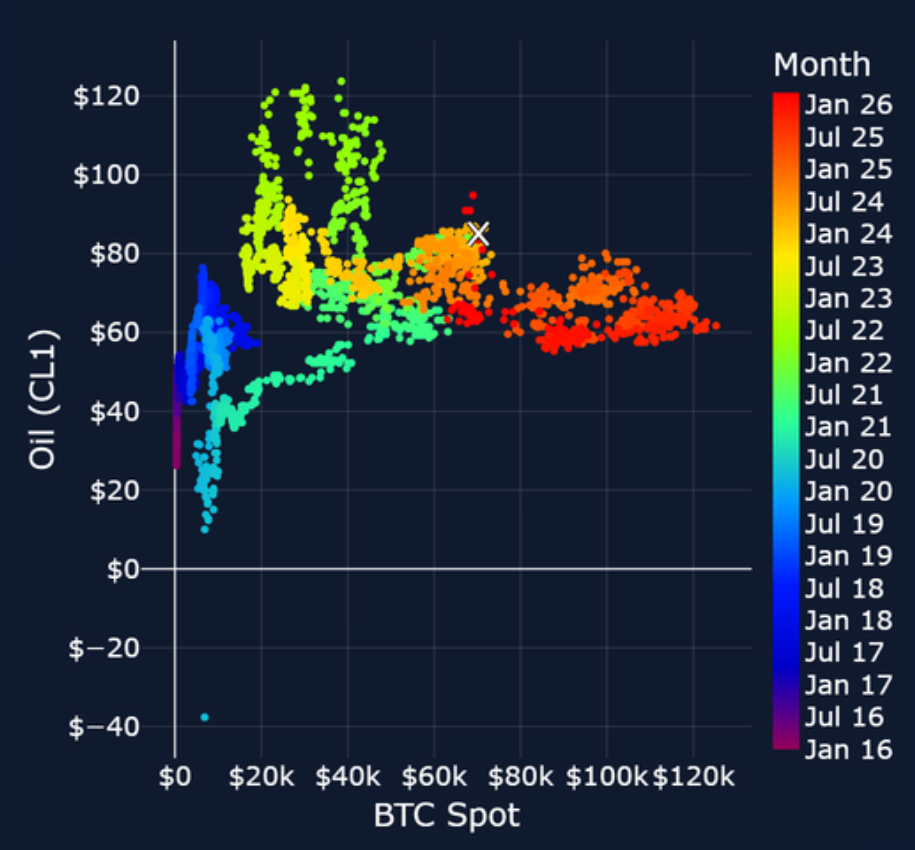
While we find little evidence for a structural relationship between BTC and oil futures that persists across time, temporary relationships have appeared at times when broader macro forces aligned for both assets. A clear example came in the post-COVID period, when both oil and BTC rallied as economies reopened and growth expectations improved. More recently, the pattern has shifted, with a trend higher in oil prices coinciding with the late-2025 sell-off in BTC.
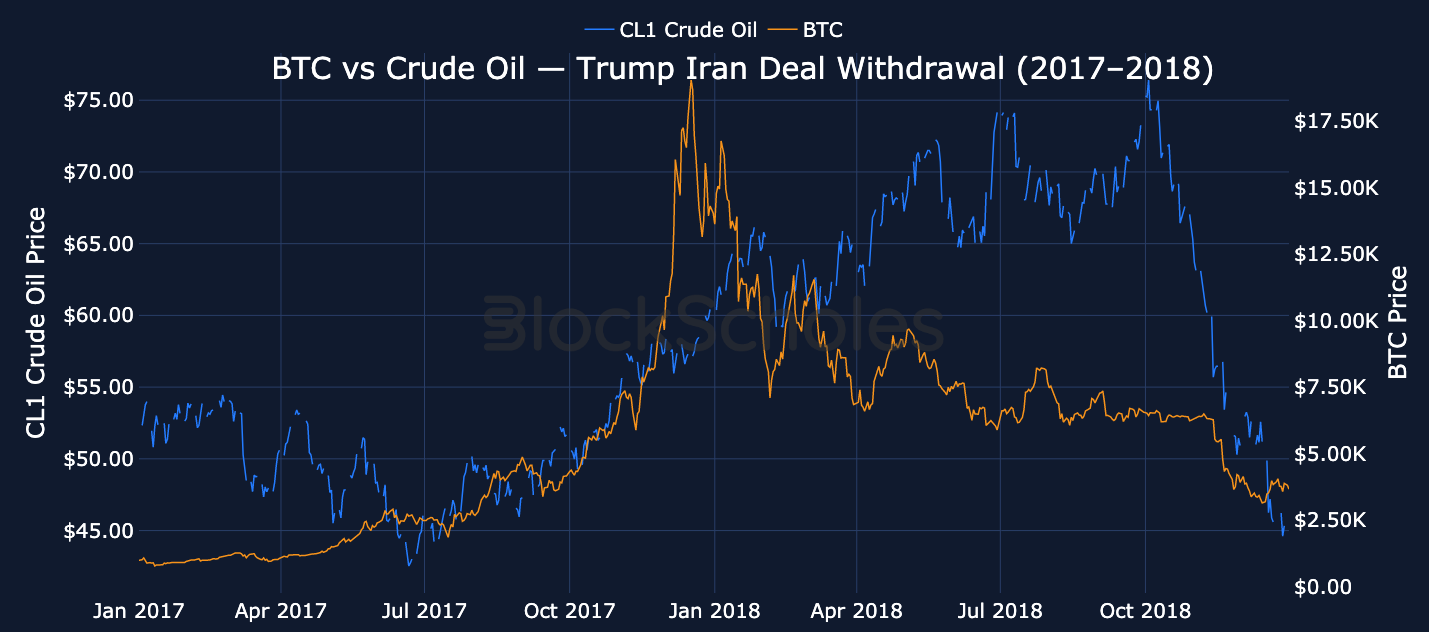
A previous period of US–Iran tensions in 2017 (during US President Trump’s first term in office) offers a useful comparison for how both BTC and oil markets responded. In 2017, oil prices spiked sharply and remained elevated for a period, reflecting concerns over potential supply disruptions while BTC rallied to its then-all time high, before reversing much of those gains throughout 2018.
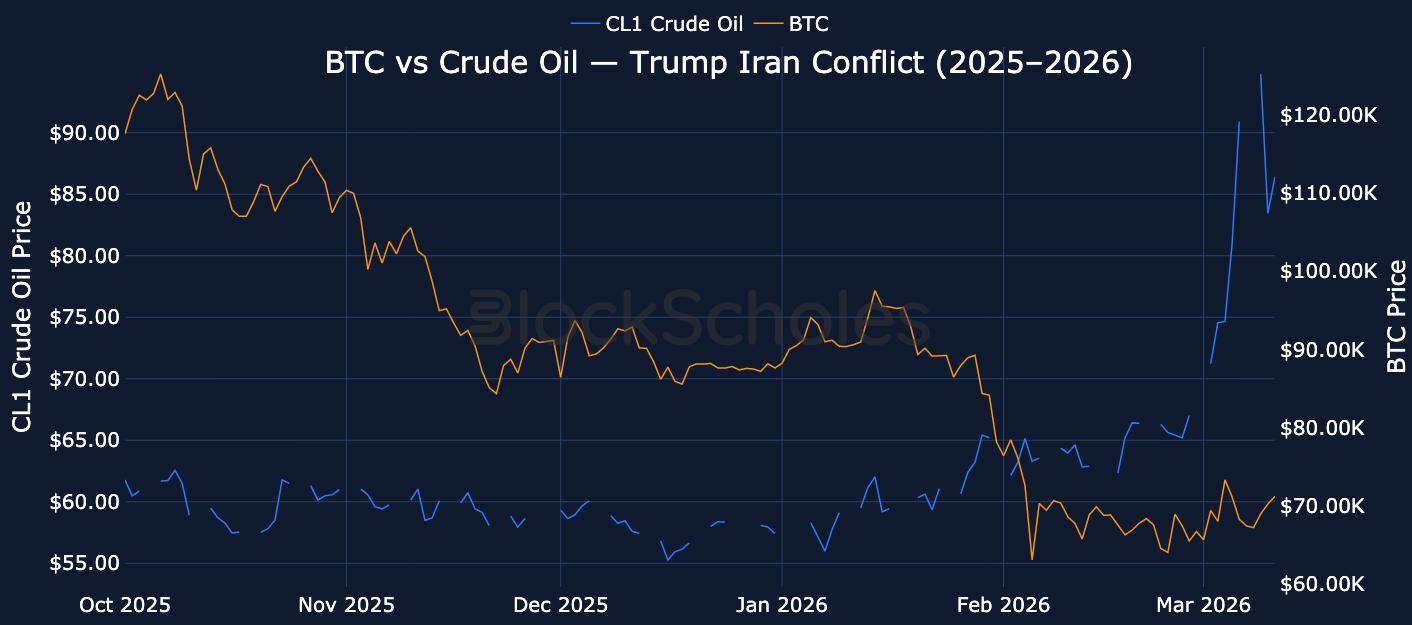
This time, BTC had been selling-off since the October 2025 all-time high and following the Oct 10th, 2025 liquidation event while oil prices had drifted sideways until early 2026. The spike higher in oil prices that followed the closure of the Straits of Hormuz occurred alongside BTC’s most recent relief rally to the top of its range at $70K, but bucks the trend of the previous movements in late 2025. While the geopolitical backdrop is similar to that in 2017, the reaction function (or apparent lack-therefore) in BTC is not.
The licence would allow the company to offer Ripple Payments in Australia, giving it a regulated framework to deliver an end-to-end platform that combines traditional banking rails with crypto-enabled settlement.
The company said the restructuring will support its goal of becoming an institutional-grade Solana infrastructure provider, with Abu Dhabi serving as its main operational base.
The collaboration will support the trading and settlement of tokenised securities in Europe, initially through structured products.
The stablecoin can be minted permissionlessly through non-custodial smart contracts by depositing supported USD assets such as USDC, USDT, PYUSD, USDB, and approved Treasury representations at a 1:1 ratio with zero minting fees.
Redemption is contract-driven and designed for flexible cross-chain liquidity movement, allowing holders to redeem USSD 1:1 into supported USD assets across different chains, with potential future redemption into U.S. dollars subject to KYC/AML requirements.
Tim Fletcher, CEO of Aon’s financial services group, said the firm’s position as a “first mover” in accepting stablecoins for premium settlement reflects its commitment to innovating on behalf of clients, in its statement on Monday.
TRON said it joined AAIF as a Gold Member and will also take a seat on the Foundation’s Governing Board.
Following the investment, Farage holds around a 6.3% stake through his investment vehicle Thorn In The Side Ltd.
The company also disclosed its first bitcoin purchase of 21 BTC at an average price of $71,594 per coin (around $1.5M) as part of its bitcoin treasury strategy.
With this accumulation, ABTC now ranks as the 17th largest publicly listed Bitcoin-holding company globally.
The prospectus describes $TDOT as an exchange-traded fund designed to track the price of DOT, with the potential to reflect staking rewards, though it is not a direct investment in Polkadot itself.
Instead, investors hold shares in a trust that owns DOT on their behalf, giving them market exposure to the token without direct ownership or the rights that come with holding DOT natively.
The team said all other vaults and user funds remain secure and confirmed it will fully reimburse affected users. The incident is being investigated with security partners, while the exploiter has been offered a 10% white-hat bounty if the funds are returned.
If approved, the system would introduce a 180-day minimum lock-up, weighted voting based on stake, staking rewards for active voters (targeting ~2% APR), and tiered incentives including USD1 benefits and prioritised partnership access for long-term supporters.
The contribution forms part of Bitwise’s earlier commitment to allocate 10% of $ETHW’s gross profits each year back to the Ethereum ecosystem following the launch of its Ethereum ETF in July 2024.
Bitwise said the donation is intended to support core protocol research, development, and the maintenance of critical open-source infrastructure.
XAUUSDT and XAGUSDT are perpetual contracts that give traders exposure to the price of gold and silver, respectively, without requiring ownership of the underlying physical metal.
These instruments draw on the pricing conventions of traditional precious metals markets, where gold and silver are typically quoted in US dollars through pairs such as XAUUSD and XAGUSD. XAUUSDT and XAGUSDT follow the same logic, but package that exposure in a perpetual contract format that can be traded through the same exchange infrastructure used for crypto derivatives.
This crypto-native format is also relevant from a trading perspective, as crypto markets operate 24/7, whereas traditional precious metals markets trade only during set market hours. For traders in crypto, XAUUSDT and XAGUSDT therefore offer a way to access gold and silver in a 24/7 market, compared to the traditional market, which operates under fixed hours.
The timing of the listing is particularly notable. Gold and silver are more relevant than ever in the current market environment, as elevated macroeconomic and geopolitical uncertainty has increased attention on traditional safe-haven and macro-sensitive assets. Both metals have also moved higher over the past week and experienced more pronounced price volatility, with gold staying bid above $5,100 per troy ounce, while silver keeps its head above $80 per troy ounce.
Bybit has listed XAUUSDT and XAGUSDT Perpetual Contracts on 9 March 2026. Trading is now open with up to 75x leverage.
Open interest and trading volume data are sourced “as is” from the Bybit exchange platform API exclusively, and as such do not represent a comprehensive picture of the sum of trading activity across all derivatives markets or exchanges. The data visualized in this report consists of hourly and daily snapshots, recorded over the previous 30 days. Daily (hourly) snapshots of trade volume record the total sum of the notional value of trades recorded in the 24H (1 hour) period, beginning with the snapshot timestamp.
If not explicitly labeled as derived from another exchange, the input instrument prices to all derivatives analytics metrics in this report are sourced from the appropriate endpoints of Bybit’s public exchange platform API. In the event that data is labeled or referred to as representing the market on another exchange source, that data is sourced from the appropriate endpoint of each respective exchange’s public API.
Macroeconomic charts and data are sourced “as is” from the Bloomberg Terminal. Exchange data is sourced “as is” from publicly available exchange APIs. Block Scholes makes no claims about the veracity of public third-party data.
After acquisition of underlying-denominated raw data for open interest and trading volume on the Bybit exchange platform from Bybit’s API endpoint, equivalent dollar-denominated figures are calculated using the concurrent value of Block Scholes’s Spot Index for the relevant underlying asset.
Block Scholes’s Spot Index represents the aggregate Spot mid-price for a given currency across the top five CEXs by volume (with USD-quoted markets). It considers the proportion of total volume in the instrument on the exchange, as well as the deviation of a data point from those on other exchanges.
Futures prices are used for Block Scholes’s futures-implied yields calculation services in order to derive the constant-tenor annualized yields displayed in the Futures section of this report.
Options prices are used for Block Scholes’s implied volatility calculation services in order to calibrate volatility surfaces, from which all derivatives volatility analytics displayed in the BTC Options and ETH Options sections of this report are calculated. Volatility smiles are constructed by calibrating to mid-market prices observed in Bybit options markets. As part of the calibration process, prices go through rigorous filtration and cleaning steps, which ensures that the resulting volatility surface is arbitrage-free and has exceptional fit to the market observables.