
Thahbib Rahman
Research Analyst
President Donald Trump has followed up his two-week ceasefire announcement with additional signals that further US-Iran negotiations are on the cards.Such signals have driven a simultaneous decline in oil prices and rally in risk-on sentiment. As such, BTC briefly traded to as high as $76K, a one-month high, while derivatives markets for ETH temporarily skewed towards call options – a rare occurrence so far this year.While ETH options traders temporarily skewed bullish, the same cannot be said for BTC options traders just yet. Skew for short-dated options tenors have recovered meaningfully, though 7-day options, for example, continue to trade with a put premium of -3%.

President Donald Trump has followed up his two-week ceasefire announcement with additional signals that further US-Iran negotiations are on the cards.
Such signals have driven a simultaneous decline in oil prices and rally in risk-on sentiment.
As such, BTC briefly traded to as high as $76K, a one-month high, while derivatives markets for ETH temporarily skewed towards call options – a rare occurrence so far this year.
While ETH options traders temporarily skewed bullish, the same cannot be said for BTC options traders just yet. Skew for short-dated options tenors have recovered meaningfully, though 7-day options, for example, continue to trade with a put premium of -3%.
Block Scholes’ Risk-Appetite Indexes for both major assets have once more crossed over the -0.5 threshold from below; a crossing that has typically marked a transition into a more bullish market regime.
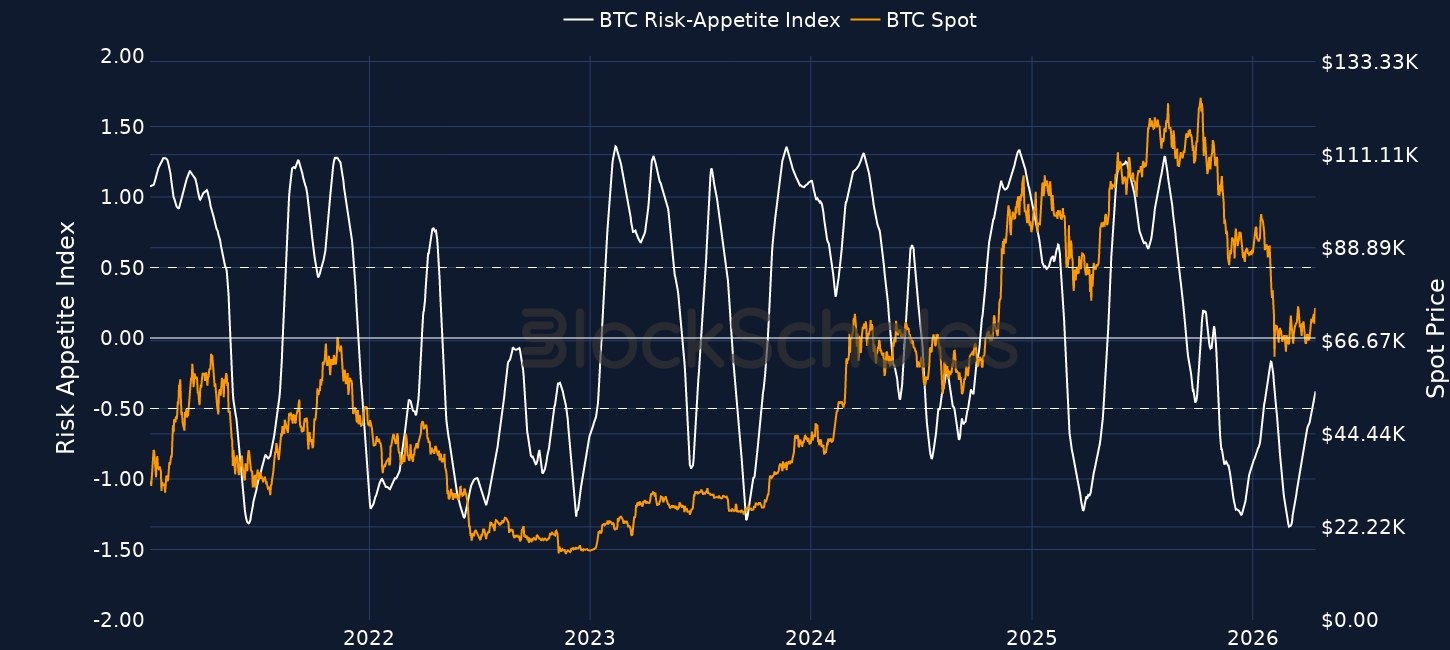
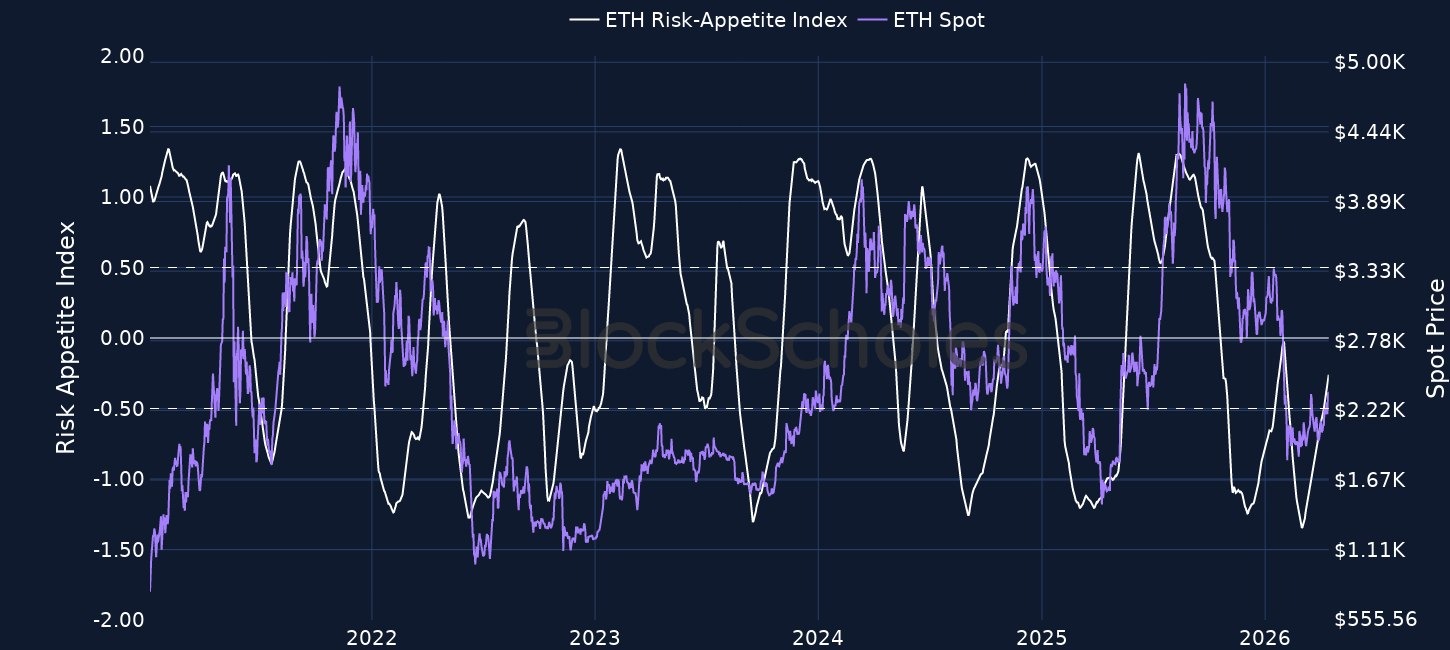
Block Scholes’ Risk Appetite Index measures the level of euphoria (above 1) or panic (below -1) in the spot market. Momentum in this index shows a strong relationship to spot returns.
The past week and a half has seen a whipsaw of headline changes regarding the prospects of a permanent end to a US-Iran war which is quickly approaching 50 days in length.
On April 7, 2026, President Trump announced the two sides had entered into a conditional two-week ceasefire.
Over the weekend, delegates from both sides took part in a marathon 21-hour negotiation in Islamabad seeking to settle their differences, though left without a formal peace agreement.
In the aftermath of the negotiations, President Trump claimed that “the meeting went well”, but Iran had failed to meet the US’s demands regarding its nuclear ambitions – as such, “Effective immediately, the United States Navy, the Finest in the World, will begin the process of BLOCKADING any and all Ships trying to enter, or leave, the Strait of Hormuz”.
Only a few days later, President Trump then took to a number of news outlets claiming optimism around the likelihood of a second-round of negotiations, which could bear the fruits of a longer-lasting end to the war.
As markets have begun to price in the path towards peace, risk-sentiment has rebounded.
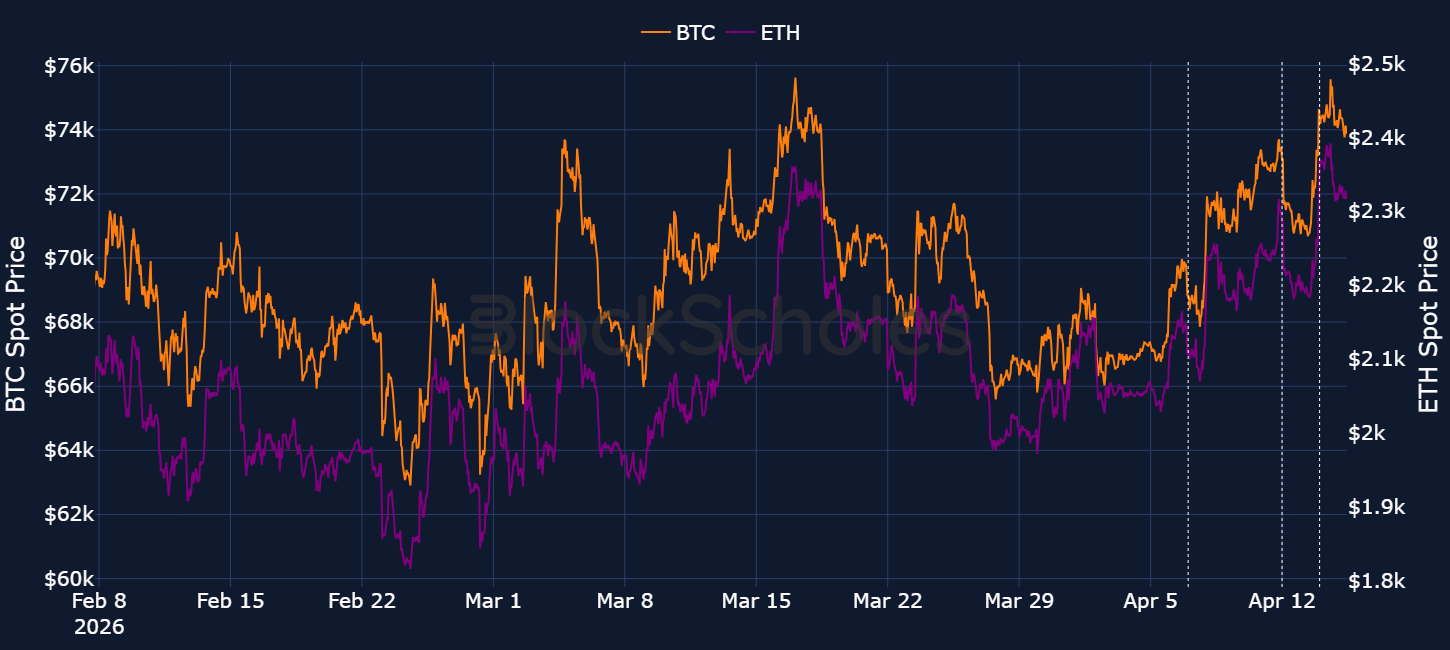
The chart below plots BTC and ETH’s spot price, with the three vertical lines representing the April 7 ceasefire, the failed weekend negotiations, and Trump’s media comments that the war is close to over.
BTC briefly rose to as high as $76K on the back of the latter, a level it last traded at on March 17, 2026, while ETH has firmly recaptured the $2,300 region.
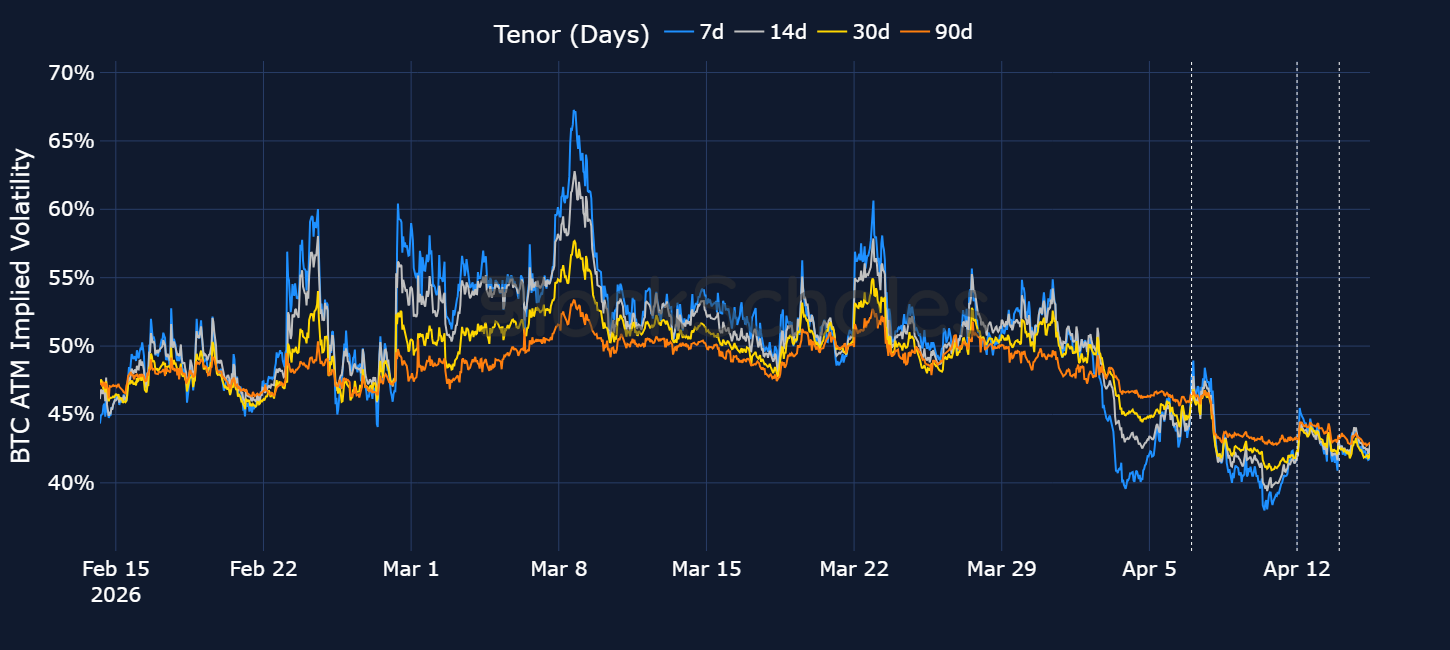
In options markets, volatility levels for short-term expirations fell by over 10 points in the aftermath of the ceasefire.
Despite President Trump’s later announcement that the US military would begin a naval blockade of the key Hormuz waterway, traders have been reluctant to price back in the same level of uncertainty that they saw prior to the ceasefire announcement.
From the moment President Trump suggested a path to de-escalation, we’ve seen traders in spot markets push spot prices higher, and traders in options markets release some of their volatility expectations across the surface.
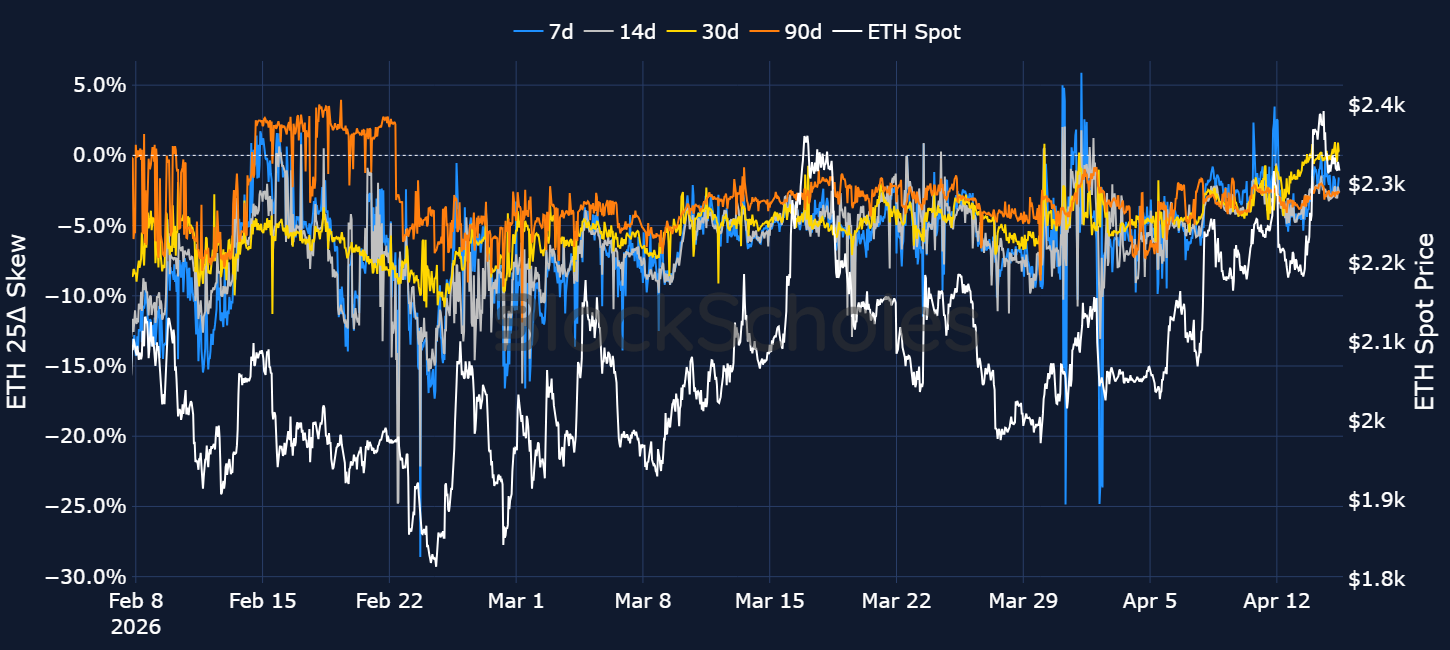
As expectations for a possible de-escalatory move increase, we’re beginning to see tentative signs that traders are indeed turning bullish over a near-term horizon, and most notably in ETH.
The chart below shows the premium assigned to put options (i.e. a negative 25-delta skew). Not only have traders entirely priced out the bearish volatility premium from when the conflict began, but short-dated 7-day and 30-day ETH options have briefly tilted positive over the past week as bullish positions become more desirable.
That premium towards OTM call options has been a rare phenomenon for most of this year and is the strongest indication yet, since the conflict began, that traders are not only indeed beginning to see green shoots of a path towards ending the conflict, but also backing that with optimistic forward looking expectations for spot price.
This is in contrast to the late-March episode, where markets remained hesitant despite President Trump’s post about a pause before targeting Iran’s energy infrastructure - both spot and options markets did not meaningfully react in a bullish manner back then.
We are yet to see as strong a shift towards call options in BTC, however.
Skew has meaningfully recovered across short and longer-dated expiries, though the 7-day 25-delta put call skew is still trading close to -3% while 90-day skew is closer to -2%.
Bybit recently launched XAUT options – options contracts that settle to the price of Tether’s XAUT token, which itself tracks the spot price of traditional gold.
After a blistering rally past $5,500 in late January this year, gold has been confined to sub-$5k levels over the past month; currently failing to act as the geopolitical safe-haven we would expect from the precious metal.
Nonetheless, the launch of Bybit’s XAUT options contracts at the beginning of April provides us with a new way of understanding how Bybit traders are positioning themselves for future movements in gold’s spot price, as well as forward looking market sentiment. Additionally, it provides us with an opportunity to compare how that positioning contrasts with that of gold traders on traditional options venues.
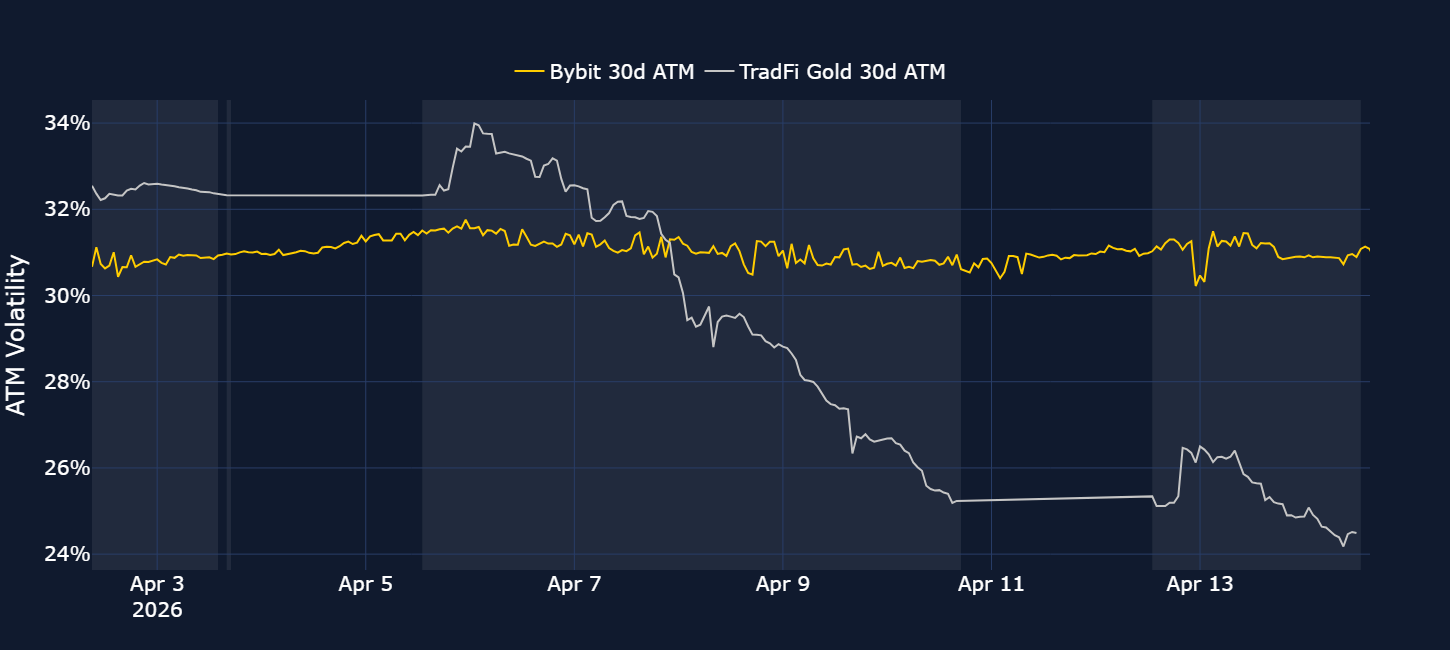
One-month contracts on Bybit initially traded at a lower implied volatility when compared to traditional market venues.
However, that changed following the April 7 ceasefire announcement. Following the confirmation of a two-week ceasefire, forward looking expectations for volatility on traditional venues dropped sharply across the curve and have remained at those lower levels, while implied volatility on Bybit contracts has remained sticky around 30%.
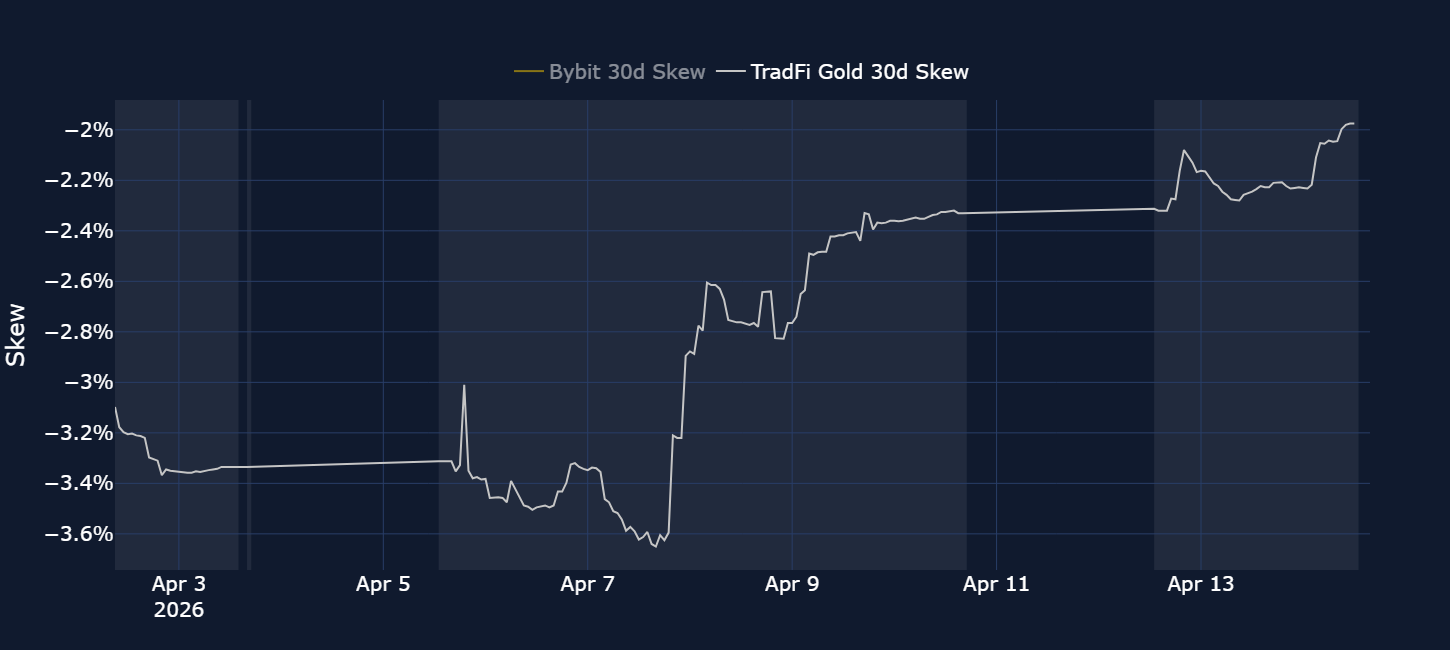
We can also compare differences in skew between the two venues. As President Trump confirmed the two-week ceasefire on April 7, TradFi gold traders in 30-day options contracts priced out much of the bearish premium towards put options.
However, despite the ceasefire and subsequent signs of further peace talks, they have not been willing, just yet, to flip bullish on the precious metal.
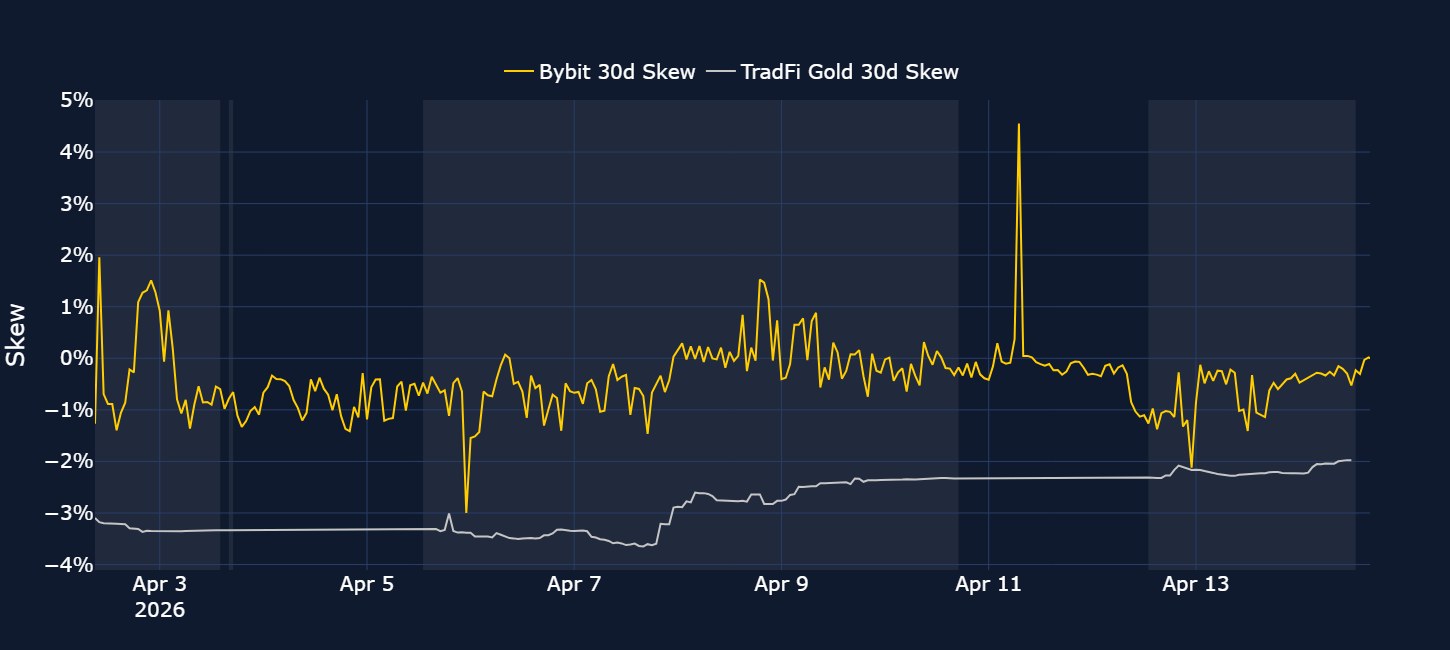
That contrasts what we saw on Bybit’s XAUT options.
Therefore, since their launch just over two weeks ago, positioning in Bybit’s XAUT options has at times contrasted that on traditional venues: implied volatility levels are yet to drop in a similar manner to TradFi gold options in spite of moves towards a longer-term peace plan, while skew has reacted more strongly (in both directions) to changing headlines compared to TradFi venues.
Visa has launched Intelligent Commerce Connect, a new solution aimed at helping businesses plug into AI-driven shopping through a single integration. Built on the Visa Acceptance Platform, it supports secure agent-initiated payments, tokenisation, authentication, and spend controls across both Visa and non-Visa cards. The product is already being piloted with partners including AWS, Aldar, Mesh and Payabli, with a wider rollout planned later this year. Visa said the launch is designed to help businesses securely accept purchases made by AI agents at scale.
Perle (PRL) is a Solana-based token that underpins a marketplace for human-verified AI data.
Public project materials describe PRL as a fixed-supply SPL Token-2022 on Solana, with mint and freeze authorities revoked, meaning the token has a fixed issuance structure, and the team cannot freeze user balances.
In practical terms, Perle is designed to connect enterprises, AI developers, and research teams with verified contributors who perform the annotation, validation, and review tasks needed for model training and evaluation.
PRL serves as the economic layer of this ecosystem, enabling payments for data services, rewarding contributors for completed work, and supporting a transparent, auditable record of contribution and reputation.
The logic behind the project is that advanced AI systems still depend heavily on high-quality human input, particularly in specialised or high-stakes domains where generic crowd-sourced datasets are insufficient. Perle proposes to organise that expert input more efficiently, verify it more rigorously, and align incentives around it using blockchain infrastructure.
Rather than focusing on AI compute or model ownership, the project is positioned around the data layer, specifically the idea that trustworthy human judgment remains essential to building and refining useful AI systems. The platform is structured as a two-sided network: on one side are enterprises and AI teams that require reliable datasets and evaluation workflows, and on the other are contributors who label, review, and validate data. This gives PRL a clearer use case than many tokens associated with the AI theme, as it is intended to operate within a live marketplace that links demand for high-quality data work with the supply of skilled human input.
What makes Perle particularly interesting is that it seeks to tokenise and coordinate human judgment as a productive input into AI. This is a more concrete proposition than broad claims around “AI + crypto,” especially as increasingly sophisticated AI systems rely on expert feedback, edge-case review, reinforcement-style evaluation, and domain-specific data curation. Perle’s thesis is that these forms of human input should be traceable, measurable, and economically rewarded within a transparent network.
If the model gains adoption, PRL could benefit from a reinforcing cycle in which enterprise demand for reliable AI data drives contributor activity, contributor activity improves dataset quality, and better dataset quality attracts further demand.
From a market perspective, the asset currently has public listings showing a circulating supply in the roughly 175–180M PRL range and a 1B maximum supply.
Bybit listed PRLUSDT Perpetual Contract in the Innovation Zone on the 26th of March; trading is now open with up to 25x leverage.
Open interest and trading volume data are sourced “as is” from the Bybit exchange platform API exclusively, and as such do not represent a comprehensive picture of the sum of trading activity across all derivatives markets or exchanges. The data visualized in this report consists of hourly and daily snapshots, recorded over the previous 30 days. Daily (hourly) snapshots of trade volume record the total sum of the notional value of trades recorded in the 24H (1 hour) period, beginning with the snapshot timestamp.
If not explicitly labeled as derived from another exchange, the input instrument prices to all derivatives analytics metrics in this report are sourced from the appropriate endpoints of Bybit’s public exchange platform API. In the event that data is labeled or referred to as representing the market on another exchange source, that data is sourced from the appropriate endpoint of each respective exchange’s public API.
Macroeconomic charts and data are sourced “as is” from the Bloomberg Terminal. Exchange data is sourced “as is” from publicly available exchange APIs. Block Scholes makes no claims about the veracity of public third-party data.
After acquisition of underlying-denominated raw data for open interest and trading volume on the Bybit exchange platform from Bybit’s API endpoint, equivalent dollar-denominated figures are calculated using the concurrent value of Block Scholes’s Spot Index for the relevant underlying asset.
Block Scholes’s Spot Index represents the aggregate Spot mid-price for a given currency across the top five CEXs by volume (with USD-quoted markets). It considers the proportion of total volume in the instrument on the exchange, as well as the deviation of a data point from those on other exchanges.
Futures prices are used for Block Scholes’s futures-implied yields calculation services in order to derive the constant-tenor annualized yields displayed in the Futures section of this report
Options prices are used for Block Scholes’s implied volatility calculation services in order to calibrate volatility surfaces, from which all derivatives volatility analytics displayed in the BTC Options and ETH Options sections of this report are calculated. Volatility smiles are constructed by calibrating to mid-market prices observed in Bybit options markets. As part of the calibration process, prices go through rigorous filtration and cleaning steps, which ensures that the resulting volatility surface is arbitrage-free and has exceptional fit to the market observables.