Thahbib Rahman
Research Analyst
After a double-digit rally in April, BTC has continued its ascent, even briefly trading past $82K — its highest level since end-January. As such, Block Scholes’ Risk Appetite Indices for both BTC and ETH have surged past a value of 1 and into a region that has typically marked further bullish price momentum. Since 2021, BTC has rallied by more than 12% on a monthly basis on 17 occasions, 9 of which were followed by a second month of higher spot prices. However, despite a backdrop of easing geopolitical tensions and a major crypto bill in the "red zone", derivatives markets are sending mixed signals.

After a double-digit rally in April, BTC has continued its ascent, even briefly trading past $82K — its highest level since end-January. As such, Block Scholes’ Risk Appetite Indices for both BTC and ETH have surged past a value of 1 and into a region that has typically marked further bullish price momentum.
Since 2021, BTC has rallied by more than 12% on a monthly basis on 17 occasions, 9 of which were followed by a second month of higher spot prices.
However, despite a backdrop of easing geopolitical tensions and a major crypto bill in the "red zone", derivatives markets are sending mixed signals.
Open interest in perpetual futures contracts is close to a 30-day high, suggesting some appetite among traders to open leveraged positions, while funding rates briefly spiked amid the spot breakout past $80K. Options markets, by contrast, show a more cautious outlook: volatility smiles continue to trade with a small put premium.
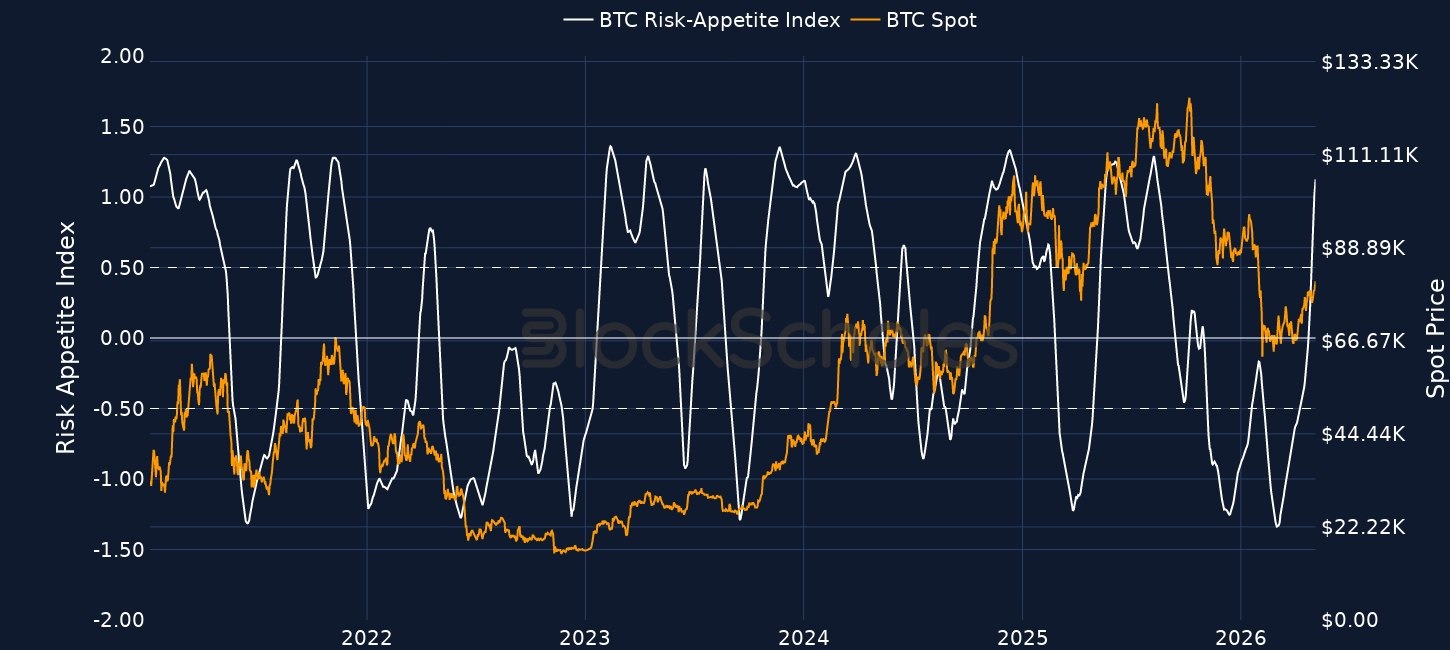
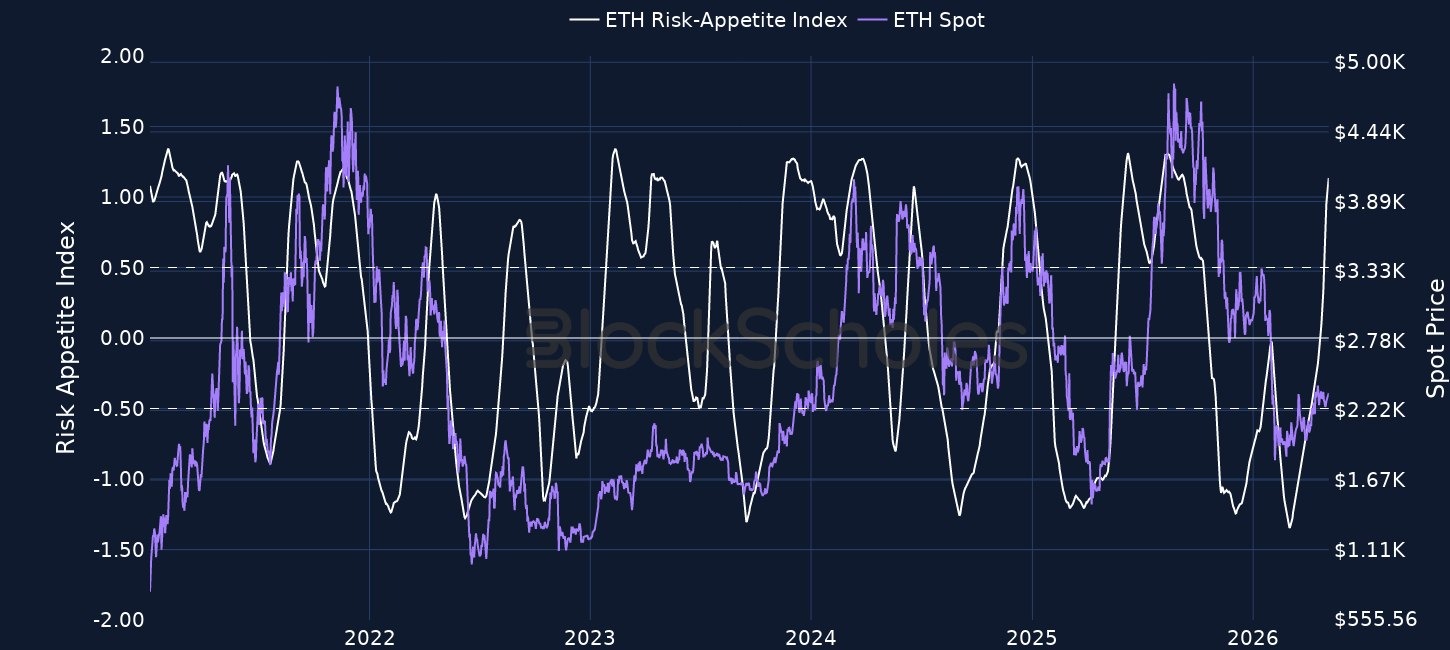
BTC recently broke past $82K, its highest level since late January 2026. Market appetite for risk has not just been apparent in crypto spot prices either — major US equity indexes, including the S&P 500 and Nasdaq-100, both closed at multiple new all-time highs since mid-April after a number of signs from President Trump and his administration that the US is looking to de-escalate Middle East tensions.
The improving geopolitical backdrop, albeit still a highly-fluid situation, alongside crypto-specific factors including progress on the previously stalled CLARITY Act, has meant that Bitcoin is already up about 6% month-to-date. That follows a 12% rally from $68K to $76K in the month of April 2026.
If history is any guide, what can we expect for the spot price for the rest of the month?

Since 2021, there have been 17 other months where BTC has rallied by about 12% or more in a single month. Looking across all 17, the average return the following month was +4.3% — a modestly bullish outlook.
More importantly, however, in 9 of those 17 months, BTC kept climbing into the next month — and when it did, those 9 months averaged a further +13.9% gain.
For proper context, 9 out of 17 episodes equates to odds that are just slightly better (53%) than a coin toss.

Still, given the strong average performance when gains are indeed extended into a second month, how are derivative markets currently positioning themselves?
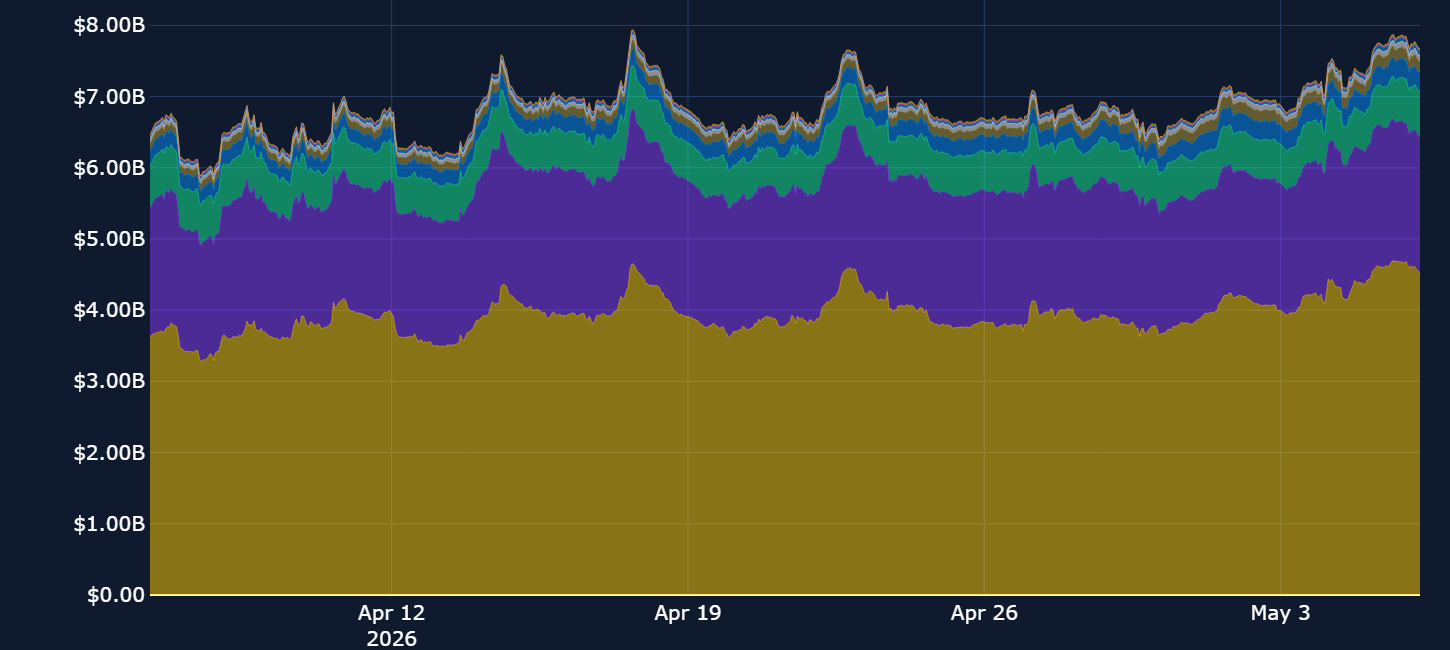
Open interest in perpetual futures contracts for BTC increased from $3.7B to over $4.5B since the beginning of the month of May, while total open interest across several blue-chip altcoins has risen close to the 30-day high reached on April 17, 2026. That date coincided with comments from President Trump that Iran had agreed to almost all of the US’s conditions and that a “good deal” would be signed between the two parties.
BTC funding rates also briefly showed optimism as spot price broke past a key psychological $80K threshold, which failed to hold for long, and rates have turned negative on a 7-day rolling average basis.
DECODE: Negative funding rates suggest traders are willing to pay a leveraged fee to maintain short positions on BTC.

Bitcoin options markets also back the cautious sentiment exhibited in perpetual futures markets.
In terms of implied volatility, May has picked up where April left off — IV levels across the curve have continued to fall with 7-day at-the-money implied volatility briefly falling to 31%.
The 30% region marks the year-to-date low for implied volatility, meaning options prices are trading close to their lowest prices so far this year.
The volatility term structure curve is upward sloping with longer-dated options trading at a premium to shorter maturities, though the curve has repriced vertically downwards, suggesting markets expect a more stable volatility environment across all forward-looking horizons.

May has also seen a compression in the premium assigned by the market to puts, particularly at shorter tenors. Traders are clearly showing less demand for downside protection but not yet willing to fully give up their premium for protection as BTC ranges around the $80K mark. This is a story we’ve seen consistently with spot rallies over the past few weeks and contrasts the at least, brief, spell of bullish sentiment in perp markets.
Despite spot price trading at a high last seen in January this year, BTC options traders are still cautious in completely shifting towards a bullish stance.
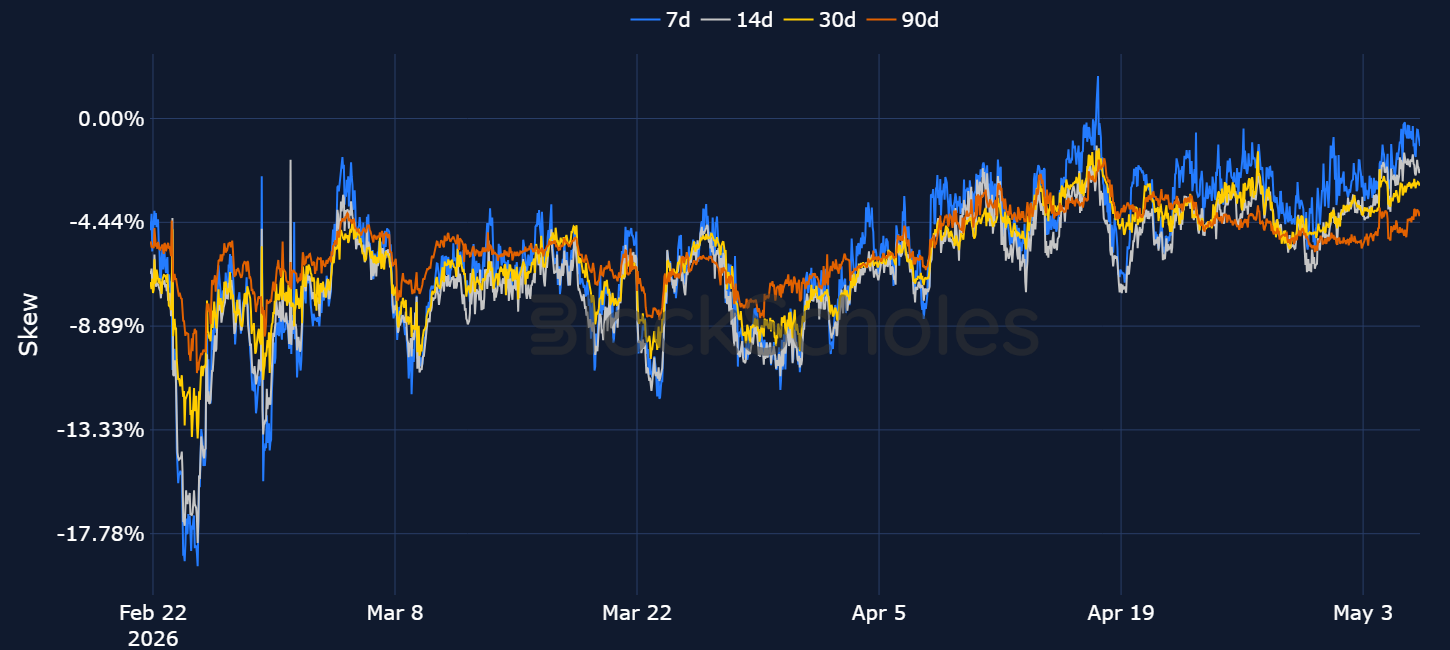
ETH options traders have shown slightly more conviction. For the first time in nearly three weeks, 25-delta 7-day call options briefly traded with a premium over OTM puts, an indication of some trader's willingness to participate in further upside moves. As the ETH spot price failed to materially break out past $2,400, however, the put-premium quickly returned.

Senate Banking Committee Chairman Tim Scott has said that the CLARITY Act is in the “red zone”, which means that the bill is close to reaching the final stage but has not crossed the finish line yet.
The Digital Asset Market Clarity Act of 2025 (H.R. 3633), which marks the most comprehensive US crypto market-structure bill ever to clear a chamber of Congress, has spent four months parked in the Senate.
As of 6 May 2026, that gridlock has finally cracked. A bipartisan compromise on stablecoin yield, struck between Senators Thom Tillis (R-NC) and Angela Alsobrooks (D-MD), has cleared the last major substantive hurdle and a Senate Banking Committee markup (a legislative process where the Senate committee discusses legislation before sending it to the full Senate for a vote) is now pencilled in for the week of 11 May.
The compromise itself is narrow but politically important:
However, the bank lobby is still not satisfied: The American Bankers Association (ABA), Bank Policy Institute, Consumer Bankers Association, Financial Services Forum and Independent Community Bankers of America have issued a joint statement saying the compromise "falls short" and asked the OCC to harden the equivalent banking rules. 52 state bankers' associations co-signed the ABA's comment letter to the Office of the Comptroller of the Currency.
Lummis, Tillis and Alsobrooks have collectively declared the stablecoin language final — Tillis responded that "we respectfully agree to disagree" with the bank lobby, and the negotiation is closed.
The Polymarket question "Clarity Act signed into law in 2026?" repriced from roughly 46% to 64% in the 24 hours after the compromise on 1 May, and has since pushed to fresh highs north of 70% as the industry has rallied behind the deal.
Senate Banking Committee Chairman Tim Scott indicated that it could move to a Senate floor vote in June or July.
The chart below shows the full lifetime of the Polymarket contract; the dotted lines mark each milestone, and the red dotted line is the yield-compromise release.

The bill is essentially a jurisdictional line between the SEC and the CFTC for digital assets, plus a federal registration regime for the venues that intermediate them:

Although crypto has responded to CLARITY-related milestones at certain points — most notably the House passage on 17 July 2025, when BTC and ETH extended their multi-week rally into the 294–134 vote — the most recent signal is harder to isolate.
The latest draft is still positive for the crypto market, given its supportive stance toward regulatory clarity. However, BTC and ETH were already grinding higher before this round of legislative progress. With US equities also on a positive trajectory, it is difficult to separate a CLARITY-driven boost from the broader improvement in risk appetite.
1) Strategy, the largest corporate Bitcoin treasury, said during its Q1 2026 earnings call on May 5th that it may begin selectively selling BTC to fund dividends tied to STRC, its high-yield perpetual preferred stock that has raised $8.5B since launch.
The firm currently holds 818,334 BTC (~3.9% of total supply) valued at ~$66.5B.
Michael Saylor stated, “We’ll probably sell some bitcoin to fund the dividend, just to inoculate the market, just to send the message that we did it.”
He added that BTC would only need to appreciate at a 2.3% annual rate for existing holdings to indefinitely support STRC dividend obligations without further equity issuance.
2) CME Group, the world’s largest derivatives exchange, plans to launch cash-settled Bitcoin volatility futures on June 1 (pending regulatory approval), enabling traders to gain exposure to BTC volatility without taking directional exposure to Bitcoin’s price.
The contracts, expected to trade under the ticker BVI, will settle against the CME CF Bitcoin Volatility Index (BVX), a real-time 30-day implied volatility benchmark derived from CME’s regulated Bitcoin options order books and updated every second during trading hours.
Each futures contract will use a multiplier of $500 × the BVX index value, expanding CME’s crypto derivatives suite with a regulated volatility product designed for hedging, volatility trading, and institutional risk management.
3) CME has launched futures contracts for Avalanche (AVAX) and Sui (SUI), further expanding its regulated crypto derivatives suite beyond BTC and ETH.
The new listings include both standard and micro contracts, giving institutional and professional traders more flexible exposure to two additional Layer 1 assets through CME’s regulated marketplace.
4) State Street Investment Management and Galaxy Digital have launched the State Street Galaxy Onchain Liquidity Sweep Fund, or SWEEP, a tokenised private liquidity fund designed to support 24/7 on-chain cash management.
The fund allows eligible stablecoin holders to sweep their assets into a yield-bearing product, subject to portfolio availability.
SWEEP launches on Solana, with additional integrations planned for Stellar and Ethereum.
5) SoFi Technologies is set to bring its stablecoin, SoFiUSD, to Solana after initially launching it on Ethereum, citing the network’s speed, low transaction costs, and high throughput as key advantages.
The announcement was made on Tuesday, following the bank’s initial launch of SoFiUSD in December 2025.
The stablecoin, issued by SoFi Bank, is fully reserved and pegged to the U.S. dollar.
6) Western Union has launched USDPT, a U.S. dollar-denominated payment stablecoin issued by Anchorage Digital Bank and built on Solana.
USDPT is designed to serve as an always-on settlement asset within Western Union’s global network, combining blockchain-based settlement with the company’s compliance, risk management and distribution capabilities.
For Western Union, the stablecoin creates a more efficient settlement layer for partners, agents and future consumer use cases.
7) Ondo has been selected to join DTCC’s Industry Working Group on tokenization, placing the firm alongside major traditional finance and digital asset institutions involved in shaping the next phase of U.S. market infrastructure.
DTCC’s tokenization initiative is aimed at bringing core capital markets processes on-chain, with a focus on improving liquidity, transparency and operational efficiency.
Ondo’s inclusion is notable given its positioning in tokenized stocks, ETFs and U.S. Treasuries, reinforcing the growing role of specialist tokenization platforms in institutional market design.
8) The US SEC has delayed approval of over two dozen proposed prediction-market ETFs from issuers including Bitwise, Roundhill, and GraniteShares, requesting additional clarity on fund structure, pricing mechanisms, and investor risk disclosures.
These ETFs are designed to give retail investors exposure to prediction markets by wrapping event-based contracts (e.g. elections, recessions, commodity prices) into exchange-traded funds that can be bought and sold like stocks.
9) MARA Holdings, a publicly traded Bitcoin mining company, has agreed to acquire Long Ridge Energy & Power for $1.5B, adding a 505MW gas plant and 1,600-acre site to support its expansion into energy-backed digital infrastructure.
The deal includes assuming ~$785M in debt with the remainder financed via cash and a backed bridge loan, and is expected to generate ~$144M in annualised EBITDA based on recent performance.
MARA plans to develop the site into a large-scale data centre and AI campus with over 1GW potential capacity, marking a strategic shift from pure BTC mining toward vertically integrated power and compute infrastructure.
10) Ethereum-based digital asset treasury, Bitmine, has staked an additional 162,088 ETH (~$366M), according to on-chain data, bringing total staked holdings to 4,194,029 ETH (~$9.48B), 82.59% of its total ETH portfolio.
11) South Korea’s Shinhan Card, one of the country’s largest credit card companies, has partnered with the Solana Foundation to test real-world stablecoin payments on the Solana blockchain.
The partnership will involve a proof-of-concept project focused on payment scenarios between customers and merchants using Solana’s testnet.
The project will explore hybrid finance models that combine traditional financial services with DeFi infrastructure, including the use of oracles to connect real-world transaction data with blockchain networks.
12) RealOpen, a platform that enables crypto holders to buy real estate using digital assets, has verified $9.4M in USDT on the TRON blockchain during a U.S. campaign promoting crypto-enabled real estate purchases, according to their announcement on the website.
The initiative, which ran from November 2025 to February 2026, attracted 343 sign-ups, 27 completed KYC verifications, and onboarded 69 real estate agents through the related TRON Real Estate Challenge.
13) Meta has started offering eligible creators the option to receive payouts in USDC stablecoins through crypto wallets on the Solana and Polygon blockchains.
Creators can connect a supported wallet to Meta’s payout system and receive funds owed to them in USDC, with Stripe acting as the payments provider.
Meta said creators may also receive crypto-related reporting from Stripe and should keep both Meta and Stripe records for tax purposes.
14) Visa’s stablecoin settlement pilot has reached a $7B annualised run rate, after the payments giant expanded the programme to support nine blockchains.
The latest expansion adds Arc, Base, Canton, Polygon and Tempo to Visa’s settlement infrastructure, joining existing support for Avalanche, Ethereum, Solana and Stellar.
Visa said the broader rollout is designed to standardise stablecoin settlement across multiple blockchain networks while giving partners access to a single payments infrastructure layer.
Billions Network is a verification platform for humans and AI agents. It allows users to prove that they are real, unique individuals while keeping their underlying personal information private.
The same verification framework is also extended to AI agents, giving them an identifiable profile linked to a creator, organisation or reputation history.
This becomes more relevant as AI agents begin to interact with users, applications and on-chain systems, where legitimacy, accountability and trust become increasingly important.
The platform is built around portable, privacy-preserving verification.
Rather than requiring users to verify separately with each application, Billions aims to let users complete verification once and reuse that proof across different products, communities and campaigns.
Its zero-knowledge design allows an application to confirm that a user meets a required condition – such as being a verified human or eligible participant – without exposing unnecessary personal data.
This makes the platform relevant for crypto-native use cases such as airdrop eligibility, sybil resistance, token launches, gated communities, loyalty programmes, reputation systems and AI-agent marketplaces.
What makes Billions distinct is that it does not stop at proof-of-personhood.
While many identity projects focus on verifying human users, Billions also addresses the question of how AI agents should be verified and trusted.
If agents are used to trade, automate workflows, communicate with users or interact with decentralised applications, they need some form of recognised identity and reputation.
Billions is positioning itself as infrastructure for that verification layer, enabling both people and agents to carry reusable credentials across the digital economy.
BILL is an ERC-20 token associated with the Billions Network ecosystem, with liquidity expanding across ecosystems, including BNB Chain and Mantle.
The Mantle integration adds a DeFi venue through Fluxion Network, giving BILL on-chain liquidity alongside centralised exchange access.
This broadens the token’s market structure: CEX listings support accessibility and trading volume, while DeFi pools allow holders to provide liquidity, earn fees or incentives, and support on-chain price discovery.
Bybit listed BILL on the Spot trading platform on May 4, 2026.
Open interest and trading volume data are sourced “as is” from the Bybit exchange platform API exclusively, and as such do not represent a comprehensive picture of the sum of trading activity across all derivatives markets or exchanges. The data visualised in this report consists of hourly and daily snapshots, recorded over the previous 30 days. Daily (hourly) snapshots of trade volume record the total sum of the notional value of trades recorded in the 24H (1 hour) period, beginning with the snapshot timestamp.
If not explicitly labelled as derived from another exchange, the input instrument prices to all derivatives analytics metrics in this report are sourced from the appropriate endpoints of Bybit’s public exchange platform API. In the event that data is labelled or referred to as representing the market on another exchange source, that data is sourced from the appropriate endpoint of each respective exchange’s public API.
Macroeconomic charts and data are sourced “as is” from the Bloomberg Terminal. Exchange data is sourced “as is” from publicly available exchange APIs. Block Scholes makes no claims about the veracity of public third-party data.
After acquisition of underlying-denominated raw data for open interest and trading volume on the Bybit exchange platform from Bybit’s API endpoint, equivalent dollar-denominated figures are calculated using the concurrent value of Block Scholes’ Spot Index for the relevant underlying asset.
Block Scholes’s Spot Index represents the aggregate Spot mid-price for a given currency across the top five CEXs by volume (with USD-quoted markets). It considers the proportion of total volume in the instrument on the exchange, as well as the deviation of a data point from those on other exchanges.
Futures prices are used for Block Scholes’s futures-implied yields calculation services in order to derive the constant-tenor annualised yields displayed in the Futures section of this report.
Options prices are used for Block Scholes’s implied volatility calculation services in order to calibrate volatility surfaces, from which all derivatives volatility analytics displayed in the BTC Options and ETH Options sections of this report are calculated. Volatility smiles are constructed by calibrating to mid-market prices observed in Bybit options markets. As part of the calibration process, prices go through rigorous filtration and cleaning steps, which ensures that the resulting volatility surface is arbitrage-free and has exceptional fit to the market observables.