
Thahbib Rahman
Research Analyst
Bitcoin’s price action remains volatile amid mixed US-Iran signals, with BTC dropping back toward $66K after a brief recovery to $69K, while options markets stay cautious with elevated implied volatility and a short-term bias toward downside protection.

On Wednesday morning, Bitcoin had staged a small recovery to $69K alongside other risk-on assets, retracing part of the drawdown seen through March as geopolitical tensions in the Middle East showed tentative signs of easing.
However, Thursday morning saw BTC fall 3% to give up those gains and return towards the $66K level as Trump promised to strike Iran ‘extremely hard’.
Both the relief rally and subsequent crash occurred in tandem with other risk-on assets as crypto price action continues in large part to suffer from geopolitical uncertainty.
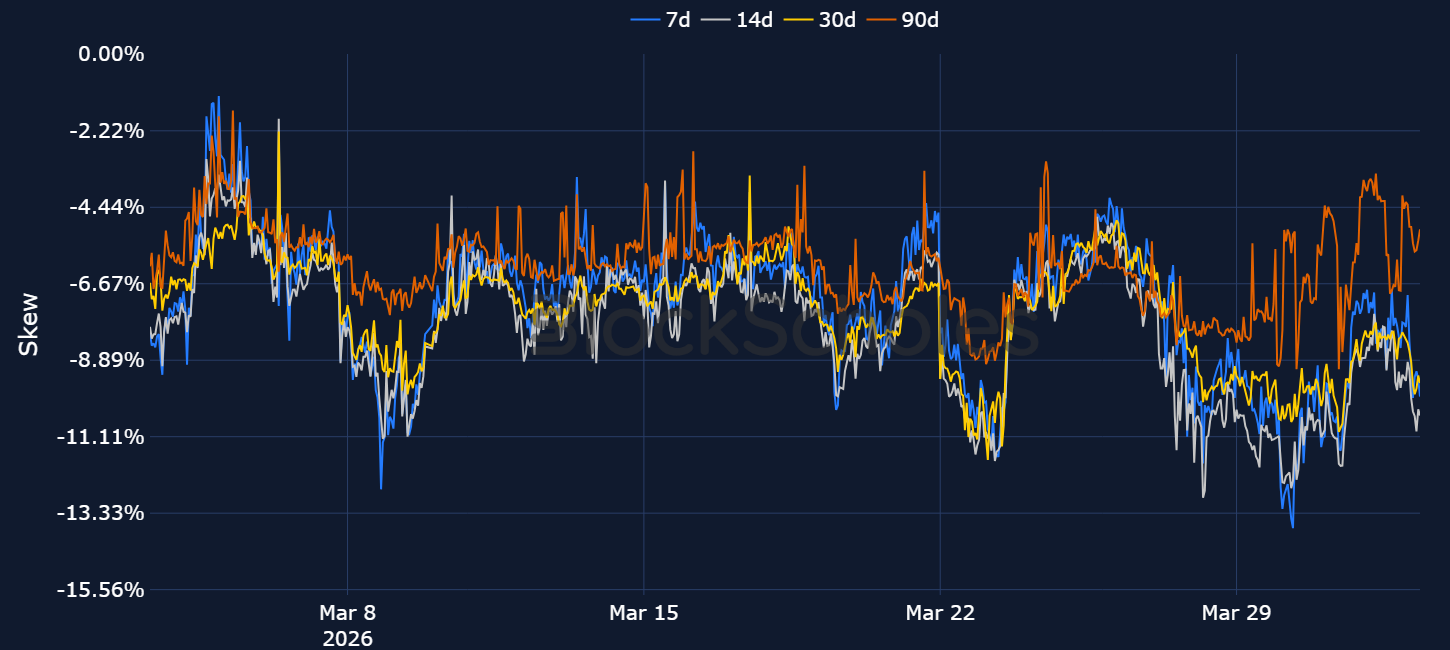
While short tenor options show a preference for puts, longer tenors show less bearish positioning than they did one week ago
In contrast to short tenor skews, green shoots of a recovery in sentiment are indicated in Block Scholes’ Risk Appetite Index, which has begun to recover from extreme bearish levels and now trends higher in both BTC and ETH. The -0.5 level has historically marked a transition away from panic-driven positioning and has acted as an indicator of the beginning of bullish momentum.
While the move higher aligns with the recent recovery in spot, the signal is more notable than what is currently being expressed in options markets, where positioning remains bearish.
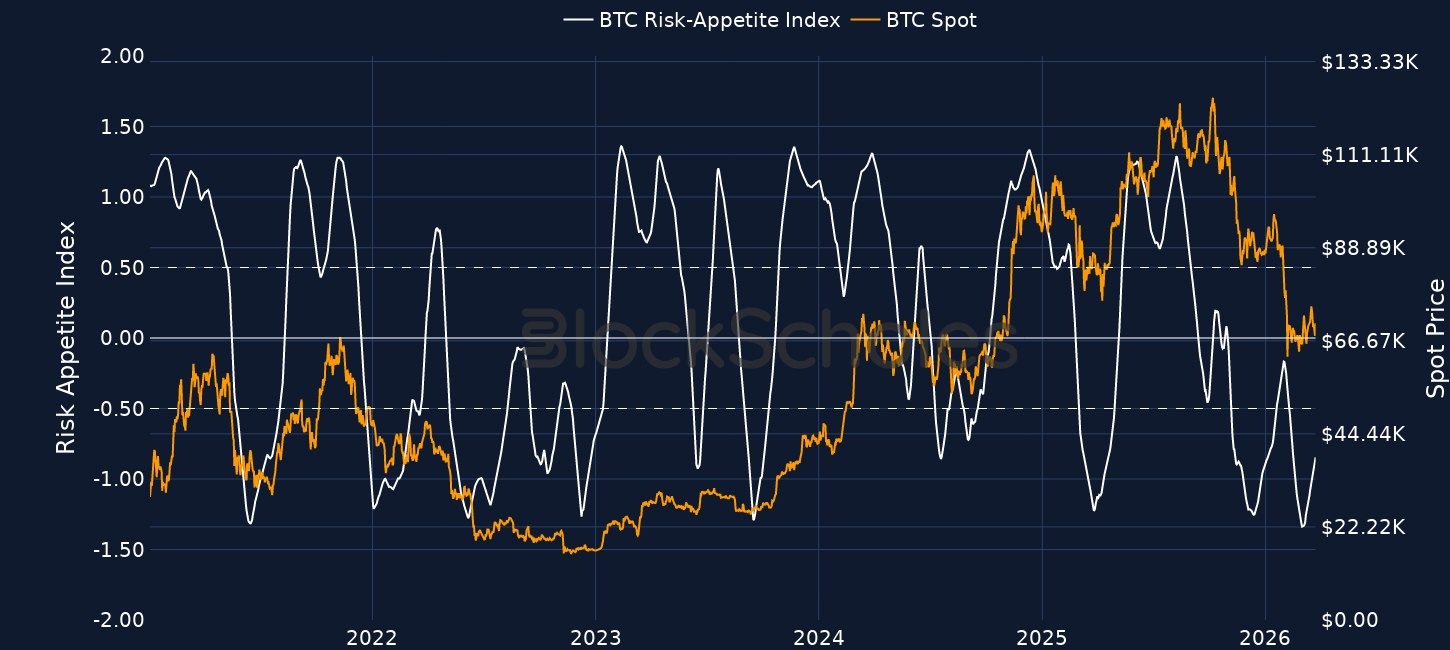
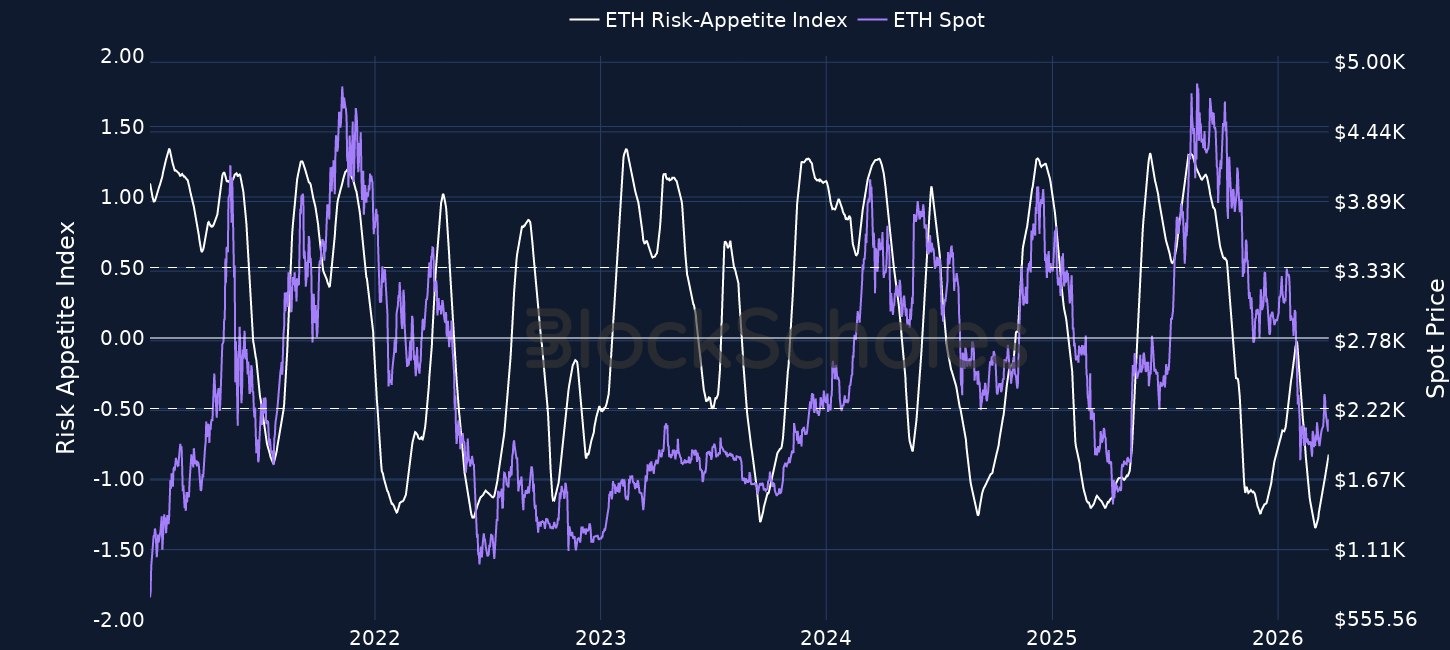
Block Scholes’ Risk Appetite Index measures the level of euphoria (above 1) or panic (below -1) in the spot market. Momentum in this index shows a strong relationship to spot returns.
Despite indicating that US military objectives may be nearing completion and suggesting a potential withdrawal from Iran within “two or three weeks”, President Trump delivered a strong reminder of his resolve for continued military strikes against Iran in a primetime speech delivered on Wednesday night.
Such promises included strikes on key energy infrastructure, offsetting earlier hopes of de-escalation and leaving BTC’s implied volatility levels elevated.
BTC ATM Implied Volatility
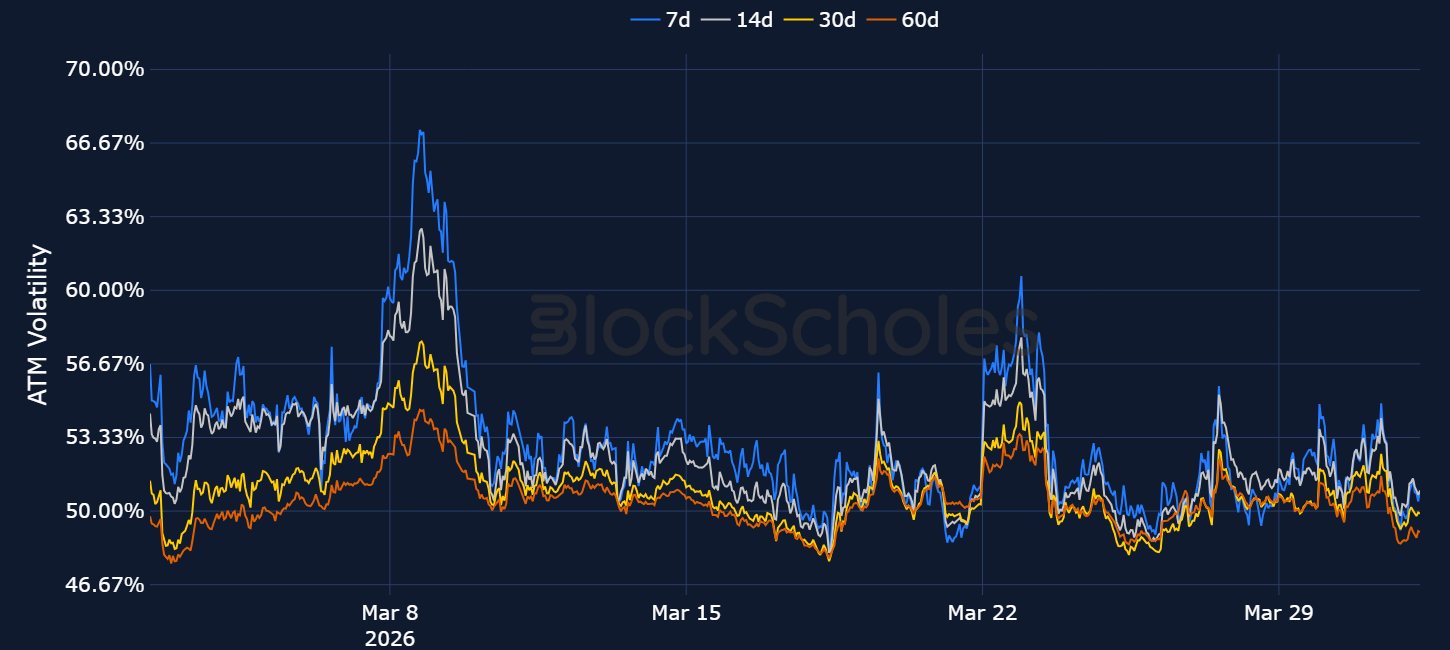
In contrast to the whipsaw in spot prices over the last three days, implied volatility levels had remained elevated throughout.
Short-dated tenors continue to trade at elevated levels as options markets remain incredibly cautious and unwilling to price-in an immediate end to the war in the Middle East (and, most importantly for markets, a reopening of the Strait of Hormuz).
While spot markets have reacted immediately to both positive and negative news for risk-on assets, crypto options markets have so far been a consistent barometer for how much faith markets place in discussions. We see that in the persistently elevated implied volatility levels for longer dated tenors over the last week, despite Trump’s delivery of a 15 point plan for peace and President Masoud Pezeshkian’s statement that Iran has the “necessary will” to end hostilities.
ETH ATM Implied Volatility
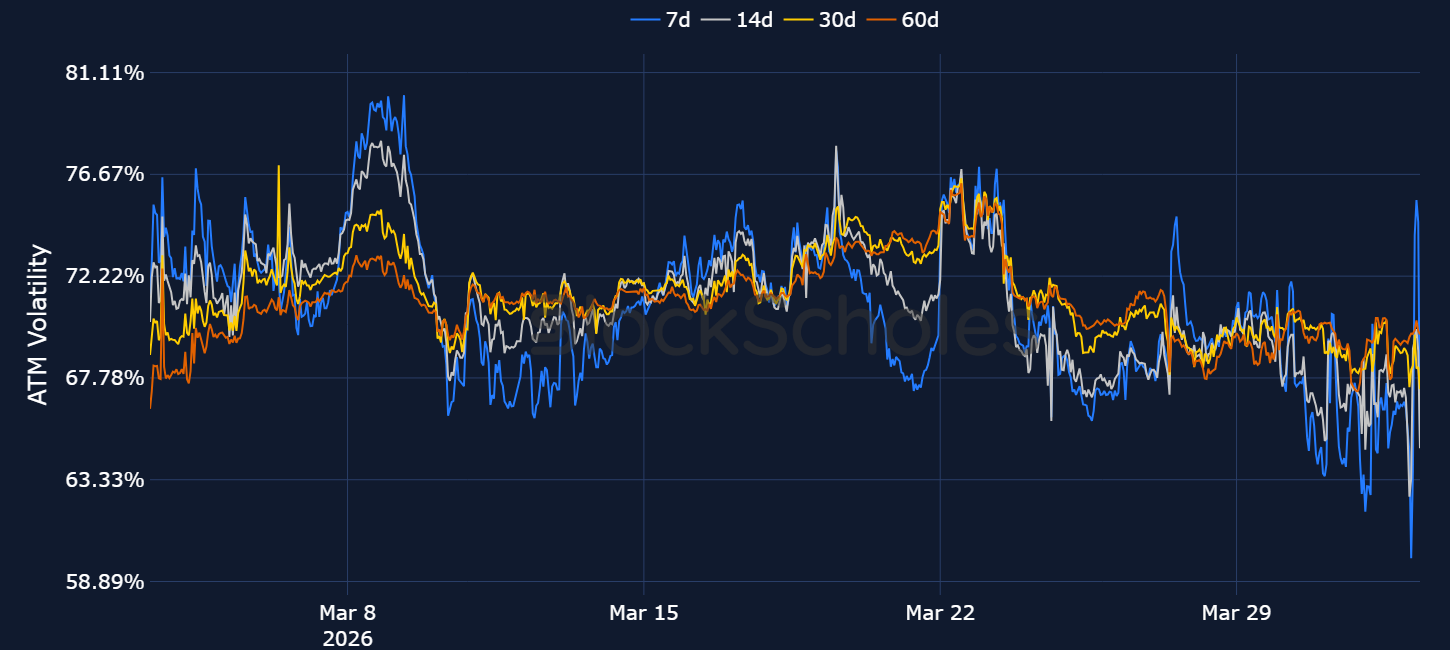
In contrast to the consistently elevated level of implied volatility, the directional sentiment expressed by options markets has repriced strongly several times in the last week in response to developments surrounding the Middle East conflict
First, overtures from both sides earlier this week saw short tenor volatility smiles move from a 13 point premium in favour of puts to a far less bearish (but still far from bullish) 6.5 point premium. Trump’s reiteration overnight of possible strikes on Iranian energy infrastructure and massing of troops in the Middle East has since returned those short tenor puts to a 10 point premium – not as bearish as positioning at the start of the week, but certainly not positioning for a rally.
Options at tenors of 90 days or longer, however, have not been – is that a small sign that markets are beginning to price for an end in sight?
The memecoin supercycle was a 2024 theory that the memecoin sector would outperform the entirety of the crypto market. Memecoin launch platforms, the most popular being Pump.fun which was created in January 2024, significantly lowered the barrier to entry, allowing non-technical users to launch a tradeable token within minutes without the need to know how to code.
The theory was largely popularized by crypto influencer Murad Mahmudov, otherwise known as ‘MustStopMurad’ at Token2049. His thesis was simple — in an attention-driven internet economy, the more speculative, retail segment of crypto traders would be less interested in tokens with fundamentals and use cases, and more attracted to tokens that were community-driven, based on viral internet culture and driven by changing social media narratives.
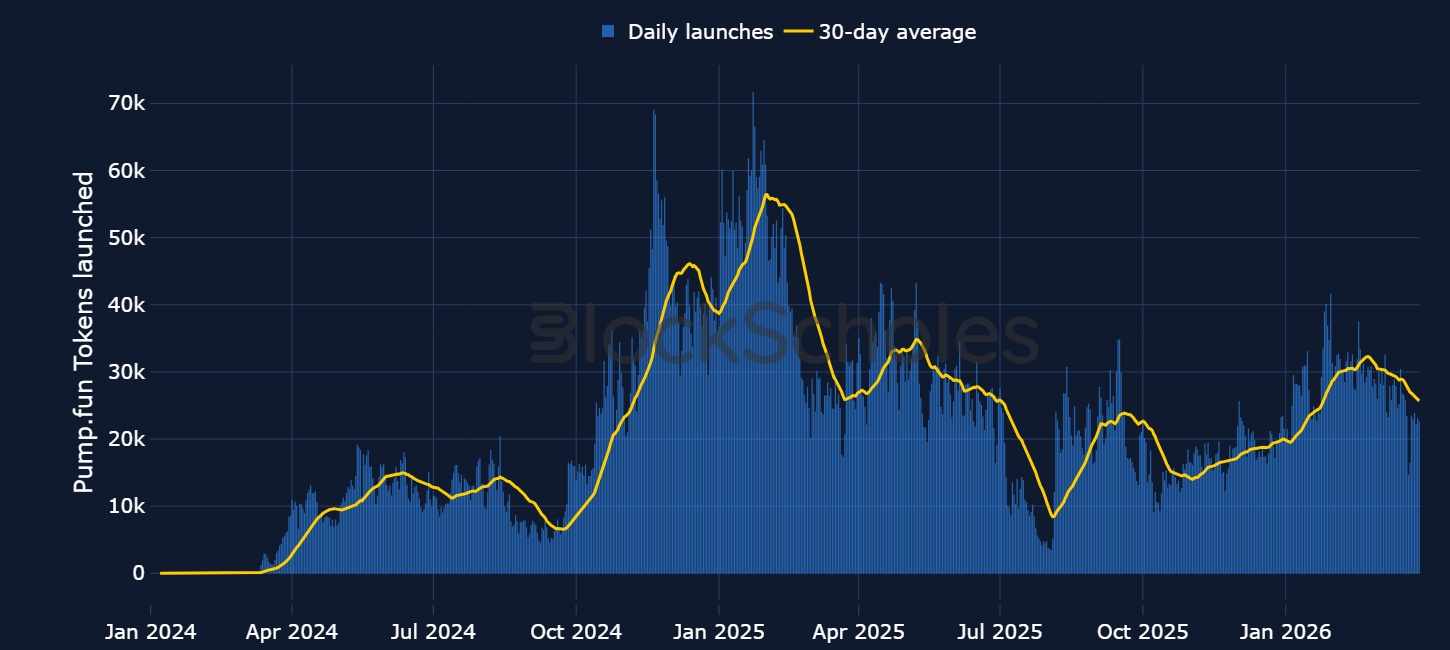
There was a period of time when Murad’s supercycle theory did appear to be true. During the November 2024 to January 2025 crypto rally that followed President Trump’s election victory, more than 70,000 new tokens were launched on Pump.fun per day — an exponential increase from the summer of 2024. Entirely new crypto-specific sectors came to emerge from memecoins too, for example, PolitiFi, where tokens such as TREMP, BODEN and KAMA allowed traders to express their view on the likely winner of the 2024 presidential election.
Such an aggressive number of daily token launches also translated into significant daily volumes and fee generation on the Pump.fun platform. At its peak on Jan 23, 2025, daily trading volume reached $553.1M. That came after President Trump and First Lady Melania Trump both officially launched their own memecoins on Solana in mid-to-late January. Now, over the past 30 days, daily token launches have averaged 25,690 per day, while average daily volumes have been $57.7M — nearly 10x below the January peak.
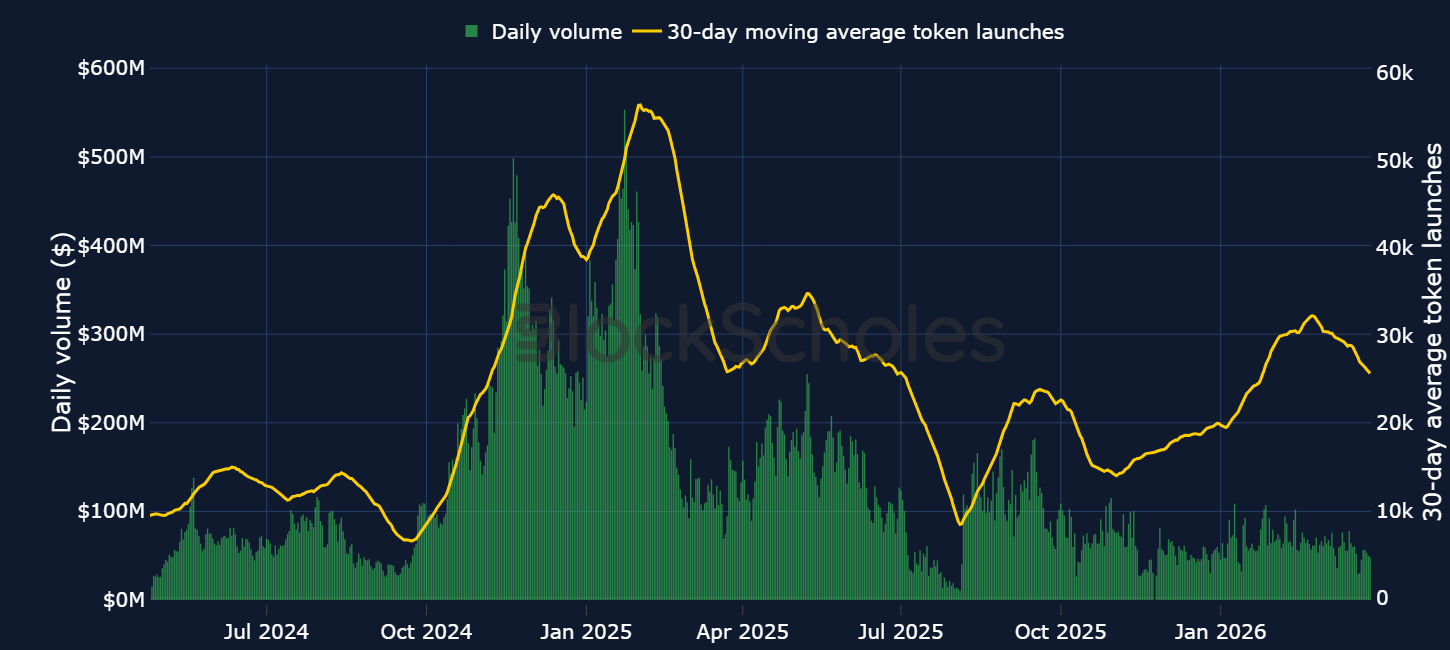
Despite Pump.fun now recording daily volumes far below the cycle extremes of 2025, the number of daily token launches on the platform still remains considerably higher than in early 2024. That suggests that token creation still remains elevated, but attention towards the memecoin sector is sparse and fading — i.e., demand is not keeping up with supply.
One potential driver that could be responsible for the lack of speculative interest in the memecoin category is a changing dynamic within crypto-native retail traders themselves. Traders that had once rotated capital from BTC into altcoins and then into high-risk memecoins may now be rotating capital across tokenised real-world assets instead. We covered how on-chain perp contracts on precious metals and US equity indexes were used by traders to react to weekend geopolitical developments in real time here. Those who made profits on the early 2026 precious metals high, for example, could have then used that capital to rotate into perpetual futures contracts tracking oil prices, which have surged amidst the ongoing US-Iran conflict.
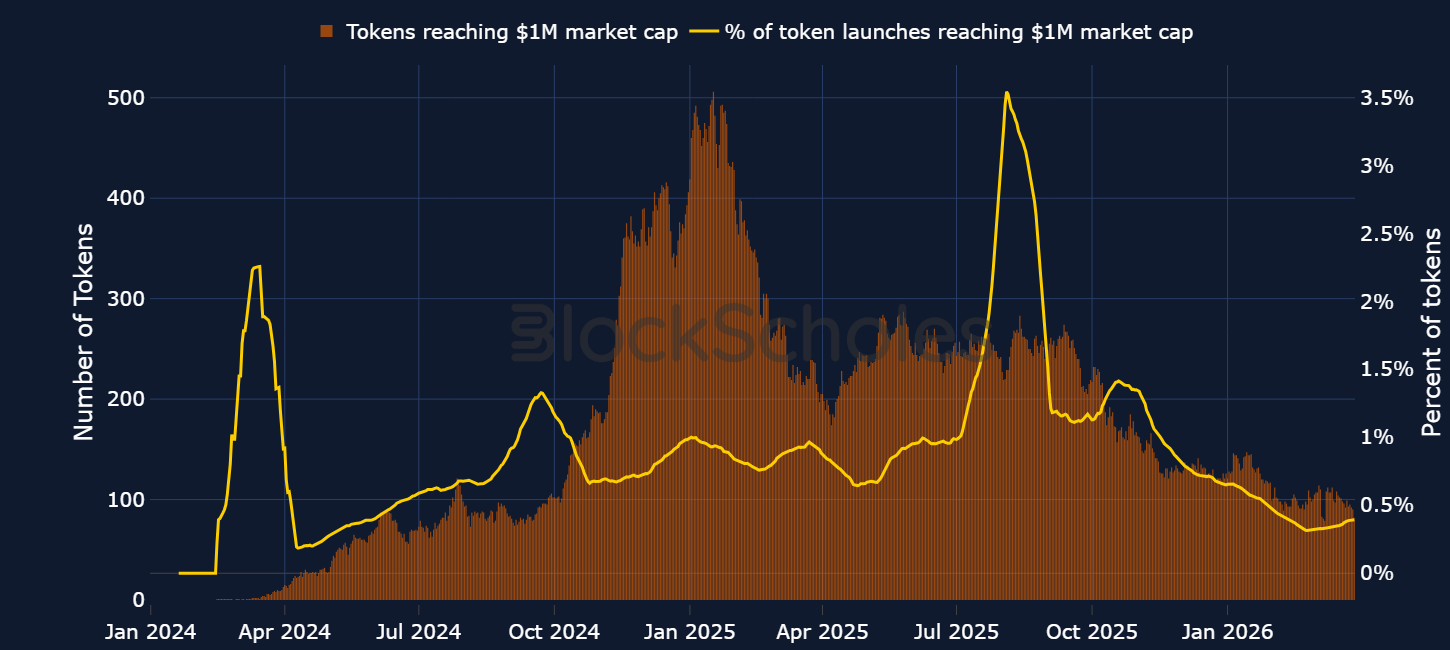
Another sign that attention has migrated elsewhere is in the quality of memecoins being launched. Pump.fun utilizes a bonding curve model to adjust token prices: as more traders buy a token, its price increases according to a mathematical curve. When a token reaches a market cap of $69,000, the platform then migrates the token for secondary trading.
Historically, tokens were migrated to Raydium, a Solana-based DEX. Now, successful tokens are migrated to PumpSwap DEX. In August 2025, more than 3.5% of total daily tokens launched reached a market cap above $1M. That percentage has plunged significantly now to 0.4% — further evidence of market overcrowding and lower conviction: a much smaller portion of tokens are sustaining meaningful attention or liquidity.
EDGE is the native token of the decentralized derivatives protocol, edgeX. Total supply is set at 1 billion EDGE. Of this, 30% is allocated to early users, split between 25% for the genesis distribution and 5% for the Pre-TGE Season, alongside 5% to liquidity, 5% to ecosystem and community, 5% to the foundation, 30% to future reserve, and 25% to core contributors.
The EDGE token is used for:
In the future, it may also have a role in supporting the network’s infrastructure and security.
The release schedule differs by category:
Another important feature of the token is the 30% future reserve.
On one hand, this gives edgeX substantial flexibility to fund ecosystem incentives, liquidity support, partnerships, and broader expansion over time.
On the other hand, it means a significant portion of the total supply remains under project control, which creates uncertainty around how and when those tokens may eventually enter circulation.
For token holders, that reserve is therefore both a source of strategic optionality and a potential source of dilution risk.
Bybit has listed EDGE on the Spot trading platform on 31 March 2026.
Open interest and trading volume data are sourced “as is” from the Bybit exchange platform API exclusively, and as such do not represent a comprehensive picture of the sum of trading activity across all derivatives markets or exchanges. The data visualized in this report consists of hourly and daily snapshots, recorded over the previous 30 days. Daily (hourly) snapshots of trade volume record the total sum of the notional value of trades recorded in the 24H (1 hour) period, beginning with the snapshot timestamp.
If not explicitly labeled as derived from another exchange, the input instrument prices to all derivatives analytics metrics in this report are sourced from the appropriate endpoints of Bybit’s public exchange platform API. In the event that data is labeled or referred to as representing the market on another exchange source, that data is sourced from the appropriate endpoint of each respective exchange’s public API.
Macroeconomic charts and data are sourced “as is” from the Bloomberg Terminal. Exchange data is sourced “as is” from publicly available exchange APIs. Block Scholes makes no claims about the veracity of public third-party data.
After acquisition of underlying-denominated raw data for open interest and trading volume on the Bybit exchange platform from Bybit’s API endpoint, equivalent dollar-denominated figures are calculated using the concurrent value of Block Scholes’s Spot Index for the relevant underlying asset.
Block Scholes’s Spot Index represents the aggregate Spot mid-price for a given currency across the top five CEXs by volume (with USD-quoted markets). It considers the proportion of total volume in the instrument on the exchange, as well as the deviation of a data point from those on other exchanges.
Futures prices are used for Block Scholes’s futures-implied yields calculation services in order to derive the constant-tenor annualized yields displayed in the Futures section of this report.
Options prices are used for Block Scholes’s implied volatility calculation services in order to calibrate volatility surfaces, from which all derivatives volatility analytics displayed in the BTC Options and ETH Options sections of this report are calculated. Volatility smiles are constructed by calibrating to mid-market prices observed in Bybit options markets. As part of the calibration process, prices go through rigorous filtration and cleaning steps, which ensures that the resulting volatility surface is arbitrage-free and has exceptional fit to the market observables.