
Thahbib Rahman
Research Analyst
While traditional risk-on assets such as US equities continue to trade at the helm of oil prices and geopolitical headlines, BTC is showing some signs of price-action that is also being driven by idiosyncratic factors. Since the conflict in the Middle East began, BTC has outperformed both gold and the S&P 500 index, up as much as 21%.

While traditional risk-on assets such as US equities continue to trade at the helm of oil prices and geopolitical headlines, BTC is showing some signs of price-action that is also being driven by idiosyncratic factors.
Since the conflict in the Middle East began, BTC has outperformed both gold and the S&P 500 index, up as much as 21%
That resilience in spot price against a macro backdrop which has seen traditional risk-assets struggle coincides with the beginning of a recovery in institutional appetite.
While still negative year-to-date, down 16%, Spot Bitcoin ETFs are currently on a six-day inflow streak, something we last saw in late September-to-October during BTC’s ascent to the $126K all-time high.
Meanwhile, Michael Saylor’s Strategy, the largest BTC digital asset treasury by supply held, has purchased more than $7B worth of the asset so far this year, equivalent to nearly 89,000 coins.
Additionally, the resilience in spot price has also bolstered a recovery in risk-sentiment. Our Risk-Appetite Index for both majors, BTC and ETH, have now bounced off their early March lows.
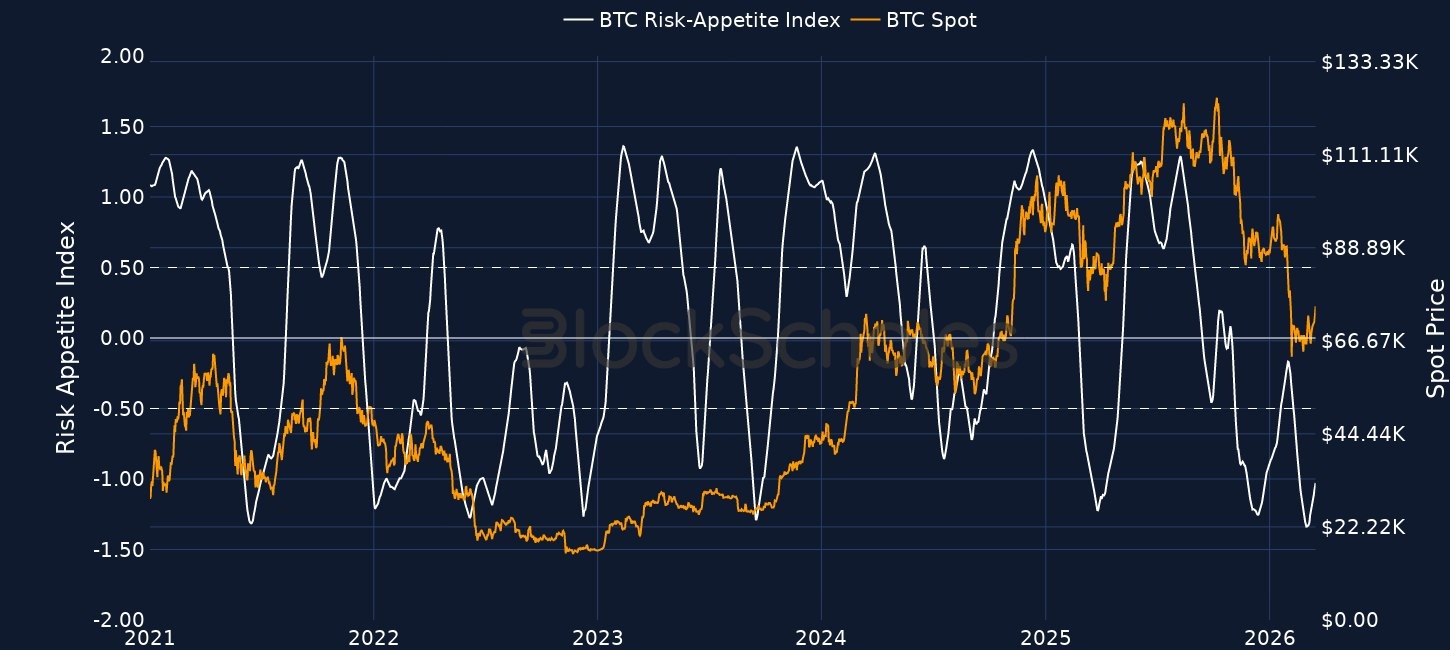
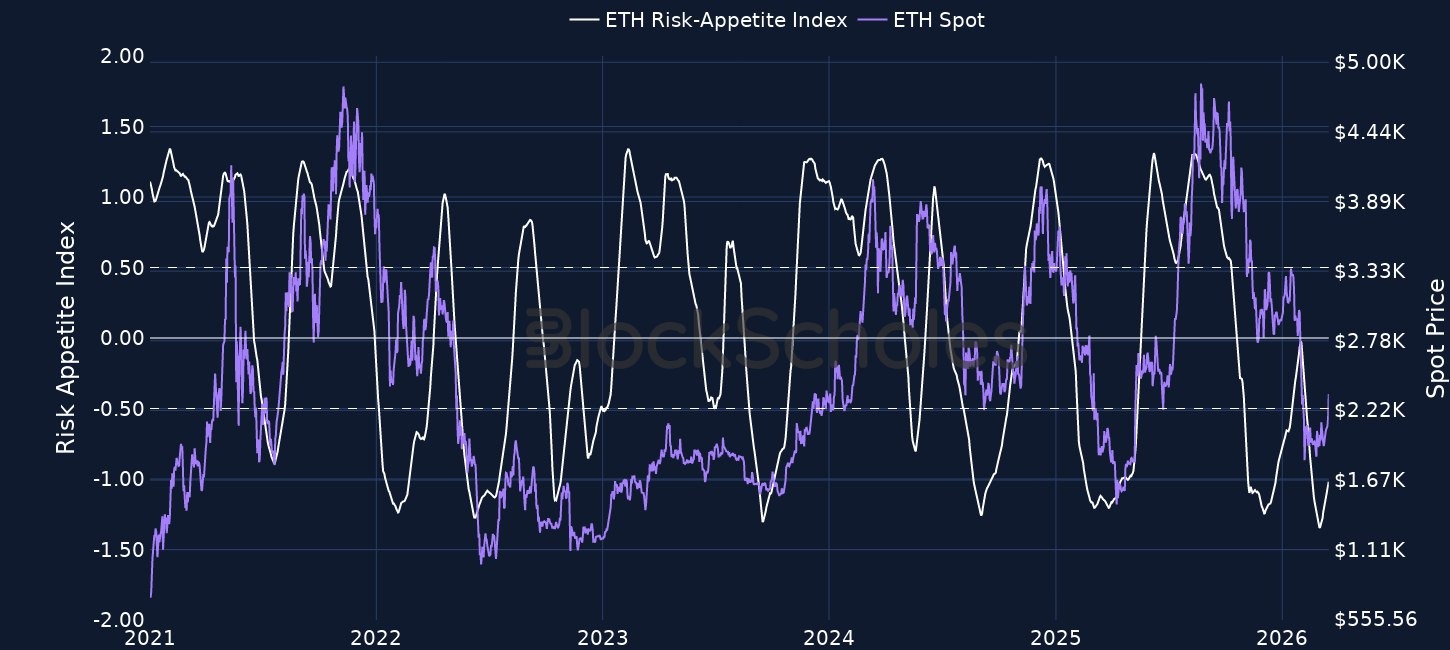
Block Scholes’ Risk Appetite Index measures the level of euphoria (above 1) or panic (below -1) in the spot market. Momentum in this index shows a strong relationship to spot returns.
Our 2026 outlook report made the case that consistent inflows and buy-side demand from Bitcoin Spot exchange-traded funds (ETFs) had “backed each crypto rally since their launch”. After the 10/10 liquidation event, however, we’ve seen sporadic demand from institutional investors to re-enter the crypto market. As such, most of the modest and brief rallies in BTC spot price year-to-date have occurred against a backdrop of weak Spot ETF demand (year-to-date net flows from Spot Bitcoin ETFs are -$280.1M).
However, half-way into the month of March, we are beginning to see tentative signs that capital is returning back to Bitcoin and the strongest signal of demand since the October crash began
Between March 9, 2026 and March 16, 2026, Spot Bitcoin ETFs purchased $962.8M of bitcoins, across six consecutive days of inflows. The last time the Spot products saw this many (or more) back-to-back days of inflows was between Sept 29, 2025 and Oct 9, 2025, a period that also coincided with the $126K all-time high.
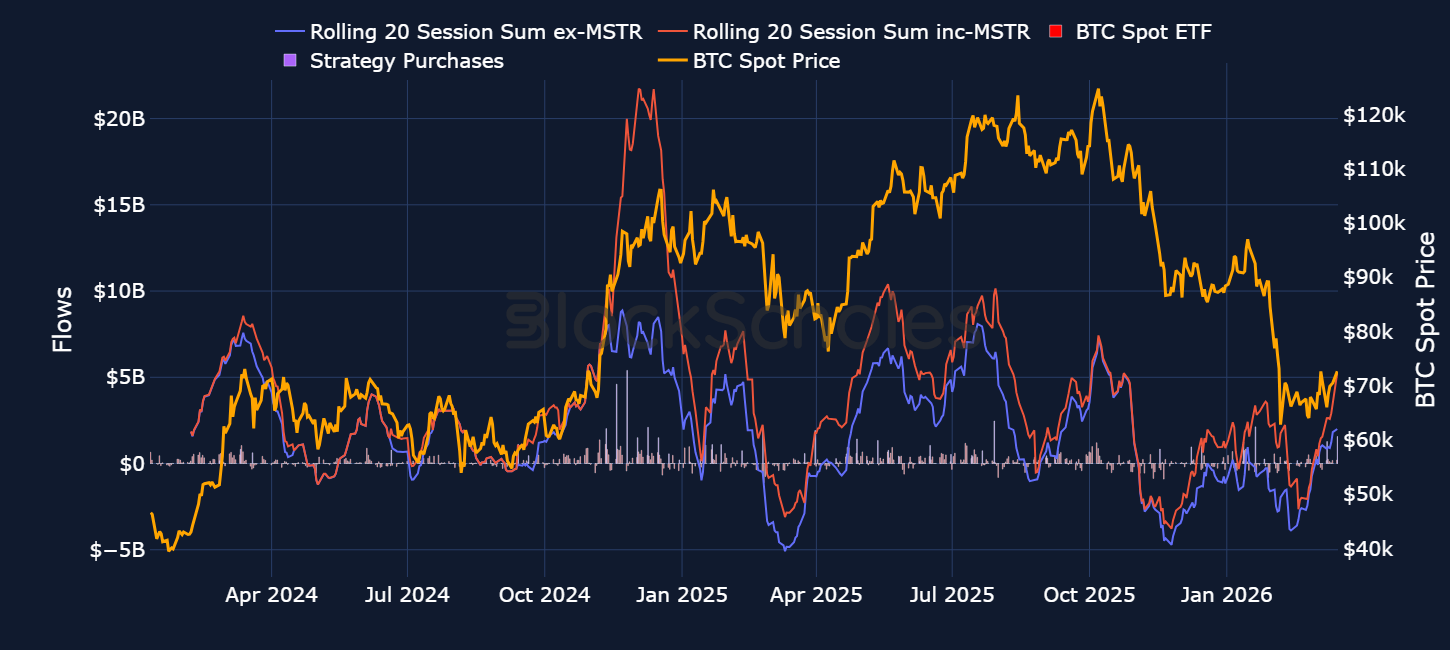
Additionally, alongside a return in ETF demand, we have also seen Strategy, the largest Bitcoin digital asset treasury firm, provide the market with a persistent structural bid. Since the start of the year, Strategy has hoovered up nearly 89,000 bitcoins, at a total cost of $7.174B. Together, the return in institutional demand from Spot ETFs and Strategy have resulted in a significant shift in the rolling 20-day sum of net flows from -$2B in late February 2026 to $5.3B.
If history is a signal, continued inflows into Spot ETFs and improved institutional sentiment could provide further support for BTC amidst the current geopolitical tensions.
The company mined 6,594.6 BTC during the year (1,718.3 in Q4), with total cost of production rising to $97,272 per BTC for the year and $106,251 in Q4.
The addition broadens payment access on the platform and reflects the wider push among regulated European crypto providers to make account funding and cash withdrawals more straightforward.
The agreement will focus initially on foreign tourists, who will be able to use crypto to pay for goods and services across KG Inicis’s merchant network, while merchants can choose to settle in either fiat or digital assets.
The proposed ETF is expected to track a diversified basket of 5–15 cryptocurrencies, selected from a submitted list of eligible assets that includes BTC, ETH, SOL, XRP, ADA, AVAX, LTC, DOT, DOGE, HBAR, BCH, LINK, XLM, SHIB, and now SUI.
The collaboration brings together one of South Korea’s largest financial groups, which generated more than $2.67B in net income in 2025, with a global bank that has already launched institutional spot BTC and ETH trading and expanded digital asset custody across multiple jurisdictions.
The case originally accused Al-Naji of defrauding investors through the BitClout social-token platform, and its dismissal comes as part of a broader trend of US regulators dropping crypto-related cases.
BlackRock’s first digital asset ETF also has a built-in staking component.
Under normal conditions, between 70% and 95% of the portfolio’s ETH is committed to staking, while the balance is kept liquid to support creations, redemptions, and day-to-day fund operations.
Of the staking income generated, 82% is paid through to investors, with the remaining 18% retained by the sponsor and execution partner.
ETHB charges a 0.25% annual sponsor fee, although this is initially reduced to 0.12% on the fund’s first $2.5B of assets during its first year.
Bloomberg, citing sources familiar with the matter, said the two banks are likely to be included in the first batch of licences issued under the new framework, which requires any company seeking to issue stablecoins in Hong Kong to obtain authorisation from the Hong Kong Monetary Authority.
The debut marks an important step in the expansion of state-backed digital currency initiatives, with FRNT designed to support faster and more efficient transfers while preserving the transparency and reserve backing expected of a public-sector asset.
Hedera provides the low-cost blockchain infrastructure underpinning the token, while Kraken, Fireblocks and LayerZero support trading access, issuance operations and cross-chain transfers from launch.
The company and its licensed affiliates, including Alpha Ladder Finance, are building an integrated platform that combines fiat and stablecoin payments with traditional and tokenised wealth management services for enterprises, financial institutions, and ultra-high-net-worth clients.
The new capital will help expand MetaComp’s StableX Network across Asia, the Middle East, Africa, and Latin America and support development of its AI-driven Web2.5 payment and wealth infrastructure.
Metaplanet Ventures will back companies building crypto financial infrastructure in Japan, while Metaplanet Asset Management will focus on bitcoin-related investment products and capital markets activity.
The company is making its first investment through the venture arm - JPY 400M into yen-backed stablecoin issuer JPYC.
Centrifuge is a blockchain-based protocol focused on bringing real-world assets on-chain and enabling decentralised access to asset-backed financing. Its core objective is to connect traditional financial markets with blockchain infrastructure by allowing off-chain assets such as private credit, invoices, and other receivables to be tokenised and funded through on-chain liquidity.
The protocol operates as a credit infrastructure layer that facilitates the creation and financing of asset pools. Asset originators introduce collateral, which is structured into investable pools, while investors supply capital and earn returns derived from the underlying cash flows. This model mirrors elements of traditional structured finance, but replaces parts of the intermediary stack with programmable smart contracts and on-chain settlement.
Centrifuge has moved from its earlier architecture around the legacy Centrifuge Chain to what it now describes as a native EVM execution environment under Centrifuge V3, with the protocol and CFG token migrated accordingly in 2025. In its current form, the protocol is structured as an open-source system for tokenising and distributing financial products across multiple blockchains through immutable smart contracts. Its architecture is built around a hub-and-spoke model, in which a single hub chain handles pool management, accounting, pricing and investment request processing, while spoke chains are used for token issuance, transfer and redemption. Within that structure, share tokens are issued as ERC-20s, vaults can be deployed using ERC-4626 for synchronous flows and ERC-7540 for request-based flows, and cross-chain movement uses a burn-and-mint mechanism.
Another key technical feature is its fully on-chain accounting system, where the hub maintains double-entry bookkeeping and consolidated records of holdings across chains. In practice, this means Centrifuge is better described as multi-chain tokenisation and fund infrastructure than as a standalone chain project.
The CFG token functions as the native coordination and governance asset of the network. It is used to participate in protocol-level decision-making, align incentives across stakeholders, and support ecosystem development. Its role is now primarily tied to governance, economic alignment, and long-term participation in the growth of the Centrifuge ecosystem.
Bybit listed the CFGUSDT Perpetual Contract on 17 March 2026. Trading is now open with up to 25x leverage.
Open interest and trading volume data are sourced “as is” from the Bybit exchange platform API exclusively, and as such do not represent a comprehensive picture of the sum of trading activity across all derivatives markets or exchanges. The data visualized in this report consists of hourly and daily snapshots, recorded over the previous 30 days. Daily (hourly) snapshots of trade volume record the total sum of the notional value of trades recorded in the 24H (1 hour) period, beginning with the snapshot timestamp.
If not explicitly labeled as derived from another exchange, the input instrument prices to all derivatives analytics metrics in this report are sourced from the appropriate endpoints of Bybit’s public exchange platform API. In the event that data is labeled or referred to as representing the market on another exchange source, that data is sourced from the appropriate endpoint of each respective exchange’s public API.
Macroeconomic charts and data are sourced “as is” from the Bloomberg Terminal. Exchange data is sourced “as is” from publicly available exchange APIs. Block Scholes makes no claims about the veracity of public third-party data.
After acquisition of underlying-denominated raw data for open interest and trading volume on the Bybit exchange platform from Bybit’s API endpoint, equivalent dollar-denominated figures are calculated using the concurrent value of Block Scholes’s Spot Index for the relevant underlying asset.
Block Scholes’s Spot Index represents the aggregate Spot mid-price for a given currency across the top five CEXs by volume (with USD-quoted markets). It considers the proportion of total volume in the instrument on the exchange, as well as the deviation of a data point from those on other exchanges.
Futures prices are used for Block Scholes’s futures-implied yields calculation services in order to derive the constant-tenor annualized yields displayed in the Futures section of this report.
Options prices are used for Block Scholes’s implied volatility calculation services in order to calibrate volatility surfaces, from which all derivatives volatility analytics displayed in the BTC Options and ETH Options sections of this report are calculated. Volatility smiles are constructed by calibrating to mid-market prices observed in Bybit options markets. As part of the calibration process, prices go through rigorous filtration and cleaning steps, which ensures that the resulting volatility surface is arbitrage-free and has exceptional fit to the market observables.