Binance Lost Around $6.3B to Hackers in the Largest Crypto Theft on Record
Binance suffered the largest crypto hack in history on Thursday, with attackers draining $6.3B from its hot wallets, while the exchange says losses will be covered in full by its SAFU fund and reserves. BTC fell 5.1% to $76.7K, its lowest since mid-September, and ETH 6.1% to $2,191, as $1.53B of positions were liquidated over 24 hours and BTC's 7-day implied vol jumped from 35.5% to 47.8%. Alphabet closed 12.6% lower in its biggest drop on record, while Strategy reported Q3 net income of $19.53B and ICE agreed to partner with TradeXYZ to bring Hyperliquid-based perpetual futures to the US.
Nasdaq-100 futures are trading 2.2% lower after Alphabet closed down 12.6% on Thursday, its biggest drop on record, while Treasuries rallied and CME FedWatch odds of a December hike fell to around 78% from 84%, and BTC fell as low as $76.7K overnight, its lowest since mid-September, with ETH down 6.1% to $2,191.
Strategy reported Q3 net income of $19.53B, driven by a $20.91B gain on its 848,517 BTC, and said CFO Andrew Kang will step down on Nov. 5, while Polygon Labs added Solana to its Open Money Stack payments platform.
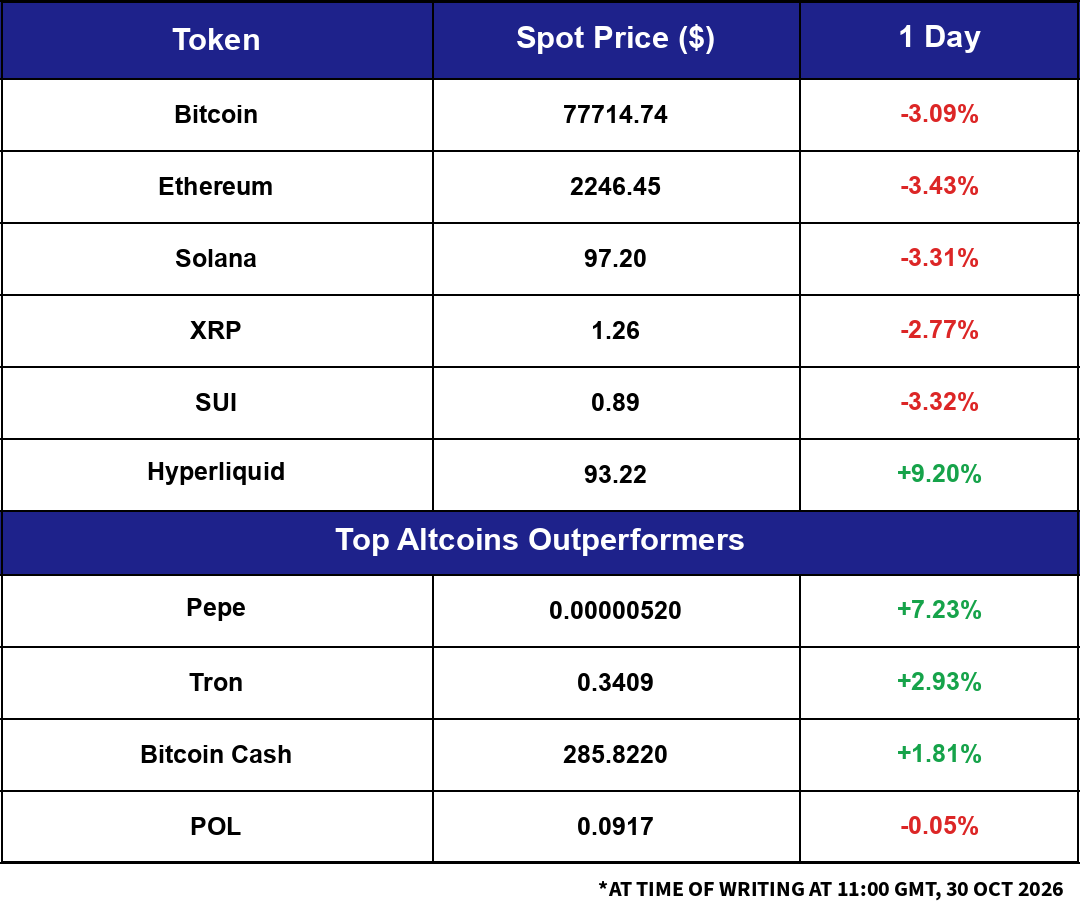
Market Snapshot: Overnight Moves
Macro & Markets
Binance suffered the largest crypto hack in history late on Thursday, with attackers draining around $6.3B from the exchange's hot wallets starting at 20:05 UTC. The theft is more than four times the size of the previous record, the $1.46B stolen from Bybit in February 2025, and according to Elliptic is "almost certainly the largest theft of any kind."
Binance says losses will be covered in full by its SAFU fund and company reserves, while stablecoin issuers have so far frozen around $3B of the stolen funds. Withdrawals from the exchange remain suspended this morning and are expected to resume within 48 hours.
Crypto markets reacted before Binance had confirmed the breach. BTC fell 2.5% in the first hour, from $80.8K at 20:00 UTC to $78.8K at 21:00 UTC, before extending its decline to $76.7K by 02:00 UTC (-5.1%), its lowest level since mid-September. It is trading at ~$77.5K this morning.
ETH fell 6.1% over the same window to $2,191, its lowest since mid-August, while BNB dropped 6.2% in the first hour alone and touched $695. Rather than selling, the attacker has been converting stolen stablecoins into ETH to avoid further freezes, while dumping smaller tokens such as AAVE, which fell 11%.
There was little sign of a Binance-specific dislocation in spot markets. USDT slipped to $0.9977 at 05:00 UTC from $0.9989 before the hack, and Binance's BTC-USDT pair traded in line with other venues once adjusted for that discount. USDT has since recovered to $0.9988.
The selloff triggered a wave of forced selling in leveraged markets. $627.7M of positions were liquidated in the first hour, 97% of them longs, rising to $1.53B over 24 hours, of which 84% were longs and almost half ($754.6M) were on Binance itself.
Perpetual funding rates compressed sharply. Funding on Binance's ETH perpetual turned negative, reaching -0.0075% per 8 hours at 02:00 UTC from +0.01% before the hack, while BTC funding fell to almost zero but stayed positive.
Rather than a broad deleveraging, traders added fresh short exposure into the decline. Open interest on Binance's BTC-USDT perpetual held steady through the initial drop before rising 4.5% between 23:00 and 04:00 UTC as prices fell, while BNB perpetual open interest on Binance jumped 12% in the hour of the hack.
Dated futures premiums narrowed alongside. The annualised basis on Deribit's end-November ETH future fell from 4.4% to as low as 2.4% at 00:00 UTC, while BTC's eased more modestly from 5.6% to 4.7%.
Options markets repriced short-dated risk sharply. BTC's 7-day at-the-money implied vol jumped from 35.5% at 20:00 UTC to 47.8% at 01:00 UTC, and at 41.6% this morning remains at its highest level since late August. ETH's 7-day vol surged from 48.7% to 67.8% before easing to 56.7%.
Demand for downside protection was concentrated in ETH. Its 7-day 25-delta put premium blew out from -6.1 to -14.7 vol points by 02:00 UTC, its steepest since late June, and still sits at -12.9 this morning. BTC's widened from -2.6 to -8.1 vol points at its peak before retracing to -4.5.
The hack coincided with a renewed selloff in AI-related shares. Alphabet closed 12.6% lower on Thursday, its biggest drop on record, while Intel is trading around 25% lower pre-market after weak Q4 guidance and Amazon is down around 7% after missing earnings estimates. Nasdaq-100 futures are trading 2.2% lower this morning, while South Korea's Kospi fell 4.9%.
US data offered some relief. Q3 GDP grew at an annualised 3.4%, above the 3.2% expected, while September core PCE inflation rose to 3.1% y/y in line with expectations. Treasuries rallied, with the 2-year yield falling 6bps to 4.61% and the 10-year 7bps to 4.98%, while CME FedWatch odds of a December hike fell to around 78% from 84%.
President Trump hailed the GDP print on Truth Social, writing that "Our Economy is ROARING".
Brent crude is trading 1.0% higher at $116.08 this morning on further reports of tankers being struck near the Strait of Hormuz, while gold has slipped below $4,000 and silver has fallen to an 11-month low of $52.16.
DeFi / Web3 / Altcoins / Crypto
Strategy reported Q3 net income of $19.53B, up from $2.79B a year earlier, largely driven by a $20.91B gain on its BTC holdings.
The company held 848,517 BTC as of Oct. 25, up 26% YTD.
Its software business generated $125.4M in revenue, down 3% year over year.
Strategy also said CFO Andrew Kang will step down on Nov. 5, with COO Reza Virasteh set to become CFO in January 2027.
MSTR shares fell about 3.5% in after-hours trading following the results.
The company said it spent $2.04B repurchasing STRC preferred shares.
Holders of STRC, STRF, STRK and STRD also approved a change allowing dividends to accrue daily, with 99.3% of votes cast in favor.
STRC’s first daily-dividend record date will be Nov. 1, while STRF, STRK and STRD will move to the new structure from Jan. 1.
ICE, the parent company of the NYSE, has agreed to partner with TradeXYZ to bring Hyperliquid-based perpetual futures to the U.S., subject to regulatory approval.
ICE would operate the regulated market and clearing infrastructure, while TradeXYZ would design and implement the markets. Hyperliquid’s HIP-3 framework would provide the underlying technology.
The planned contracts would cover crypto, equities, indices, commodities and FX and would be accessible through participating brokers and platforms.
ICE is also making a strategic investment in TradeXYZ as part of the partnership.
HYPE rose about 15% on the announcement, trading around $91.21 at publication time.
TradeXYZ’s existing HIP-3 markets have already built significant activity in perpetual contracts tied to stocks, indices and commodities.
The planned U.S. launch follows CFTC staff guidance and no-action relief earlier this year that opened a path for perpetual futures to be offered under a regulated framework.
Polygon Labs has added Solana to its Open Money Stack, extending the payments platform to support bank-to-crypto transfers and payouts involving the Solana network.
Businesses can use a single integration to receive funds from bank accounts, move assets across supported blockchains and send payouts to recipients.
The stack now connects Solana with networks including Polygon, Ethereum and TRON.
Kira is among the first companies using the Solana integration to move between USD and stablecoins and handle supplier payments.
The platform can also support customer accounts and wallets, asset conversion and payment routing to bank accounts, cards, cash services and crypto wallets.
The Solana expansion follows the network’s Alpenglow upgrade, which reduced transaction finality from about 12.8 seconds to roughly 150 milliseconds.
Figure 4. ETH at-the-money implied volatility across selected tenors. Source: Deribit, Block Scholes.
Figure 5. BTC 25-delta put-call skew ratio across selected tenors. Source: Deribit, Block Scholes.
Figure 6. ETH 25-delta put-call skew ratio across selected tenors. Source: Deribit, Block Scholes.
Block Scholes is an FCA-regulated institutional crypto derivatives analytics platform. Live data, IV surfaces, and backtesting available via blockscholes.com.
Nasdaq-100 futures are trading 2.2% lower after Alphabet closed down 12.6% on Thursday, its biggest drop on record, while Treasuries rallied and CME FedWatch odds of a December hike fell to around 78% from 84%, and BTC fell as low as $76.7K overnight, its lowest since mid-September, with ETH down 6.1% to $2,191.
Strategy reported Q3 net income of $19.53B, driven by a $20.91B gain on its 848,517 BTC, and said CFO Andrew Kang will step down on Nov. 5, while Polygon Labs added Solana to its Open Money Stack payments platform.
Market Snapshot: Overnight Moves
Macro & Markets
Binance suffered the largest crypto hack in history late on Thursday, with attackers draining around $6.3B from the exchange's hot wallets starting at 20:05 UTC. The theft is more than four times the size of the previous record, the $1.46B stolen from Bybit in February 2025, and according to Elliptic is "almost certainly the largest theft of any kind."
Binance says losses will be covered in full by its SAFU fund and company reserves, while stablecoin issuers have so far frozen around $3B of the stolen funds. Withdrawals from the exchange remain suspended this morning and are expected to resume within 48 hours.
Don't miss what's next
Upgrade your Block Scholes account to unlock this article and other exclusive insights
Premium
$30/mo
Access previous and future reports, market insights & deep dives.
Binance suffered the largest crypto hack in history on Thursday, with attackers draining $6.3B from its hot wallets, while the exchange says losses will be covered in full by its SAFU fund and reserves. BTC fell 5.1% to $76.7K, its lowest since mid-September, and ETH 6.1% to $2,191, as $1.53B of positions were liquidated over 24 hours and BTC's 7-day implied vol jumped from 35.5% to 47.8%. Alphabet closed 12.6% lower in its biggest drop on record, while Strategy reported Q3 net income of $19.53B and ICE agreed to partner with TradeXYZ to bring Hyperliquid-based perpetual futures to the US.
Intercontinental Exchange, the owner of the New York Stock Exchange, is making a strategic investment in trade[XYZ] as the two plan a US market for 24/7 perpetual futures built on Hyperliquid infrastructure, subject to CFTC approval, after trade[XYZ]'s existing Hyperliquid markets generated more than $650B in volume in just over a year. The Fed held rates at 3.75%-4.00% with two members dissenting in favour of a further hike, while US Q3 GDP grew 3.4%, above the 3.2% consensus. BTC slipped back to $80.1K, while Coinbase added Ripple's RLUSD stablecoin across its retail app, Exchange and Prime.