
Thahbib Rahman
Research Analyst
With the US midterms on 3 November, prediction markets price Democratic control of the House at over 90% and the Senate at around 64%, yet BTC spot shows negligible correlation with those odds and options carry only a small election premium compared with 2024. We examine what a change in Senate control could mean for the stalled CLARITY Act, how equities and BTC have performed after past midterms and after the first hike of each Fed cycle, and why the vote is unlikely to produce a November 2024-style move unless the result surprises.

The US midterm elections on 3 November 2026 will see all 435 House seats and 35 of 100 Senate seats contested, with Republicans seeking to defend their majorities in both chambers. The election will determine congressional control for the remaining two years of President Trump's term, which ends on 20 January 2029. The political and macroeconomic backdrop shares similarities with the 2024 presidential election, when Republicans secured the presidency and control of Congress amid a shifting Federal Reserve policy cycle.
However, the direction of monetary policy differs between the two elections. In September 2024, the Fed began easing monetary policy with a 50bp cut, bringing the federal funds target range down to 4.75–5.00% ahead of the November presidential vote. By contrast, the 2026 midterms follow the Fed's first rate increase since July 2023, with a 25bp hike on 16 September bringing the target range back up to 3.75–4.00%. September’s move followed 175bp of cumulative cuts between September 2024 and December 2025, and five consecutive holds through July 2026.
Changes in interest-rate expectations affect liquidity conditions, discount rates and investor demand for risk assets, while the composition of Congress influences the legislative outlook for digital assets, including market structure and regulatory oversight. Against this backdrop of electoral uncertainty and an evolving rate cycle, the midterms introduce another factor shaping the outlook for crypto markets, which is particularly relevant for the outstanding CLARITY Act. Prediction markets serve a dual purpose, both as a potential “source of truth” for electoral expectations and as a means of gaining direct exposure to political outcomes.
Both traditional polls and prediction markets point towards a Democratic win in the upcoming midterms, particularly in the House. The Silver Bulletin generic congressional ballot average showed Democrats ahead by 8.9 points on 5 October, while FiftyPlusOne recorded an 8-point lead on 6 October. By 19 October, FiftyPlusOne's Democratic lead had widened to 8.5 points, with 51.7% support against 43.2% for Republicans. Prediction markets reflect similar expectations, with Kalshi and Polymarket pricing Democratic control of the House at 90.4% and 91.5%, respectively, compared with 63.5% and 64.5% for Senate control, as of 26 October. The lower Senate probabilities reflect the requirement for Democrats to gain four seats, relative to their current holdings, to secure a majority, compared with a net gain of three in the House.
Democrats have historically been associated with a less crypto-friendly regulatory stance than Republicans. Recent Democratic objections to crypto market-structure legislation have focused on conflicts of interest, investor protections, and regulatory oversight. A change in congressional control could therefore affect the progress and scope of legislation governing US digital asset markets such as the outstanding CLARITY Act.

Figure 1. Kalshi and Polymarket implied probability of Democratic control of the House and the Senate. Source: Kalshi, Polymarket, Block Scholes.
However, this risk is not directly reflected in the BTC spot market. In 2026, the correlation between daily changes in Kalshi’s probability of Democratic Senate control and BTC daily returns averaged -0.02 as of 26 October, indicating negligible relationship between BTC spot returns and the evolving midterm expectations.
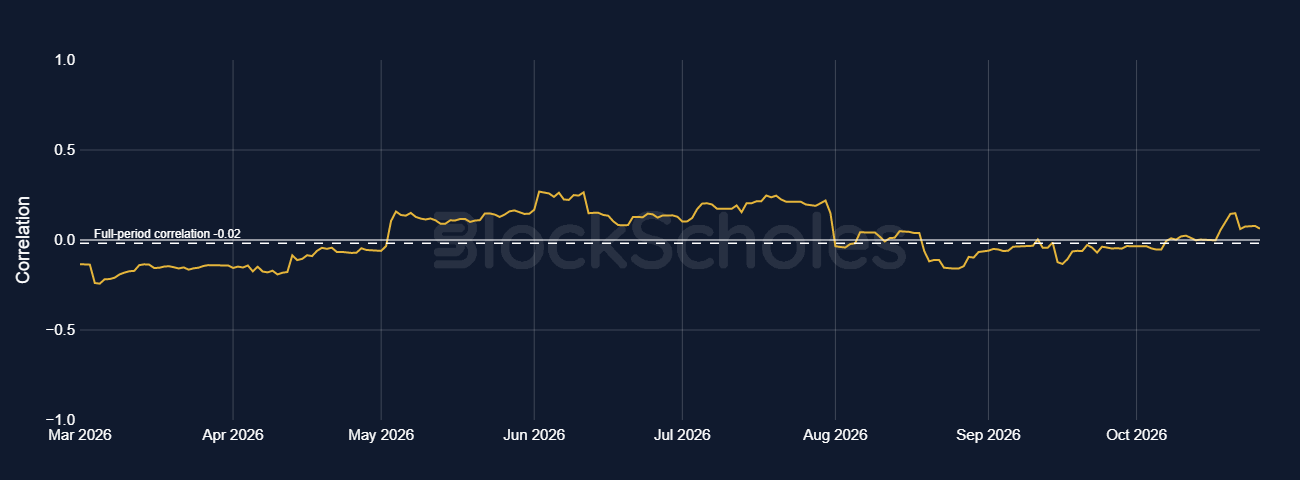
Figure 2. Rolling 60-day correlation between daily changes in Kalshi’s probability of Democratic Senate control and BTC daily returns. Source: Kalshi, Block Scholes.
Even within options markets, the BTC ATM implied volatility term structure as of 26 October 2026 at 09:00 UTC shows only a slight rise around the midterm election date. Forward implied volatility for the 7–14-day window containing the election stands at 37.8%, just 2.8 points above the 14–30-day forward (35.0%) and 0.1 points above the 30–60-day forward (37.7%).
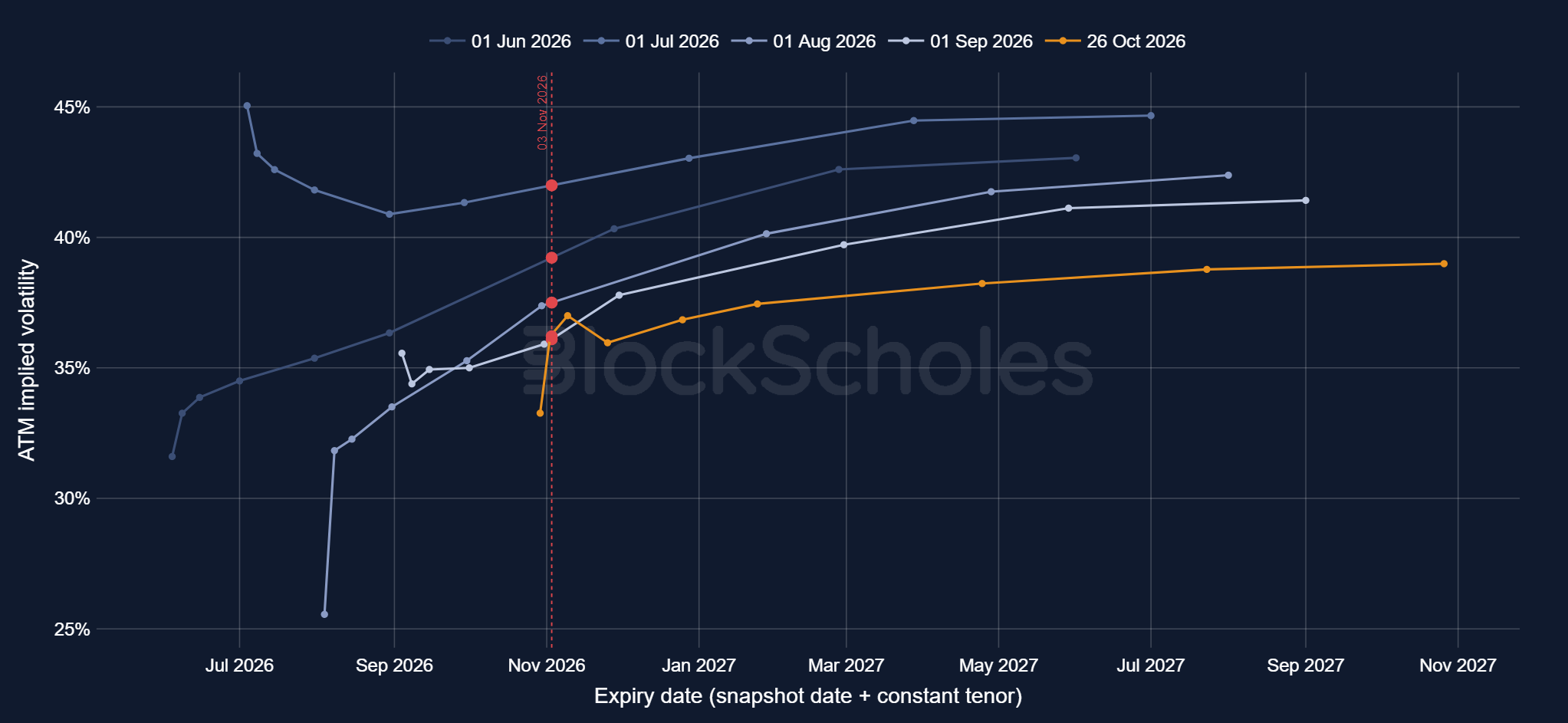
Figure 3. BTC at-the-money implied volatility term structure leading into the 2026 midterm elections. Source: Deribit, Block Scholes.
This contrasts with the 2024 presidential election, when BTC options showed a distinct event premium around the November vote several months in advance, with implied volatility elevated for expiries spanning the election. At the equivalent point eight days before the election, 28 October 2024, forward implied volatility for the election window had reached 62.7%, standing 14.4 points above the 14–30-day forward (48.3%) and 10.8 points above the 30–60-day forward (51.9%). This suggests a substantially smaller election-specific volatility premium in 2026 compared with 2024.
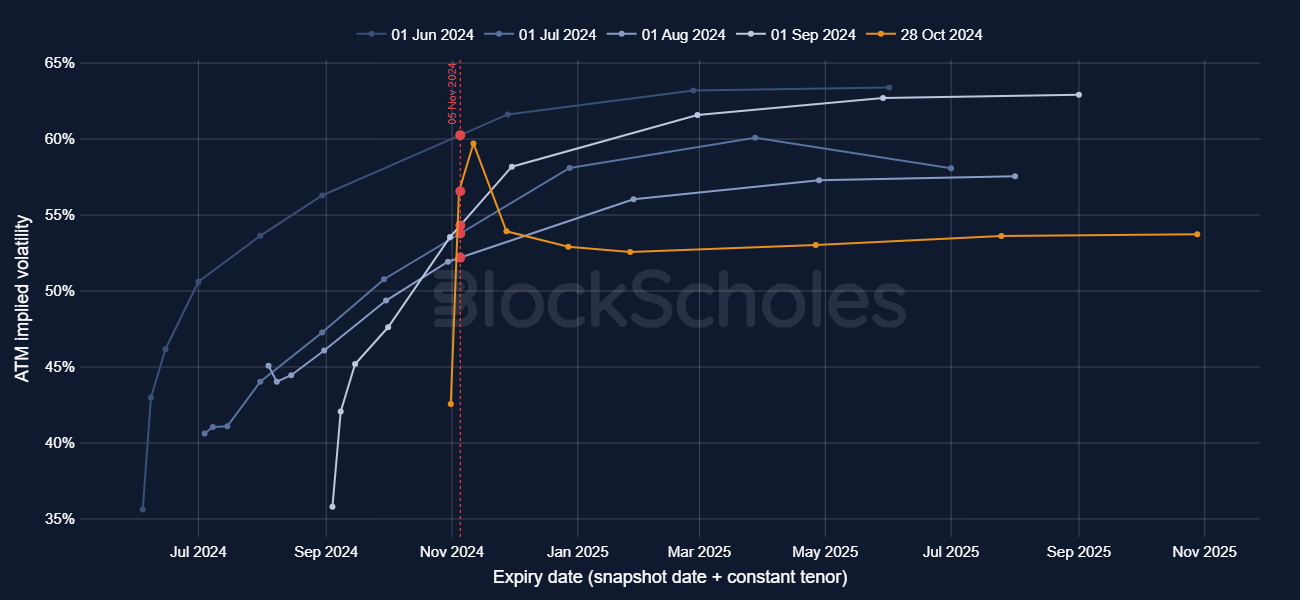
Figure 4. BTC at-the-money implied volatility term structure leading into the 2024 presidential election. Source: Deribit, Block Scholes.
With Kalshi pricing Democratic control of the Senate at 63.5% as of 26 October, a change in congressional leadership could alter the path of crypto legislation. The majority party appoints committee chairs, including the Senate Banking Committee chair, while the majority leader controls the floor schedule. Democratic control would therefore shift authority over which crypto bills advance, when they reach a vote and which provisions are prioritised during negotiations. However, crypto legislation has previously attracted bipartisan support, even under Democratic opposition to parts of the Republican regulatory agenda.
Under Republican control of Congress and the presidency since January 2025, the GENIUS Act demonstrated the need for Democratic support and the role of negotiations in passing crypto legislation. The GENIUS Act initially failed a Senate cloture vote on 8 May 2025 after Democrats withdrew support, citing concerns over political officials' crypto business interests. Following revisions, it passed the Senate 68–30 on 17 June and the House 308–122 on 17 July, before being signed into law on 18 July.
With 53 Senate seats currently held by Republicans, cloture, the vote to end debate on a bill, has required at least seven Democratic votes to reach the 60-vote threshold, assuming unanimous Republican support. Final passage, the vote to approve a bill, generally requires only a simple majority of senators voting, meaning more votes in favour than against, provided a quorum of 51 senators is present or presumed to be present.
The CLARITY Act remains the largest outstanding piece of crypto market-structure legislation. Despite advancing through the Senate Banking Committee in May 2026, the CLARITY Act failed to secure cloture on the motion to proceed on 15 September, with a 49–50 vote falling short of the required 60 votes. The bill remains eligible for reconsideration before the current Congress ends.
Prediction markets reflect the market’s limited conviction of near-term passage on 26 October, with Polymarket pricing the CLARITY Act becoming law in 2026 at 3.1% and broader crypto market-structure legislation at 8.9%. The current Congress continues through the post-election period until 3 January 2027, leaving a remaining window to advance legislation before unfinished bills expire.
A Democratic majority from January 2027 would give the party greater control over crypto legislation, including the ability to negotiate changes to existing proposals. If the CLARITY Act remains unenacted, it would need to be reintroduced in the new Congress, with Democrats having greater influence over its terms. Democratic control could therefore shift negotiations towards tighter ethics provisions, changes to DeFi oversight, and revisions to the division of regulatory authority between the SEC and CFTC.
Given BTC's correlation with US equity indices, we can use the S&P 500's longer history as an indication of how midterms have historically affected risk-on assets. In the latest reading of 2026 so far, BTC's daily correlation with the S&P 500 stands at 0.53, with a beta of 1.70, as of 23 October. Across the last eight midterms, the S&P 500 averaged a 14.3% return in the year following the six elections in which Republicans won the House, compared with 9.8% following the two Democratic wins. With positive one-year returns following all eight midterms, historical equity performance shows no clear relationship between subsequent equity returns and which party controlled the House or whether control changed hands over these horizons.
BTC's shorter history also shows a similar picture, its one-year returns exceeded those of the S&P 500 following all three recent midterms: +25.6% versus +4.2% in 2014, +44.4% versus +12.7% in 2018, and +78.1% versus +14.2% in 2022, respectively.
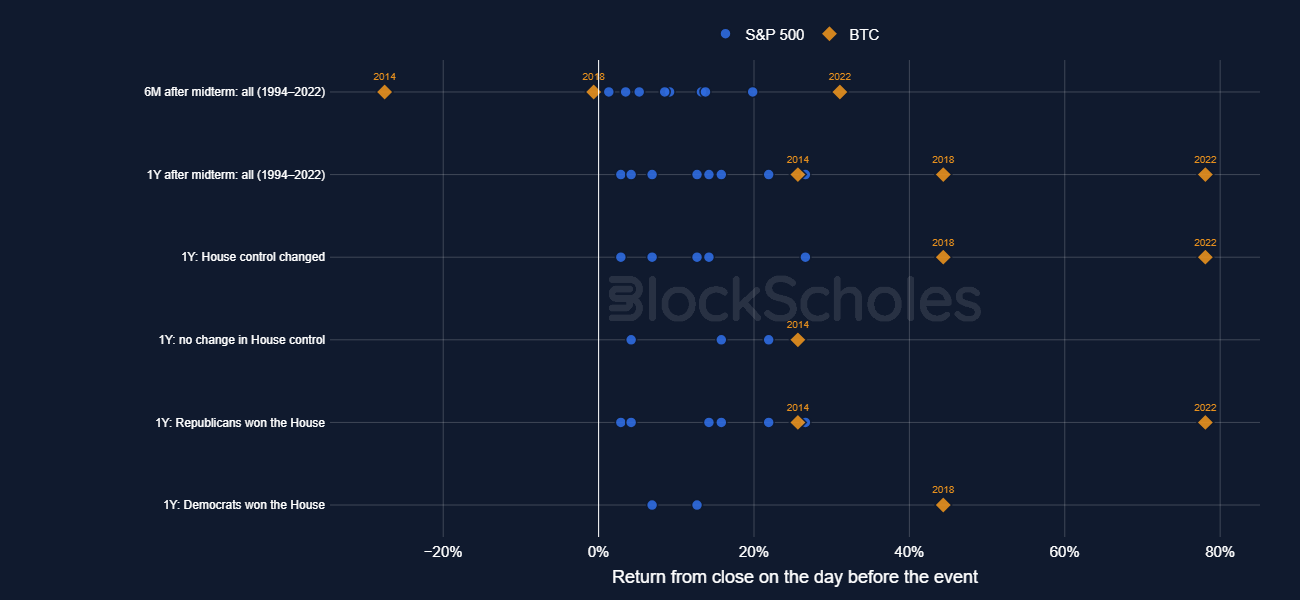
Figure 5. S&P 500 and BTC returns after midterm elections since 1994, by House outcome. Source: Yahoo Finance, Block Scholes.
However, to understand the relationship between BTC and midterms, we must first understand it in the context of crypto’s own “four-year cycle”.
These post-midterm returns also coincide with BTC's four-year cycle, which has historically shaped its price movements. Each midterm since 2014 has fallen 23–30 months after the preceding BTC halving, with the 2014, 2018 and 2022 elections occurring 71, 39 and 13 days before their respective cyclical lows, followed by price recoveries over the subsequent year. This overlap makes it difficult to separate the impact of the elections from the 4 year cycle or other market events such as in 2022, when the FTX collapse coincided with the midterm period.
In the current cycle, BTC peaked on 6 October 2025, 534 days after the halving, compared with 525 and 547 days in the previous two cycles, and BTC subsequently fell 53% from its October 2025 peak to its lowest recorded price so far this cycle, as of 26 October, on 30 June 2026, 126 days before the upcoming midterms. This differs from the previous three cycles, when BTC fell 83% to its December 2018 low 39 days after the election, 77% to its November 2022 low 13 days after the election and 85% to its January 2015 low, 71 days after the election.
The current cycle has therefore seen a smaller peak-to-trough drawdown and an earlier low relative to the election. However, as covered in previous reports, BTC has diverged from its historical cycle, with macroeconomic conditions playing a greater role in price movements.
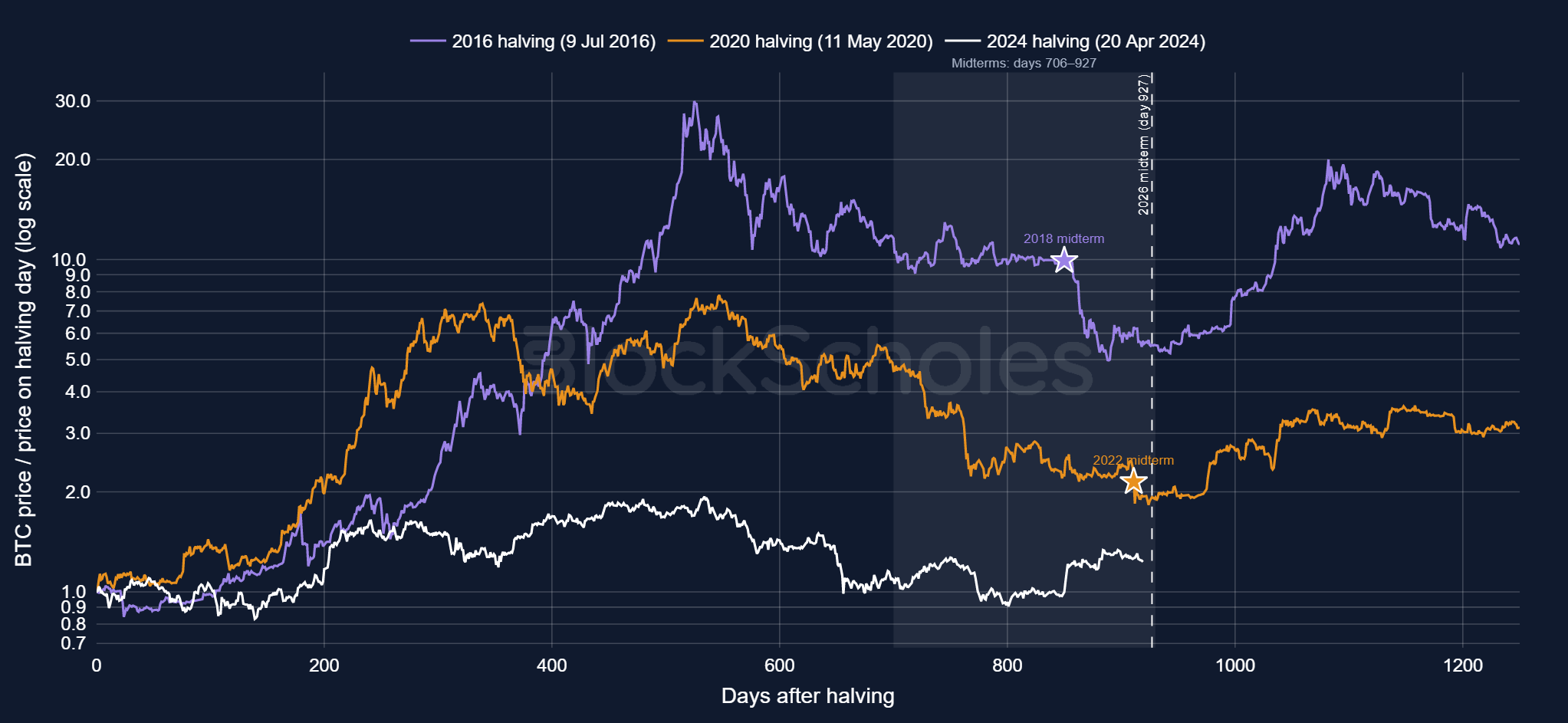
Figure 6. BTC price relative to the halving-day price after the 2016, 2020 and 2024 halvings, with each midterm marked. Source: Yahoo Finance, Block Scholes.
The 2026 midterms also coincide with the evolving rate cycle, which has been a more direct driver of BTC and broader equity markets. The election falls between the 28 October and 9 December FOMC meetings, for which Polymarket implies a 25bps hike probability of 5.5% and 75.5% respectively, as of 26 October.
Either way, given that The FOMC has already raised rates once in 2026, by 25bp on 16 September, Polymarket prices exactly one further hike in 2026, at either the October or the December meeting, at 73.0%. It prices no further hike in 2026 (one hike in total) at 22.5% and hikes at both remaining meetings (three in total) at 4.5%, as of 26 October.
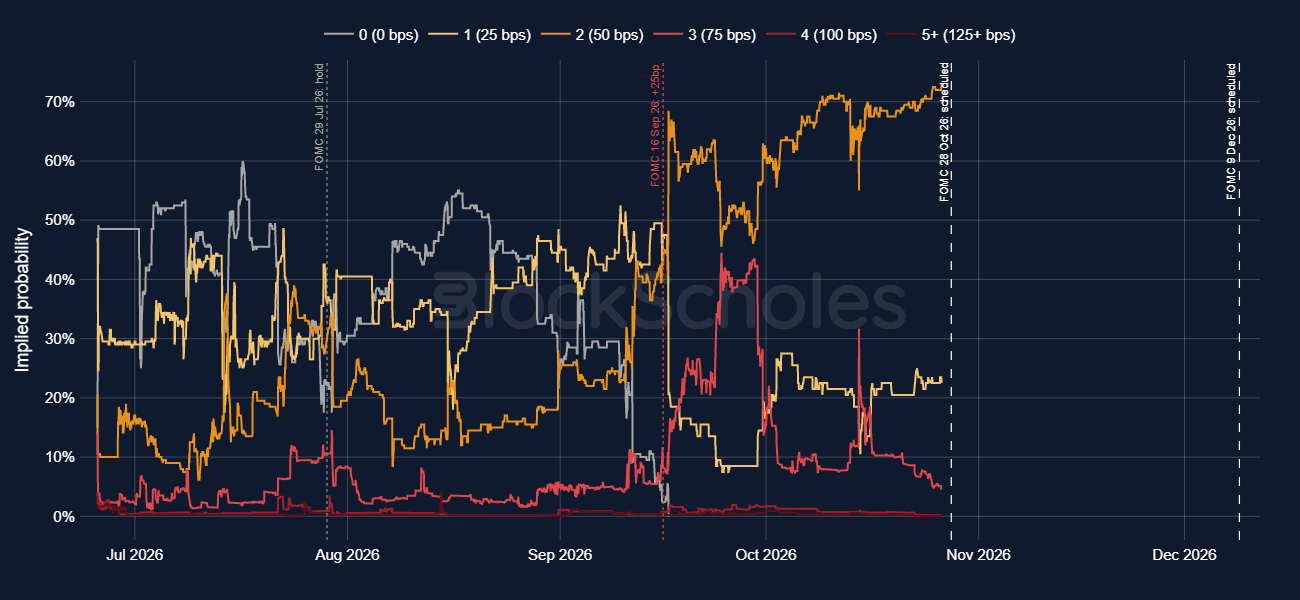
Figure 7. Polymarket implied probabilities for the number of Fed rate hikes in 2026. Source: Polymarket, Block Scholes.
Although market-implied probabilities point towards further rate hikes, it cannot be confirmed that September is the start of a sustained tightening cycle. Across five completed hiking cycles since 1994, the S&P 500 fell in the first month following the initial hike in four cases but rose over the subsequent year in four. In the previous hiking cycle, beginning in 2022, BTC returned +0.1% after one month and -32.4% after one year.
Following the most recent 2026 hike, BTC gained 5.1% between the 16 September 2026 hike and 26 October, while the S&P 500 has risen 0.5% from 15 September to 23 October. One difference may be the expected scale of tightening. The 2022 cycle delivered 525bp of hikes, while the futures curve on 23 October 2026 implies approximately 93bp for the current cycle.
The September hike also followed 175bp of easing since 2024, rather than the near-zero rates that preceded tightening in 2022.
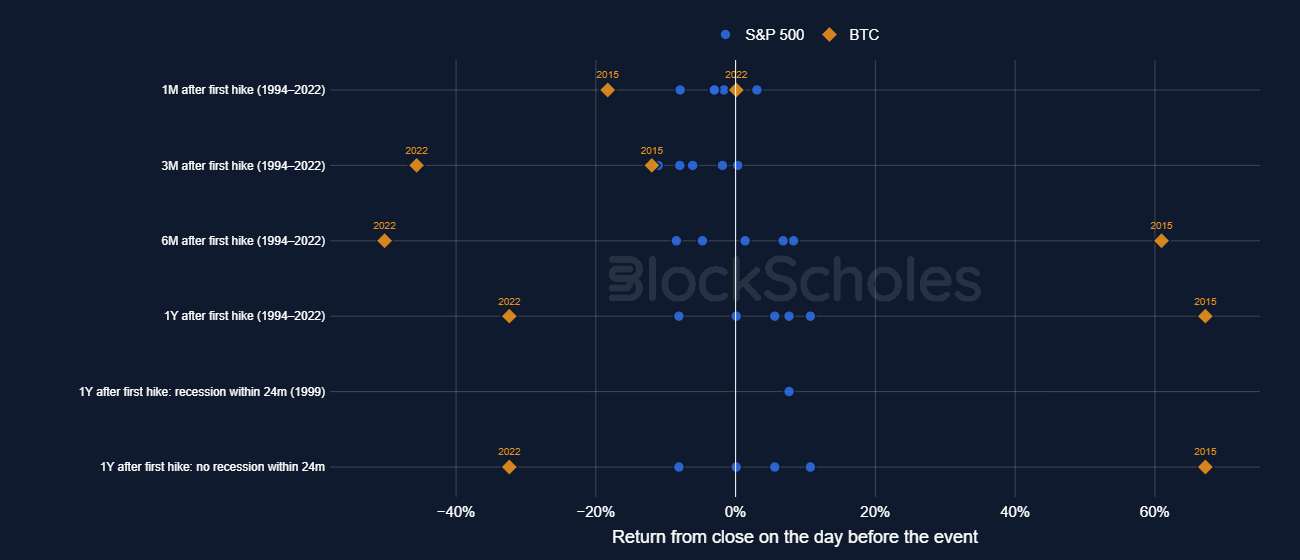
Figure 8. S&P 500 and BTC returns after the first rate hike of each Fed hiking cycle since 1994, by horizon and recession outcome. Source: Yahoo Finance, FRED, Block Scholes.
In the month following the 50bp cut on 18 September 2024, BTC rose 14.5% and the S&P 500 gained 4.1%, compared with respective gains of 7.6% and 1.0% following the 25bp hike on 16 September 2026. However, the 2024 presidential election, which coincided with the second 25bp cut two days later, played a major role in driving returns. BTC rose 46.1% and the S&P 500 gained 6.3% over the subsequent 30 days, exceeding their respective returns following the initial cut.
This larger move was anticipated by the elevated election-specific volatility premium observed in BTC options ahead of the presidential vote. More broadly, across 40 rate cuts and 52 hikes since 1994, the S&P 500 has averaged a 0.2% return one month after either decision, suggesting that the direction of the initial policy move alone has not consistently determined near-term equity performance.
The upcoming midterms present a similar macroeconomic and political backdrop to 2024, but while the 2024 presidential election coincided with the beginning of an easing cycle, the 2026 midterms follow the first hike after 175bp of cumulative easing. Markets are pricing a hold at the 28 October meeting and a 75.5% probability of another hike in December. Eight days before the 2024 election, forward implied volatility for the election window stood 10.8 points above the 30–60-day level, compared with just 0.1 points ahead of the 2026 midterms. The smaller election-specific volatility premium suggests a more limited market reaction to the midterms than to the 2024 presidential election and subsequent rate cut.
Historical returns following midterms have been positive for both equities and BTC, with the S&P 500 rising in the year following all eight elections since 1994 and BTC outperforming the index following each of the last three. However, these returns also overlap with recoveries in BTC's four-year cycle, making it difficult to attribute subsequent gains directly to the elections. The current cycle has already differed from previous ones, with BTC recording a smaller 53% drawdown and reaching its lowest price so far 126 days before the midterms.
Meanwhile, the negligible correlation between BTC returns and changing Senate election probabilities, together with the limited election premium in options markets, suggests that the upcoming vote is not currently being priced as a major catalyst for BTC. The more direct impact of the election is likely to be through its implications for crypto legislation, particularly the CLARITY Act, although Polymarket assigns just a 3.1% probability of its passage in 2026. Given the differences in the macro backdrop, the midterms are unlikely to produce a move comparable to November 2024 unless the result materially differs from expectations.
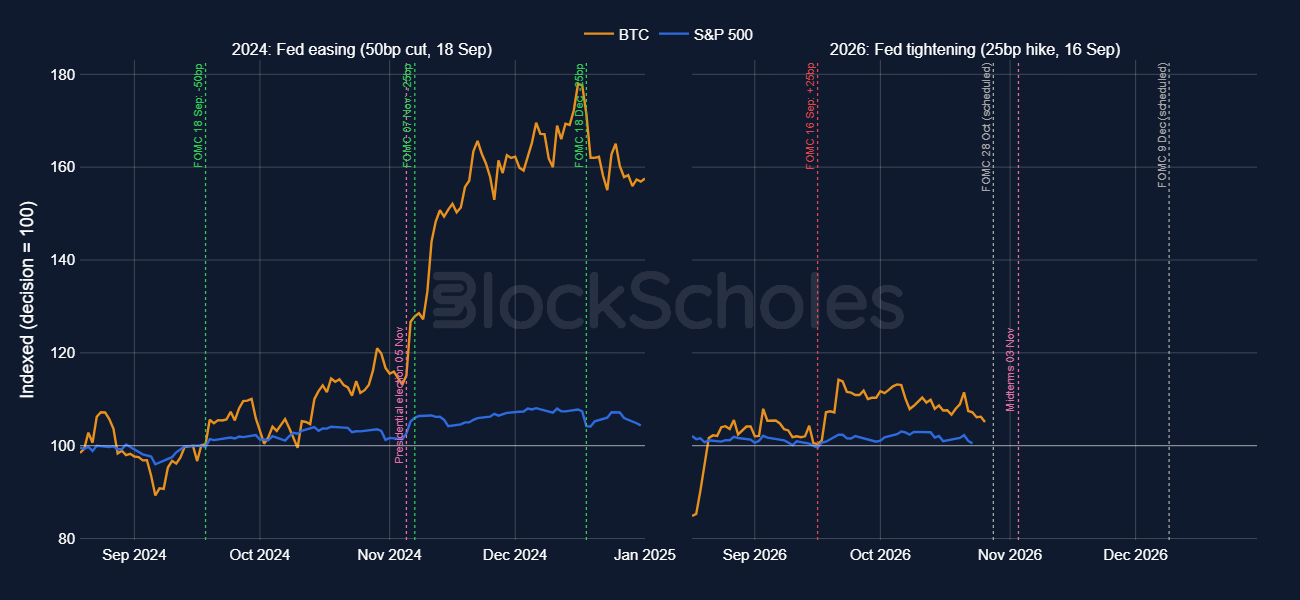
Figure 9. S&P 500 and BTC, indexed to 100 at the decision, from 30 days before to 105 days after the 18 September 2024 50bp cut and the 16 September 2026 25bp hike. Source: Yahoo Finance, Block Scholes