
Thahbib Rahman
Research Analyst
Bitget’s Cross-Asset Unified Account (UTA) allows 370+ eligible assets, including 125 tokenised US stocks, to act as margin rather than sit idle. We model a representative $1M multi-asset portfolio of tokenised equities and crypto perpetual swaps and find it requires ~$165K less USDT margin, roughly half the capital otherwise required. But the efficiency depends on the type of collateral, not just how much of it there is: collateral that moves in line with the positions it backs brings the liquidation point six percentage points closer than holding USDT. We also map liquidation risk by collateral volatility and correlation, and explore the UTA’s use cases beyond margining.

Disclaimer: Bitget operates across multiple jurisdictions, each with its own regulatory requirements. The availability of Bitget products and services varies by jurisdiction and is subject to applicable laws and local regulations. Any discussion of Bitget's products, services or institutional offering is for general informational purposes only and should not be construed as an offer, solicitation or financial advice. Bitget is not licensed or regulated by the Monetary Authority of Singapore. Singapore is a restricted jurisdiction under Bitget's Terms of Use, and Bitget does not make its services available to, solicit or target persons in Singapore.
This report was commissioned by Bitget. Block Scholes retained full editorial independence over its data, analysis and conclusions.
Bitget, serving over 125 million users worldwide, positions itself as the world’s largest Universal Exchange (UEX) – designed to optimise on the characteristics that made both centralised and decentralised exchanges so popular by providing the best user experience of both worlds.
The UEX experience also provides traders with broad access to a plethora of different assets, beyond the classical universe of crypto-native tokens. Bitget’s UEX allows users to trade over 2M cryptocurrencies and a rapidly growing sector of real-world assets (RWAs), including tokenised stocks, ETFs, commodities, precious metals and foreign exchange, all from a single account.
For most of its history, the crypto industry has operated as a closed system, growing to a peak of over $4T through crypto-native tokens and applications. Since 2024, the growth of tokenisation has begun to change that underlying composition: traditional (or “real-world”) assets are a $100T+ addressable market and exchanges and institutions alike are continuously pushing towards tokenisation. While Bitget’s UEX already allows users to trade TradFi assets around the clock, traders now expect more.
The next stage of tokenisation therefore focuses on utility – going beyond simply enabling multi-asset trading to focus on capital-efficient multi-asset trading. As such, in July 2026, Bitget launched the Cross-Asset Unified Account (UTA), the next phase of its UEX product.
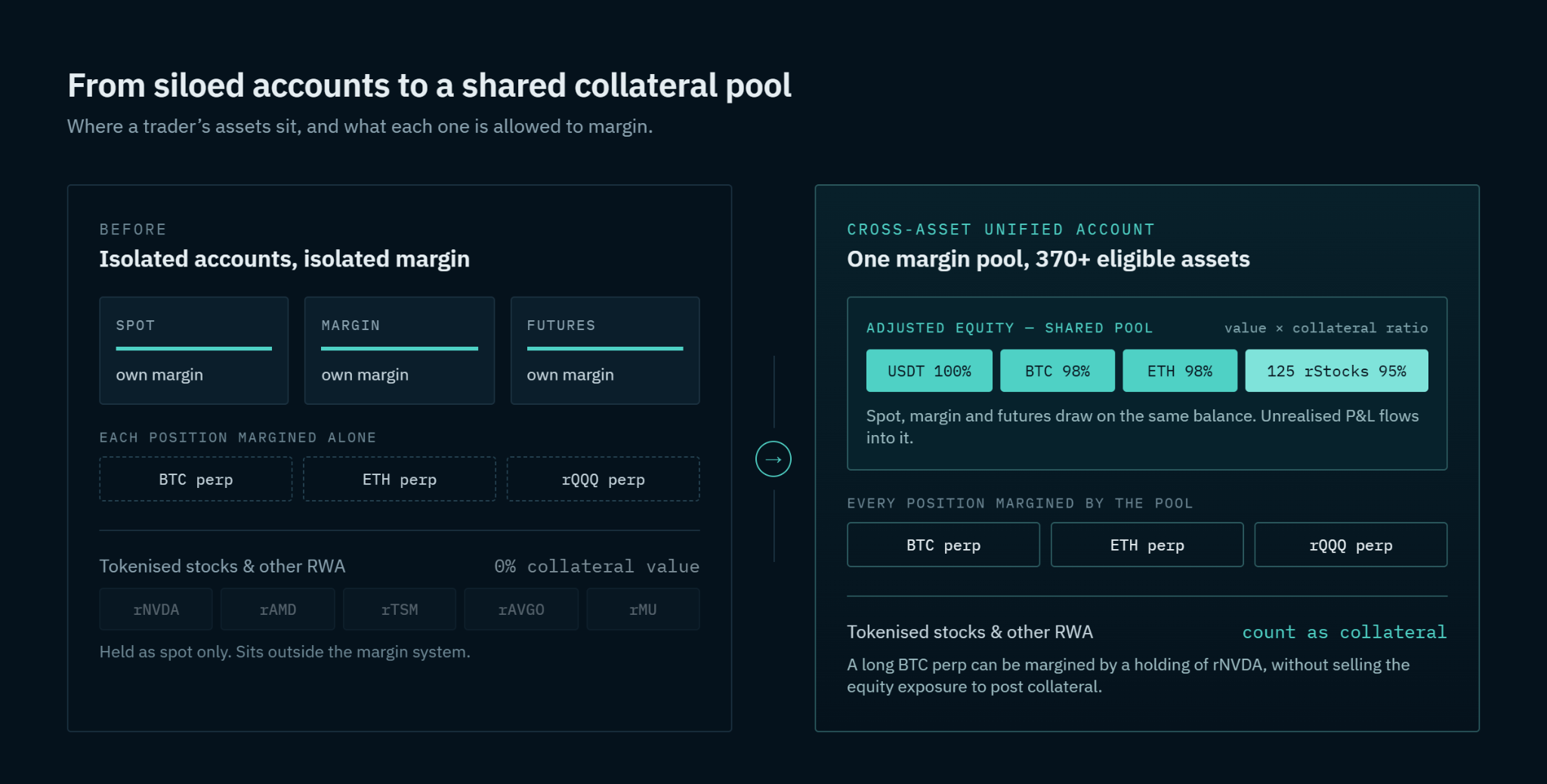
Figure 1: The transition from generation 1 of Bitget’s Cross-Asset Unified Account to generation 3. Sources: Bitget, Block Scholes
UTA is Bitget’s advancement towards further utility by integrating tokenised US equities into the same capital framework that is used for crypto trading. This means that beyond just stablecoins or crypto-assets being used as collateral to margin positions on Bitget, RWA assets can be used as collateral to margin trader positions, with different assets contributing different levels of margin.
The account type brings together more than 370 eligible assets, including 125 US rStocks into a single, unified margin pool that can be used to improve capital efficiency when trading. The initial phase of the Cross-Asset Unified Account supports most major US equities (in tokenised form), including Apple (rAAPL), Amazon (rAMZN), Google (rGOOGL), Nvidia (rNVDA), the Nasdaq-100 ETF (rQQQ) and more.
The macroeconomic backdrop over the past few months has provided an illustrative case study for understanding and visualising the capital efficiency unlock that Bitget's third evolution of the Cross-Asset Unified Account can provide over its previous generations.
In August, markets repriced their expectations for a Federal Reserve rate hike after Chair Kevin Warsh's keynote Jackson Hole speech while the US switched from a military campaign against Iran to a measure of maximum economic pressure. AI-heavyweights and semiconductor firms struggled to recover from their sharp June-July sell-off and, most importantly for crypto, the rise in US long-dated yields to multi-decade highs preceded an expansion of US Treasury buybacks, after which BTC repriced sharply higher to around $80K.
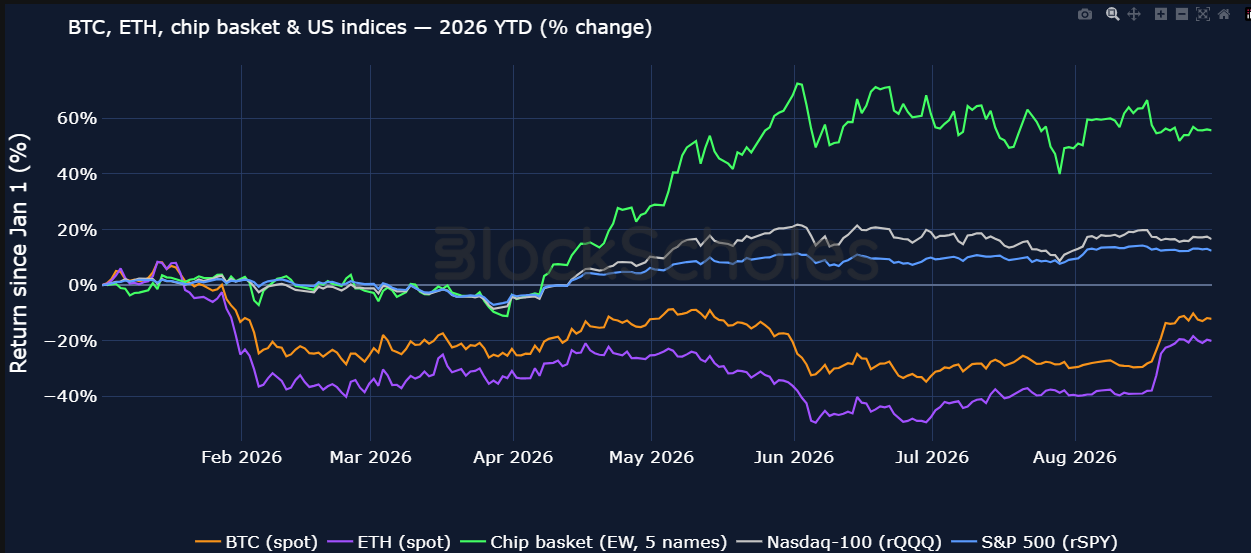
Figure 2: Percentage returns of constituent assets in the simulated portfolio, year-to-date. Chip basket is equal weighted. Sources: Bitget, Block Scholes
We simulate a hypothetical institutional book consisting of both RWAs and crypto assets that were impacted by those changeable macro conditions. We use that portfolio to quantify just how much of a reduction in necessary capital an institutional trader would benefit from in margining such a portfolio through a Cross-Asset Unified Account.
The portfolio is designed as a $1M multi-asset book with an AI chip / Nasdaq-100 relative-value sleeve and a long crypto bias. A long position is held across five large AI-related tokenised stocks ($175K total):
and a short position is held in a Nasdaq-100 ETF perp ($115K) at 5x leverage. The portfolio also has a long crypto bias, consisting of BTC and ETH perp positions sized $410K and $300K respectively, taken with 5x leverage.
This simulated portfolio generated returns of 17% over the month of August on the gross $1M notional position size, mostly due to the rally in BTC and ETH spot price, while the individual chipmakers returned a small profit which was balanced out by a small loss in the Nasdaq-100 ETF short position.
In the first generation of UTAs, margin for this portfolio was separated along two axes:
In addition, spot, margin and futures sat in separate wallets entirely. The net effect was a fragmented distribution of capital, with minimal utilisation of assets. Under generation 1 of the margining engine, our hypothetical institutional trader would be required to pay:
That gives a total upfront initial-margin cost of $165K on top of the $175K for the spot positions.
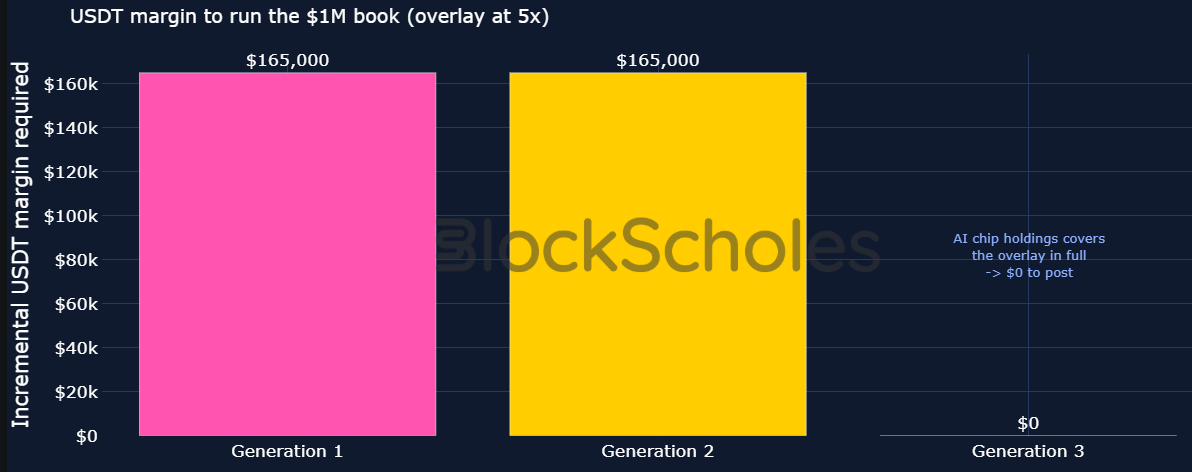
Figure 3: Comparison between margin requirements across three generations of Bitget’s Unified Account model. Sources: Bitget, Block Scholes
Under the second generation, all crypto-native assets held in a trader's account were unified and merged into a single margin pool. This meant that one pool consisting of several assets could act as collateral for multiple different positions. While this still required the same amount of collateral as generation 1, the difference is that the same $165K sat in one shared pool backing all three legs of the portfolio at once. An unrealised profit on the short Nasdaq-100 ETF leg could offset losses on the long BTC and ETH legs, making the same capital more robust and efficient.
The latest generation (Cross-Asset Unified Account), extends that framework beyond cryptocurrencies, bringing tokenised US stocks and other real-world assets into the same unified margin system. In this case, the tokenised stock holdings of Nvidia, Micron Technology and other chipmakers are given the same status and utility as cryptocurrency holdings and are allowed to enter the same pool as potential collateral.
This means that the long positions in the AI-chip stocks can be used to collateralise the perpetual futures positions. Based on a 95% discount rate (defined as the fraction of an asset's market value that the UTA considers towards its adjusted equity: the sum of each asset's market value multiplied by its discount rate, with unrealised profit and loss netted against the same figure in real time), the $175K tokenised-stock holdings contribute $166K of collateral which fully covers the $165K requirement for the perp positions. Therefore the trader need not post any extra USDT.
As mentioned, this portfolio performed well in the month of August. However, with generation 3 of the UTA, the trader is able to deploy less capital to open the portfolio, increasing their returns. Under generations 1 and 2, the trader would have committed roughly $340K to run the book: the $175K spent on the spot chip basket, plus the $165K of margin that must be posted separately in USDT. Under generation 3, the only capital committed is the $175K spent on the stocks the trader wanted to hold anyway as part of the portfolio, $165K less committed capital – 16.5% of notional, or roughly half the capital otherwise required.
The three phases of evolution in the Cross-Asset Unified Account type have therefore been aimed at solving key problems faced by crypto traders:
The rStocks eligible in Cross-Asset Unified Account are from Bitget's June rollout of Stocks 2.0, an upgraded tokenised stock spot product issued by Reality. Each rStock is designed to track the price of the corresponding underlying security, but one of the main differences to other providers of tokenised equities is that with Reality, eligible cash dividends are distributed directly as USDT to the holder, instead of being reinvested back into the token holding.
In our hypothetical portfolio, we applied a 95% 'discount rate' to the AI stock holdings.
Stablecoins are used as the benchmark: a dollar of USDT or USDC counts as a full dollar of collateral (with a discount rate of 100%), while every other asset is discounted. This is because the exchange has to allow for the collateral itself losing value in the time it would take to liquidate it should a position move against the trader. There are two factors that determine the size of that discount. The first is the asset itself – the more liquid and less volatile an asset is, the higher value it can contribute to the portfolio's collateral.
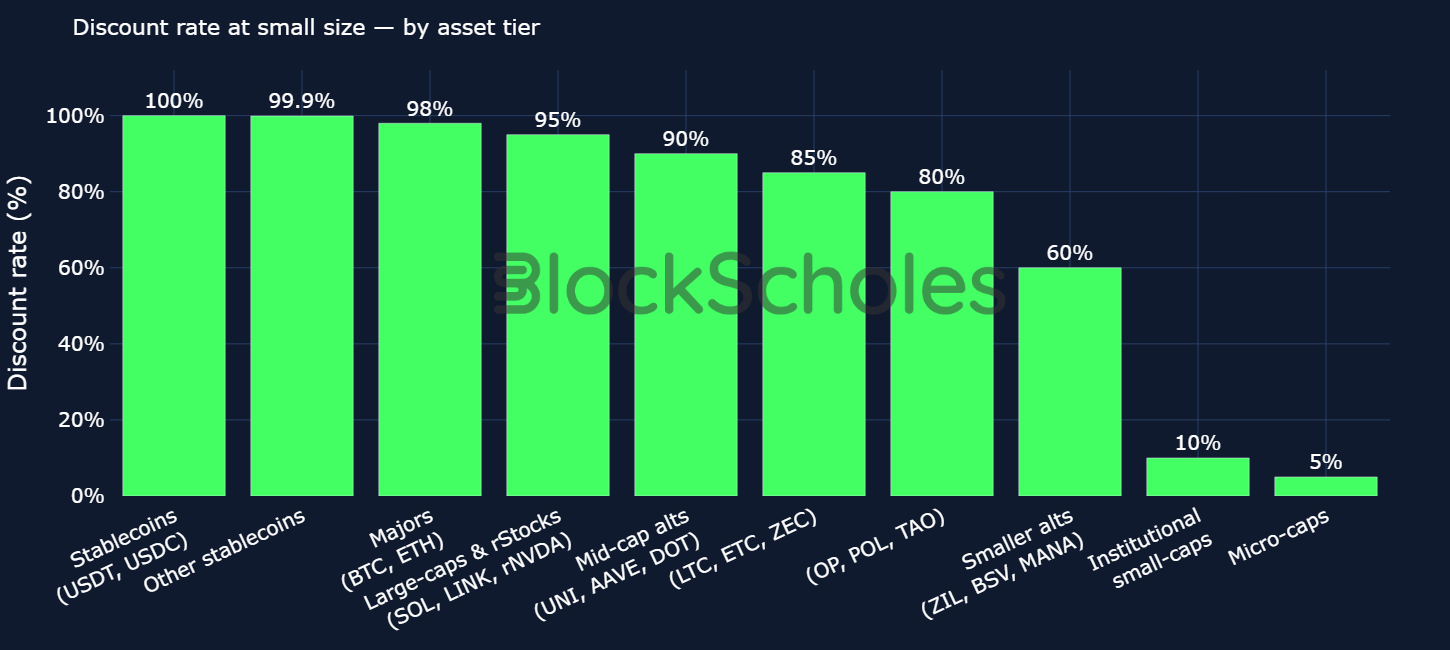
Figure 4: Discount rate applied to each asset class at small position size, grouped by tier from cash down to micro-caps. Rates are taken per-coin from Bitget's public discount-rate endpoint (https://api.bitget.com/api/v3/market/discount-rate) and shown with representative example tokens. Sources: Bitget, Block Scholes
The two largest US-dollar stablecoins by market-cap contribute 100% of their value as margin, while the ratio is 98% for holdings of BTC and ETH. Bitget's stablecoin BGUSD has a ratio of 98% also, while the discount rate for holdings of other smaller-cap stablecoins (such as USDe, PYUSD) is 95%. Large-cap altcoins and blue-chip large market-cap US stocks have a ratio of 95%. Growth stocks also have a similar 95% ratio. This then declines to 90% for mid-cap altcoins such as UNI and AAVE and to a lower 80% for smaller-cap tokens such as OP and POL.
Despite crypto assets typically having a higher volatility than traditional US stocks, BTC and ETH for example are discounted less than large-cap equities partly due to liquidity and trading-hours availability. BTC collateral can be liquidated if a position moves against a trader around the clock with limited price impact as BTC has a deeper, more liquid market than tokenised assets. However, tokenised stocks are less liquid outside Traditional Finance hours when the off-chain asset isn’t trading, contributing to their lower contribution to collateral equity.
This doesn’t mean however that such collateral cannot be liquidated when US markets are closed. Since tokenised stocks trade continuously on Bitget (including during weekends and market holidays) a position that must be closed while the underlying share is not trading off-chain can still be liquidated against the prevailing mark price. However, the depth of the tokenised market may be thinner during hours when the traditional asset isn’t trading which may result in the collateral being sold at a worse level than during more liquid hours.
The second factor is position size. Despite an asset such as rMSFT, or Microsoft Corp, belonging in the 95% discount ratio tier, that ratio tiers down as the size of the position / holding grows. This is essentially a concentration haircut, reflecting the market impact of having to unwind a large position at once.
For USDT and USDC, the ratio remains 100% at every position size. For majors BTC and ETH the ratio decays slowly with position size:
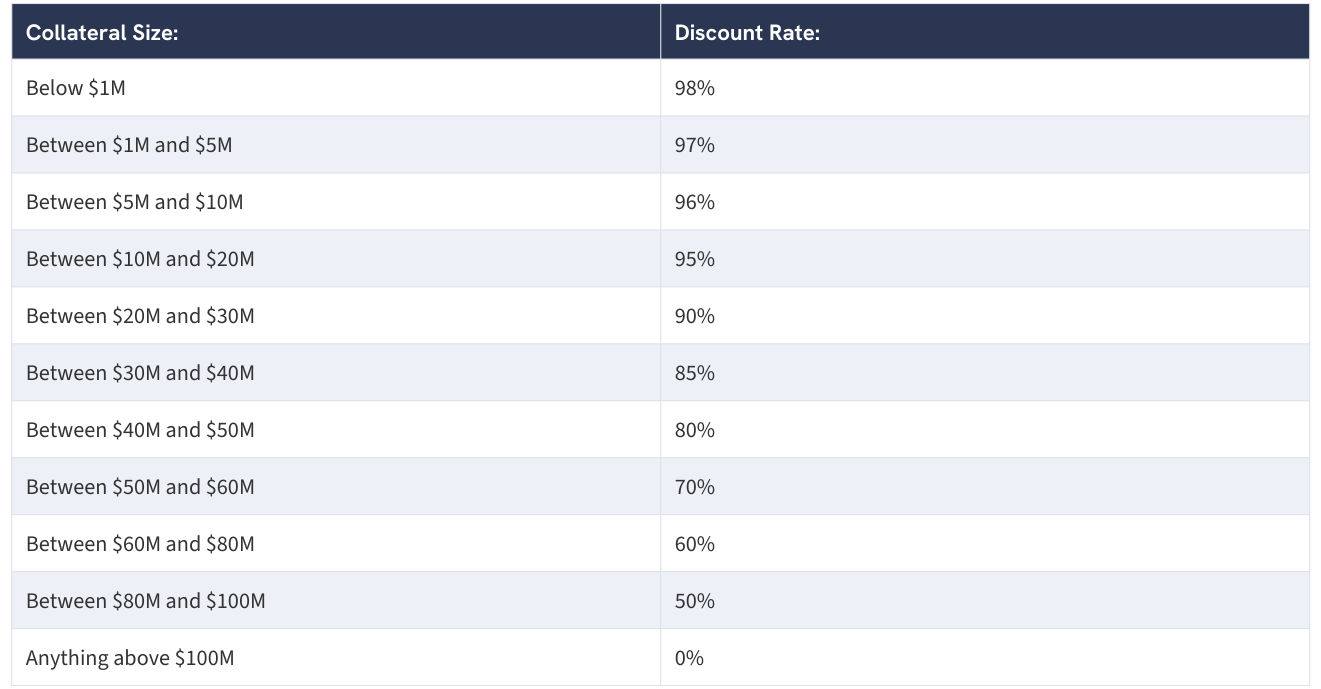
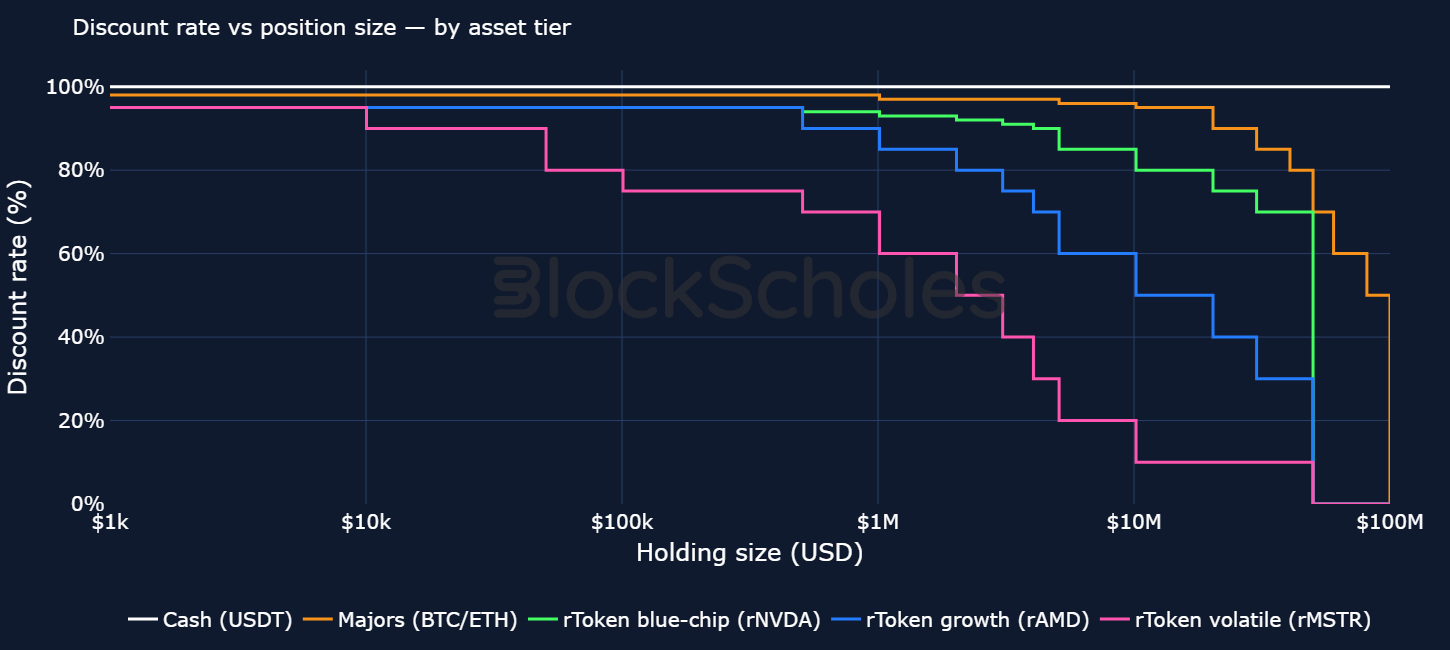
Figure 5: Discount rates for different assets based on holdings size. Sources: Bitget, Block Scholes
The ratio for a large-cap tokenised stock such as rNVDA decays at a faster rate, holding its 95% ratio up to roughly $500K before stepping down gradually. Very volatile tokenised stocks, such as rMSTR, representative of shares of Strategy Inc., have the fastest decay.
In our hypothetical portfolio, given the size of each position in the five tokenised stocks and given that they belong in a higher tier of asset class, the discount rate comes to 95%, meaning the $175K position can provide collateral worth 95% of its value (~$166K).
The unified account allows a wider asset set as collateral, with holdings that previously sat idle in a spot balance deployed to margin other positions (at their published discount rate) in a single collateral pool that backs the entire portfolio. Native equity exposure can be retained and used as margin for a crypto position simultaneously, with no initial liquidation, conversion cost, or loss of exposure incurred.
That efficiency does come with a notable caveat that traders should be aware of. Our previous simulated portfolio was sized such that the collateral just about meets the initial-margin requirements, meaning the trader is not required to post anything at the outset of the position.
However, this also means the account begins with very little spare equity above the initial margin required to open the positions (despite remaining well above the ~$8K maintenance margin threshold required to keep the positions open). As we explain in more detail in the next section, the correlation between the collateral and the positions it backs governs how quickly that margin buffer can disappear.
At open, the book's adjusted equity is roughly $166K. This is well above the maintenance margin (the level at which the account is liquidated), which is estimated to be around $8,150 for this portfolio. That is calculated as the sum, across the three perpetual legs, of each position's notional multiplied by its maintenance-margin rate from Bitget's contract specifications: 4% on the $115K short Nasdaq-100 leg ($4,600), and 0.5% on each of the $410K BTC and $300K ETH legs ($2,050 and $1,500). The equity is therefore well above the maintenance level, though only slightly higher than the initial-margin (the margin required to open the positions in the first place).
The underlying portfolio is long crypto assets and long AI-chip stocks, both risk-on assets, that, as we show in the next section, tend to fall together in a broad risk-off environment. In this case, the collateral is marked down at the very moment the positions are both losing, and the account's equity is squeezed from both sides at once.
It is therefore useful to understand what happens to the portfolio’s adjusted equity under two conditions: when the AI-chip basket alone sells off, with the rest of the book left unchanged, and secondly, when there is a broader sell-off across chips and the long BTC and ETH positions too.
Because the AI chip stocks are held as unleveraged collateral rather than as a leveraged position, the effect of a sell-off limited to the AI-chipmaker sector alone is relatively contained: a 10% fall in the AI stock basket takes the book's adjusted equity from $166K to $150K, and a 20% fall to $133K leaves the account well clear of the $8K liquidation level in both cases.
The book's real vulnerability is the correlated case, where the leveraged BTC and ETH legs fall at the same time as the collateral. For example, a broad 10% sell-off across chips, BTC and ETH and the Nasdaq-100 takes the portfolio’s adjusted equity from $166K to $90K (though the short Nasdaq-100 perp leg in the portfolio does partly benefit from this sell-off).
That is, a 10% move in the market almost halves the account's equity – though this is mostly a leverage effect rather than a collateral one: of the roughly $76K fall, $16.6K comes from the chip collateral being marked down, with the rest driven by the leveraged BTC and ETH legs. A 20% sell-off leaves adjusted equity at roughly $14K, close to the level at which the exchange would begin to liquidate – partially closing positions to bring the margin ratio back to a safe level rather than force-closing the entire book outright.
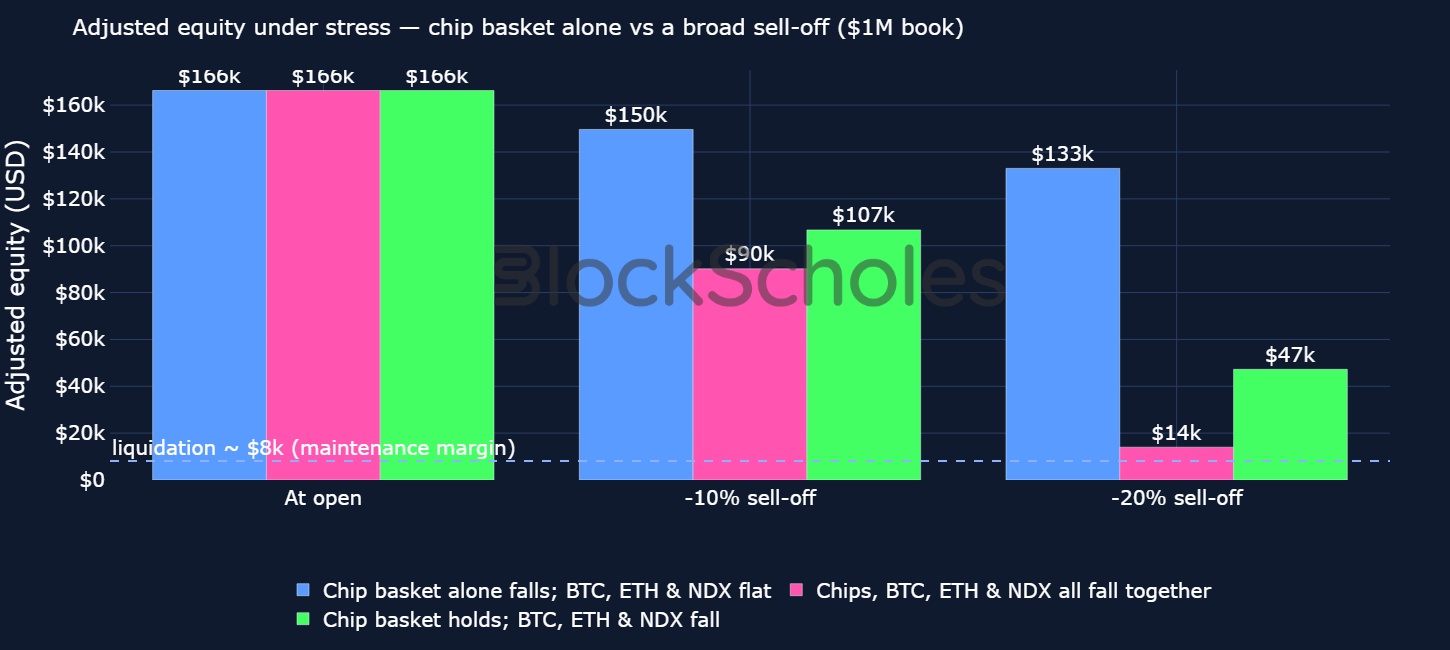
Figure 6: Adjusted equity of the $1M book under stress, for a chip-basket-only sell-off versus a broad sell-off across chips, BTC and ETH, shown at −10% and −20%. The maintenance-margin (liquidation) level sits at ~$8K throughout. Sources: Bitget, Block Scholes
This highlights two points: firstly, the trader should always have a collateral buffer that leaves room in case of an adverse, broad-based market sell-off: on this book, liquidation is reached at around a 21% correlated fall, and roughly $30K of additional USDT collateral would extend that to about 25%.
Secondly, it highlights the importance of the choice of collateral as much as the quantity. With the correlated chip basket as collateral we saw that the portfolio reaches liquidation at a 21% correlated fall. With an equivalent $166K of USDT (the same value as the equity collateral, without the risk of a drawdown) it survives to a 27% correlated sell-off. Correlated collateral therefore brings liquidation roughly six percentage points closer, and it is that gap, rather than the headline fall in equity, that isolates its true cost – a theme we develop in the next section.
As highlighted in S2, the Cross-Asset Unified Account converts a portfolio’s assets to collateral by applying a discount rate (dependent on the collateral asset’s liquidity, volatility, and risk profile) to their market value and summing the result into a single adjusted equity figure. The same valuation of an asset applies to a given asset irrespective of the portfolio that it collateralises.
The portfolio’s margin requirement is computed separately, at position level, against the mark price and the applicable maintenance margin rate. The margin engine allows for offsetting between positions, and between realised and unrealised P&L, within the pool.
As a result, the key measure for a portfolio’s liquidation risk is the buffer between the account’s current margin ratio and the point at which liquidation is triggered. Correlation between assets therefore determines how likely the account is to be liquidated before the trader chooses to close.
Positively correlated collateral can fall at the same time as the position, increasing the pressure on the account. Uncorrelated collateral reduces the likelihood that both will suffer large losses at the same time, while negatively correlated collateral can rise as the position falls, helping to offset some of the loss.
Crypto and equities share exposure to common drivers, including global liquidity conditions, real rates, and aggregate risk appetite, meaning positive correlation between them is the most common state. Each also carries independent drivers, with equities responding to earnings, sector rotation, and company-specific news, while crypto responds to protocol developments, digital asset product flows, and leverage conditions internal to crypto markets. That independence is variable over time, and weakest in broad risk-off events, when the common driver dominates.
As seen in the chart below, since Jan 2022 the 60-day BTC to Nasdaq-100 ETF (QQQ) correlation averaged +0.41, with a minimum of −0.13 and a maximum of +0.75. BTC-QQQ, BTC-SPX, ETH-QQQ and ETH-SPX all followed similar trajectories.
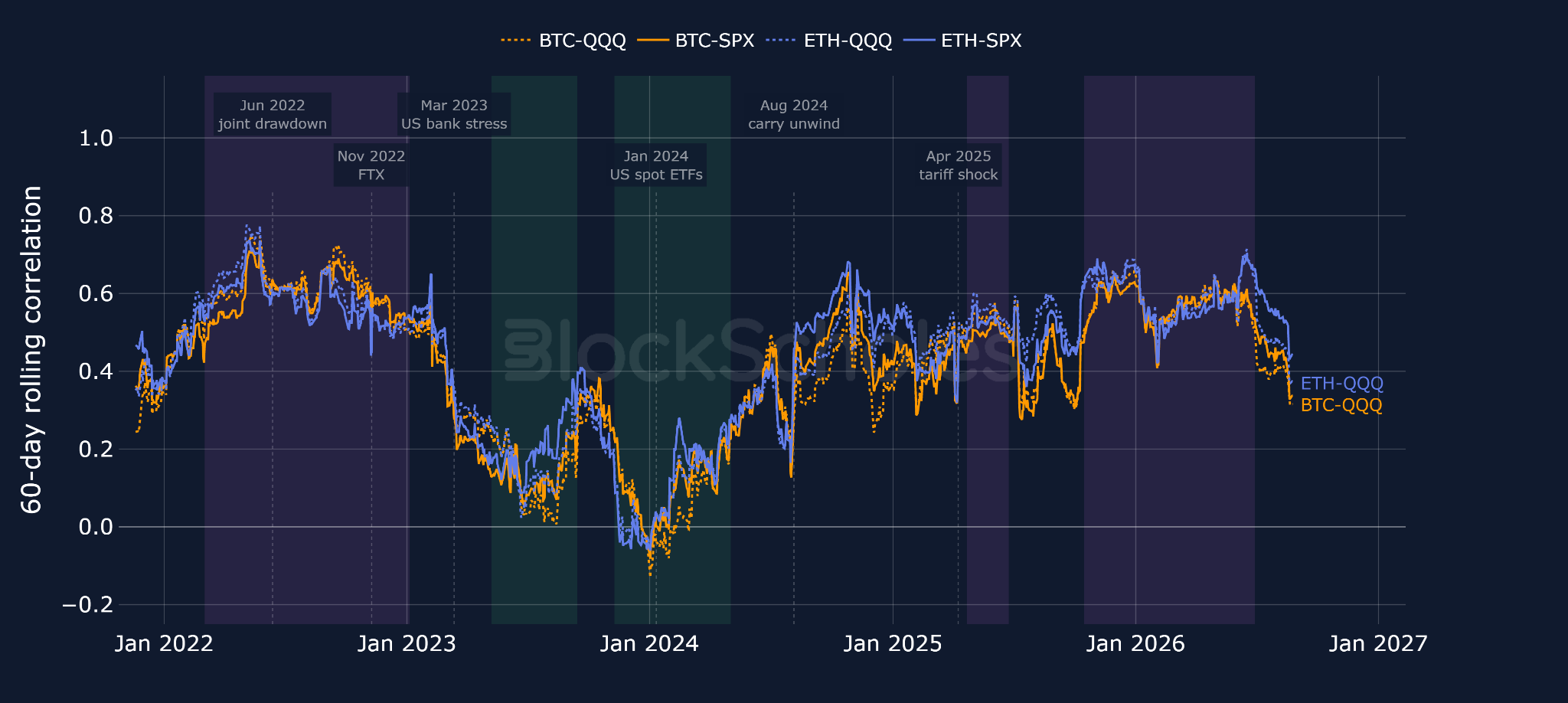
Figure 7: Rolling correlation between BTC (orange) and ETH (purple) against SPX (solid line) and QQQ (dotted line) respectively. Sources: Bloomberg, Block Scholes
Since mid-2024 these assets have traded with a much higher and sustained correlation between equities and crypto. After reaching a low average of +0.07 from November 2023 to May 2024, correlation began to rise as rate-cut expectations restored a common macro driver, with the August 2024 global carry unwind pushing both markets lower at the same time.
Correlation remained elevated through the 2025 tariff shock, averaging +0.53 from April to June, when both equities and crypto reacted strongly to the same macro events. This can be seen clearly below where the convergence of the 60-day correlation range has shifted to entirely positive in 2025 and 2026.
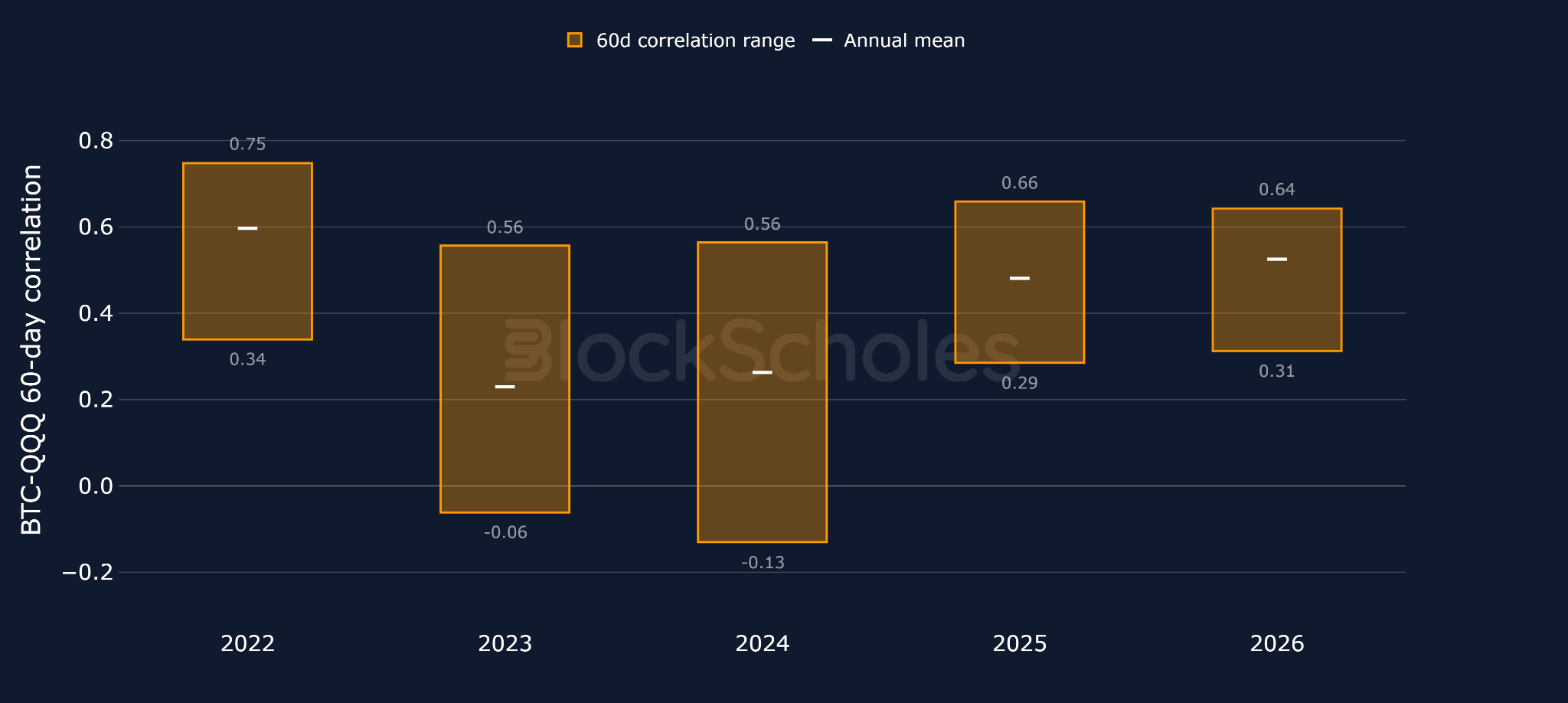
Figure 8: Distribution of rolling 60-day correlation estimate between BTC and the Nasdaq-100 ETF (QQQ). Sources: Bloomberg, Block Scholes
Positively correlated collateral, in which the portfolio’s value moves in line with the value of the collateral, will tend to amplify directional exposure during both market rallies and drawdowns. In contrast, a negatively correlated structure would see a portfolio’s value move in the opposite direction to the value of its collateral in response to market moves. In this case, adverse moves in the position may be partially offset by favourable moves in the collateral base.
The effectiveness of this framework is ultimately dependent on the correlation structure between the portfolio and the underlying collateral.
Bitget’s broader unified collateral framework enables a far more flexible deployment of a trader’s capital across their portfolio. By bringing a wider range of assets into the eligible collateral pool, institutional portfolios such as the one highlighted in Section 2 are able to remain productive while expressing additional positions and strategies. Alongside that flexibility, a cross-asset portfolio margin also reduces the burden of deploying capital solely for margin purposes, the extent of which is dependent on the correlation structure of the portfolio.
The volatility of a portfolio plays a large role in managing collateral requirements – and is a key determinant in the discount rate applied to viable collateral assets. While correlation determines the direction in which collateral may move relative to the portfolio, volatility determines the magnitude of those moves. More volatile collateral is subject to larger price swings, increasing the risk that its value falls sharply during periods of market stress. This matters because when collateral becomes more volatile, a trader will need to hold more collateral to maintain the same protection against liquidation.
The UTA expands the collateral set to include equities and other traditional financial assets, which typically exhibit lower realised volatility than crypto assets. Because these assets tend to experience smaller price swings, the collateral base can remain more stable during market stress, reducing the need for excess margin buffers.
Since January 2022, BTC has traded with a much higher volatility (51% on average) than QQQ (22%). Between April and June 2025, 60-day realised volatility in both QQQ and SPX briefly rose to multi-year highs, peaking at approximately 40% and 33%, respectively. Over the same period, ETH 60-day realised volatility peaked at 89%. In contrast, BTC 60-day realised volatility peaked at 49%, a level that remained within its typical historical volatility distribution. The distinction between asset correlation and realised volatility highlights how each can be assessed independently when optimising collateral selection and overall capital efficiency.
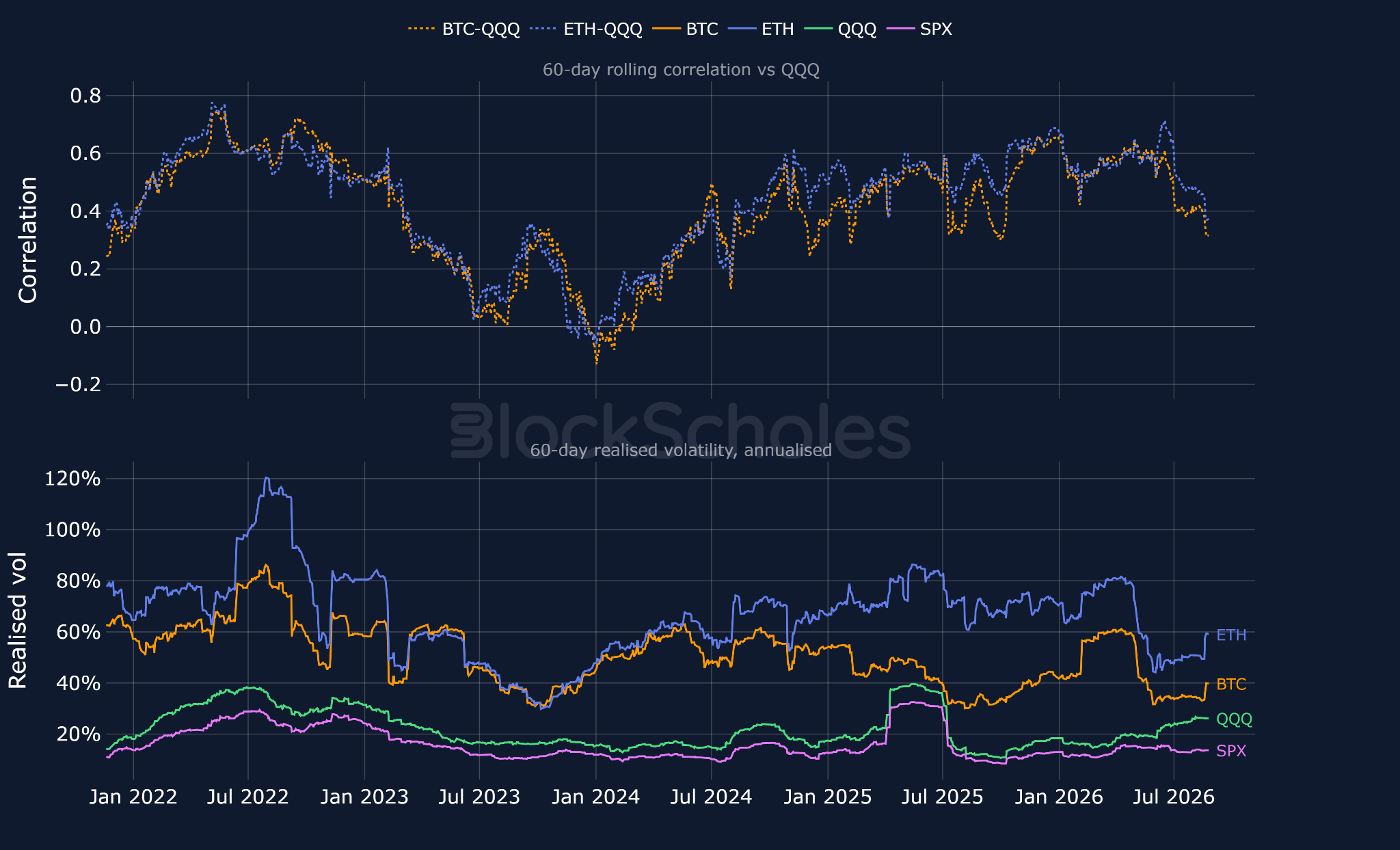
Figure 9: Crypto–QQQ correlation chart from Figure 7, alongside rolling 60-day realised volatility of BTC (orange), ETH (purple), SPX (pink) and QQQ (green). Sources: Bloomberg, Block Scholes
Since Bitget aggregates all collateral into a single adjusted equity figure, traders must manage the relationship between collateral and portfolio exposure through the construction of both. From a volatility perspective, incorporating equities into the collateral mix can help preserve a stronger margin buffer, as their typically lower realised volatility can reduce fluctuations in collateral value relative to crypto assets.
This chart shows how the liquidation risk is related to two factors: the volatility of the collateral and its correlation with the portfolio it supports.
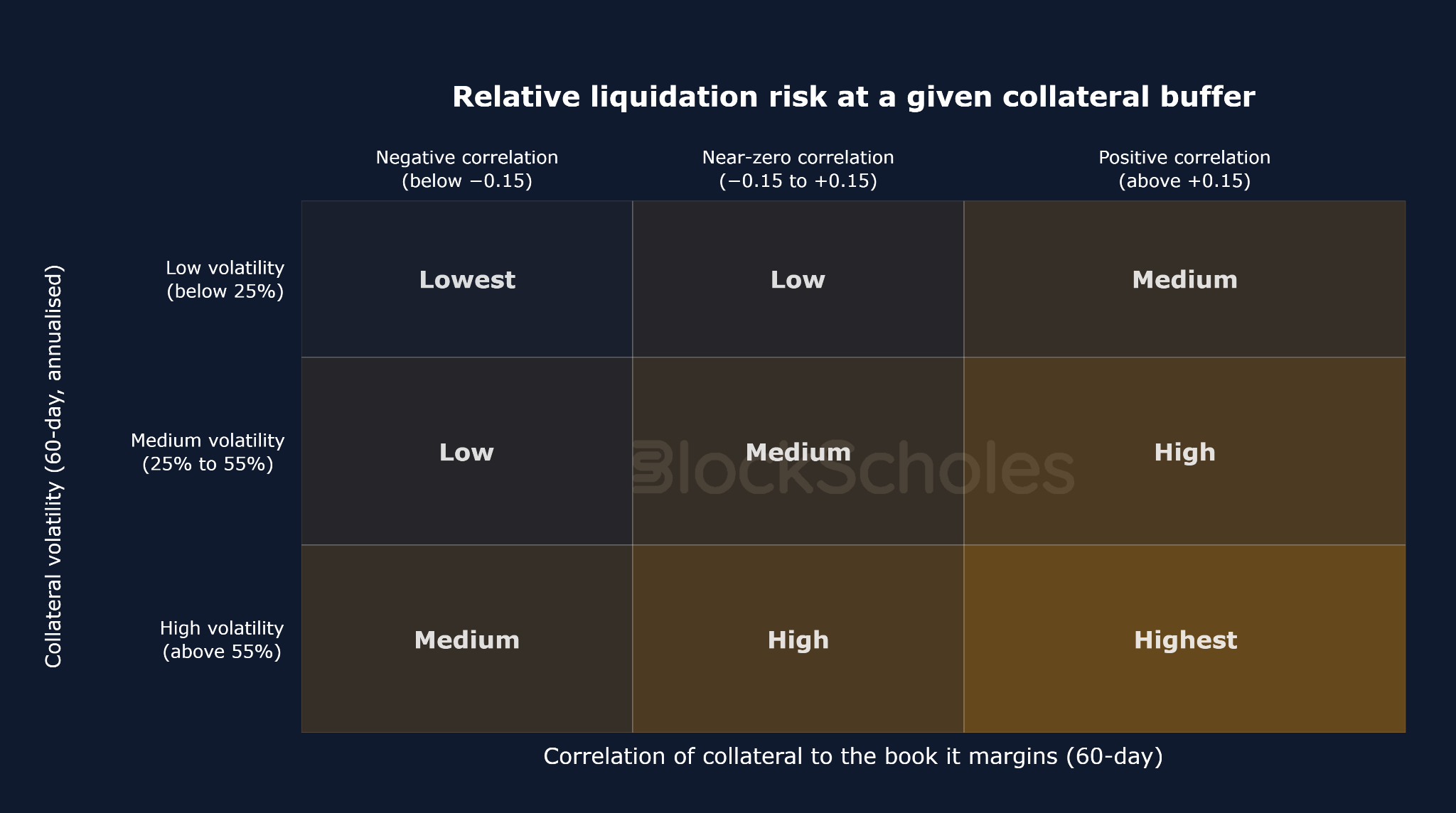
Figure 10: Correlation matrix between collateral and portfolio. Source: Block Scholes
Disclaimer: This framework is illustrative only. The appropriate level depends on the trader’s risk appetite, leverage, holding period, portfolio composition, and market conditions. Correlation and volatility can change across regimes, so liquidation risk and the amount of capital that can be safely deployed may also change over time.
In the hypothetical portfolio described above, a $175K basket of AI-chip rStocks is used to margin a perpetual futures book that is long BTC and ETH and short the Nasdaq-100 ETF. The collateral basket comprises five AI-chip rStocks: Nvidia (rNVDA), Advanced Micro Devices (rAMD), Broadcom (rAVGO), Taiwan Semiconductor Manufacturing (rTSM) and Micron Technology (rMU). The basket is equal-weighted at $35K per stock, giving a total market value of $175K. This collateral is then measured against the perpetual futures book it supports, consisting of a $410K long BTC position, a $300K long ETH position and a $115K short Nasdaq-100 ETF position.
The resulting correlation is determined by the composition of the full trading book rather than by the collateral basket in isolation. Over a 60-day window, the collateral basket of long positions in AI rStocks has a correlation of +0.24 to the long BTC perp and +0.27 to the long ETH perp, but +0.90 to the short Nasdaq-100 ETF perp. The short Nasdaq-100 ETF leg therefore offsets part of the positive co-movement generated by the long crypto perp positions, reducing the collateral basket’s correlation to the book P&L (excluding the P&L of the collateral assets) from +0.26 to +0.19.
Volatility, by contrast, is driven by the composition of the collateral itself – and does not consider the positions that it collateralises. The basket’s 60-day realised volatility, from 1 June 2026 to 25 August 2026 inclusive, is 56%, above BTC’s 40% over the same period. Over five years, however, the basket has averaged 41% realised volatility versus 52% for BTC, indicating that the lower-volatility characteristics of equity collateral hold on average, though not under current conditions. This effect is more consistent for diversified equity indices such as the Nasdaq-100 ETF, at 26% realised volatility over the same 60-day period, than for single stocks or the concentrated semiconductor basket.
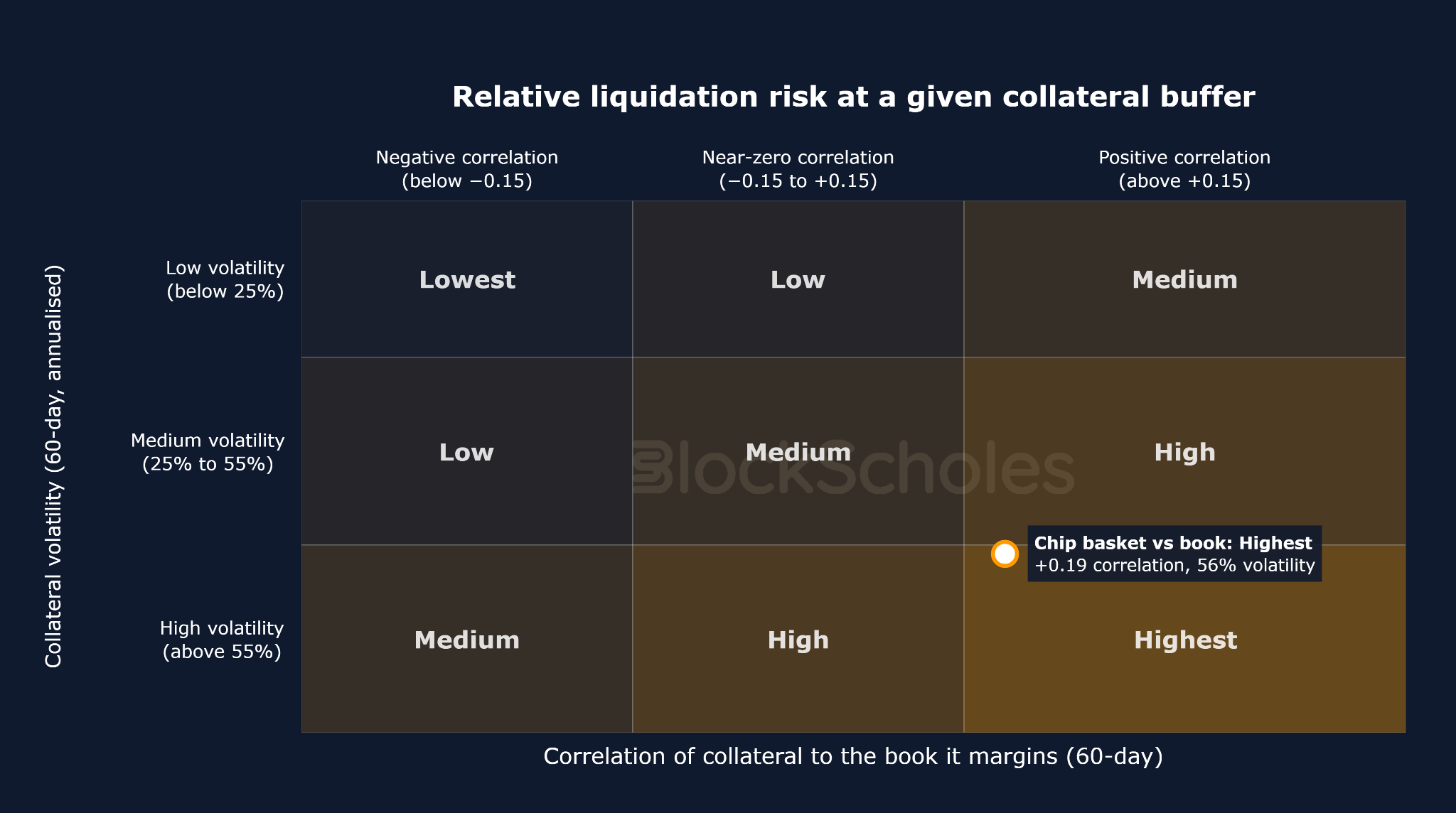
Figure 11: Hypothetical portfolio position on the correlation matrix between collateral and portfolio. Source: Block Scholes
As of 25 August 2026, the basket sits in the highest-risk cell of the matrix, marginally above the 55% volatility and +0.15 correlation thresholds. Between 19 November 2021 and 25 August 2026, the basket spent 73% of days in the high cell, 20% in the medium cell and 7% in the highest-risk cell, with no observations in the low or lowest categories. 2023 was the only year in which the medium-risk cell was the most frequent. Correlation to the book reached a low of −0.19 in January 2024, while realised volatility peaked at 68% in April 2025.
USDT, which would have been required as collateral under generations 1 and 2, sits in the low-risk cell with effectively zero volatility and zero correlation to the assets it collateralises.
Beyond the capital-efficiency benefits from a margin and collateral point of view, Bitget's integration of US tokenised stocks (rStocks) into the single unified margin system gives traders a few other benefits too.
A single rStock holding can play several roles at once. Most simply, it gives the holder exposure to the underlying US equity – as we saw in Section 2, each rStock tracks the price of the corresponding security, so the trader gains from any appreciation in the off-chain stock. What the unified account adds is that this exposure no longer has to be given up to be useful: the same holding can serve as collateral and margin for other positions in the portfolio without the trader first selling it down into stablecoins, as earlier architectures forced them to.
The holding can also earn while it sits in a user’s portfolio. When the underlying stock pays a cash dividend, the tokenised holder receives it – a distinguishing feature of the Stocks 2.0 product, since Reality distributes eligible dividends directly as USDT rather than reinvesting them into the token as other providers do. Certain equity exposures therefore carry a secondary income stream, one that accrues regardless of how the token is being put to use elsewhere.
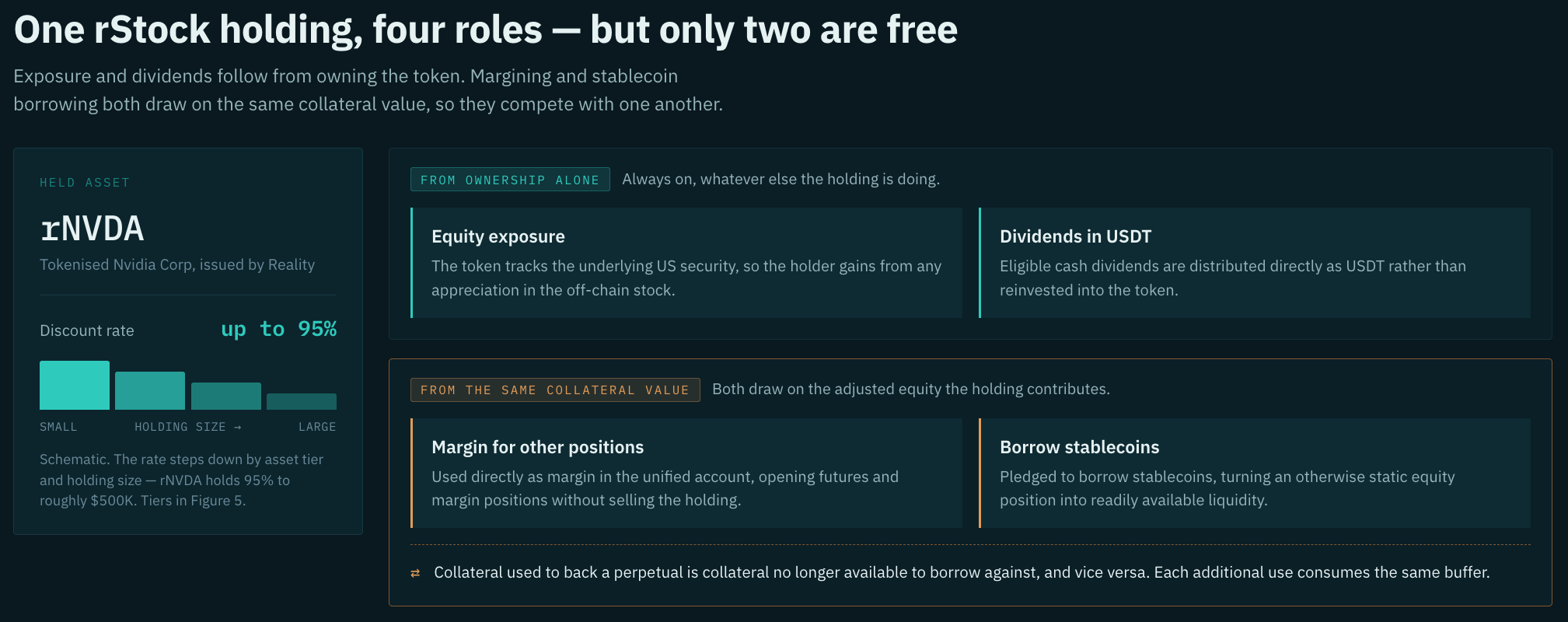
Figure 12: Summary of main benefits of the Cross-Asset Unified Account. Sources: Bitget, Block Scholes
That same holding can also be pledged to borrow stablecoins, turning an otherwise static equity position into readily available liquidity.
Exposure and the dividend stream come from the ownership of the token alone, and continue whether or not the holding is being used for anything else. Margining a position and borrowing stablecoins, however, both lean on the collateral value the holding contributes to the account. Collateral used to back a perp is collateral no longer available to borrow against, and vice versa. The benefit of the unified account is that holdings of tokenised assets do not need to be unwound to be put to work for other use cases: the trader keeps the equity exposure and the dividends while that same collateral value is used elsewhere.
Bitget's Cross-Asset Unified Account extends portfolio margining beyond crypto to tokenised equities and other real-world assets, letting a single pool of collateral back a complex, multi-asset portfolio. A representative equity-crypto portfolio showed that the efficiency gained from a combined margin account is quantifiable: the same positions that previously required roughly $165K of separately posted USDT margin can instead be collateralised by tokenised-stock holdings the trader already held in the trade.
The efficiency gain is not without its risks. The resilience of a book depends on the collateral mix a trader assembles rather than on any single published ratio, since it is the collateral's correlation and volatility that determine how quickly the margin buffer erodes.
Collateral positively correlated with the position it margins amplifies both gains and drawdowns: in our stress test a broad 10% sell-off almost halves the account's adjusted equity, and a 20% move leaves it on the edge of liquidation. We find that the portfolio survives a drawdown of 21% with correlated equity collateral, compared to a control case of USDT collateral of the same value that is liquidated after a correlated sell-off of 27%. Lower-volatility, less-correlated collateral preserves the margin buffer for larger sell-off levels. Another noteworthy point is that the discount rates can be dynamically adjusted by Bitget, which could immediately cut or increase how much margin a given holding provides.
Overall, the immediate benefit of Bitget’s broader unified collateral framework is greater flexibility in how a single capital base is deployed by a trader. By reducing the separately posted stablecoin margin a portfolio requires, an institution can keep more of its existing holdings productive while retaining the ability to express additional positions or strategies. The extent to which that added capacity directly reduces risk or results in greater trading activity depends on how it is used, rather than following automatically from the account type. As shown in the stress test, the value of the account type depends on a multitude of factors such as how a trader’s collateral is constructed, its correlation, volatility, leverage and the liquidation buffer it leaves.