The Bank of Japan Raised Rates to Their Highest Level Since 1995 in a Split 7-2 Vote
The Bank of Japan raised its policy rate by 25bp to around 1.25%, its highest level since 1995, in a split 7-2 vote, though the yen still fell 1.3% to 157.95 against the dollar. Sixteen of eighteen FOMC dots now sit at 4.1% or higher for end-2026, and markets price an 87% chance of another hike this year, while BTC climbed to $78.2K, its highest since 9 September. In crypto, S&P Global agreed to acquire smart-contract security firm OpenZeppelin, and the CFTC broadened no-action relief for developers routing users to regulated derivatives markets.
Sixteen of the eighteen FOMC participants who submitted projections put the funds rate at 4.1% or higher at the end of 2026, implying at least one more hike. Markets now price an 87% chance of another hike this year, up from 77% before Warsh's press conference.
S&P Global agreed to acquire OpenZeppelin, a smart-contract security firm that has completed more than 900 security engagements, to strengthen its assessment of onchain risk for traditional financial institutions and crypto-native firms. Terms were not disclosed.
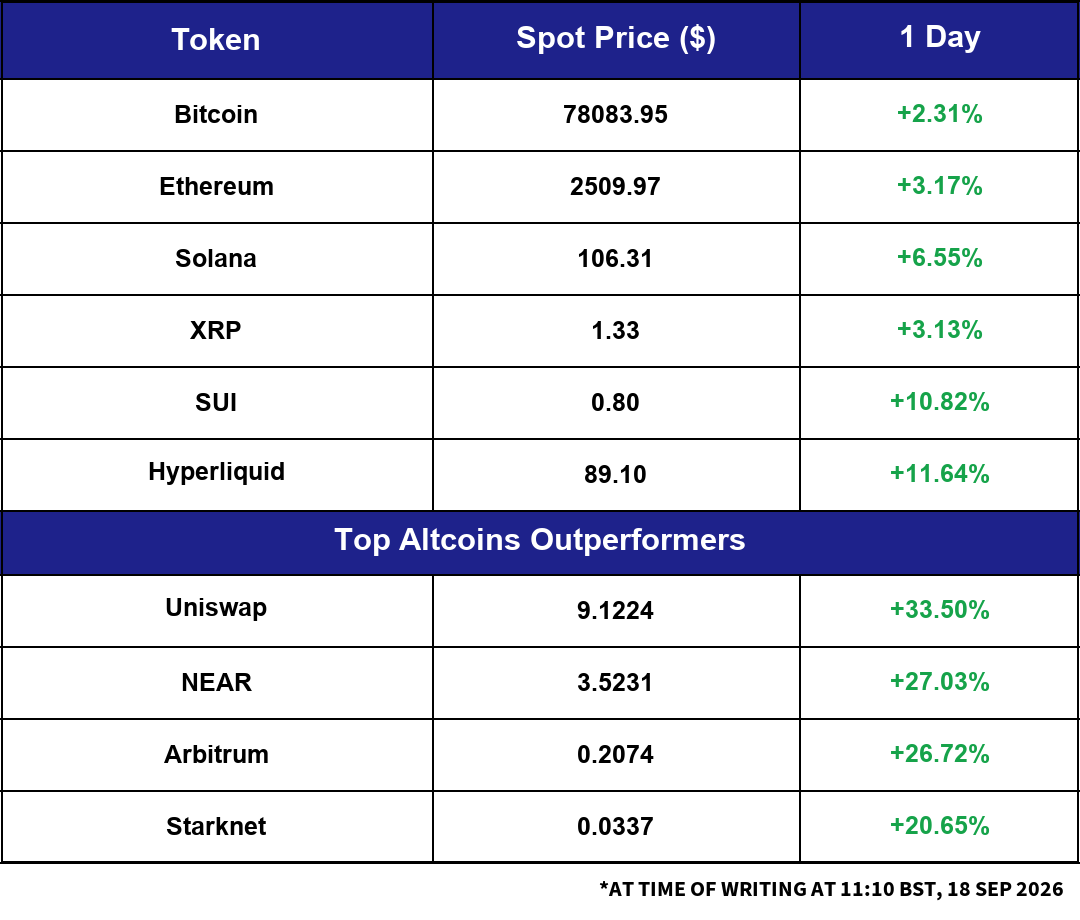
Market Snapshot: Overnight Moves
Macro & Markets
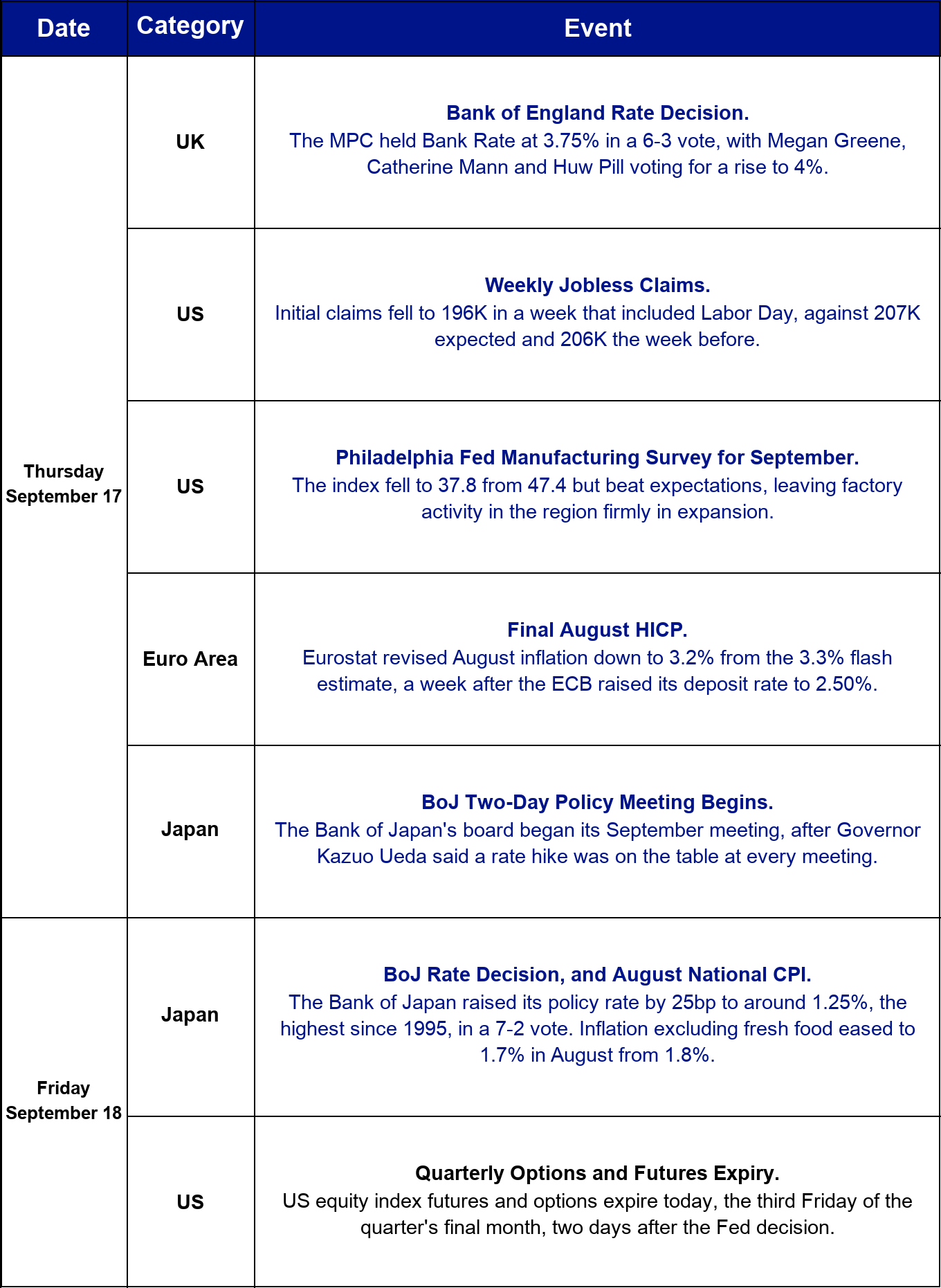
The Bank of Japan raised its policy rate by 25bp to around 1.25% on Friday, the highest level since 1995, in a 7-2 vote.
The BoJ hike comes after US Treasury Secretary Scott Bessent has spent three weeks publicly lobbying for exactly this outcome, telling Reuters around the G20 meetings in Asheville in late August that he expected Governor Kazuo Ueda to "do the right thing", and following up on CNBC with "I have information that the market doesn't have, and it's my belief that the Japanese government and the BOJ will do the things that will lead to a stronger yen."
However, the yen has since fallen 1.3% to 157.95 against the dollar, in the opposite direction to Bessent’s intent.
A weaker yen raises the odds of Japanese FX intervention, increasing the chances that Japan sells US Treasuries to raise dollars to buy yen. Bessent said as much in testimony to the House Financial Services Committee this week: "a stronger yen means that the Japanese government will not have to sell US assets to finance foreign currency intervention."
In contrast to the unanimously hawkish decision delivered by the FOMC on Wednesday, BoJ Governor Ueda framed the move as preemptive rather than the start of a sequence and faced two dissenters.
Wednesday's FOMC remains the week's defining event, and the surprise was the dot plot rather than the hike. Chairman Kevin Warsh summarised it as "the plain fact is that inflation is too high and has been for too long." Warsh again declined to submit a projection of his own, but the eighteen participants who did were emphatic: sixteen of the eighteen 2026 dots sit at 4.1% or higher, implying at least one further hike in October or December, and four of those sit at 4.4%, implying two. Only two participants see the funds rate ending the year where it is now.
Warsh continued his pattern of : "This won't surprise you, I'm not in the forward guidance business."
However, markets have priced in their view of the likely path of monetary policy regardless: odds on an October hike moved from 40% before the press conference to 49% after it, and the probability of at least one more hike this year went from 77% to 87%.
The S&P 500 rose 1.12% to 7,638, the Nasdaq Composite 1.69% to 26,418 and the Dow 0.62% to 51,780, recovering Wednesday's post-FOMC losses on the back of softer oil and an easing long end.
WTI settled around $101.91 and Brent $104.82, both a little lower on the day.
Despite the strong headwinds this week, crypto spot prices have been conspicuously positive.
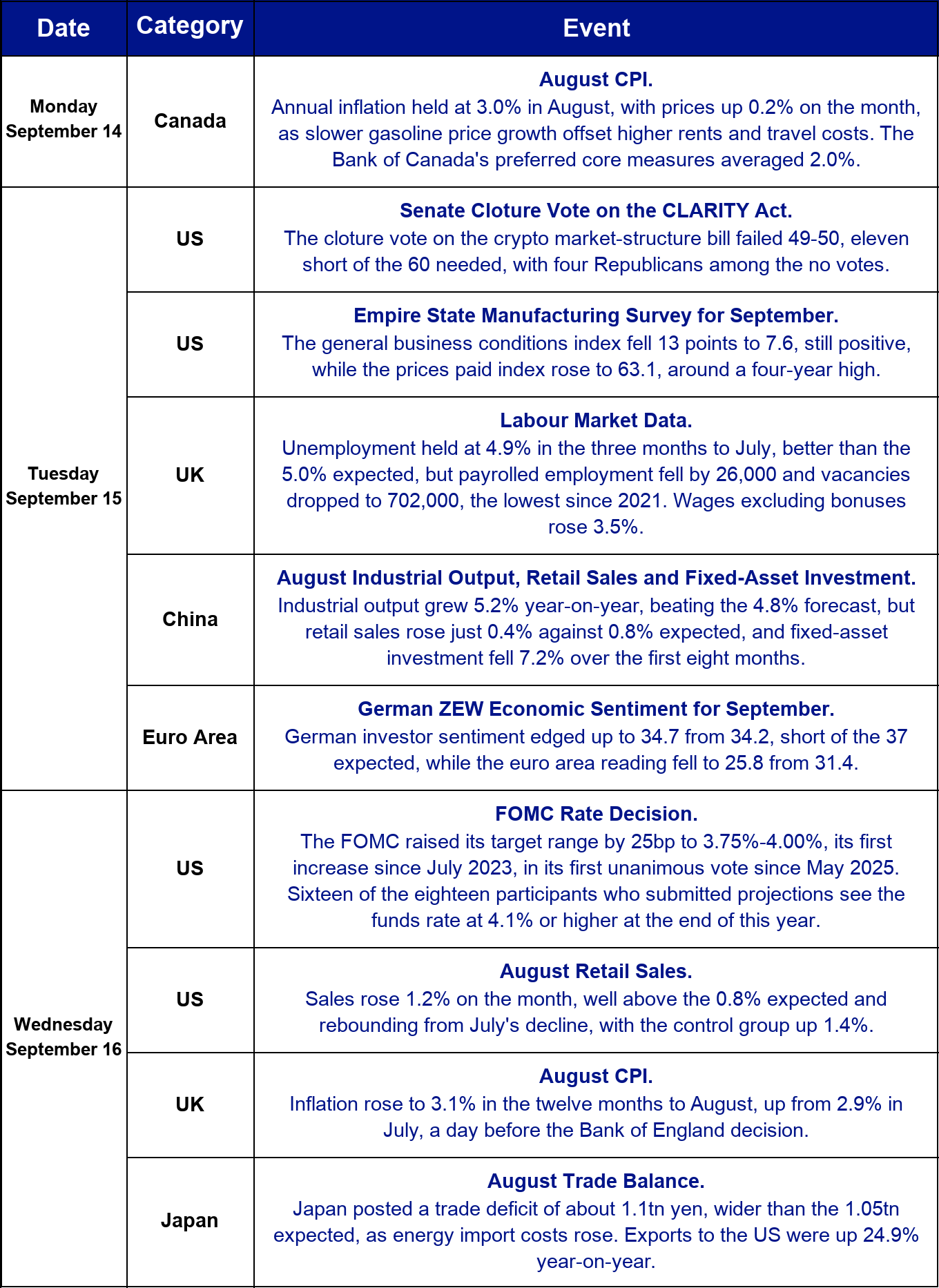
Between the Senate's failed cloture vote on the CLARITY Act on Tuesday, it fell 49-50, eleven short of the sixty needed, with four Republicans among the no votes, and a hike more hawkish than markets had positioned for, the majors have spent the week grinding higher rather than lower.
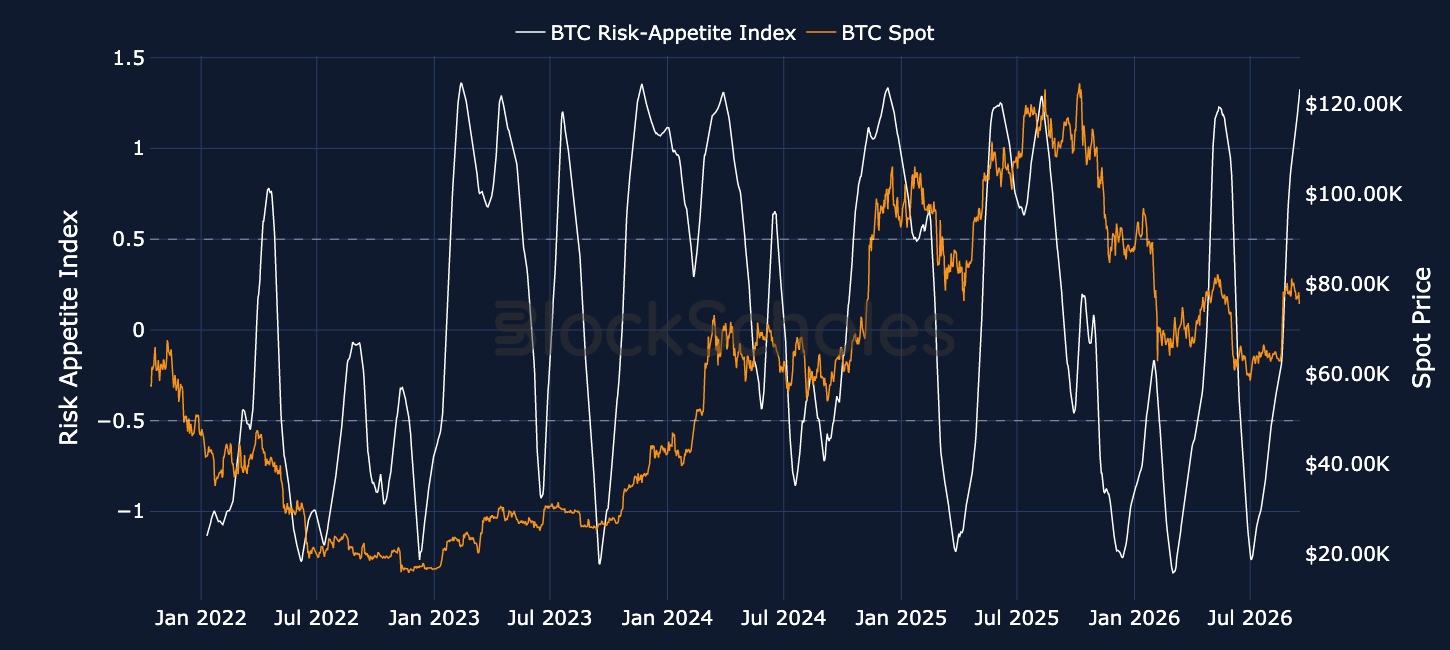
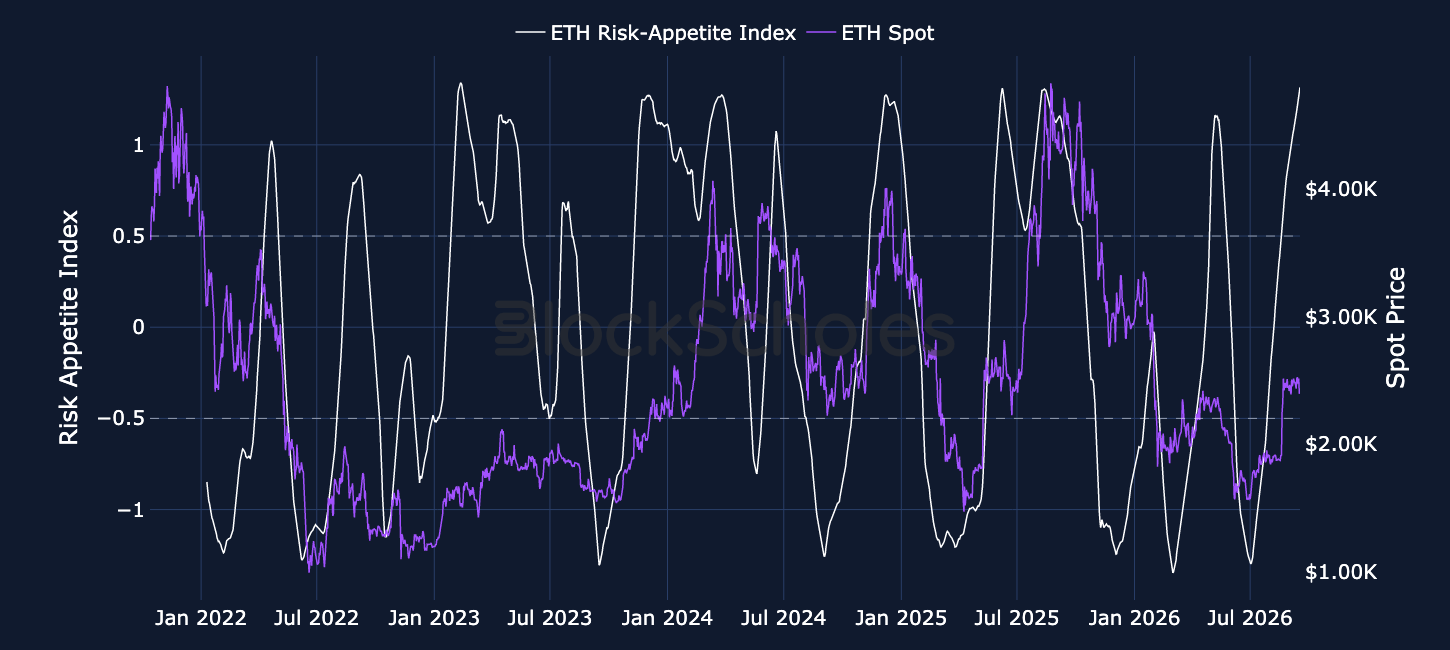
BTC trades at $78.2K, up 2.2% over the last 24 hours and 3.5% since the FOMC statement, its highest since 9 September and the top of the $75.7K-$78.2K band it has held since the CPI print. ETH is up 2.5% at $2,503, back above the $2,500 level it lost on Tuesday.
DeFi / Web3 / Altcoins / Crypto
The CFTC has issued a broader “no-action position” for software developers that connect users to regulated derivatives markets, giving crypto trading-tool builders more regulatory clarity.
Under the framework, the CFTC said it would not recommend enforcement action against qualifying developers for failing to register as introducing brokers, provided they meet certain conditions.
Those conditions include disclosures, policies and procedures, and operating as software providers that route users to designated contract markets rather than acting like traditional brokers.
The move expands relief the CFTC previously gave specifically to crypto wallet provider Phantom when it added derivatives trading functionality.
The new position could also apply beyond crypto-related software, according to the agency.
The announcement came shortly after the SEC released its own “innovation exemption” aimed at facilitating onchain trading of tokenized stocks.
Both agencies are moving ahead with crypto rules under their existing authority after the CLARITY Act failed its cloture vote in the Senate.
The limitation is that no-action positions are not permanent law and could be withdrawn or changed by a future CFTC administration.
World, the identity-focused crypto project formerly known as Worldcoin, is rolling out World Money, a self-custodial financial “super app” in more than 150 countries.
The app combines stablecoin payments, trading, yield products, investing and virtual accounts in one platform.
World Money supports balances in eight currencies and allows users to send digital assets internationally.
In the U.S., Stripe powers a funding flow that lets users convert money from Apple Pay into stablecoins, typically within minutes.
The app also integrates with Kalshi and Morpho, while World ID verification can unlock boosted rewards on eligible Earn products.
World says the identity layer is intended to verify that accounts belong to real people, particularly as AI-generated and automated accounts become more prevalent.
World operates under Tools for Humanity, which was co-founded by Alex Blania and OpenAI CEO Sam Altman.
The launch builds on World’s earlier push toward “super app” functionality, including crypto payments, chat and native USDC support.
S&P Global has agreed to acquire OpenZeppelin, a major smart contract security firm, as it expands its digital asset strategy into onchain risk assessment.
OpenZeppelin provides smart contract audits, security assessments and open-source development libraries used across stablecoins, tokenized funds, DeFi protocols and other blockchain applications.
The company says its software libraries have supported more than $37T in value transferred and that it has completed over 900 security engagements.
Under the deal, OpenZeppelin will continue operating as a standalone business unit under its existing name.
CEO Demian Brener will remain in charge and report to S&P Global Ratings President Yann Le Pallec.
S&P Global said the acquisition will strengthen its ability to assess smart contract and onchain technology risk for both traditional financial institutions and crypto-native firms.
Financial terms were not disclosed, and the transaction remains subject to closing conditions.
Ethena has launched USDe and sUSDe on the TRON network, expanding its digital dollar products to one of the largest stablecoin ecosystems.
Users can now bridge USDe and sUSDe to TRON through Stargate Finance and hold or transfer both assets on the network.
USDe is Ethena’s dollar-denominated synthetic stablecoin, while sUSDe is its rewards-bearing version that gives holders exposure to yield generated by the Ethena protocol.
Support is expected to expand across major TRON DeFi platforms including JustLend DAO and SUN.io, followed by broader integrations with wallets, exchanges and payment applications.
USDe on TRON will remain connected to liquidity across Ethena’s other supported networks, maintaining interoperability across its multichain ecosystem.
The integration gives Ethena access to TRON’s more than 403M accounts and a network that already carries substantial stablecoin activity.
USDe is now available across more than a dozen networks as Ethena continues expanding distribution through centralized exchanges and DeFi platforms.
Crypto.com’s U.S.-regulated derivatives exchange, Nadex, has registered with the SEC to offer security futures products, including single-stock futures.
The registration became effective on Sept. 14 and gives the company a regulatory path to bring futures tied to individual U.S. stocks to market.
Crypto.com is also working with the SEC and CFTC on plans to offer single-stock perpetual futures in the U.S.
Nadex operates under OG.com and is already registered with the CFTC as both a designated contract market and derivatives clearing organization.
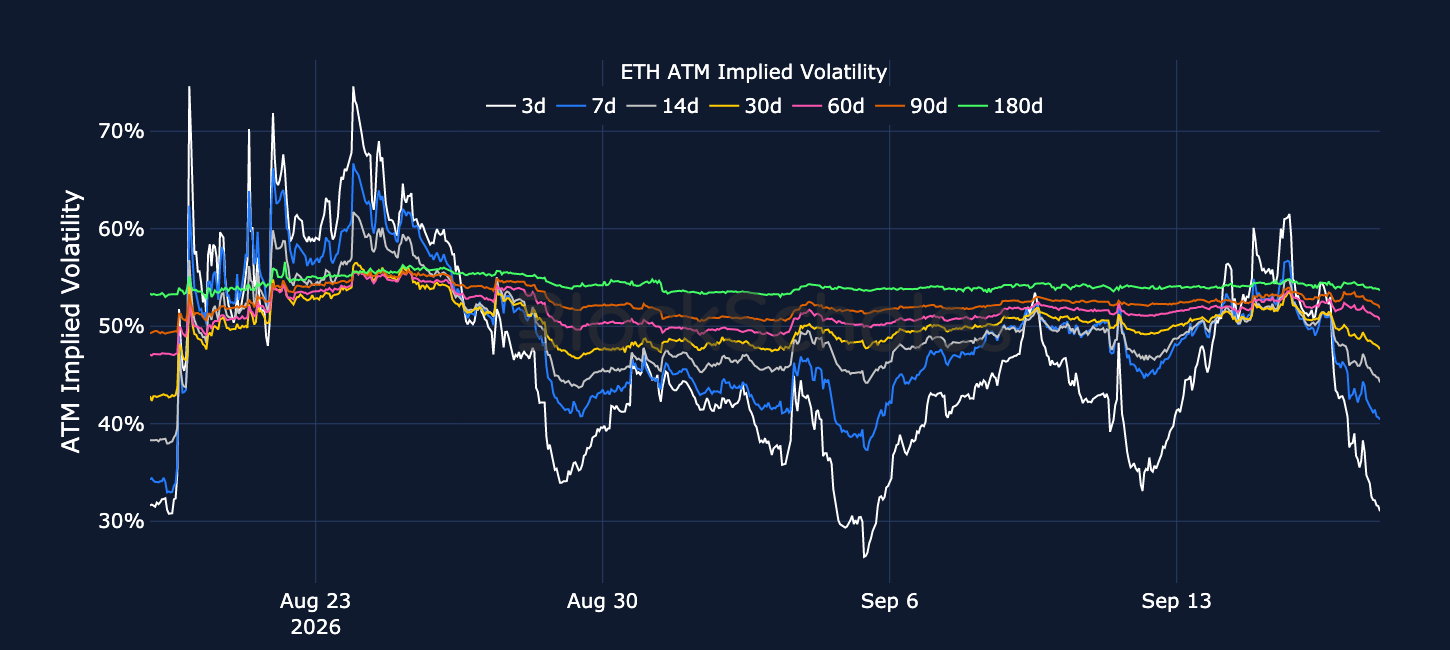
Figure 4. ETH at-the-money implied volatility across selected tenors. Source: Deribit, Block Scholes.
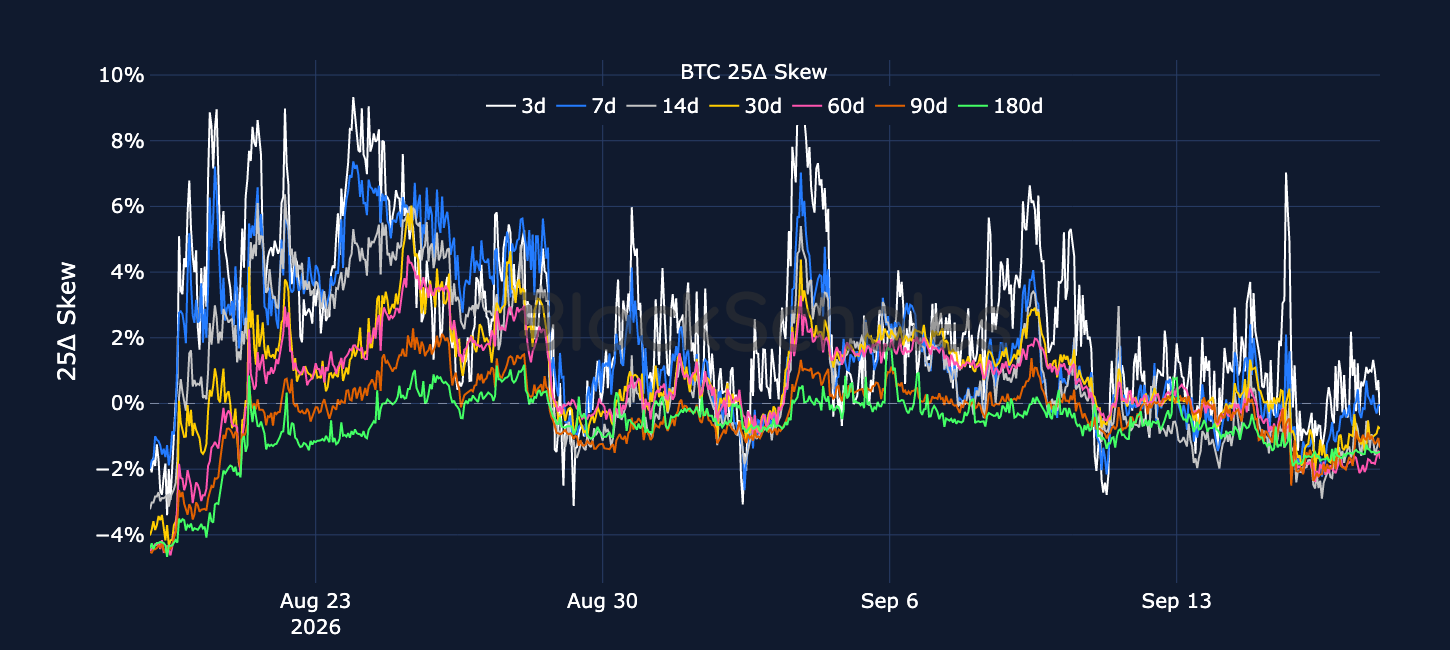
Figure 5. BTC 25-delta put-call skew ratio across selected tenors. Source: Deribit, Block Scholes.
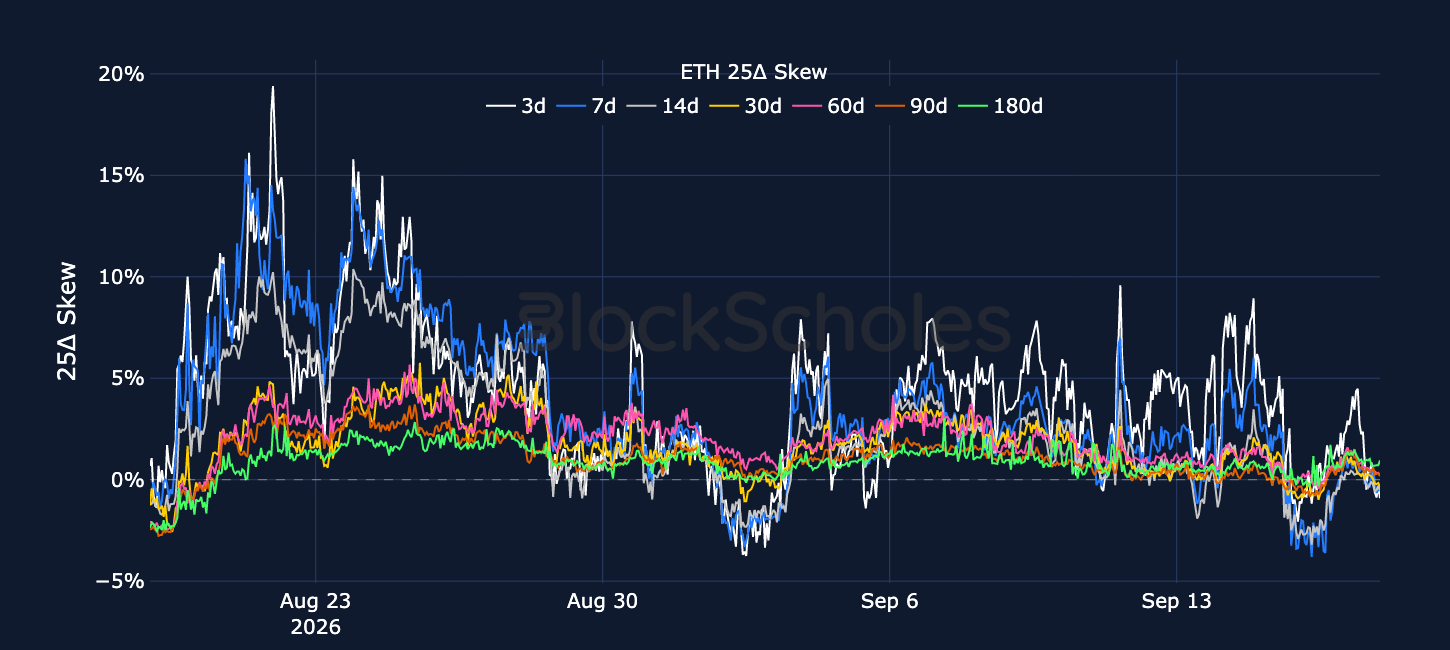
Figure 6. ETH 25-delta put-call skew ratio across selected tenors. Source: Deribit, Block Scholes.
Block Scholes is an FCA-regulated institutional crypto derivatives analytics platform. Live data, IV surfaces, and backtesting available via blockscholes.com.
Sixteen of the eighteen FOMC participants who submitted projections put the funds rate at 4.1% or higher at the end of 2026, implying at least one more hike. Markets now price an 87% chance of another hike this year, up from 77% before Warsh's press conference.
S&P Global agreed to acquire OpenZeppelin, a smart-contract security firm that has completed more than 900 security engagements, to strengthen its assessment of onchain risk for traditional financial institutions and crypto-native firms. Terms were not disclosed.
Market Snapshot: Overnight Moves
Macro & Markets
The Bank of Japan raised its policy rate by 25bp to around 1.25% on Friday, the highest level since 1995, in a 7-2 vote.
The BoJ hike comes after US Treasury Secretary Scott Bessent has spent three weeks publicly lobbying for exactly this outcome, telling Reuters around the G20 meetings in Asheville in late August that he expected Governor Kazuo Ueda to "do the right thing", and following up on CNBC with "I have information that the market doesn't have, and it's my belief that the Japanese government and the BOJ will do the things that will lead to a stronger yen."
However, the yen has since fallen 1.3% to 157.95 against the dollar, in the opposite direction to Bessent’s intent.
Don't miss what's next
Upgrade your Block Scholes account to unlock this article and other exclusive insights
Sixteen of the eighteen FOMC participants who submitted projections put the funds rate at 4.1% or higher at the end of 2026, implying at least one more hike. Markets now price an 87% chance of another hike this year, up from 77% before Warsh's press conference.
S&P Global agreed to acquire OpenZeppelin, a smart-contract security firm that has completed more than 900 security engagements, to strengthen its assessment of onchain risk for traditional financial institutions and crypto-native firms. Terms were not disclosed.
Market Snapshot: Overnight Moves
Macro & Markets
The Bank of Japan raised its policy rate by 25bp to around 1.25% on Friday, the highest level since 1995, in a 7-2 vote.
The BoJ hike comes after US Treasury Secretary Scott Bessent has spent three weeks publicly lobbying for exactly this outcome, telling Reuters around the G20 meetings in Asheville in late August that he expected Governor Kazuo Ueda to "do the right thing", and following up on CNBC with "I have information that the market doesn't have, and it's my belief that the Japanese government and the BOJ will do the things that will lead to a stronger yen."
However, the yen has since fallen 1.3% to 157.95 against the dollar, in the opposite direction to Bessent’s intent.
Don't miss what's next
Upgrade your Block Scholes account to unlock this article and other exclusive insights
Premium
$30/mo
Access previous and future reports, market insights & deep dives.
The Bank of Japan raised its policy rate by 25bp to around 1.25%, its highest level since 1995, in a split 7-2 vote, though the yen still fell 1.3% to 157.95 against the dollar. Sixteen of eighteen FOMC dots now sit at 4.1% or higher for end-2026, and markets price an 87% chance of another hike this year, while BTC climbed to $78.2K, its highest since 9 September. In crypto, S&P Global agreed to acquire smart-contract security firm OpenZeppelin, and the CFTC broadened no-action relief for developers routing users to regulated derivatives markets.
The FOMC raised its target range by 25bp to 3.75%-4.00%, its first hike since July 2023 and its first unanimous vote since May 2025, with Chairman Kevin Warsh describing the move as removing a dose of accommodation. The median dot now projects 4.1% at the end of this year, implying one more hike, and two-year yields rose from 4.61% to 4.74%, their highest since 2024, while BTC held around $76K. In crypto, the SEC and CFTC are pressing ahead with rulemaking after the CLARITY Act stalled, and Tether has emerged as a $1.5B lender to US bullion dealer Gold.com.