The Fed Raised Rates for the First Time Since 2023, With One More Hike Penciled In for This Year
The FOMC raised its target range by 25bp to 3.75%-4.00%, its first hike since July 2023 and its first unanimous vote since May 2025, with Chairman Kevin Warsh describing the move as removing a dose of accommodation. The median dot now projects 4.1% at the end of this year, implying one more hike, and two-year yields rose from 4.61% to 4.74%, their highest since 2024, while BTC held around $76K. In crypto, the SEC and CFTC are pressing ahead with rulemaking after the CLARITY Act stalled, and Tether has emerged as a $1.5B lender to US bullion dealer Gold.com.
The FOMC raised its target range by 25bp to 3.75%-4.00% in its first unanimous vote since May 2025, and the median dot now projects 4.1% at the end of this year, implying one more hike. Two-year yields rose from 4.61% to 4.74%, their highest since 2024.
Tether has become a major lender to the gold market, financing about $1.5B to US bullion dealer Gold.com, which accounted for most of the dealer's $1.7B of outstanding precious-metal leases at the end of June.
Market Snapshot: Overnight Moves
Macro & Markets
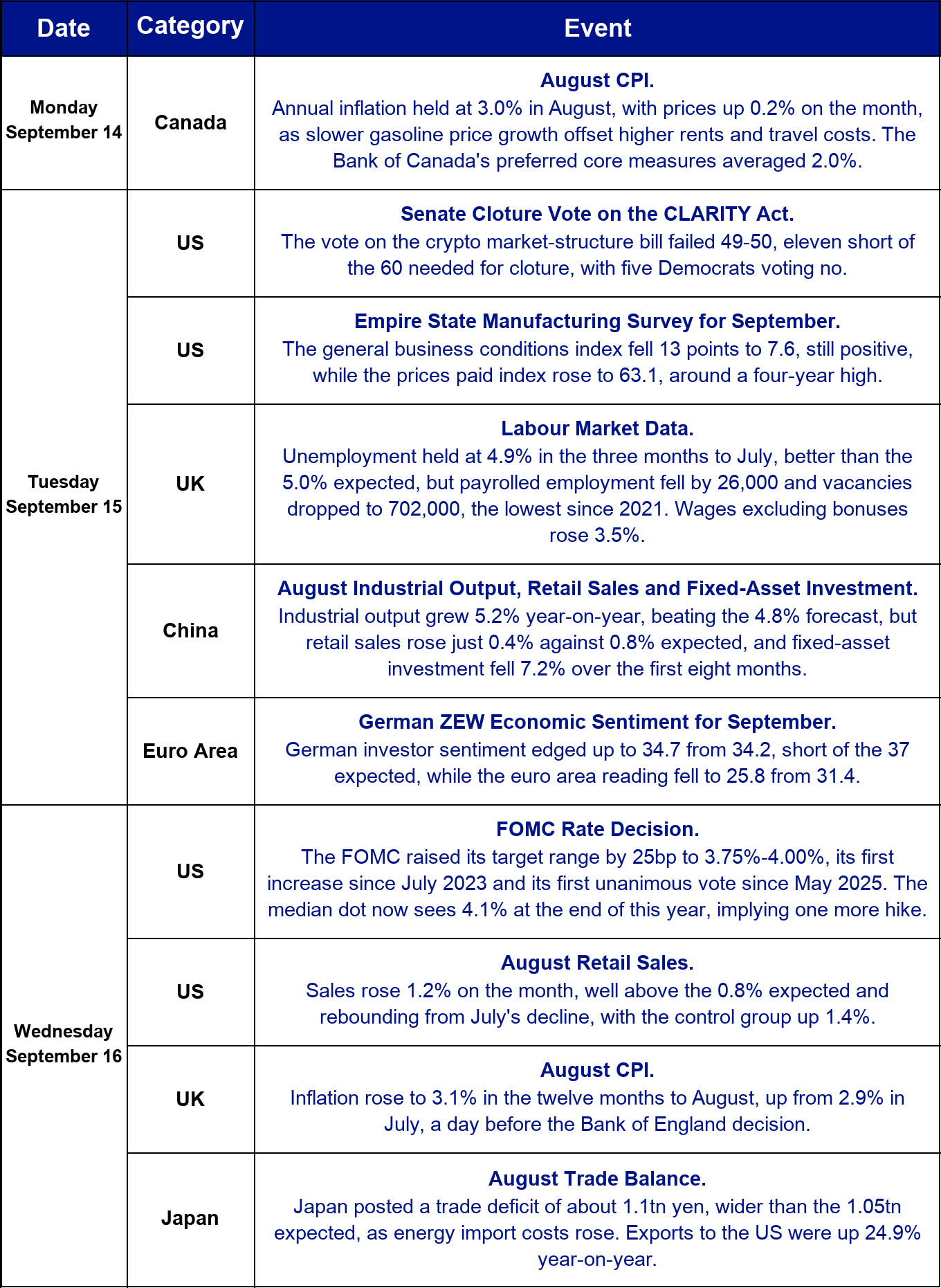
In its first unanimous decision since May 2025, the FOMC voted to raise its benchmark interest rate by 25bp to a target range of 3.75%-4.00%, marking the first rate increase since July 2023.
Chairman Kevin Warsh reiterated a view he laid out at the policy symposium in Jackson Hole that he “would be hard pressed to describe broad financial conditions as restrictive”. As such, the decision to hike was to remove “a dose of accommodation”, and to ensure that a supply-side inflation shock does not “have second and third order effects on the economy”.
What perhaps surprised markets more than the decision to hike itself, given it was priced in with more than 90% probability, was the dot plot summary provided by Fed officials (though as Warsh has done previously, abstained from providing his own dot).
According to the median FOMC participant, the appropriate federal funds rate will be 4.1% at the end of this year and will remain there next year, indicating one more hike before year-end.
When asked what had changed between the July meeting and the meeting yesterday to influence a rate hike, Warsh argued that there were broadly three main reasons. The first was that the FOMC wanted more data and time to better gauge the state of the US economy. Over the seven week period, Warsh claimed there had been several data points to suggest the US economy had strengthened and that the “Labour side of the Fed’s congressional remit is in good shape”.
Secondly, he claimed that inflation trends, and not single data points, continue to suggest a lack of progress on the inflation side of the Fed’s mandate. He said that “This summer’s inflation readings do not tell me that underlying trends have meaningfully improved”. Finally he pointed to uncertainty from geopolitical events as a further reason.
One point Warsh continued to focus on through the shorter-than-usual press conference was on trends in the data, “I’m not a data point dependent guy, so I won’t react one way or another to data that shows up on our doorstop”.
The chairman also rejected the idea that the Fed was boxed into a hike given that markets had priced in the event at such a high probability. Answering a journalist, Warsh said, “I’ll observe market prices and see what they have to say, but today was our decision”.
He also took a page out of his predecessor's book when asked what the decision meant for his relationship with President Trump who has continued to advocate for lower interest rates. Warsh responded “I’ve got nothing for you on the discussion with the President”.
The response from financial markets was clear, on Wall Street stocks were driven down to their lowest levels since July with the S&P 500 declining 0.45% and the Dow Jones losing 1.21%. The Nasdaq-100 on the other hand ended the session flat.
Short-dated Treasuries underperformed, with two-year yields hitting the highest since 2024, up from 4.61% to 4.74%.
The US dollar strengthened with the DXY climbing above 100, while 10-year yields rose by a smaller 7bps from 4.95% to 5.02% intraday, though closed slightly lower than where they opened on the day.
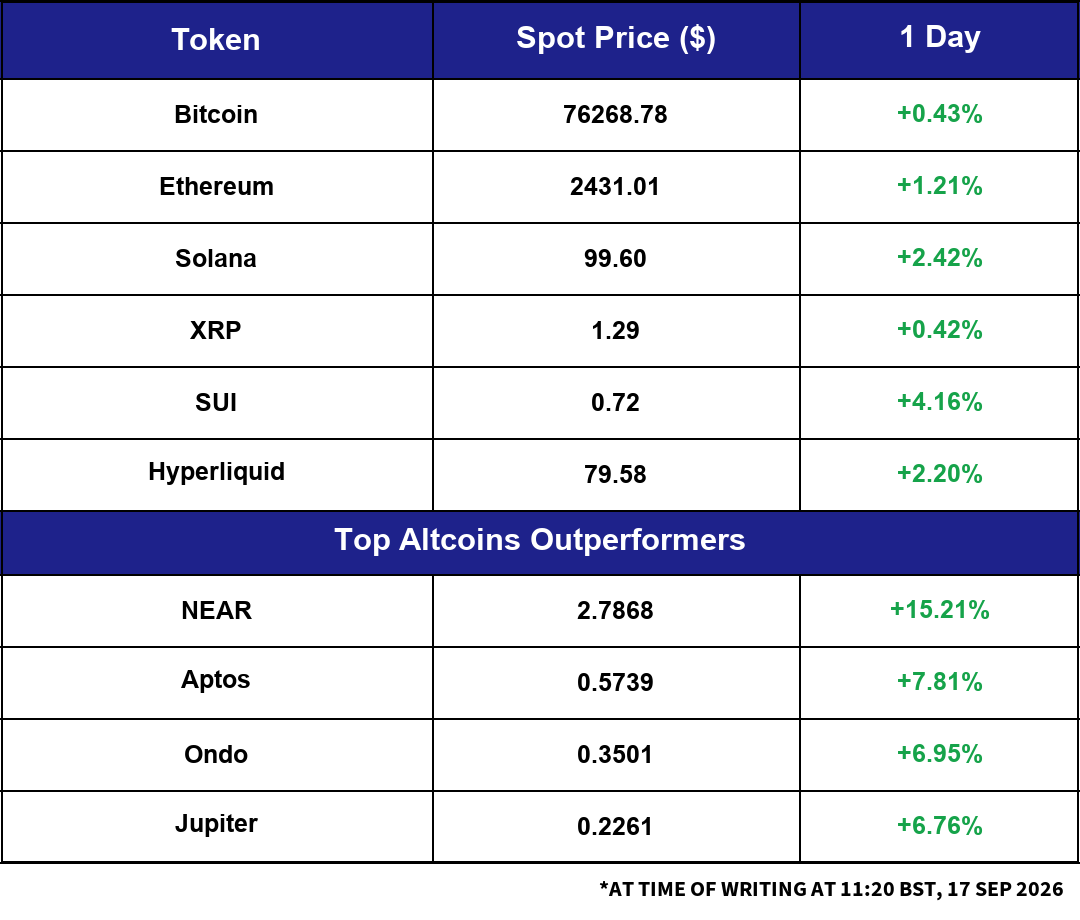
Meanwhile BTC showed resilience, falling to $76K, the lower-end of the range it has been trading at over the past month.
Chairman Warsh was also asked what had been driving the recent selloff in the US bond market, to which he responded with three reasons.
The first reason he stated was the strength of the US economy, “Part of the reason why we’ve seen over the course of 2026, long-term yields go up, is the economy has strengthened.”
He also argued that a competition for capital and the surge in capex from hyperscalers have meant the “competition for capital is real”. Finally, he argued that geopolitics and “the situation in hotspots around the world are driving long-term yields”.
DeFi / Web3 / Altcoins / Crypto
The SEC and CFTC are preparing to move ahead with crypto rulemaking under their existing authority after the Clarity Act failed to advance in the U.S. Senate.
The Senate voted 49-50 against advancing the bill, short of the 60 votes required.
SEC Chair Paul Atkins said the agency would continue acting within its statutory authority to provide regulatory certainty for investors and crypto businesses.
CFTC Chair Mike Selig similarly said the agency is ready to push forward rules for digital asset markets despite the legislative setback.
The agencies have already been building a crypto framework independently of Congress.
In March, the SEC issued an interpretation clarifying how federal securities laws apply to different categories of crypto assets, with the CFTC coordinating its approach under the Commodity Exchange Act.
The SEC also proposed Regulation Crypto Assets in August, a new framework that would set specific rules for how crypto projects can raise money from investors under U.S. securities law, including tailored offering exemptions and a conditional safe harbor that could allow a token to stop being treated as part of an investment contract once the project has completed the key managerial work promised to investors.
The main limitation is that agency rules are less permanent than legislation because they can be challenged in court or changed by future administrations.
The House Ways and Means Committee has advanced the Digital Asset Tax Certainty Act in a 38-5 vote, moving the first federal crypto tax framework toward the full House.
The bill would exempt crypto network or transaction fees of $10 or less from tax, although the exemption would not apply to service providers conducting transactions for others.
That provision would take effect in December 2027 if the legislation becomes law.
The bill would also require the Treasury Department to create a Digital Asset Voluntary Disclosure Program within 12 months, allowing eligible taxpayers to amend prior returns and settle outstanding tax, interest and penalties.
Mining and staking rewards would be treated as ordinary income under the proposal.
However, the bill does not resolve when mining and staking income should be recognized for tax purposes.
It would also allow certain investment trusts to stake digital assets without that activity alone changing their tax status.
The House is expected to leave Washington until after the November elections, so further action may come during the lame-duck session.
Attention is also expected to shift to the Senate Finance Committee, which has shown interest in developing similar digital asset tax legislation.
Justin Sun has launched the Justin Sun Prize, a decentralized academic bounty program focused on mathematics, formal verification and AI-assisted scientific research.
The initiative offers rewards of up to $1M for individual problems, with prizes tied directly to specific mathematical breakthroughs and machine-verifiable proofs.
According to the sponsored announcement, the first round recognized work on 66 mathematical problems.
The announcement says a $1M top prize was awarded to an OpenAI research team for a claimed solution and formalized proof related to the three-dimensional Navier-Stokes existence and smoothness problem.
It also states that the proof was produced by an internal OpenAI model and formally verified in Lean by a model referred to as GPT-6 Astra.
The prize is designed without traditional nomination or credential requirements, allowing individuals or AI systems to qualify if they are first to produce an accepted breakthrough.
Its problem list includes major mathematical challenges such as the Riemann Hypothesis, Goldbach’s Conjecture and formal verification of the Poincaré Conjecture.
Proofs, verification materials and problem criteria are intended to be published openly, while prize payments will be recorded onchain.
Winners can receive payments in either USDT on TRON or USDC on Ethereum.
Sun said the initiative is intended to make mathematics and open scientific research a central focus of his philanthropic work.
Tether has become a major lender in the gold market, providing about $1.5B in financing to U.S. bullion dealer Gold.com.
According to Gold.com’s annual report, Tether accounted for most of the company’s $1.7B in outstanding precious-metal leases at the end of June.
Gold.com owed Tether about $1.45B in payables and advances during the reported period.
Tether had also acquired a stake in Gold.com earlier in 2026, deepening its exposure to the precious-metals sector.
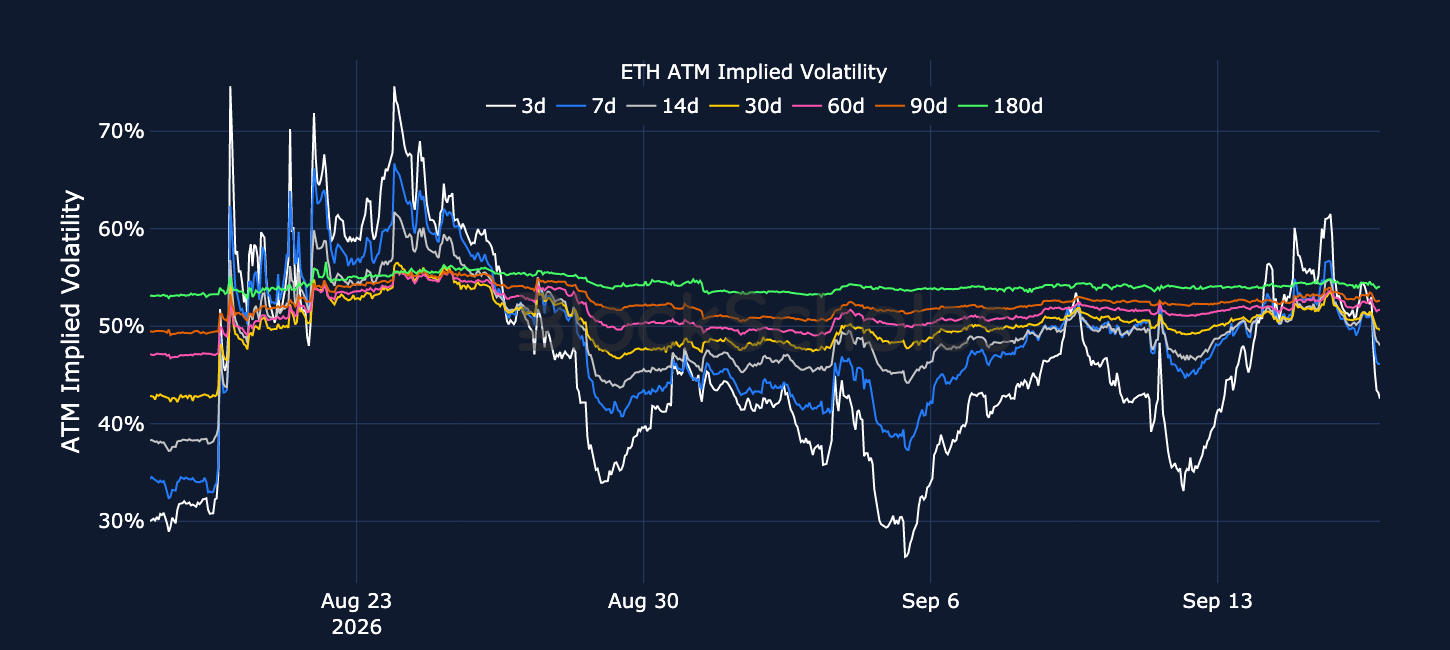
Figure 4. ETH at-the-money implied volatility across selected tenors. Source: Deribit, Block Scholes.
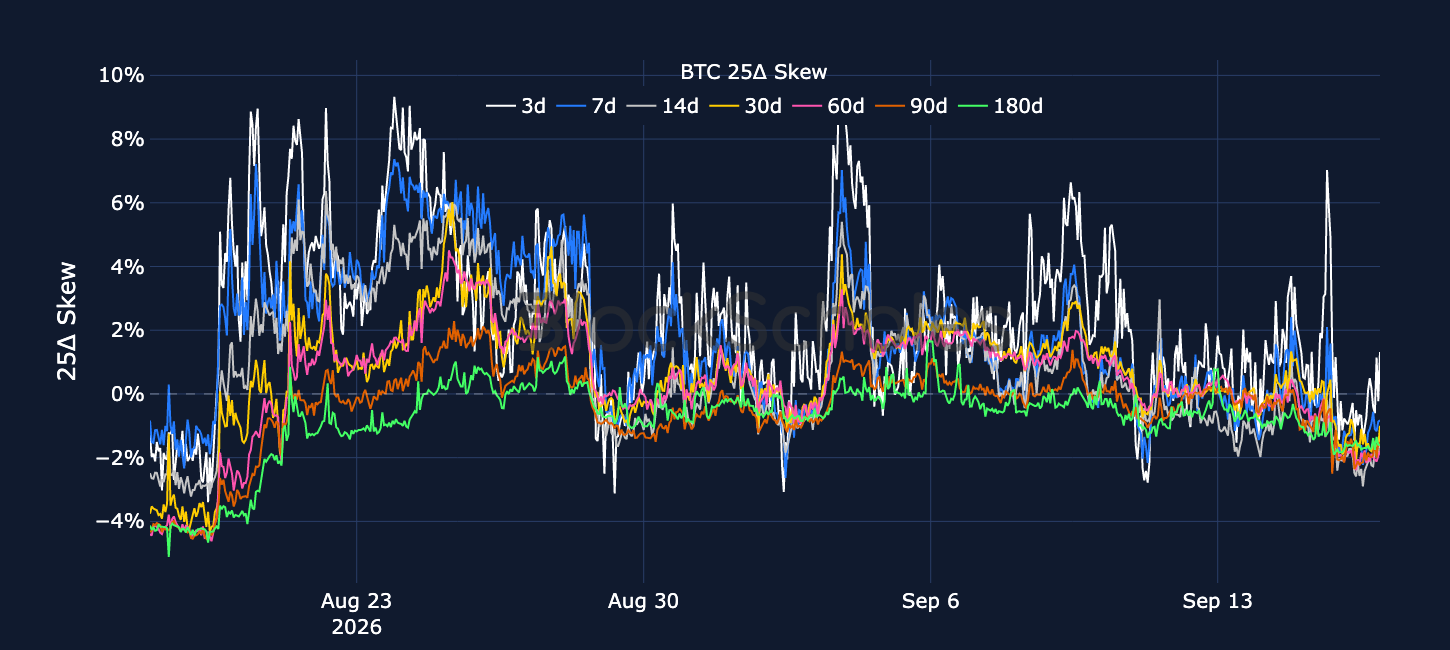
Figure 5. BTC 25-delta put-call skew ratio across selected tenors. Source: Deribit, Block Scholes.
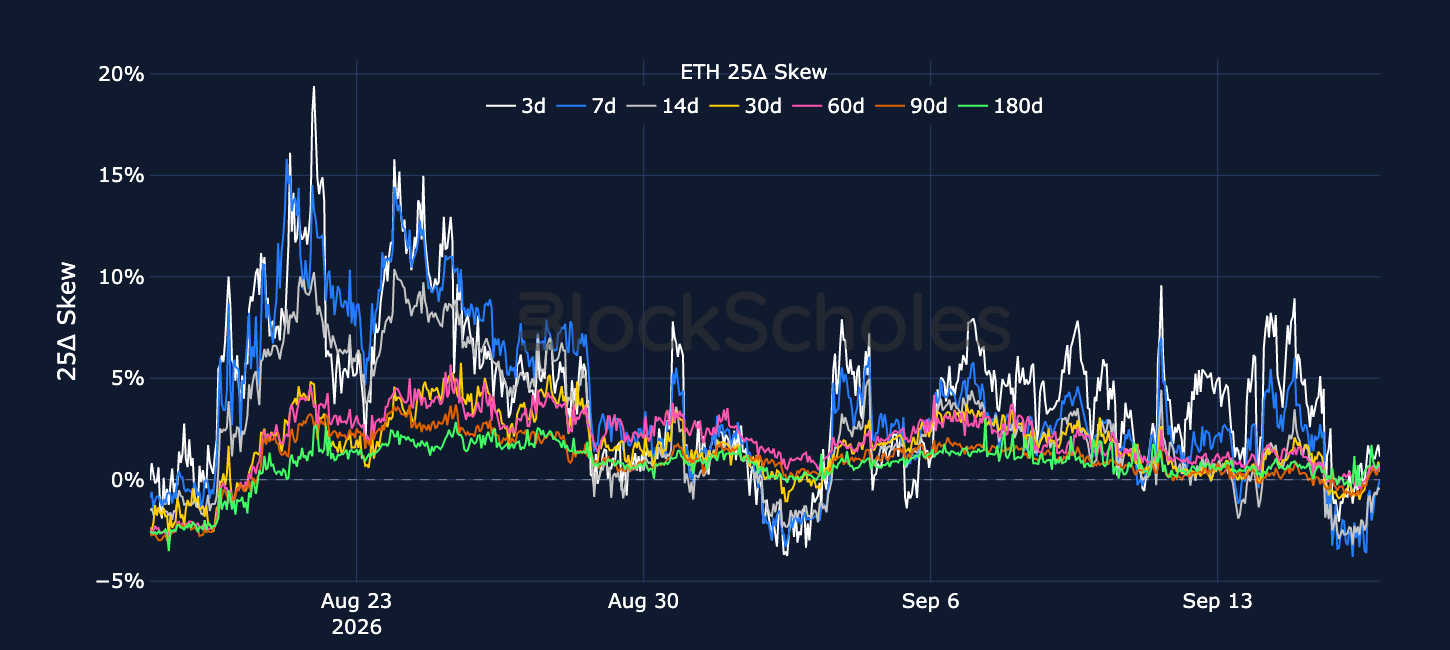
Figure 6. ETH 25-delta put-call skew ratio across selected tenors. Source: Deribit, Block Scholes.
Block Scholes is an FCA-regulated institutional crypto derivatives analytics platform. Live data, IV surfaces, and backtesting available via blockscholes.com.
The FOMC raised its target range by 25bp to 3.75%-4.00% in its first unanimous vote since May 2025, and the median dot now projects 4.1% at the end of this year, implying one more hike. Two-year yields rose from 4.61% to 4.74%, their highest since 2024.
Tether has become a major lender to the gold market, financing about $1.5B to US bullion dealer Gold.com, which accounted for most of the dealer's $1.7B of outstanding precious-metal leases at the end of June.
Market Snapshot: Overnight Moves
Macro & Markets
In its first unanimous decision since May 2025, the FOMC voted to raise its benchmark interest rate by 25bp to a target range of 3.75%-4.00%, marking the first rate increase since July 2023.
Chairman Kevin Warsh reiterated a view he laid out at the policy symposium in Jackson Hole that he “would be hard pressed to describe broad financial conditions as restrictive”. As such, the decision to hike was to remove “a dose of accommodation”, and to ensure that a supply-side inflation shock does not “have second and third order effects on the economy”.
What perhaps surprised markets more than the decision to hike itself, given it was priced in with more than 90% probability, was the dot plot summary provided by Fed officials (though as Warsh has done previously, abstained from providing his own dot).
According to the median FOMC participant, the appropriate federal funds rate will be 4.1% at the end of this year and will remain there next year, indicating one more hike before year-end.
Don't miss what's next
Upgrade your Block Scholes account to unlock this article and other exclusive insights
The FOMC raised its target range by 25bp to 3.75%-4.00% in its first unanimous vote since May 2025, and the median dot now projects 4.1% at the end of this year, implying one more hike. Two-year yields rose from 4.61% to 4.74%, their highest since 2024.
Tether has become a major lender to the gold market, financing about $1.5B to US bullion dealer Gold.com, which accounted for most of the dealer's $1.7B of outstanding precious-metal leases at the end of June.
Market Snapshot: Overnight Moves
Macro & Markets
In its first unanimous decision since May 2025, the FOMC voted to raise its benchmark interest rate by 25bp to a target range of 3.75%-4.00%, marking the first rate increase since July 2023.
Chairman Kevin Warsh reiterated a view he laid out at the policy symposium in Jackson Hole that he “would be hard pressed to describe broad financial conditions as restrictive”. As such, the decision to hike was to remove “a dose of accommodation”, and to ensure that a supply-side inflation shock does not “have second and third order effects on the economy”.
What perhaps surprised markets more than the decision to hike itself, given it was priced in with more than 90% probability, was the dot plot summary provided by Fed officials (though as Warsh has done previously, abstained from providing his own dot).
According to the median FOMC participant, the appropriate federal funds rate will be 4.1% at the end of this year and will remain there next year, indicating one more hike before year-end.
Don't miss what's next
Upgrade your Block Scholes account to unlock this article and other exclusive insights
Premium
$30/mo
Access previous and future reports, market insights & deep dives.
The FOMC raised its target range by 25bp to 3.75%-4.00%, its first hike since July 2023 and its first unanimous vote since May 2025, with Chairman Kevin Warsh describing the move as removing a dose of accommodation. The median dot now projects 4.1% at the end of this year, implying one more hike, and two-year yields rose from 4.61% to 4.74%, their highest since 2024, while BTC held around $76K. In crypto, the SEC and CFTC are pressing ahead with rulemaking after the CLARITY Act stalled, and Tether has emerged as a $1.5B lender to US bullion dealer Gold.com.
The Senate's cloture vote on the CLARITY Act failed 49-50, eleven votes short of the 60 needed, after five Democrats voted against it. BTC fell below $76K for the first time in almost a month and spot BTC ETFs shed $450.4M, their largest daily outflow since late June, while the 10-year Treasury yield rose above 5% ahead of today's Fed decision. The House Ways and Means Committee also released a 114-page crypto tax bill, up for markup today, with a $10 de minimis exemption and wash-sale rules for digital assets.