
Thahbib Rahman
Research Analyst
Bitcoin is down 25% year-to-date, driven less by crypto-specific factors than by a deteriorating macro backdrop: a supply-side energy shock pushed US headline inflation above 4%, moving markets from pricing two 2026 cuts to expecting a hike. This note shows BTC's reaction function to CPI surprises is re-forming — on a 12-release rolling window the 1-hour R² has climbed to nearly 80%, surpassing even the 2022–23 peak, though with smaller magnitude per surprise and concentrated at the one-hour horizon. Its sensitivity to nonfarm payrolls has moved the other way, fading to near zero in 2026, mirroring the Fed's own shift of attention from the labour market to inflation.

Bitcoin is down 25% year-to-date, extending a decline that initially began back in Q4 2025 with the October 10-10 liquidation event. However, the bearish price-action exhibited this year has largely been driven by a deteriorating macro backdrop, rather than purely crypto-specific factors.
One of those macro drivers has been higher inflation off the back of a supply-side energy spike from the US-Iran conflict. Headline inflation in the US climbed from 2.4% year-on-year in January to above 4% by May. That resulted in a repricing of market expectations for a more hawkish Federal Reserve: having entered 2026 pricing for two rate cuts, markets have since moved towards expecting one rate hike by year-end.
Given the market and the Fed’s increased attention-shift towards inflation, BTC’s reaction-function to surprises in CPI releases is beginning to increase again, a relationship we saw back in 2022-23. At the same time, its sensitivity to nonfarm payrolls (NFP) reports has faded.
Historically, Bitcoin has, on average, sold off in the hour after an upside CPI surprise, and rallied when CPI came in below expectations. We define a surprise in CPI as the difference in the headline year-over-year figure recorded in the Bureau of Labor Statistics' CPI report minus the market’s median expectation. A positive surprise in CPI therefore means inflation came in hotter than the consensus view.
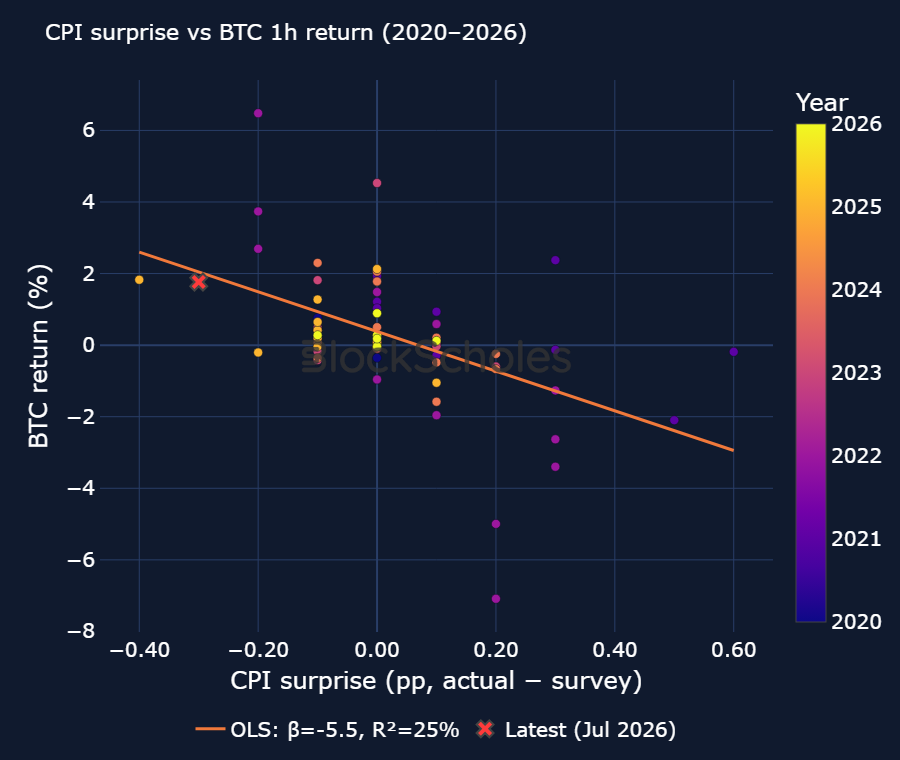
Over a six-year sample beginning in 2020, 25% of BTC's first-hour return has been explained by the CPI surprise, and a 1 percentage-point (pp) upside surprise has coincided with a roughly 5.5% decline in BTC over the following hour. Equivalently, scaling down to a more realistic surprise, a 0.1pp hotter-than-expected print (e.g., headline CPI came in at 4.0%, while markets had expected a reading of 3.9%), has preceded a −0.55% move on average.
This matches macroeconomic intuition: a higher-than-expected print generally pushes the market to price a more hawkish Fed (higher rates for longer) which has historically been a headwind for risk-on assets like BTC.
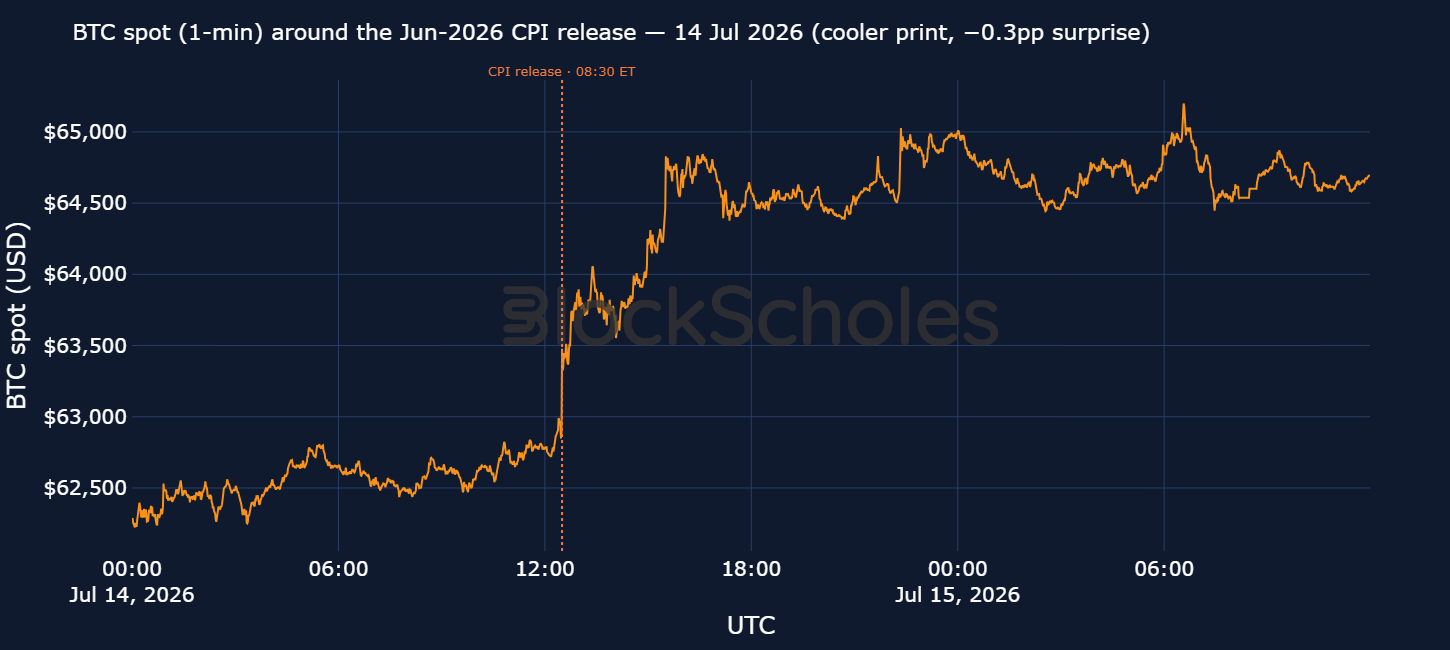
The most recent CPI release is an example of how a cooler-than-expected print has supported sentiment in BTC. On 14 July 2026, the June CPI report showed headline annual inflation at 3.5%, down sharply from 4.2% in May and below the 3.8% consensus: a clear downside surprise, helped by a drop in oil prices in mid-May to June. Bitcoin reacted immediately, jumping toward $65K and closing the day up 2.9% as markets pared back expectations for a July rate hike.
While a static, full-sample regression over the last six years already showcases a moderately strong negative relationship, it only captures the average of that relationship. It ignores the effect of changing market dynamics over time.
To see the evolution in the relationship, we run the same regression on a rolling window — re-estimating it on a moving block of consecutive releases and plotting how the sensitivity (the slope, β) and the strength of fit (R²) change through time.
We begin first with a 24-release (roughly two-year) window:
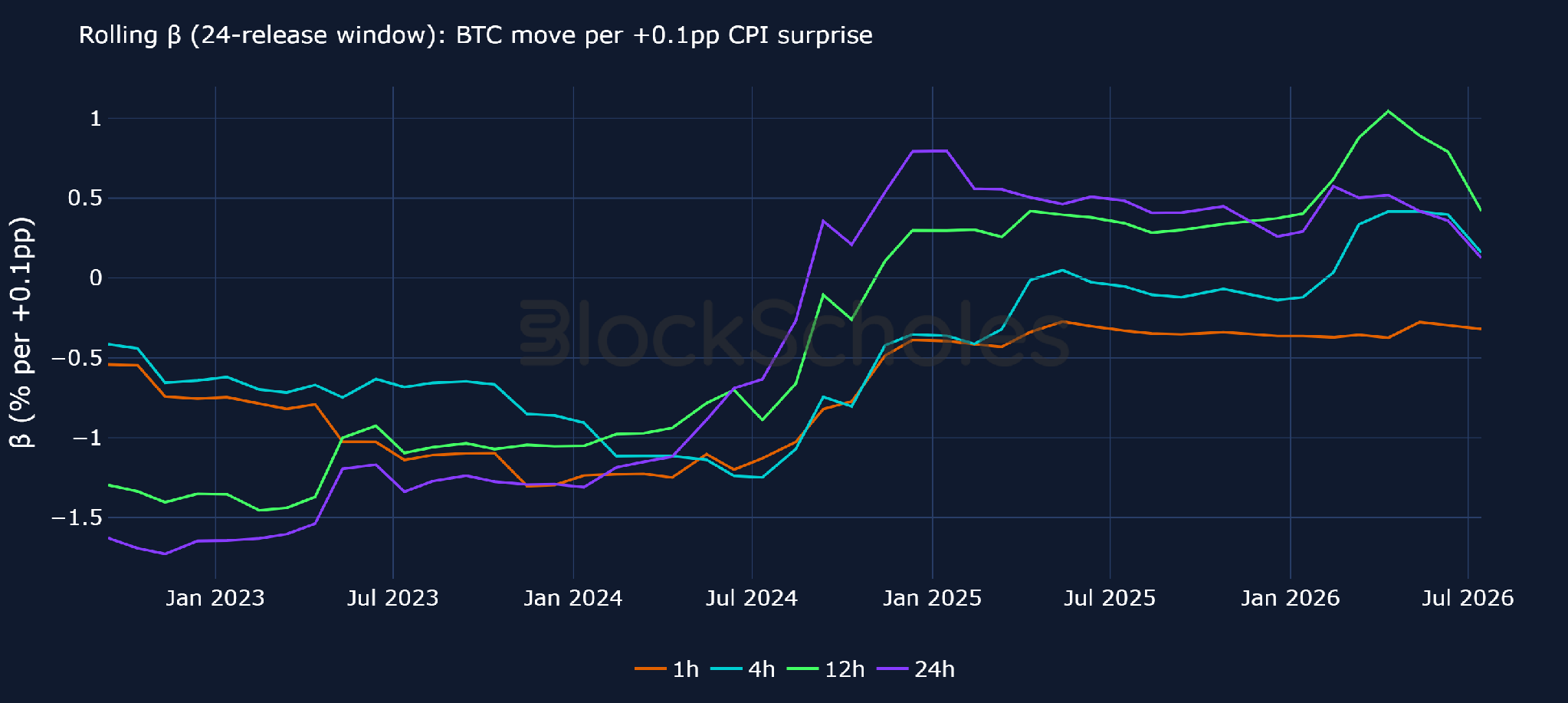
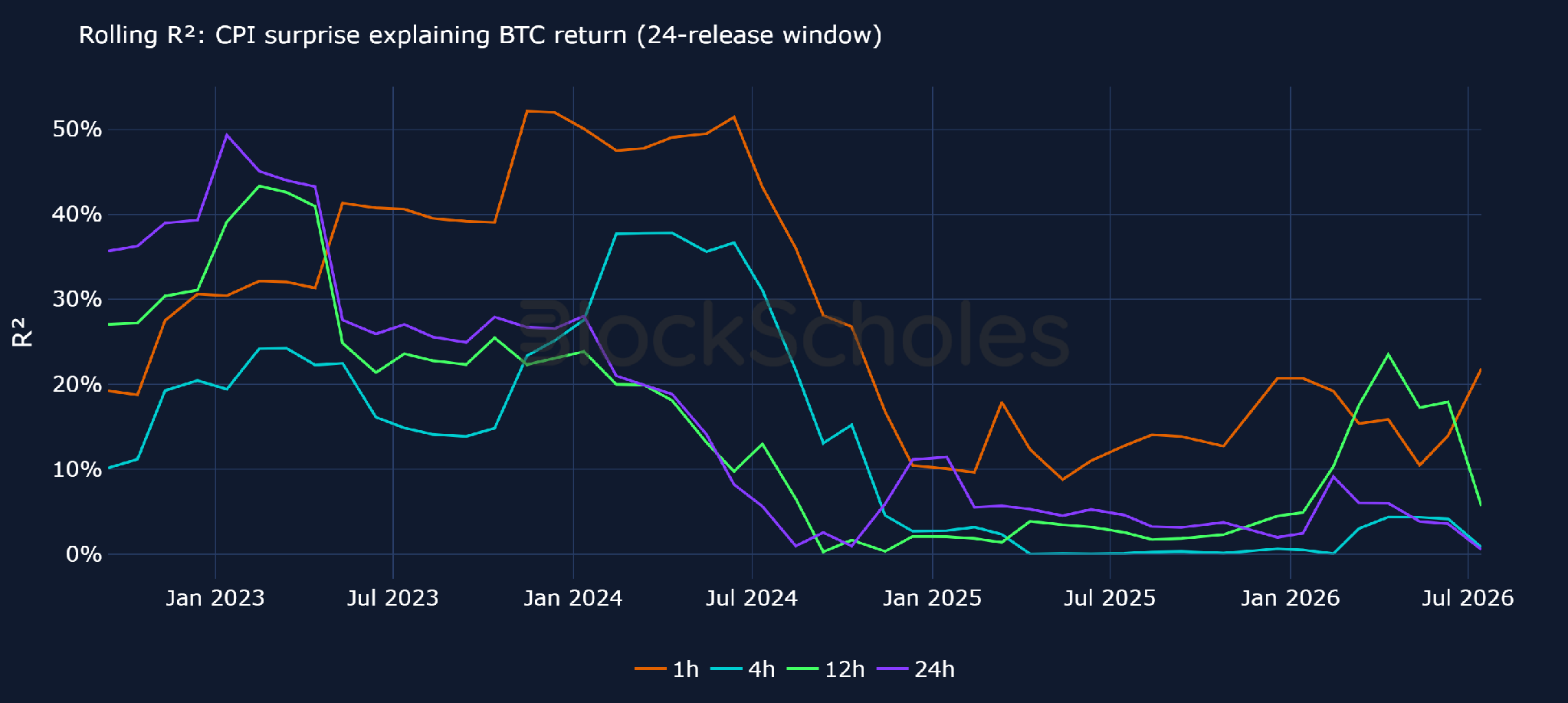
At the peak of the relationship (when the R² was highest, 52%), the 1-hour rolling β was -13% per pp. This meant that a 1pp surprise in CPI historically would have coincided with a 13% drop in BTC’s spot price over the next hour on average (or equivalently, a 0.1pp surprise in CPI coincided with a 1.3% drop in spot price on average). This 24-month window spans December 2021 to November 2023, covering the heart of the Fed’s post-Covid rate hike cycle.With CPI surprises averaging a 0.16pp standard deviation in that window, a typical upside surprise mapped to roughly a −1.3% BTC move within the hour. Importantly, this was accompanied by a strong R²: over half of BTC's first-hour return was explained by the surprise in the CPI alone.
Through late 2024 and into 2025 both the slope and its explanatory power collapsed. An upside surprise in CPI had a smaller impact on BTC, and the R² decayed toward zero.
However, in 2026, tentative signs of a resurgence in that relationship have emerged. In June 2026, the 1-hour rolling β was -3.2% per pp surprise in CPI. While that is smaller than the peak back in 2023, the R² over the 1-hour return period has jumped up in 2026 to around 22%, a level last seen back in late 2024.
This can be seen even more clearly when tightening the rolling window from 24 releases to 12, where a shorter window puts a stronger proportional weight on recent releases and removes some of the quieter 2024-25 period from the window.
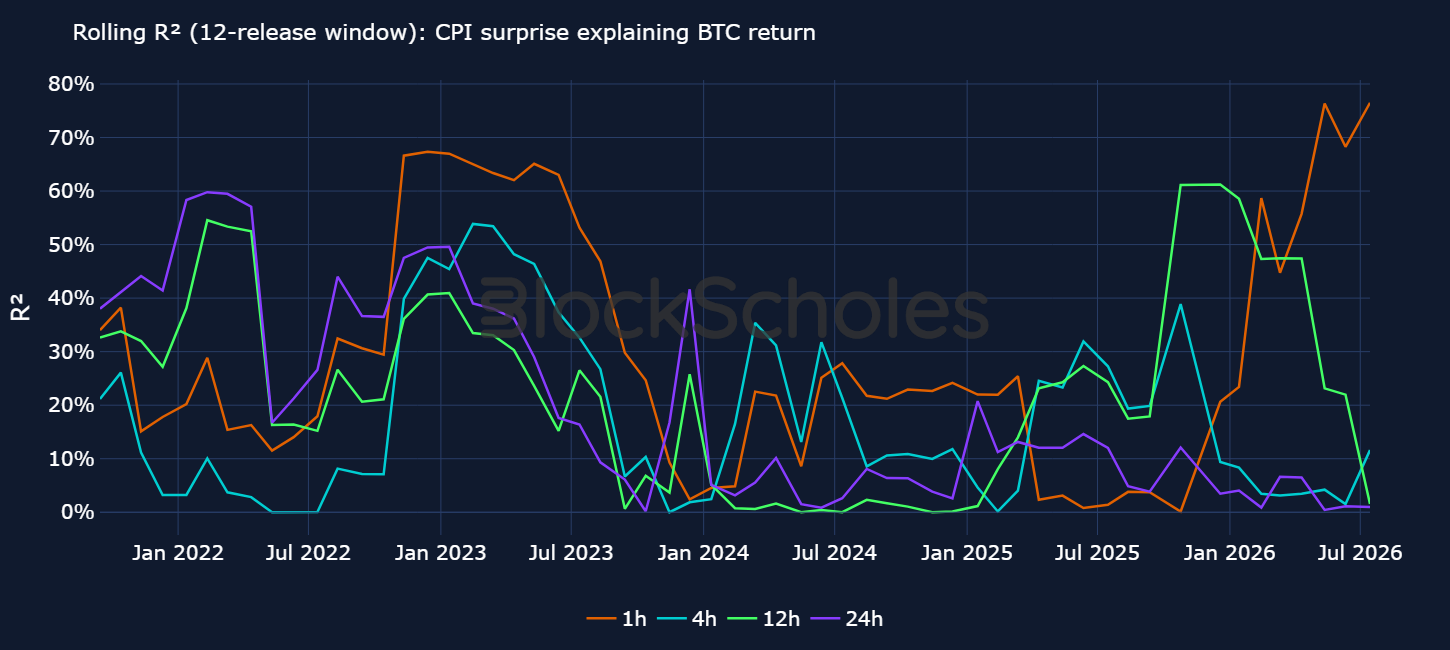
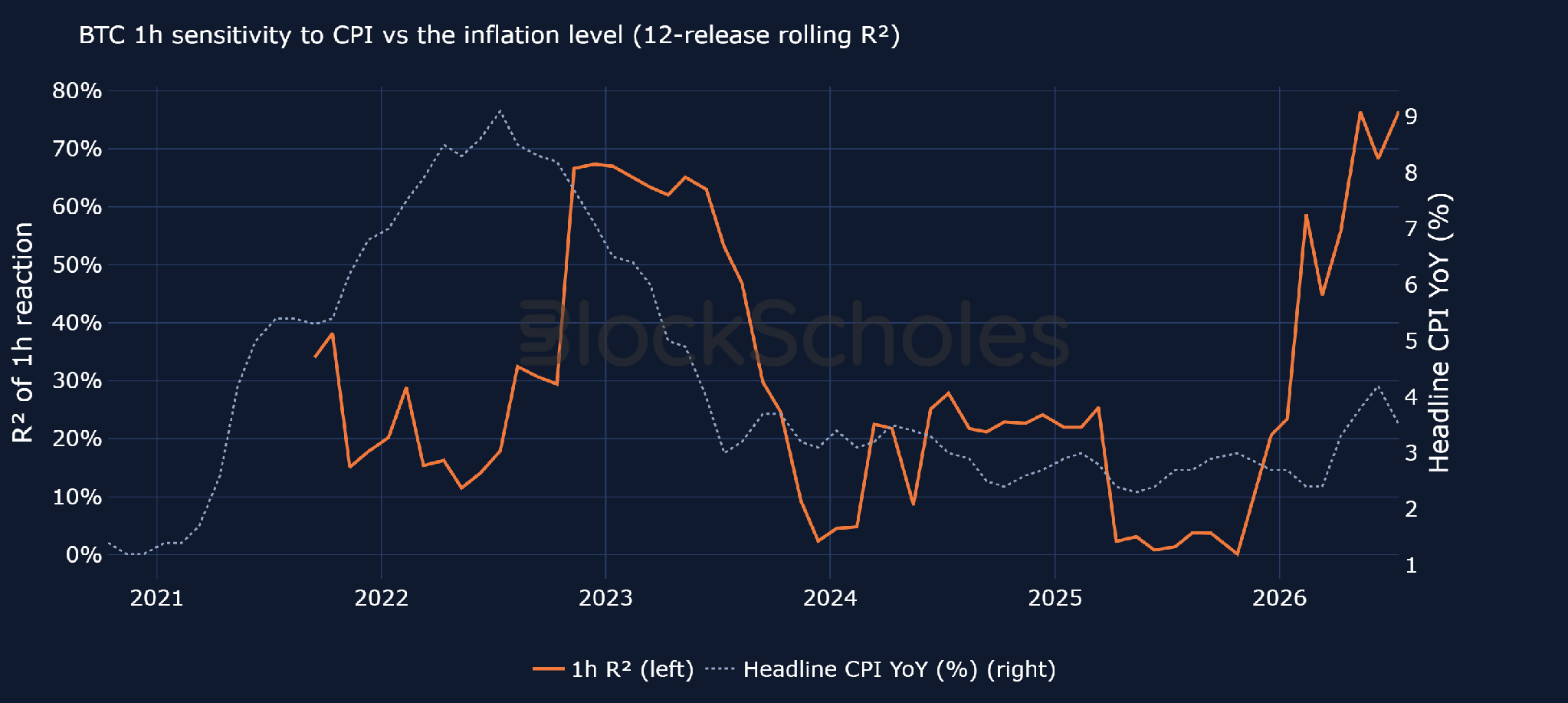
The 1-hour R² has increased steeply through 2026 to nearly 80%, surpassing even the 2022–23 peak. As such, there is evidence that over the past year, BTC is once more reacting more strongly to surprises in CPI.
This resurgence in the sensitivity of 1-hour returns to CPI has coincided with the sharp rise in the headline inflation level itself and, subsequently, Fed policymakers increasingly shifting attention towards inflation. Over the past week alone, a number of Fed speakers have argued that they will be ready to support hikes soon if inflation does not come down, or are already in favour of slightly tighter policy:
So far however, this has been specific to the immediate, one-hour horizon; and not the longer 4-to-24-hour periods.
CPI helps us understand what is happening in the US economy from an inflation point of view. A key report that covers the other side of the US economy, namely labour market strength, is the BLS’s nonfarm payrolls (NFP) report. The same static-regression over the last six years reveals a weaker relationship between surprises in US payrolls and BTC first hour returns.
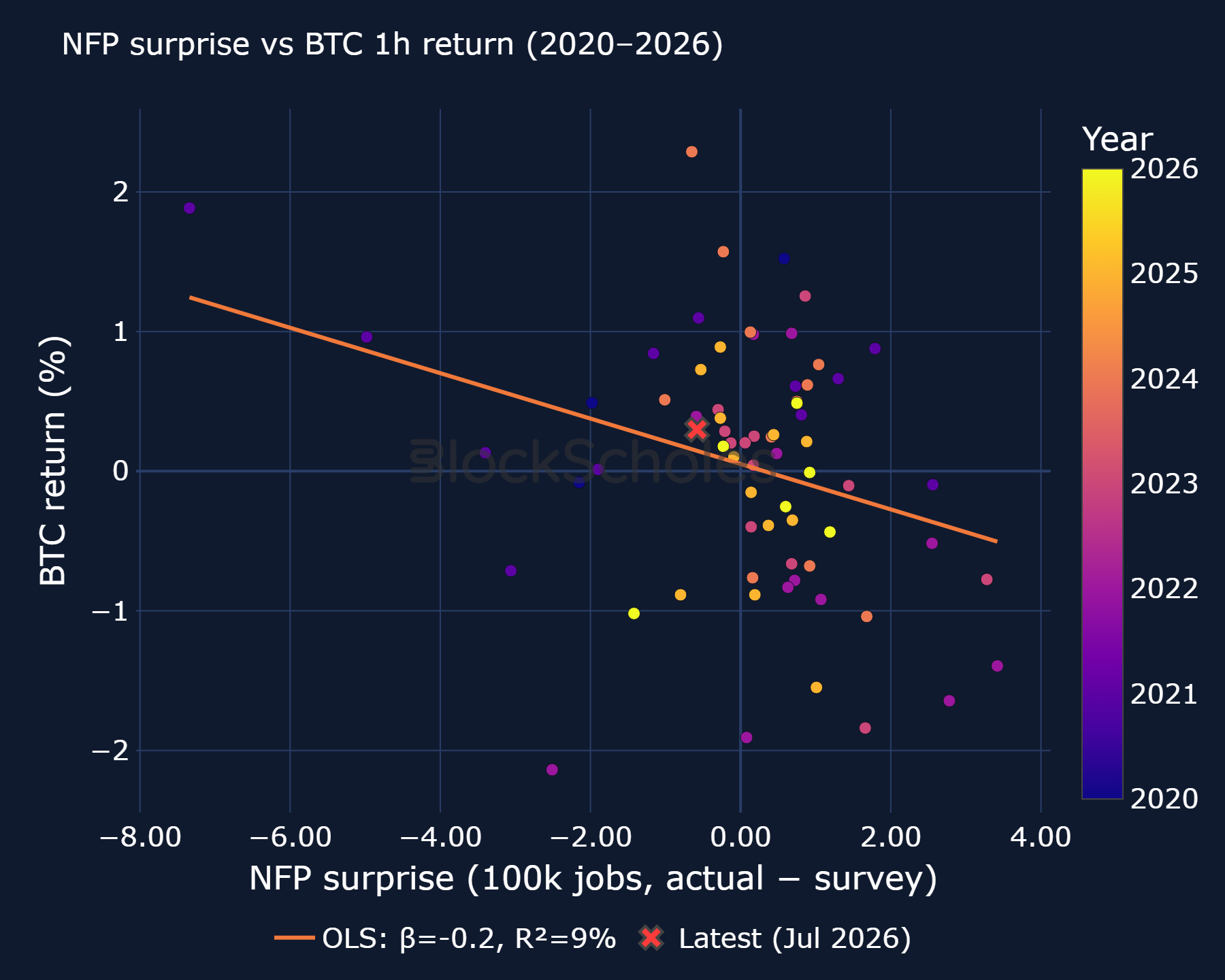
According to the full-sample regression, a 100K surprise in jobs has pushed BTC down 0.16% over the hour following the NFP release, with a smaller R² of 9% over the window.
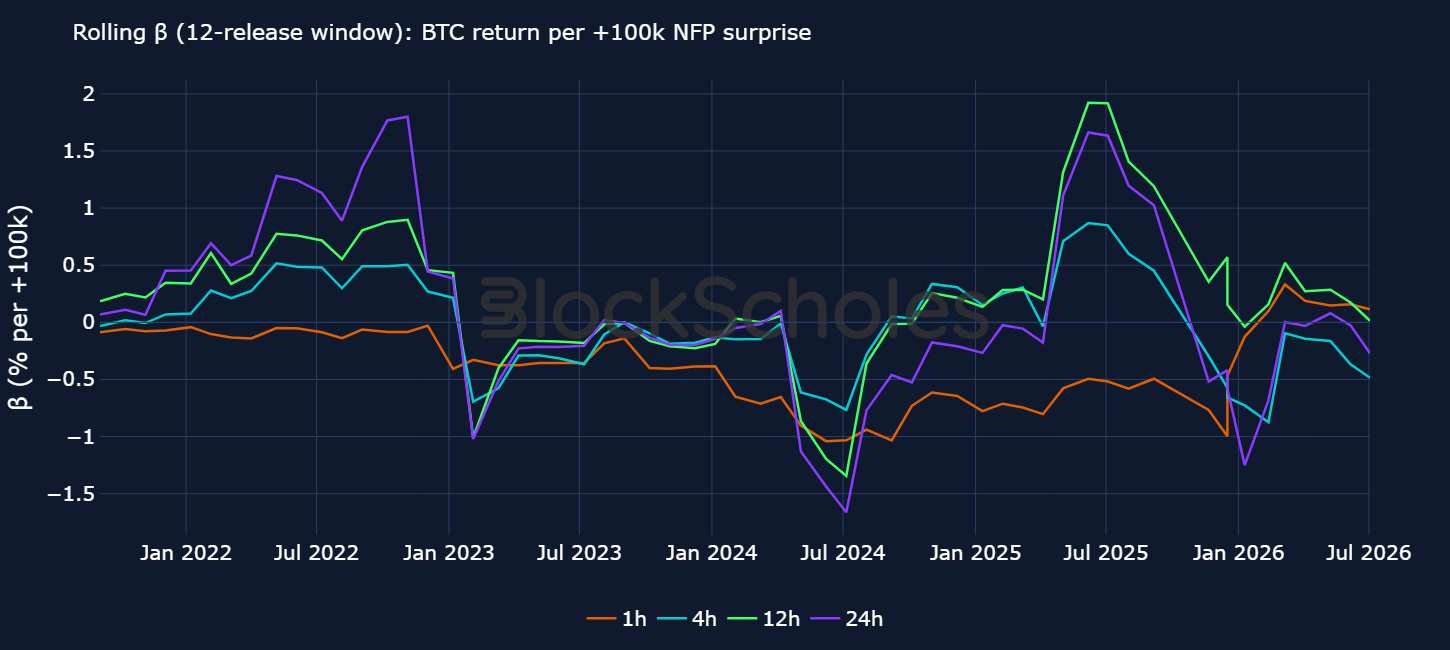
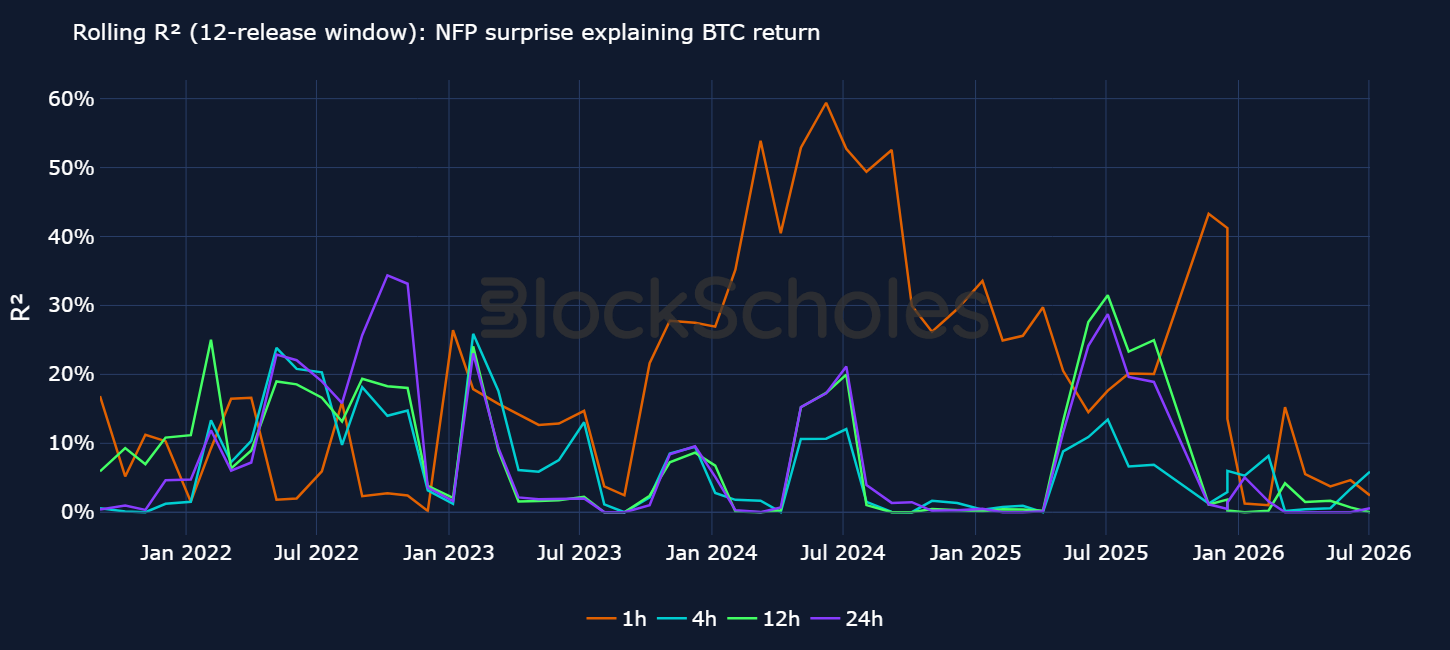
Similar to the CPI analysis, a static, single-period regression does however obscure the changing dynamics of that relationship. The peak in BTC’s 1-hour returns’ sensitivity to surprises in payrolls occurred in the summer of 2024 — a time when the US economy posted significantly weak jobs data, unemployment peaked at 4.3% and then-Chair Jerome Powell famously indicated a pivot towards rate cuts. The R² peaked at 59% in June 2024 and stayed above 30% into the late-end of the year, while over the same period, sensitivity to CPI releases began to show signs of fading.
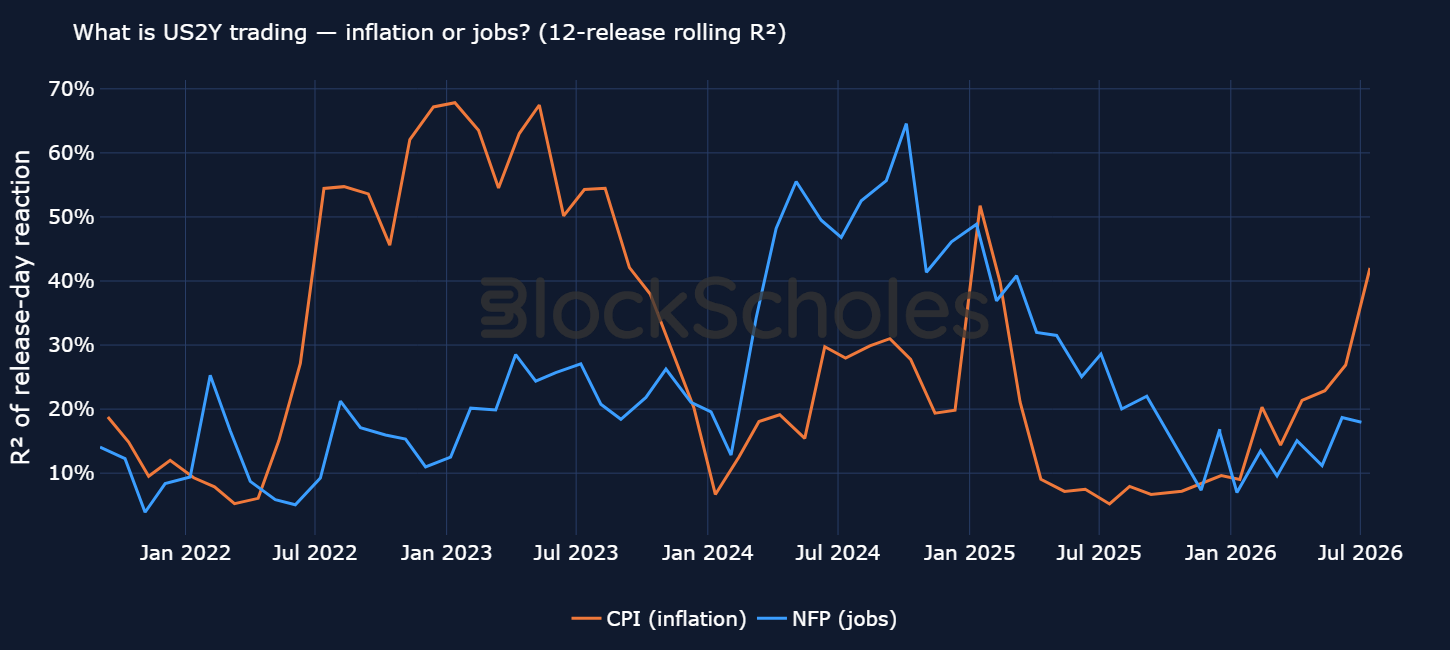
That was not specific to BTC either. A similar regression of CPI surprises and NFP surprises against 24-hour changes in the two-year US treasury yield, which is sensitive to changes in Fed policy, reveals something similar. Two-year yields reacted their strongest in the 2022-23 period when the Fed was tightening policy, while the R² between NFP surprise and two-year yields peaked in 2024 when policymakers shifted their attention to cracks in the labour market.
Fast-forward to today, we see the R² between BTC returns and NFP surprises is close to zero across all horizons in 2026, compared to its 60% peak back in 2024. Where Bitcoin's reaction function to CPI is beginning to re-form, its reaction to payrolls is fading.
As highlighted, that divergence directly coincides with a shift from the Federal Reserve itself. In his first congressional testimony, on 14 July 2026 — the same morning as the June CPI release — Chair Warsh described the labour market as "broadly stable," with "job creation … keeping pace with the workforce" and the unemployment rate "low and … changed little over the past year." On inflation however he claimed that the FOMC committee has "no tolerance for persistently elevated inflation" and a "resolute commitment to restoring price stability”.
When asked about the softer June CPI print, he cautioned against declaring victory — "there might be some that … say 'mission accomplished' … That is not my view." The 2026 macro anxiety has been around inflation, not the jobs market, and this is being reflected in an increase in BTC’s sensitivity to CPI prints, and not to nonfarm payrolls.
Through 2026 Bitcoin has unmistakably traded to macro-headwinds. Down 25% year-to-date, the inflation scare and hawkish repricing on Fed expectations has proven to be a headwind on spot price. At the same time, Fed officials have increasingly made it clear their focus is now on the inflation side of the dual mandate, cautioning that sticky US inflation may warrant the need for tighter monetary policy.
In line with this, BTC’s immediate reaction to CPI surprises is re-forming. On a 12-release window the surprise now explains close to 80% of Bitcoin's first-hour move — the strongest reading on record — albeit with smaller magnitude per surprise than the 2022–23 peak, and concentrated at the one-hour horizon.
At the same time, the reaction to payrolls has gone the other way, fading to near-zero in 2026 — consistent with the Fed, and a market more focused on inflation rather than the labour market. Not only do we think it will be interesting to see whether BTC’s relationship to CPI surprises continues over the course of the year, but with oil prices now below their 2026 peak and a market that has historically overpriced rate hike expectations, it will be interesting to see whether the historical relationship of downside surprises in CPI supporting BTC’s spot price, remains.