Fed Officials Weigh the AI Boom's Inflation Impact as Wholesale Prices Cool
Wholesale inflation cooled again, with headline PPI up 5.5% YoY against a 6.2% forecast and core PPI at 4.7% versus 5.2% expected, reinforcing Tuesday's soft CPI; the S&P 500 closed up 0.38% while the Nasdaq-100 fell 0.28% as chipmakers dragged, and BTC held between $64.5K and $65.5K. Fed Chair Warsh, John Williams and Lisa Cook all weighed whether the AI investment boom is inflationary, with Williams calling rates well positioned and Cook prepared to act, while further US strikes on Iran — including its first attack on a supertanker — kept Brent between $84 and $86.
Block Scholes is an FCA-regulated institutional crypto derivatives analytics platform. Live data, IV surfaces, and backtesting available via blockscholes.com.
Wholesale inflation cooled again, with headline PPI up 5.5% YoY against a 6.2% forecast and core PPI at 4.7% versus 5.2% expected, reinforcing Tuesday's soft CPI. The S&P 500 closed up 0.38% while the Nasdaq-100 fell 0.28% as chipmakers dragged, and BTC held between $64.5K and $65.5K.
Fed Chair Warsh, John Williams and Lisa Cook all weighed whether the AI investment boom is inflationary, with Williams calling rates well positioned and Cook prepared to act. Further US strikes on Iran, including its first attack on a supertanker, kept Brent between $84 and $86.
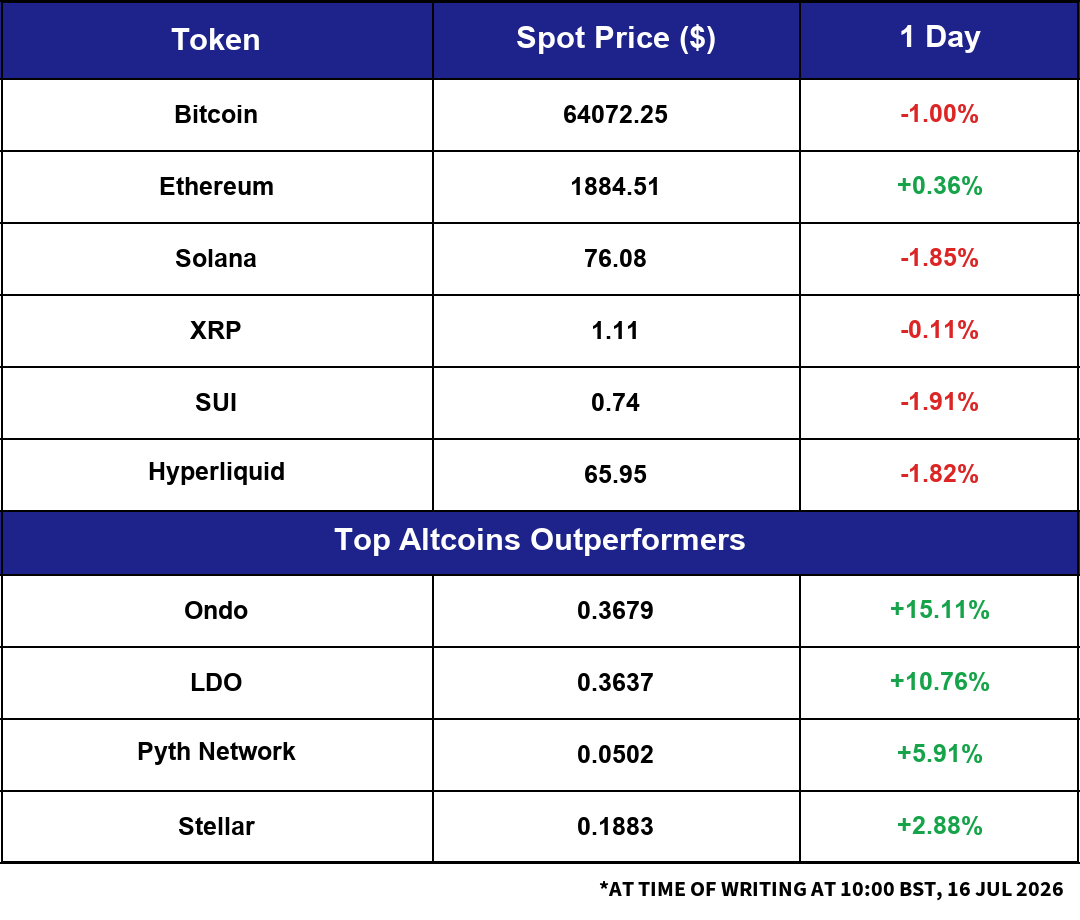
Market Snapshot: Overnight Moves
Macro & Markets
BTC held up between $64.5K and $65.5K throughout yesterday’s trading session, while US equities finished the session higher, following another softer-than-expected inflation report.
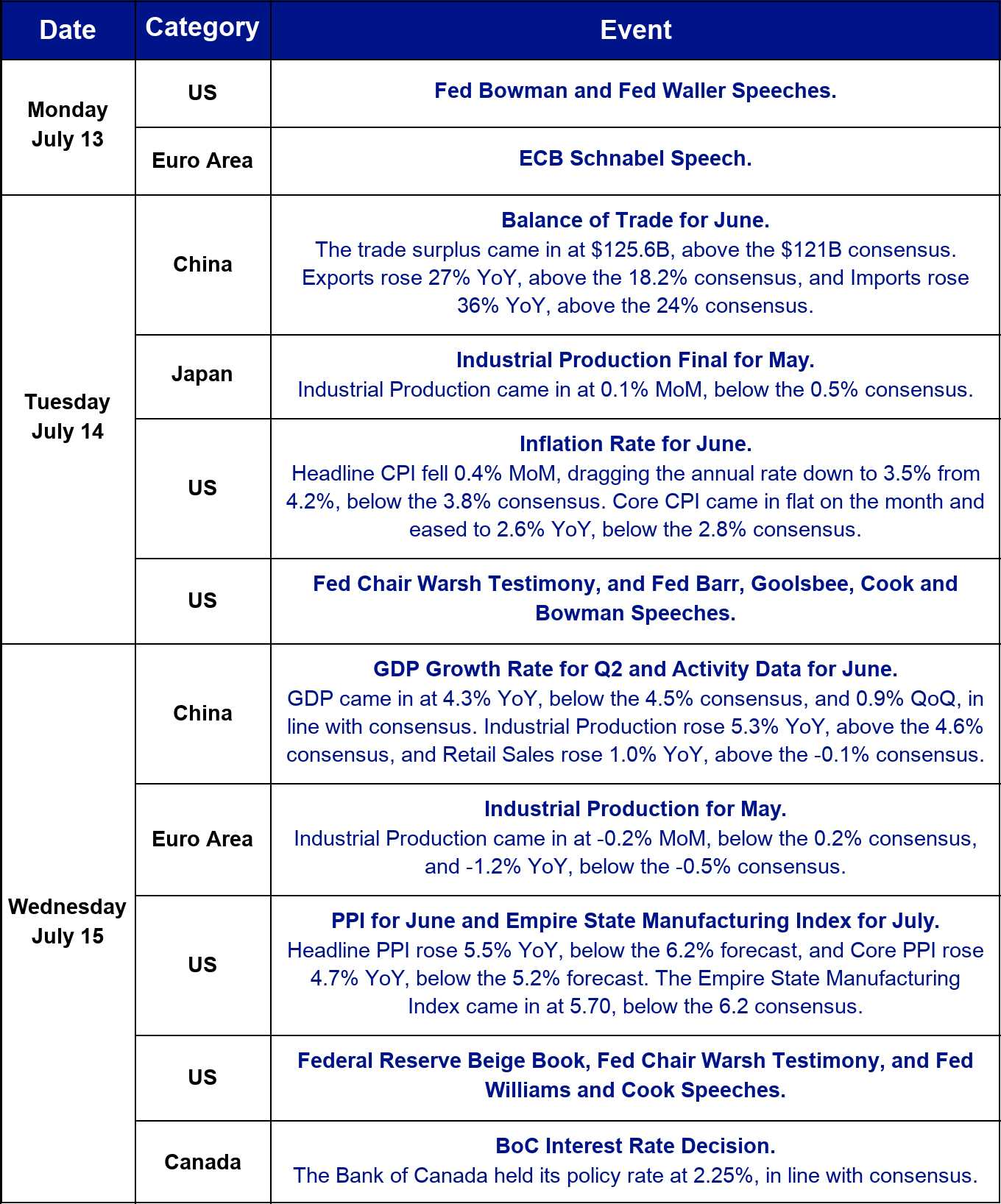
The headline producer price index rose 5.5% year-over-year (against a forecast of 6.2%), while the core PPI increased 4.7% from a year earlier (versus expectations of 5.2%).
The report showed that a 6.4% decline in energy costs in June from a month earlier helped drive down inflation at the wholesale level. That softer print supported Tuesday’s CPI, which also came in lower than expected.
Most major US equity benchmark indices ended the day higher, the S&P 500 closed the mid-week session up 0.38%, the Dow Jones rose 0.29% and the Russell-2000 advanced 0.39%.
The Nasdaq-100 on the other hand ended the day in the red (-0.28%) dragged down by chipmakers. The PHLX Semiconductor Sector index fell 2.08%.
While inflation in June showed a promising slowdown at both the wholesale and consumer level, continued conflict in the Middle East is threatening the outlook.
The US launched another round of airstrikes on Iran yesterday as President Trump has pledged to intensify his attacks on the country until it stops targeting ships in the Strait of Hormuz.
The US Central Command said the most recent of the attacks was a 90-minute operation where the US military targeted missile storage and launch sites on Greater Tunb Island in the Persian Gulf near the Strait of Hormuz as well as air defense sites and coastal surveillance installations.
Similar to the wave of strikes earlier this week and last week, the move was designed to “degrade Iran’s ability to threaten” shipping in the waterway.
Additionally, the US military attacked a supertanker travelling deep within the Persian Gulf, its first attack on a vessel since it reimposed its blockade in the Strait of Hormuz.
The Curacao-flagged Belma crude oil tanker was attacked by missiles from an American aircraft after the vessel repeatedly ignored warnings that it was violating the blockade by sailing through international waters toward Kharg Island, a key oil export terminal for Iran.
Despite the escalations, President Trump did reiterate his claims that Iran is seeking more talks. In an interview with Fox Business, the president said, “We received a call just as I was coming here that they want to meet”.
Brent crude oil has continued to fluctuate between $84 and $86 per barrel, though remains significantly lower than the $120 level it reached during the peak of the conflict.
In the second day of testimonials before a US Senate panel, Fed Chair Kevin Warsh said that the investment boom in artificial intelligence is likely to raise prices in the year ahead, though it may not result in persistent inflationary pressures.
Warsh said that it is easier to measure the effects of the AI build-out on the demand-side of the economy, as the boom is already driving up capital spending and the price of memory chips. However, it is harder to estimate the effects on the economy’s ability to supply goods and services, as policymakers are still understanding when the technology's broader productivity benefits may materialise.
He said, “I don’t view a one-time change in prices as necessarily being inflationary because I think there’s a supply response; in that way this is different from a foreign conflict and what it might do, which tends to reduce the supply side of the economy” and added, “Will it increase measured prices over the course of the next 12 months? I suspect it will…. Whether that’s inflationary or not, that’s up to the Federal Reserve, and we're going to have something to say about that."
When asked about his discussions with President Trump, Warsh responded, "I just don't want to be in the business of sharing discussions that the president and I have”.
Warsh added, “I will tell you what I’ve said to the president repeatedly, and said to the Treasury secretary: They chose an independent guy to do an independent job, and that’s exactly what I plan on doing”.
Speaking at an event in New York, John Williams, the NY Fed President also focused on the impact of AI-induced inflation.
Williams reiterated his view that interest rates are currently "well positioned", even as demand from AI is putting upward pressure on inflation in his view, "I am confident that these investments will support strong productivity growth in coming years. But, right now, we're in a race between available supply and surging demand".
According to the NY Fed President, "The supply-demand imbalances stemming from AI-related investment should recede over time as more supply comes online. "That said, the magnitude and duration of these supply-demand imbalances are highly uncertain."
Last week he cautioned that if AI-driven demand was sustained, the Fed wouldn't be able to "look through" its results.
Williams also said in his remarks that while "Inflation is unquestionably too high”, there are “encouraging reasons to expect that inflation has peaked and should edge down in coming quarters,” citing that tariffs shouldn’t add additional pressures on consumer prices, shelter inflation remains on a downward trajectory and energy prices appear to have peaked.
In a speech to the Exchequer Club of Washington, Fed Governor Lisa Cook said she is "prepared to act" if inflation does not soon begin to slow, though is willing to wait "a bit more time" for that to happen.
"I see it as prudent to give a bit more time to observe how inflation unfolds from here. Going forward, though, I believe the risks continue to be strongly weighted toward higher inflation for at least two reasons".
The two reasons she cited were, the investment boom around AI, “the AI buildout does not show signs of slowing”, and “the recent big supply shocks, tariffs and the Middle East conflict”.
DeFi / Web3 / Altcoins / Crypto
Strategy, the largest bitcoin treasury company, plans to remain a long-term buyer of BTC despite recently selling more than $215M worth, CEO Phong Le told Bloomberg TV.
Le said the company would only begin reassessing risks tied to its debt if bitcoin fell to roughly $8,000-$10,000, adding that its current balance sheet remains secure.
Strategy also raised about $467M through common stock sales, bringing its cash reserve to roughly $3B, which it says can cover preferred dividends for around two years and support future bitcoin purchases.
Ethereum treasury company, Bitmine Immersion Technologies, reported $45.7M in Ethereum staking and validator revenue for the quarter ended May 31, representing 98% of its $46.5M in total revenue, according to an SEC filing.
The company said roughly 4.9M ETH, or 85% of its Ethereum holdings, has been staked through MAVAN, its institutional staking platform, with Chairman Tom Lee projecting annualized staking rewards of $284M once its entire ETH position is staked.
Jesse Pollak, the Coinbase executive who created Base, Coinbase’s Ethereum Layer 2 network, is handing the Base app to Jordan “Cobie” Fish so he can focus entirely on developing the underlying Base blockchain.
Pollak said several social and creator-focused experiments tied to Farcaster, Zora, miniapps and creator coins fell short, prompting the app’s leadership change.
He will now prioritize turning the Base network into infrastructure for global finance through trading, stablecoin payments and AI agents.
Nasdaq-listed Hyperion DeFi has entered a new HYPE Asset Use Service (HAUS) agreement with Skew Technologies, committing 500,000 staked HYPE to support the launch of institutional perpetual futures markets on Hyperliquid's HIP-3 infrastructure.
In return, Hyperion will receive an equity stake in Skew alongside a share of future market listing revenues.
The partnership reflects Hyperion's strategy of generating yield from its HYPE treasury while backing ecosystem growth.
It also follows the company's decision to unwind earlier HIP-3 arrangements tied to the now-retired USDH stablecoin, as Hyperliquid continues its transition to USDC as its primary quote asset.
Volvo Group is exploring a proprietary cryptocurrency within a private blockchain-based settlement system for its supply chain.
The pilot creates a closed ecosystem where Volvo, material suppliers, and transport partners can settle transactions using a dedicated digital token while recording logistics data on a shared ledger.
According to Volvo executive Ivan Branco, the project is intended to simplify settlements, improve transparency, and reduce complexity in information sharing, rather than target public cryptocurrency markets.
The company believes a blockchain-based settlement system could reduce complexity, improve transparency, and streamline information sharing between supply chain participants.
The Czech Ministry of Finance, the government agency overseeing gambling regulation, added Polymarket, a crypto-based prediction market platform, to its list of unauthorized online gambling operators, requiring internet providers to block access within 15 days.
The decision highlights ongoing regulatory questions over whether prediction market platforms fall under gambling or financial market regulations.
Ostium, an Arbitrum-based perpetual futures exchange, paused trading after a security incident caused losses from its public OLP vault between 14:18 and 14:23 UTC.
The team said it identified the issue within minutes and coordinated the shutdown of trading contracts within an hour to contain the damage.
Ostium is working with law enforcement, SEAL 911 (a crypto incident-response group), and third-party cybersecurity specialists while it investigates and prepares further updates.
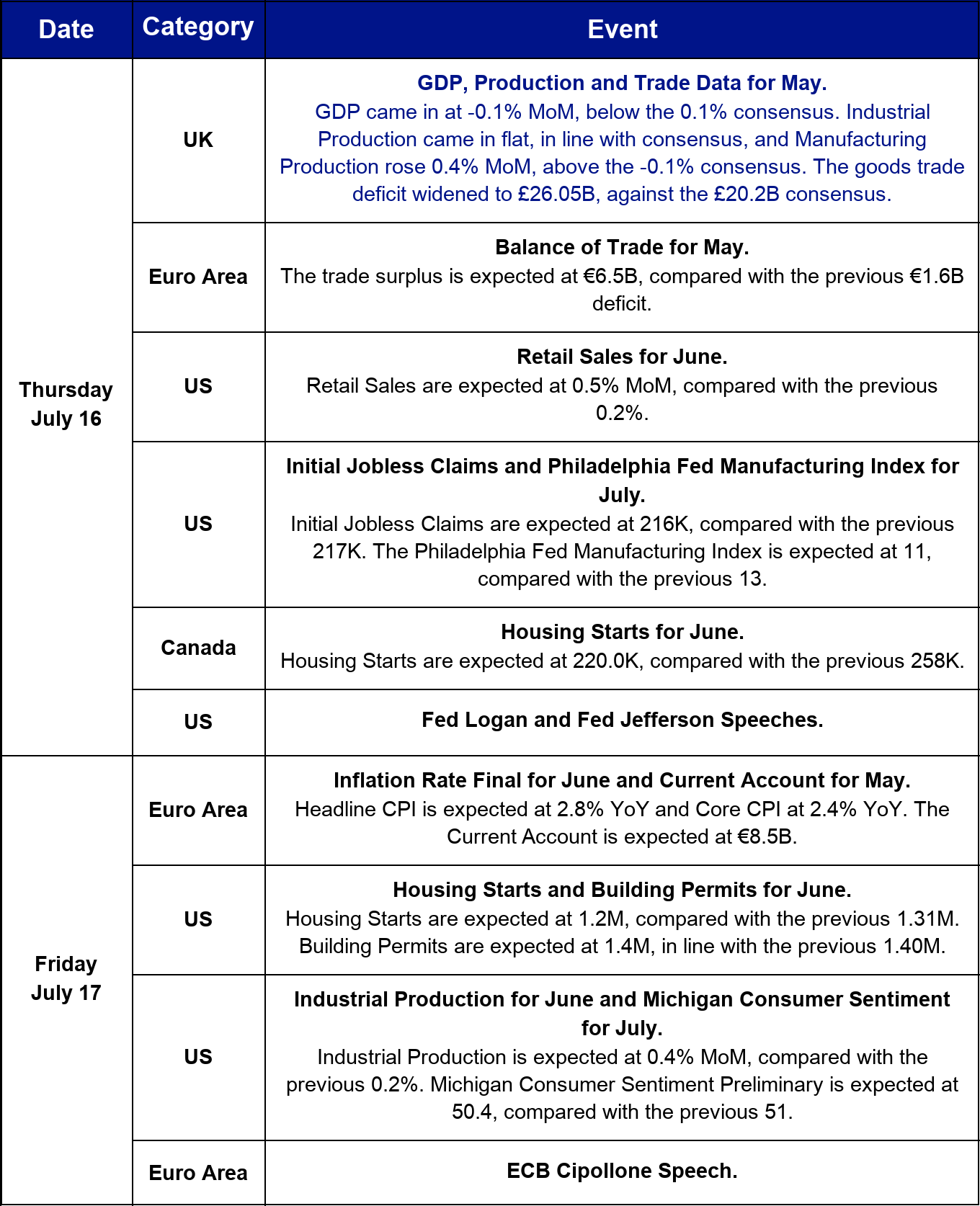
This Week's Calendar
Charts of the Day
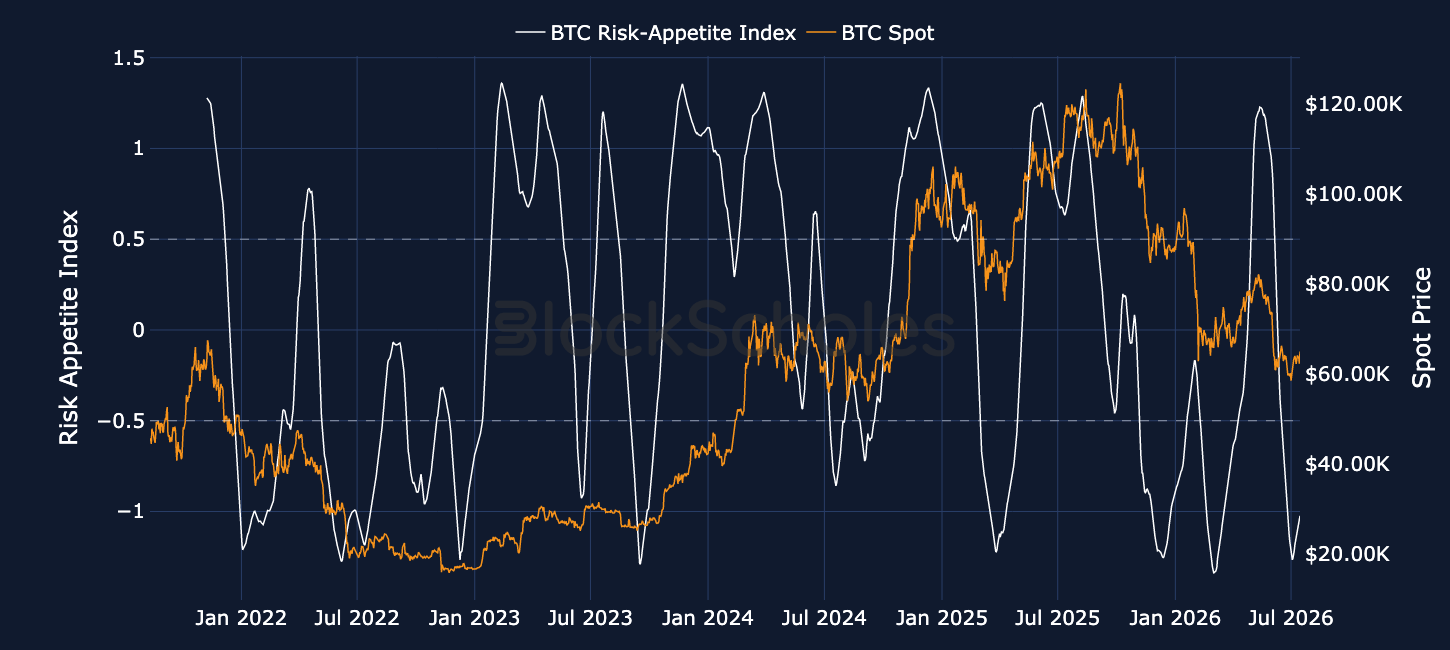
Figure 1. Block Scholes BTC Risk-Appetite Index (white, left-hand axis) and BTC spot price (orange, right-hand axis).
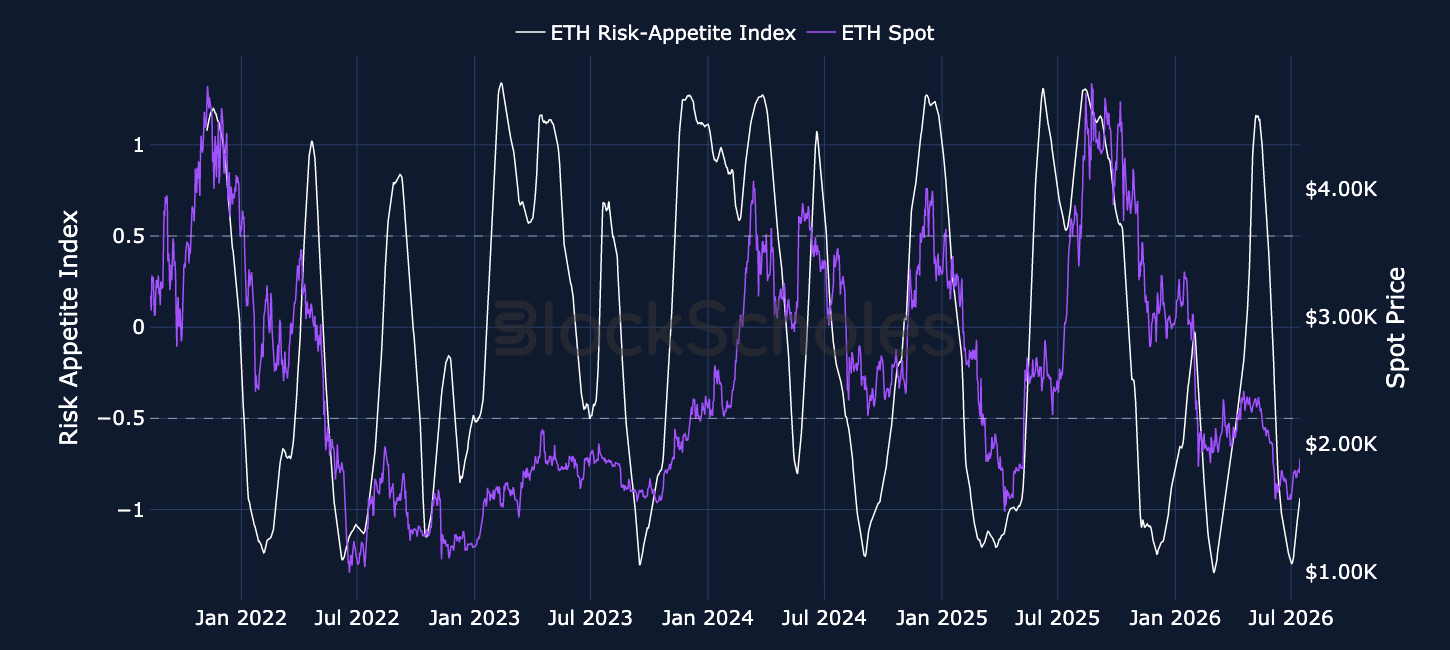
Figure 2. Block Scholes ETH Risk-Appetite Index (white, left-hand axis) and ETH spot price (purple, right-hand axis).
Block Scholes is an FCA-regulated institutional crypto derivatives analytics platform. Live data, IV surfaces, and backtesting available via blockscholes.com.
In Today's Note
Wholesale inflation cooled again, with headline PPI up 5.5% YoY against a 6.2% forecast and core PPI at 4.7% versus 5.2% expected, reinforcing Tuesday's soft CPI. The S&P 500 closed up 0.38% while the Nasdaq-100 fell 0.28% as chipmakers dragged, and BTC held between $64.5K and $65.5K.
Fed Chair Warsh, John Williams and Lisa Cook all weighed whether the AI investment boom is inflationary, with Williams calling rates well positioned and Cook prepared to act. Further US strikes on Iran, including its first attack on a supertanker, kept Brent between $84 and $86.
Market Snapshot: Overnight Moves
Macro & Markets
BTC held up between $64.5K and $65.5K throughout yesterday’s trading session, while US equities finished the session higher, following another softer-than-expected inflation report.
The headline producer price index rose 5.5% year-over-year (against a forecast of 6.2%), while the core PPI increased 4.7% from a year earlier (versus expectations of 5.2%).
The report showed that a 6.4% decline in energy costs in June from a month earlier helped drive down inflation at the wholesale level. That softer print supported Tuesday’s CPI, which also came in lower than expected.
Most major US equity benchmark indices ended the day higher, the S&P 500 closed the mid-week session up 0.38%, the Dow Jones rose 0.29% and the Russell-2000 advanced 0.39%.
Don't miss what's next
Upgrade your Block Scholes account to unlock this article and other exclusive insights
Block Scholes is an FCA-regulated institutional crypto derivatives analytics platform. Live data, IV surfaces, and backtesting available via blockscholes.com.
In Today's Note
Wholesale inflation cooled again, with headline PPI up 5.5% YoY against a 6.2% forecast and core PPI at 4.7% versus 5.2% expected, reinforcing Tuesday's soft CPI. The S&P 500 closed up 0.38% while the Nasdaq-100 fell 0.28% as chipmakers dragged, and BTC held between $64.5K and $65.5K.
Fed Chair Warsh, John Williams and Lisa Cook all weighed whether the AI investment boom is inflationary, with Williams calling rates well positioned and Cook prepared to act. Further US strikes on Iran, including its first attack on a supertanker, kept Brent between $84 and $86.
Market Snapshot: Overnight Moves
Macro & Markets
BTC held up between $64.5K and $65.5K throughout yesterday’s trading session, while US equities finished the session higher, following another softer-than-expected inflation report.
The headline producer price index rose 5.5% year-over-year (against a forecast of 6.2%), while the core PPI increased 4.7% from a year earlier (versus expectations of 5.2%).
The report showed that a 6.4% decline in energy costs in June from a month earlier helped drive down inflation at the wholesale level. That softer print supported Tuesday’s CPI, which also came in lower than expected.
Most major US equity benchmark indices ended the day higher, the S&P 500 closed the mid-week session up 0.38%, the Dow Jones rose 0.29% and the Russell-2000 advanced 0.39%.
Don't miss what's next
Upgrade your Block Scholes account to unlock this article and other exclusive insights
Premium
$30/mo
Access previous and future reports, market insights & deep dives.
US stocks ended flat and Treasury yields eased as Fed officials backed one more hike this year without an aggressive cycle, while BTC slipped 0.2% to $83.4K and ETH fell 0.5% to $2,504 overnight ahead of CPI. Strive bought 3,311 BTC, DRW and Marex completed a swap on a tokenized benchmark, and Ledger confirmed tampered reseller devices stole recovery phrases.
The chip selloff spread to Asia and the S&P 500 closed marginally lower, while BTC was flat at $83.5K after a V-shaped rebound ahead of bank earnings. Bitmine and Strategy added to their holdings.