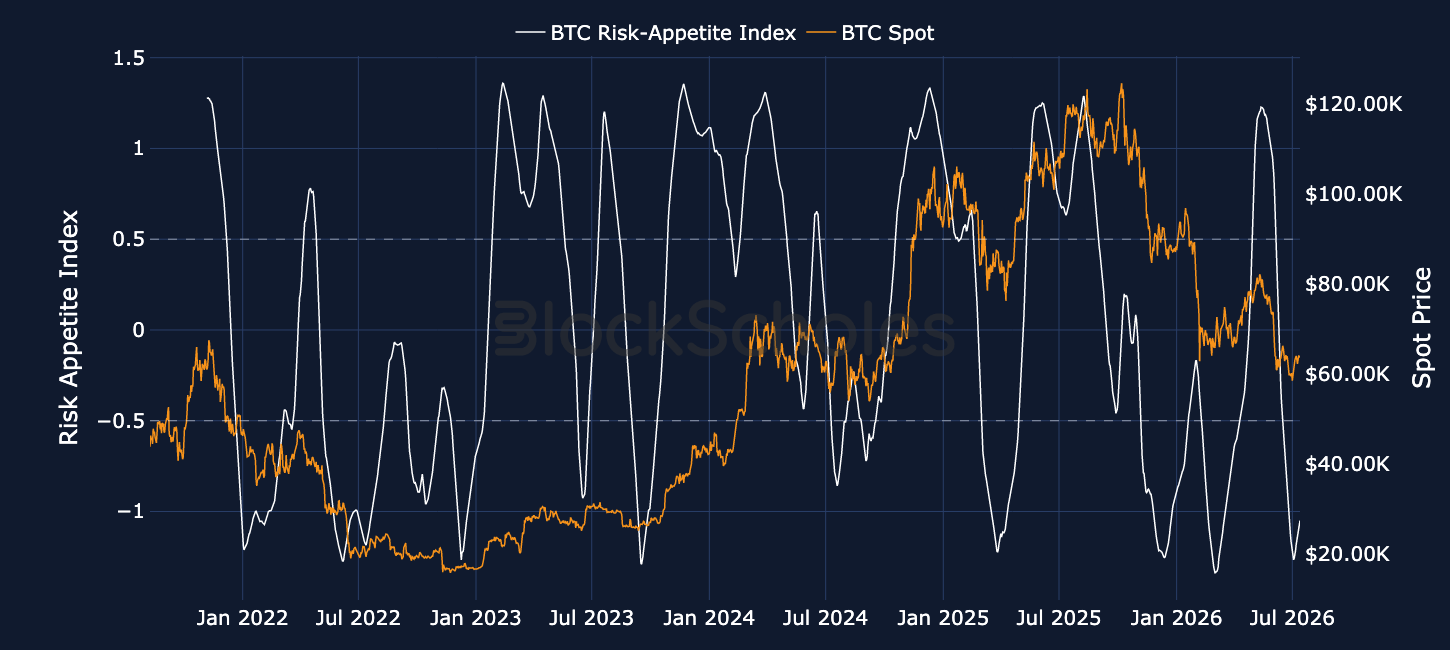
Bitcoin Slips Below $62K as Hormuz Blockade and Hawkish Waller Sour Risk Appetite
Risk appetite soured after President Trump reinstated a US blockade of Iranian ships in the Strait of Hormuz: BTC briefly fell below $62,000, the Nasdaq-100 dropped 1.88% and Brent crude jumped more than 10% to $85, while Fed Governor Waller warned rates may need to rise, lifting the odds of a July hike to 43%. US banking groups urged the Senate to tighten the CLARITY Act's stablecoin reward rules, HMRC proposed no-gain, no-loss tax treatment for crypto lending and liquidity pools, Hyperliquid's HIP-3 markets now account for nearly half of its perpetual volume, and SBI partnered with the Solana Foundation on a Japan-based onchain finance venture.

Block Scholes is an FCA-regulated institutional crypto derivatives analytics platform. Live data, IV surfaces, and backtesting available via blockscholes.com.
Recent Research from Block Scholes
- Block Scholes x Castle Labs: The Renaissance of Onchain Options
- How On-Chain Markets Have Priced Recent IPOs
- From Aggregation to Execution: The Next Layer of Onchain Trading Infrastructure
- Tokenised Markets on Bitget UEX: Liquidity Conditions in Bitget’s Real World Asset Perpetual Markets
In Today's Note
- Risk appetite soured after President Trump reinstated a US blockade of Iranian ships in the Strait of Hormuz. BTC briefly fell below $62,000 and the Nasdaq-100 dropped 1.88%, while Fed Governor Waller warned rates may need to rise, lifting the odds of a July hike to 43%.
- US banking groups urged the Senate to tighten the CLARITY Act's stablecoin reward rules, and HMRC proposed no-gain, no-loss tax treatment for crypto lending and liquidity pools. Hyperliquid's HIP-3 markets now account for nearly half of its perpetual volume, and SBI partnered with the Solana Foundation on a Japan-based onchain finance venture.
Market Snapshot: Overnight Moves

Macro & Markets
- With the US and Iran in a standoff over traffic in the Strait of Hormuz, risk appetite has taken a hit across crypto assets and US equities, while Brent crude has jumped more than 10% to trade at $85 per barrel.
- BTC briefly fell below $62,000 and the S&P 500 finished 0.79% lower.
- Meanwhile, the Nasdaq-100 plunged by a larger 1.88% amidst a larger sell off in semiconductor and chipmakers (the Philadelphia Semiconductor Sector index dropped by 4.78%).
- President Trump announced yesterday that the US has reinstated its blockade of Iranian ships passing through the Strait of Hormuz and is demanding a 20% reimbursement for all other cargo that is shipped through the waterway.
- On Truth Social Trump claimed Iranian ships would be blocked from entering or leaving, but vessels from other nations could pass through. However, the US, “as a matter of FAIRNESS, will be reimbursed, at the rate of 20% on all cargo shipped, for any and all costs necessary to do the job of providing safety and security to this very volatile section of the World”.
- The peace treaty negotiated in June had stipulated for toll-free commercial shipping during a 60-day negotiating window between both sides.
- Trump claimed the US would become the straits “GUARDIAN,” while the US Central Command claimed military forces will officially begin to blockade traffic to and from Iranian ports and coastal areas beginning Tuesday 4 p.m. New York time.
- It also said yesterday that the US military had completed another series of strikes following a five-hour mission aimed at degrading “Iran’s ability to attack commercial shipping.”
- Speaking on Fox News Trump said the US should be compensated for helping to keep traffic moving through the strait, as other countries "made all the money" previously.
- "We guarded it for nothing, and now we're going to guard it, and we're going to get paid for guarding it, a lot of money. But we just want to be reimbursed for doing all of this, for putting our people in danger."
- Iran’s government said the deal with the US has “undoubtedly entered a crisis phase”, while Iranian Foreign Minister Abbas Araghchi wrote on X that “Iran has always been the GUARDIAN of the Strait and will remain so FOREVER … 20% is of course too much. We will be fair.”
- Adding to the risk off mood, Federal Reserve Governor Christopher Waller warned that the central bank may need to raise interest rates in the near term if underlying core inflation continues to move higher.
- Speaking at an event in New York, Waller claimed, "If we get another hot reading on core inflation this week, then the FOMC will need to consider tightening monetary policy in the near term”.
- According to Waller, monetary policy was at a "crossroads" because of a number of supply-side forces that have shaped inflationary pressures, including tariffs, higher energy prices and artificial intelligence.
- "No matter how you cut it, or what measure you want to use, inflation is up this year. At this point, I am concerned about the elevated pace of core inflation."
- Waller pointed to the core PCE index which hit 3.4% in the year through May, which began rising in January, before the US-Iran war began, and "has steadily moved up” since.
- "I would be very pleased to see a lower reading on core inflation, but after its escalation over the first half of this year, I will need to see several months of lower readings to feel that inflation is moving in the right direction," Waller said. Should such an outcome occur, he indicated support for holding rates where they are.
- Following yesterday’s events, bond traders have massively repriced expectations for the July 29 FOMC meeting.
- That’s evident both in Fed funds futures contracts which now price in a 43% chance of a rate hike, versus 8% one month ago, as well as short-term US treasury yields.
- The two-year Treasury note’s yield, most sensitive to Fed policy, now trades around 4.29%.
- The CPI report for June released later today is expected to show a 0.1% drop in overall prices from May, bringing the year-on-year rate down to 3.8% from 4.2%.
- Core prices are seen rising 0.2% from May and 2.8% from last June.
DeFi / Web3 / Altcoins / Crypto
- US banking groups have urged the Senate to tighten the CLARITY Act’s stablecoin rules, warning that reward structures could make stablecoins function like bank deposits.
- In a joint letter sent on Monday to Senate Majority Leader John Thune and Minority Leader Charles Schumer, the American Bankers Association, the Independent Community Bankers of America and 76 state banking associations called for clearer guardrails around payment stablecoins.
- The groups said Section 404 may still allow balance- or tenure-based rewards that resemble interest, potentially driving deposits away from community banks and reducing funding for mortgages, small businesses and agricultural lending.
- HM Revenue & Customs (HMRC) is introducing new tax legislation for cryptoasset lending and liquidity pools in the UK.
- Under the proposed framework, eligible deposits into lending protocols would be treated on a “no gain, no loss” basis, meaning capital gains tax would be deferred until an actual economic disposal takes place.
- Underlying collateral would also be disregarded for capital gains tax purposes.
- HMRC’s approach follows industry feedback that treating these transactions differently would create a significant administrative burden for taxpayers.
- The UK has published a roadmap for tokenizing wholesale financial markets, estimating that the sector could contribute up to £33B in annual economic output and £14B in annual tax revenue by 2035.
- The report, led by the government’s Wholesale Digital Markets Champion Christopher Woolard, focuses on tokenized government bonds, stablecoins and onchain settlement infrastructure.
- It calls for the first issuance under the Digital Gilt Instrument pilot by the first quarter of 2027.
- The roadmap also recommends expanding the use of tokenized collateral, modernizing payment rails and establishing clearer legal and tax standards to support institutional adoption.
- Hyperliquid’s HIP-3 markets now account for nearly 50% of the platform’s daily perpetual trading volume, up from roughly 2% at the start of the year.
- The growth has been driven by rising demand for onchain equity trading, led by TradeXYZ markets tracking the Nasdaq-100 and stocks such as Nvidia and Tesla.
- These contracts trade around the clock and settle in stablecoins rather than underlying shares.
- Bitcoin and Ethereum tweet volumes have fallen to 12-month lows, despite growing institutional involvement in crypto.
- Mentions of Bitcoin have dropped to around 130,000, while Ethereum mentions have declined to roughly 40,000 - levels last seen in 2020, before spot ETFs and major corporate treasury allocations became prominent.
- Solana-based DEX Jupiter has launched Jupiter Gacha, a beta platform where users can buy and trade tokenized, graded Pokémon and One Piece cards onchain.
- Each card is authenticated, sealed in a physical slab and represented by a token that can be traded directly through Jupiter. Users purchase random packs, with the underlying collectible remaining tied to its onchain representation.
- Jupiter’s entry could strengthen the growing market for tokenized collectibles and encourage broader adoption across categories such as sports cards, watches and luxury goods.
- SBI Holdings, a Japanese financial conglomerate, partnered with Solana Foundation, to build a Japan-based onchain financial market, with Solana Foundation taking a stake in SBI R3 Japan.
- SBI R3 Japan, SBI’s blockchain joint venture with Sumitomo Mitsui Financial Group, plans to rebrand as SBI Solana Global and support stablecoins including JPYSC, SBI’s yen based stablecoin.
- The venture will also focus on tokenized real-world assets such as corporate bonds, commercial paper, funds and real estate, along with cross-border settlement, institutional onchain financial services and payment infrastructure for AI agents on Solana.
- Japan’s leading digital asset issuance and management platform, Progmat, has completed the migration of its security token platform to a dedicated Avalanche Layer 1.
- The move transferred roughly $2.7B, in active tokenized assets from a private Corda 5 ledger to a public, EVM-compatible blockchain.
- Progmat said the migration was completed on schedule with no disruption to participating financial institutions.
- The new architecture is blockchain-agnostic, making future multi-chain expansion easier, while all existing smart contracts were ported to EVM without changing the behaviour of live projects. Rights-transfer processing is now reported to be three to five times faster, with finality in under two seconds.
- Progmat holds around 53% of Japan’s security token market and 64.6% of total issuance value, including a large share of tokenized real estate and corporate bonds.
- Bitcoin treasury company Strategy sold 4.8M MSTR shares for about $466.7M between July 6 and July 12, but did not buy or sell any bitcoin during the week according to Strategy’s Monday 8-K filing with the SEC.
- The proceeds lifted Strategy’s USD reserve by $450M to $3B, while its bitcoin holdings remained unchanged at 843,775 BTC, acquired for about $63.7B at an average price of $75,476 per coin.
- The filing follows Saylor’s cryptic post that “orange dots tell only part of the story,” as Strategy’s newer capital framework allows share sales and, separately, limited bitcoin sales to fund reserves, dividends, interest payments and securities repurchases.
- Robinhood Chain generated around $3.1B in decentralized exchange volume during its first week, placing it among the five largest chains by DEX activity, according to Bernstein.
- Since launching its public mainnet on July 1, the Arbitrum-based Ethereum Layer 2 has attracted more than 65,000 users, with roughly $300M in stablecoins and $13M in tokenized stocks held on the network.
- The chain is designed for tokenized assets and financial services, with integrations from Uniswap, Morpho, Lighter, Chainlink and BitGo.
This Week's Calendar


Charts of the Day