Bitcoin Rebounds Above $64K as Soft June CPI Slashes Fed Hike Bets
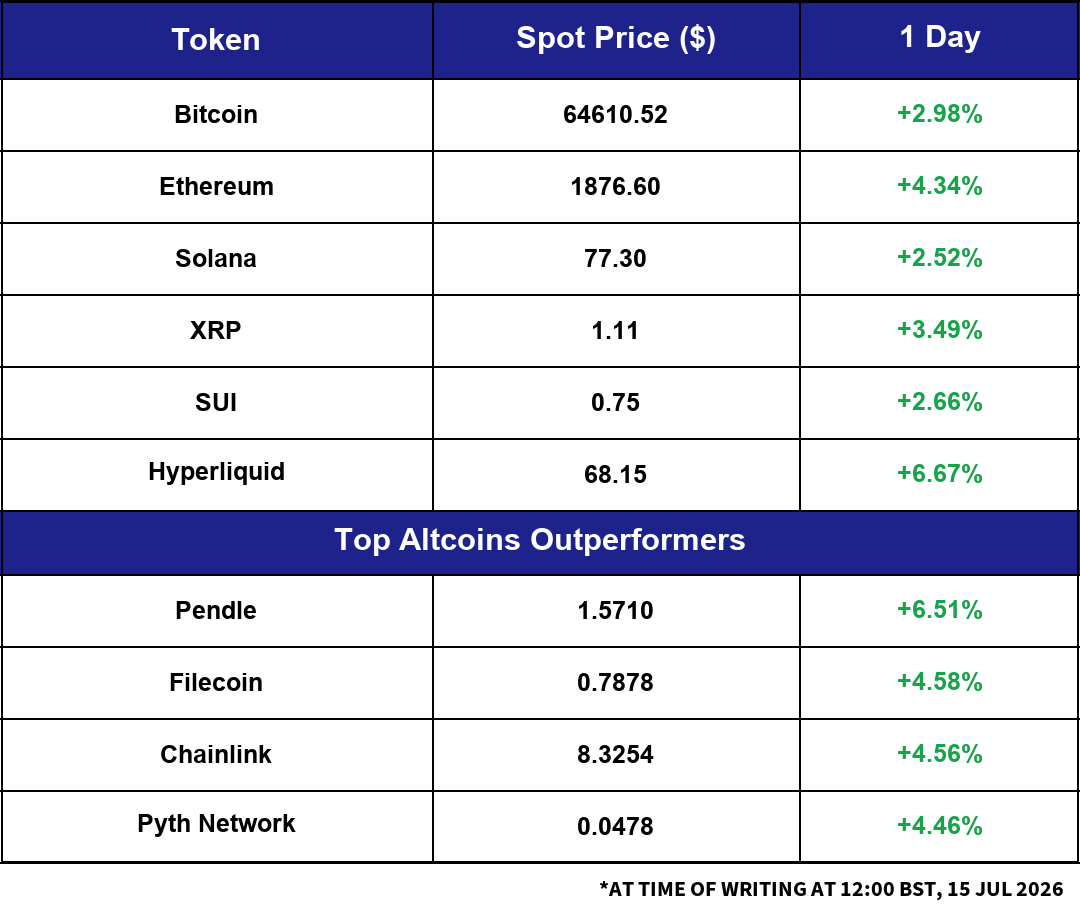
June CPI printed sharply below expectations — headline inflation fell 0.4% MoM to a 3.5% annual rate and core eased to 2.6% YoY — sending front-end yields lower, cutting the odds of a July Fed hike from 40% to 17%, and lifting risk assets: BTC rose around 3.3% to roughly $64,700 and ETH outperformed, up around 5.3% to about $1,880. The ECB selected 36 banks and payment firms, including Deutsche Bank, Revolut and Stripe, for a 12-month digital euro pilot; the CFTC ordered Kalshi to keep its prediction-market trades in place against a state-court challenge; Tether led a $7M round in payments firm Pact Labs; and EthSystems spun out of the Ethereum Foundation to build confidential onchain infrastructure for institutions.
Block Scholes is an FCA-regulated institutional crypto derivatives analytics platform. Live data, IV surfaces, and backtesting available via blockscholes.com.
June CPI printed sharply below expectations, with headline inflation falling 0.4% MoM to a 3.5% annual rate and core easing to 2.6% YoY. Front-end yields dropped, the odds of a July Fed hike fell from 40% to 17%, and risk assets rallied: BTC added around 3.3% to roughly $64,700 and ETH outperformed, up around 5.3% to about $1,880.
The ECB selected 36 banks and payment firms, including Deutsche Bank, Revolut and Stripe, for a 12-month digital euro pilot. The CFTC ordered Kalshi to keep operating prediction markets in Maryland, Tether led a $7M round in payments firm Pact Labs, and EthSystems spun out of the Ethereum Foundation to build confidential onchain infrastructure for institutions.
Market Snapshot: Overnight Moves
Macro & Markets
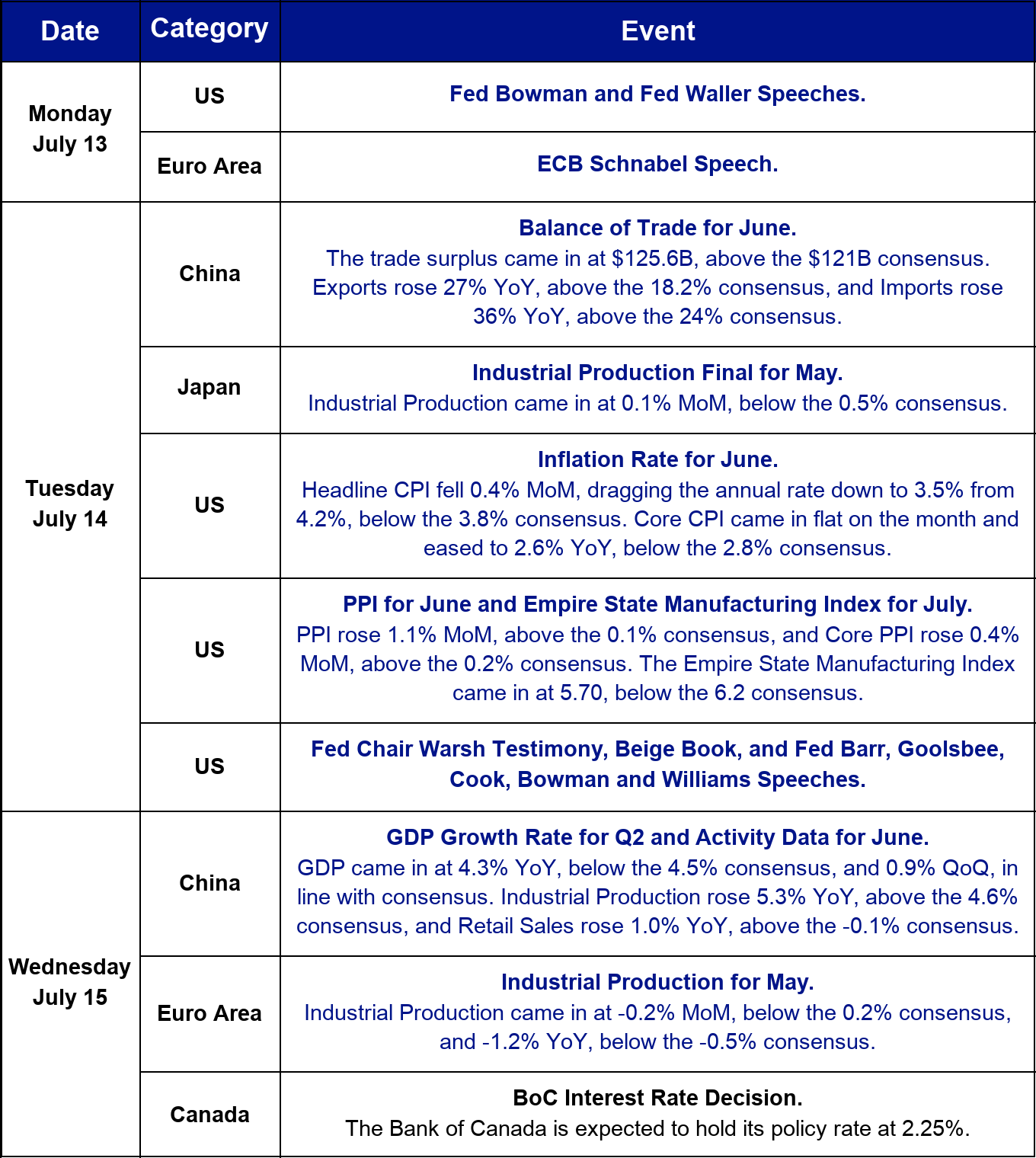
Yesterday’s release of June’s CPI figure printed sharply below expectations, with headline inflation falling 0.4% month on month, the largest single-month decline since April 2020, dragging the annual rate down to 3.5% from 4.2% in May and undershooting the 3.8% consensus.
Core inflation came in flat on the month, and down to 2.6% year-on-year (from 2.9%, versus 2.8% expected).
However, while it was the first easing in the annual rate in five months, it was driven primarily by a decrease in energy prices: according to the BLS’ release, “The index for energy fell 5.7 percent in June after rising 3.9 percent in May, 3.8 percent in April, and 10.9 percent in March. The energy index was the largest contributor to the monthly all items decrease”.
In addition, the lower inflation print for July comes at a time when the Middle East conflict has re-escalated, with Brent prices back above $85 a barrel (up more than 10% since Sunday).
Importantly for the Fed, despite the recent move higher in oil prices, forward inflation expectations are still well anchored (the 5y5y forward breakeven sits at roughly 2.22%, little changed).
Front-end yields dropped significantly following the CPI print, mirroring the move in Fed funds futures, where expectations for a July hike fell from 40% down to 10% briefly and which now trade at 17%.
The policy-sensitive 2-year yield dropped as much as 14bp to 4.14%, its biggest one-day move since February, before settling around 4.18%, while the 10-year fell by a smaller two basis points to ~4.58%.
Risk assets welcomed the repricing in expectations.
Over the 24 hours to 09:00 UTC, BTC added ~3.3% to around $64,700, clawing back the ground lost when it slipped below $62,000 earlier in the week following President Trump’s 20%-toll announcement.
ETH outperformed, up ~5.3% to roughly $1,880.
The S&P 500 closed up 0.38%, while the tech-heavy Nasdaq-100 finished up 1.1%.
On the US-Iran conflict, President Trump has since dropped his proposed 20% Strait of Hormuz cargo levy, saying it will be replaced by Gulf-state investment in the US, even as the US naval blockade of Iranian ports formally took effect at 4pm ET.
Chair Warsh cautioned against the inflation print during his testimony to the Senate, stating, "I'm not going to show up here and say 'mission accomplished'", while the Chicago Fed President Austin Goolsbee called the report "surprisingly benign" but wanted several more months of the same. Governor Waller warned earlier this week that another hot reading would warrant a near-term hiking response from the Fed.
DeFi / Web3 / Altcoins / Crypto
The European Central Bank has selected 36 banks and payment companies for a 12-month digital euro pilot due to begin in the second half of 2027.
Participants including Deutsche Bank, UniCredit, Revolut, Stripe and Adyen will test beta digital euro accounts, merchant payments and operational processes across online, offline and point-of-sale transactions.
The trial is part of the ECB’s preparations for a possible retail central bank digital currency, but any launch will depend on EU legislation, with the institution targeting readiness for a potential first issuance in 2029.
The CFTC, the U.S. derivatives regulator, ordered Kalshi, a federally regulated prediction market platform, to keep Michigan users’ trades in place despite a state court directive requiring some sports-related contracts to be canceled.
The dispute centers on whether Kalshi’s event contracts fall under federal commodities law or state gambling rules, with Michigan treating the products as unlicensed wagering while the CFTC argues Congress gave it exclusive oversight.
CFTC Chairman Michael Selig said, “The Commission will not allow states or state courts to bully registered entities,” as the agency continues challenging similar state actions across the U.S.
CleanSpark, a bitcoin mining and digital infrastructure company, secured $6.6B in contracted revenue through a 20-year lease with an unnamed investment-grade global technology company that plans to use 175 MW of computing capacity at its Sandersville, Georgia campus starting in late 2027.
The tenant also gained exclusive rights to negotiate over CleanSpark’s 885 MW Texas portfolio, while two optional five-year renewals could increase the Georgia agreement’s total value to $11.6B.
Galaxy Digital, a crypto financial services firm, launched GOFR, a managed borrowing product that combines variable rates from DeFi lending protocols including Aave, Morpho, Spark and Kamino into one continuously adjusted rate for institutional and accredited clients.
Borrowers deal only with Galaxy, which manages wallets, smart contracts and collateral handling, while the firm is committing up to $100M in first-loss protection and setting a $1M minimum loan size.
South Korea’s Ministry of Finance and Economy, the government agency overseeing fiscal policy and state assets, plans to introduce a National Asset Basic Act that would bring cryptocurrencies and intellectual property into the country’s public asset management framework.
The proposal would replace a state asset management system that has largely focused on real estate since 1950 and could allow authorities to hold, record, manage and dispose of government-owned crypto, including assets obtained through seizures, forfeitures or other official processes.
If enacted, the law would provide clearer rules for handling crypto-related state assets while supporting South Korea’s broader efforts to expand its blockchain industry and digital asset regulations.
Tether, the issuer of the USDT and USAT stablecoins, led a $7M Series A in Pact Labs, a payments infrastructure company, to expand use of USAT across payroll, credit and everyday transactions in the U.S.
Blockchange Ventures and Lasagna also joined the round, which will help Pact Labs build systems that allow employers to settle wages around the clock and give workers faster access to their pay.
USAT, Tether’s U.S.-focused stablecoin designed to comply with the GENIUS Act, had more than $140M in circulation as of April, according to the company’s latest attestation.
EthSystems, a for-profit company spun out of the Ethereum Foundation’s institutional privacy team, will build confidential Ethereum infrastructure and provide consulting for banks, asset managers and other regulated institutions.
The startup was founded by former Foundation employees Mo Jalil, Oskar Thorén and Aaryamann Challani and is backed by Ethereum co-founder Joe Lubin and treasury firms Bitmine and SharpLink.
Its goal is to let institutions use public Ethereum without exposing sensitive information such as client identities, positions or transaction details, while continuing to publish open-source tools and technical specifications.
This Week's Calendar
Charts of the Day
Figure 1. Block Scholes BTC Risk-Appetite Index (white, left-hand axis) and BTC spot price (orange, right-hand axis).
Figure 2. Block Scholes ETH Risk-Appetite Index (white, left-hand axis) and ETH spot price (purple, right-hand axis).
Block Scholes is an FCA-regulated institutional crypto derivatives analytics platform. Live data, IV surfaces, and backtesting available via blockscholes.com.
In Today's Note
June CPI printed sharply below expectations, with headline inflation falling 0.4% MoM to a 3.5% annual rate and core easing to 2.6% YoY. Front-end yields dropped, the odds of a July Fed hike fell from 40% to 17%, and risk assets rallied: BTC added around 3.3% to roughly $64,700 and ETH outperformed, up around 5.3% to about $1,880.
The ECB selected 36 banks and payment firms, including Deutsche Bank, Revolut and Stripe, for a 12-month digital euro pilot. The CFTC ordered Kalshi to keep operating prediction markets in Maryland, Tether led a $7M round in payments firm Pact Labs, and EthSystems spun out of the Ethereum Foundation to build confidential onchain infrastructure for institutions.
Market Snapshot: Overnight Moves
Macro & Markets
Yesterday’s release of June’s CPI figure printed sharply below expectations, with headline inflation falling 0.4% month on month, the largest single-month decline since April 2020, dragging the annual rate down to 3.5% from 4.2% in May and undershooting the 3.8% consensus.
Core inflation came in flat on the month, and down to 2.6% year-on-year (from 2.9%, versus 2.8% expected).
However, while it was the first easing in the annual rate in five months, it was driven primarily by a decrease in energy prices: according to the BLS’ release, “The index for energy fell 5.7 percent in June after rising 3.9 percent in May, 3.8 percent in April, and 10.9 percent in March. The energy index was the largest contributor to the monthly all items decrease”.
In addition, the lower inflation print for July comes at a time when the Middle East conflict has re-escalated, with Brent prices back above $85 a barrel (up more than 10% since Sunday).
Don't miss what's next
Upgrade your Block Scholes account to unlock this article and other exclusive insights
Block Scholes is an FCA-regulated institutional crypto derivatives analytics platform. Live data, IV surfaces, and backtesting available via blockscholes.com.
In Today's Note
June CPI printed sharply below expectations, with headline inflation falling 0.4% MoM to a 3.5% annual rate and core easing to 2.6% YoY. Front-end yields dropped, the odds of a July Fed hike fell from 40% to 17%, and risk assets rallied: BTC added around 3.3% to roughly $64,700 and ETH outperformed, up around 5.3% to about $1,880.
The ECB selected 36 banks and payment firms, including Deutsche Bank, Revolut and Stripe, for a 12-month digital euro pilot. The CFTC ordered Kalshi to keep operating prediction markets in Maryland, Tether led a $7M round in payments firm Pact Labs, and EthSystems spun out of the Ethereum Foundation to build confidential onchain infrastructure for institutions.
Market Snapshot: Overnight Moves
Macro & Markets
Yesterday’s release of June’s CPI figure printed sharply below expectations, with headline inflation falling 0.4% month on month, the largest single-month decline since April 2020, dragging the annual rate down to 3.5% from 4.2% in May and undershooting the 3.8% consensus.
Core inflation came in flat on the month, and down to 2.6% year-on-year (from 2.9%, versus 2.8% expected).
However, while it was the first easing in the annual rate in five months, it was driven primarily by a decrease in energy prices: according to the BLS’ release, “The index for energy fell 5.7 percent in June after rising 3.9 percent in May, 3.8 percent in April, and 10.9 percent in March. The energy index was the largest contributor to the monthly all items decrease”.
In addition, the lower inflation print for July comes at a time when the Middle East conflict has re-escalated, with Brent prices back above $85 a barrel (up more than 10% since Sunday).
Don't miss what's next
Upgrade your Block Scholes account to unlock this article and other exclusive insights
Premium
$30/mo
Access previous and future reports, market insights & deep dives.
The chip selloff spread to Asia and the S&P 500 closed marginally lower, while BTC was flat at $83.5K after a V-shaped rebound ahead of bank earnings. Bitmine and Strategy added to their holdings.
US equities closed near record highs on Friday as Houthi strikes on Saudi Arabia lifted Brent toward $105, while BTC rose 0.6% to $83.4K and ETH gained 2.0% to $2,550 overnight ahead of this week's CPI. XRP Ledger patched a critical supply-cap bug and Blockchain.com applied for CFTC licences.