Coinbase and Marqeta Expanded Their Partnership to Let Businesses Offer Payment Cards Backed by Stablecoin Balances
The selloff in US tech shares extended last Friday, sending the Nasdaq-100 to its worst week (-5.5%) since April 2025 as chipmakers fell for an eighth consecutive day, their longest slide since 2008. US Treasuries showed tentative signs of reclaiming their safe-haven status, with 10-year yields down around 16bps and 30-year yields close to 20bps, while BTC fell to $80K before reclaiming $82K in Asian trading hours. Coinbase and Marqeta are expanding their partnership to let businesses offer payment cards backed by customers’ stablecoin balances, with settlement on Coinbase’s Base network.
The Nasdaq-100 fell 5.5% last week, its worst week since April 2025, with chipmakers down for an eighth consecutive day, while 10-year and 30-year Treasury yields fell around 16bps and 20bps respectively.
At Nacha's Payments Innovation Alliance Fall Meeting, the Digital Sovereignty Alliance helped lead discussions on using stablecoins and tokenised deposits for payments, alongside "Know Your Agent" frameworks for verifying AI agents that initiate transactions.
Market Snapshot: Overnight Moves
Macro & Markets
Last Friday the selloff in risk-on US equities and tech shares extended further, driving the Nasdaq-100 to its worst week (-5.5%) since the tariff-related selloff back in April 2025.
Chipmakers related to the AI trade fell for an eighth consecutive day, their longest slide since 2008, with the Philadelphia Semiconductor sector index down 3.83% on the day and 16% since the selloff first began.
One of the most affected companies in the recent rout has been CoreWeave, a neocloud company that markets have focused on due to its outsized reliance on high-yield debt markets to finance its AI buildout infrastructure. Its stock sank over 12% on Friday.
Amidst the AI-stock market rout, Nvidia Corp. CEO Jensen Huang took an optimistic view during an event last week. He claimed that “All of this is going to pass, and the reason for that is very simple. It’s going to be transformative. It’s going to impact in a very positive way every single industry and every single country. There’s no question it will continue, and we’re at the beginning of that.”
Meanwhile, the S&P 500 fell 1.09% and BTC followed suit, declining to $80K before trading sideways over the weekend.
Alongside the slowdown in AI-related growth, risk-on sentiment was also dragged down by a rally in oil prices towards the tail-end of last week. Brent crude rose from $105 a barrel to $110 a barrel, raising concerns that US inflation would be harder to contain.
Today, US stock futures point to a tentative rebound in sentiment as S&P 500 futures trade 0.52% higher and contracts for the Nasdaq-100 have climbed 1.1%.
BTC has jumped more than 2% in Asian trading hours from its lows to reclaim $82K. Ether is up close to 4% from its lows, while Solana has gained close to 5%.
Institutional demand in BTC has pulled back for the past two weeks however. US-listed spot Bitcoin exchange-traded funds recorded $228.6M in outflows last week following $681M in outflows in the previous week.
US Treasuries showed tentative signs last week of having reclaimed their traditional status as a safe haven asset.
As the outlook for AI-firms soured last week, 10-year yields declined around 16bps over the same period of time and 30-year yields fell close to 20bps.
The last time yields fell by that much and the tech-heavy Nasdaq-100 declined more than 5% in the same week was in April 2025 after President Trump’s Liberation Day tariffs.
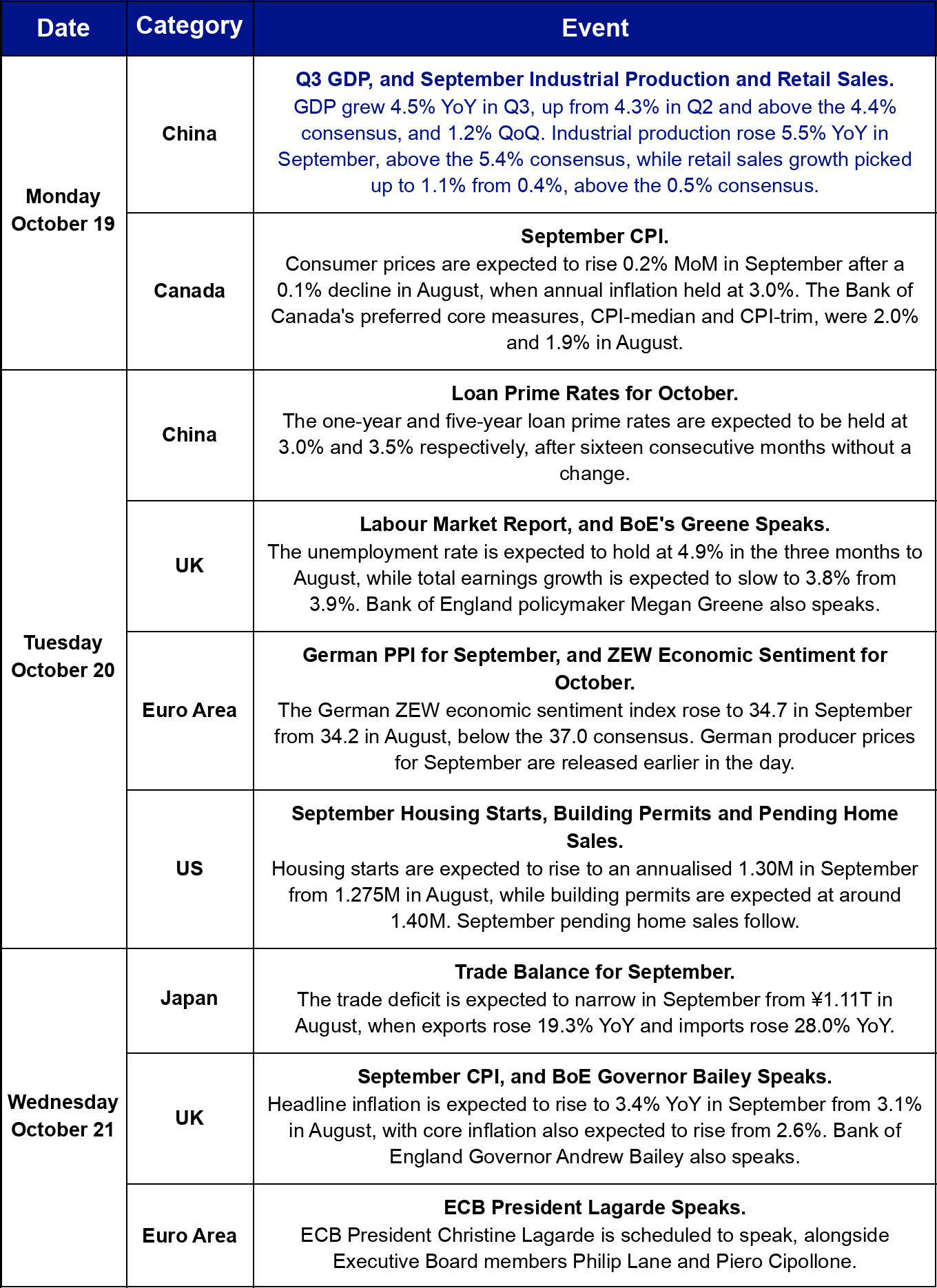
Looking to the week ahead, headline inflation in the UK is expected to increase to 3.4% in September, with markets expecting the first interest rate hike from the Bank of England in over three years in its next meeting in November.
Meanwhile Fed policymakers are in their blackout period ahead of the Oct. 27-28 policy meeting.
A hotter-than-expected CPI report last week initially caused traders to price in a 50% probability of an October rate hike, but after Fed Chair Kevin Warsh’s lack of remarks on monetary policy during his fireside chat at the IMF’s annual meetings, expectations for a hike now trade below 15%.
DeFi / Web3 / Altcoins / Crypto
Coinbase and Marqeta are expanding their partnership to let businesses offer payment cards backed by customers’ stablecoin balances.
Coinbase will custody the stablecoins and handle conversion between digital assets and fiat currencies.
Marqeta will manage card issuance and payment processing.
Coinbase’s Base network will provide the onchain settlement infrastructure.
The setup is designed to let businesses fund card programs 24/7 while allowing cardholders to spend stablecoin balances at merchants that accept card payments.
The product is aimed at Marqeta’s business customers, including both crypto and traditional companies.
Coinbase and Marqeta already work together on Coinbase’s U.S. debit card, which Marqeta has processed since 2020.
The companies did not disclose fees, a launch date or which stablecoins will be supported initially.
The Digital Sovereignty Alliance participated in Nacha’s Payments Innovation Alliance Fall Meeting in Chicago, where industry participants discussed emerging payment technologies and regulation.
DSA Senior Policy Advisor Molly Woodman helped lead discussions around the Next-Gen Currency Project Team, which DSA co-leads with Nacha.
The project is focused on the use of digital assets such as stablecoins and tokenized deposits for payments and money movement.
Its work includes examining how digital assets could connect with traditional payment systems, tracking regulatory developments and identifying operational implications for financial institutions.
Participants also discussed agentic payments, including how financial institutions may handle transactions initiated by AI agents.
Another area of focus was “Know Your Agent” frameworks, which are intended to help institutions identify and verify autonomous software agents involved in payment activity.
Figure 4. ETH at-the-money implied volatility across selected tenors. Source: Deribit, Block Scholes.
Figure 5. BTC 25-delta put-call skew ratio across selected tenors. Source: Deribit, Block Scholes.
Figure 6. ETH 25-delta put-call skew ratio across selected tenors. Source: Deribit, Block Scholes.
Block Scholes is an FCA-regulated institutional crypto derivatives analytics platform. Live data, IV surfaces, and backtesting available via blockscholes.com.
The Nasdaq-100 fell 5.5% last week, its worst week since April 2025, with chipmakers down for an eighth consecutive day, while 10-year and 30-year Treasury yields fell around 16bps and 20bps respectively.
At Nacha's Payments Innovation Alliance Fall Meeting, the Digital Sovereignty Alliance helped lead discussions on using stablecoins and tokenised deposits for payments, alongside "Know Your Agent" frameworks for verifying AI agents that initiate transactions.
Market Snapshot: Overnight Moves
Macro & Markets
Last Friday the selloff in risk-on US equities and tech shares extended further, driving the Nasdaq-100 to its worst week (-5.5%) since the tariff-related selloff back in April 2025.
Chipmakers related to the AI trade fell for an eighth consecutive day, their longest slide since 2008, with the Philadelphia Semiconductor sector index down 3.83% on the day and 16% since the selloff first began.
One of the most affected companies in the recent rout has been CoreWeave, a neocloud company that markets have focused on due to its outsized reliance on high-yield debt markets to finance its AI buildout infrastructure. Its stock sank over 12% on Friday.
Don't miss what's next
Upgrade your Block Scholes account to unlock this article and other exclusive insights
Premium
$30/mo
Access previous and future reports, market insights & deep dives.
The selloff in US tech shares extended last Friday, sending the Nasdaq-100 to its worst week (-5.5%) since April 2025 as chipmakers fell for an eighth consecutive day, their longest slide since 2008. US Treasuries showed tentative signs of reclaiming their safe-haven status, with 10-year yields down around 16bps and 30-year yields close to 20bps, while BTC fell to $80K before reclaiming $82K in Asian trading hours. Coinbase and Marqeta are expanding their partnership to let businesses offer payment cards backed by customers’ stablecoin balances, with settlement on Coinbase’s Base network.
Dip buying helped US equities recover from a week-long selloff in risk assets, with the S&P 500 ending a three-day decline 0.33% higher, while credit stress at AI cloud provider CoreWeave kept concerns about the AI trade in focus. Fed Chair Kevin Warsh told the IMF and World Bank meetings in Bangkok that an AI-led investment surge is putting upward pressure on inflation, and market-implied odds of an October pause rose to 85% from 72% after his comments. BTC briefly fell below $80K before recovering to $82.1K, while ETH rose 3.4% overnight to $2,450.