Small Caps Lead Broadening Equity Rally and BTC Tests $84K
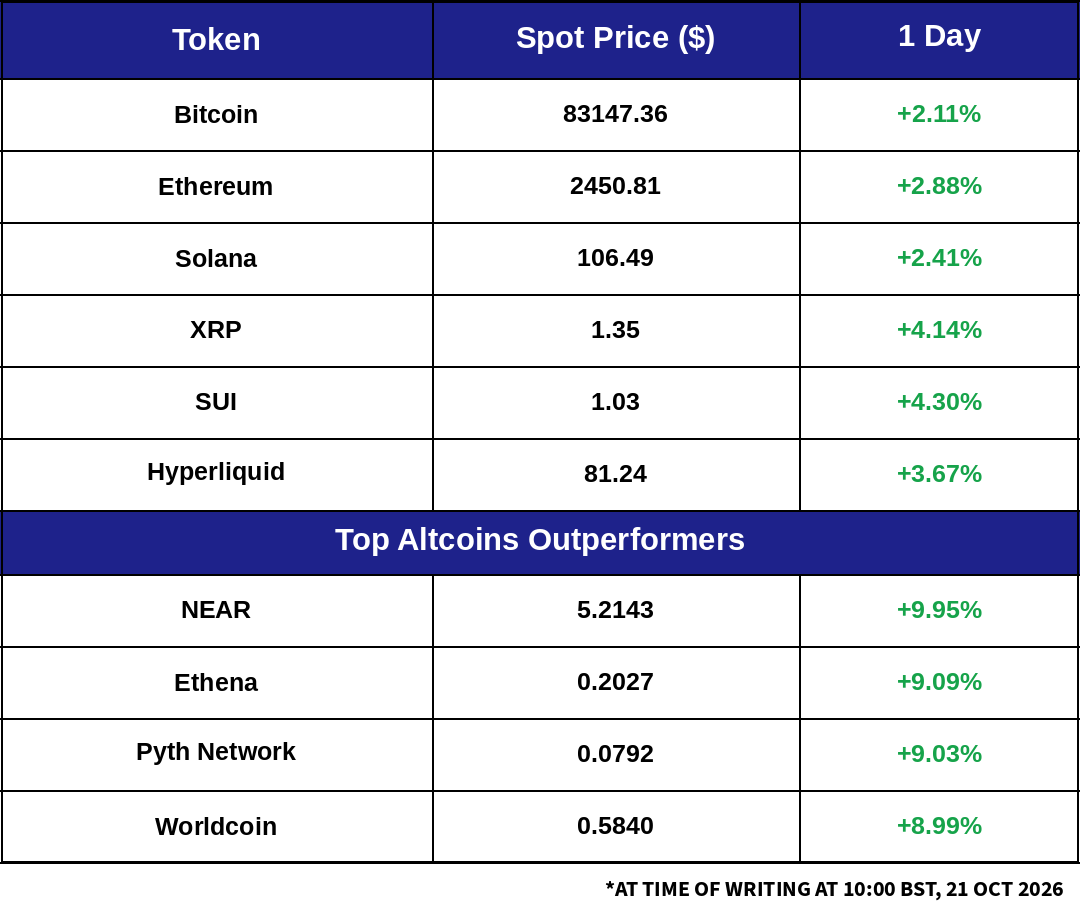
The US equity rebound broadened beyond tech as the Russell 2000 gained 1.65% and Treasury yields eased, while BTC rose 2.1% to $83.1K and ETH gained 2.9% to $2,451 overnight. BlackRock filed for a Bitcoin Managed Protection ETF, J.P. Morgan forecast 10% annual BTC returns over a decade, and FINMA approved Switzerland's first spot Bitcoin ETF.
Block Scholes is an FCA-regulated institutional crypto derivatives analytics platform. Live data, IV surfaces, and backtesting available via blockscholes.com.
The US equity rebound broadened beyond tech as the Russell 2000 gained 1.65% and Treasury yields eased, while BTC rose 2.1% to $83.1K and ETH gained 2.9% to $2,451 overnight.
BlackRock filed for a Bitcoin Managed Protection ETF, J.P. Morgan forecast 10% annual BTC returns over a decade, and FINMA approved Switzerland's first spot Bitcoin ETF.
Market Snapshot: Overnight Moves
Macro & Markets
Monday's rebound in US equities broadened away from tech on Tuesday, with the Dow Jones rising 1.02% and the small-cap Russell 2000 gaining 1.65%, while the tech-heavy Nasdaq Composite ended flat (-0.02%) and the S&P 500 added 0.28%.
The Philadelphia Semiconductor sector index slipped 0.29%, a day after snapping its eight-session losing streak.
CoreWeave recovered from a 5.5% drop at the open, and a fresh 52-week low of $57.24, to close 1.7% higher, after Nvidia CEO Jensen Huang voiced support for the company but said Nvidia saw no need to backstop it.
Nasdaq-100 futures are nonetheless trading 0.6% higher this morning, with Tesla and Meta reporting earnings later today.
BTC jumped 2.2% in the two hours following the US equity open, from $81.4K at 12:00 UTC to $83.2K at 15:00 UTC, retesting the top of the $80K-$84K range it has held for the past two weeks.
Unlike Monday, the move does not appear to have been ETF-led. Inflows into US spot Bitcoin ETFs slowed to $23.2M on Tuesday (IBIT +$29.9M, BITB -$10.3M), far lower than Monday's $526.7M.
ETH outperformed in the same window, rising 3.7% from $2,381 to $2,470, despite US spot Ether ETFs recording a fifth consecutive day of outflows (-$26.1M on Tuesday and -$103.3M on Monday). That takes the streak to -$388.9M, led by redemptions from BlackRock's ETHA.
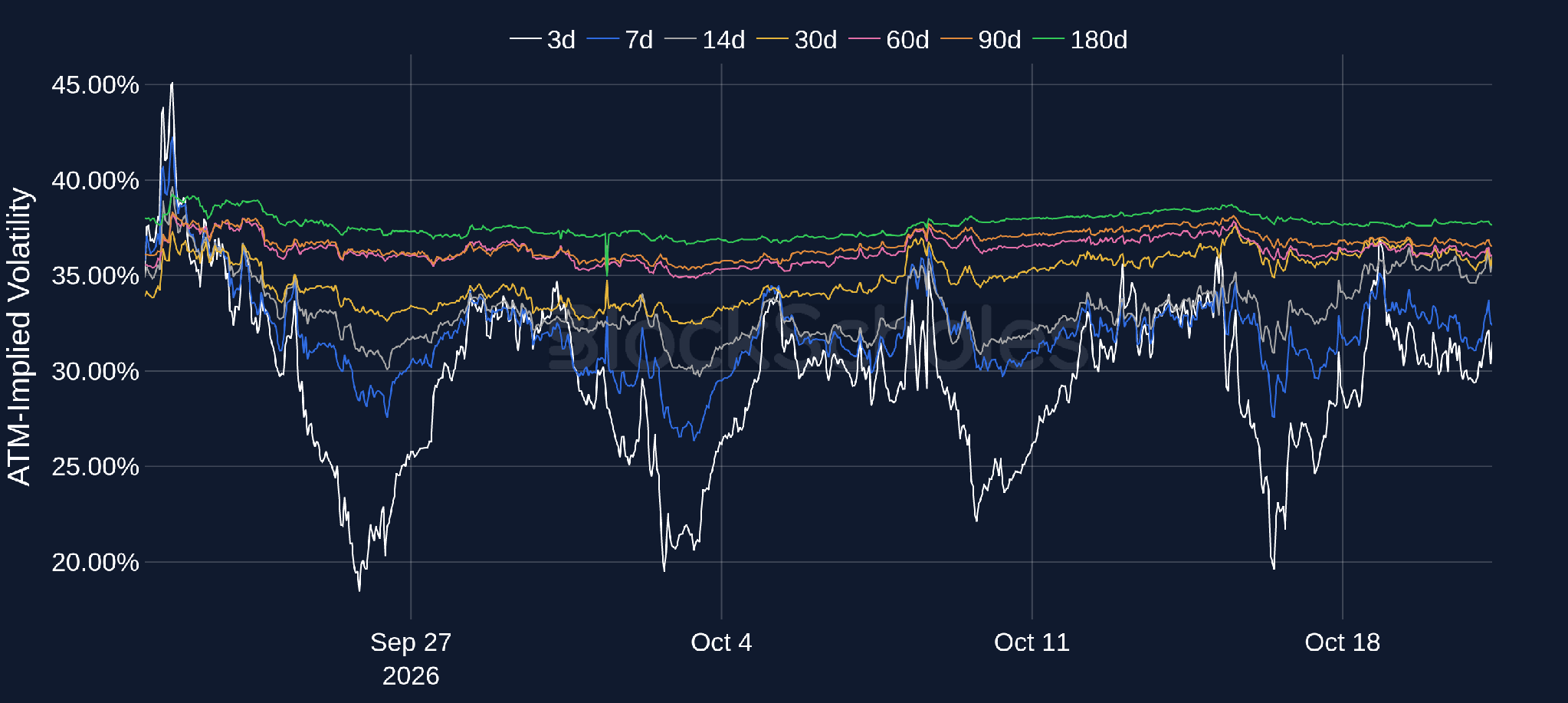
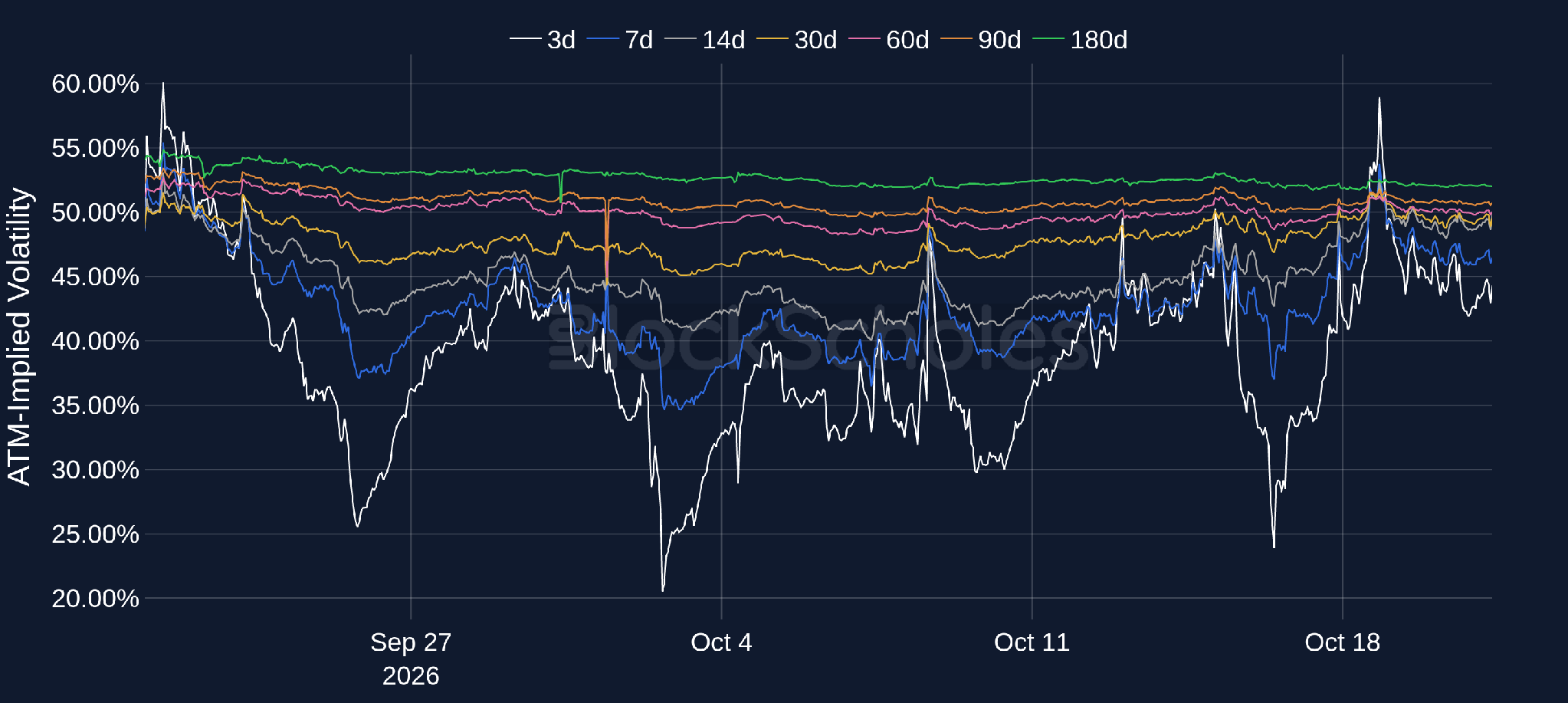
BTC's options market remains calm despite last week's equity selloff. 7-day at-the-money implied vol trades at 32.6%, below 30-day (35.5%) and 180-day (37.7%) levels in response to crypto’s relatively calm weathering of the equity storm.
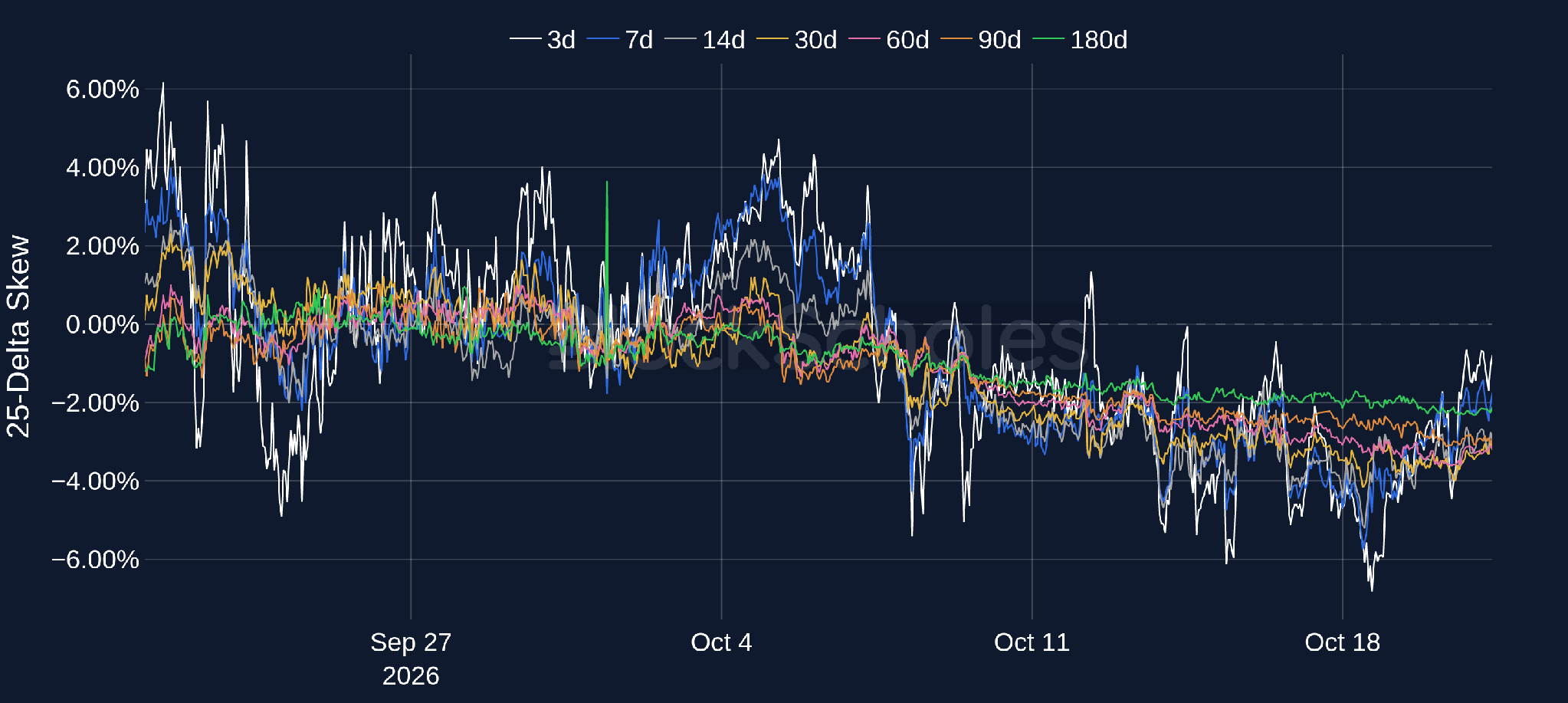
Demand for short-dated downside protection has faded as spot has moved higher: the 7-day 25-delta risk reversal has narrowed from -4.6 vol points on Oct. 18 to -1.7 this morning, though 30-day puts still trade at a 3-vol premium to calls.
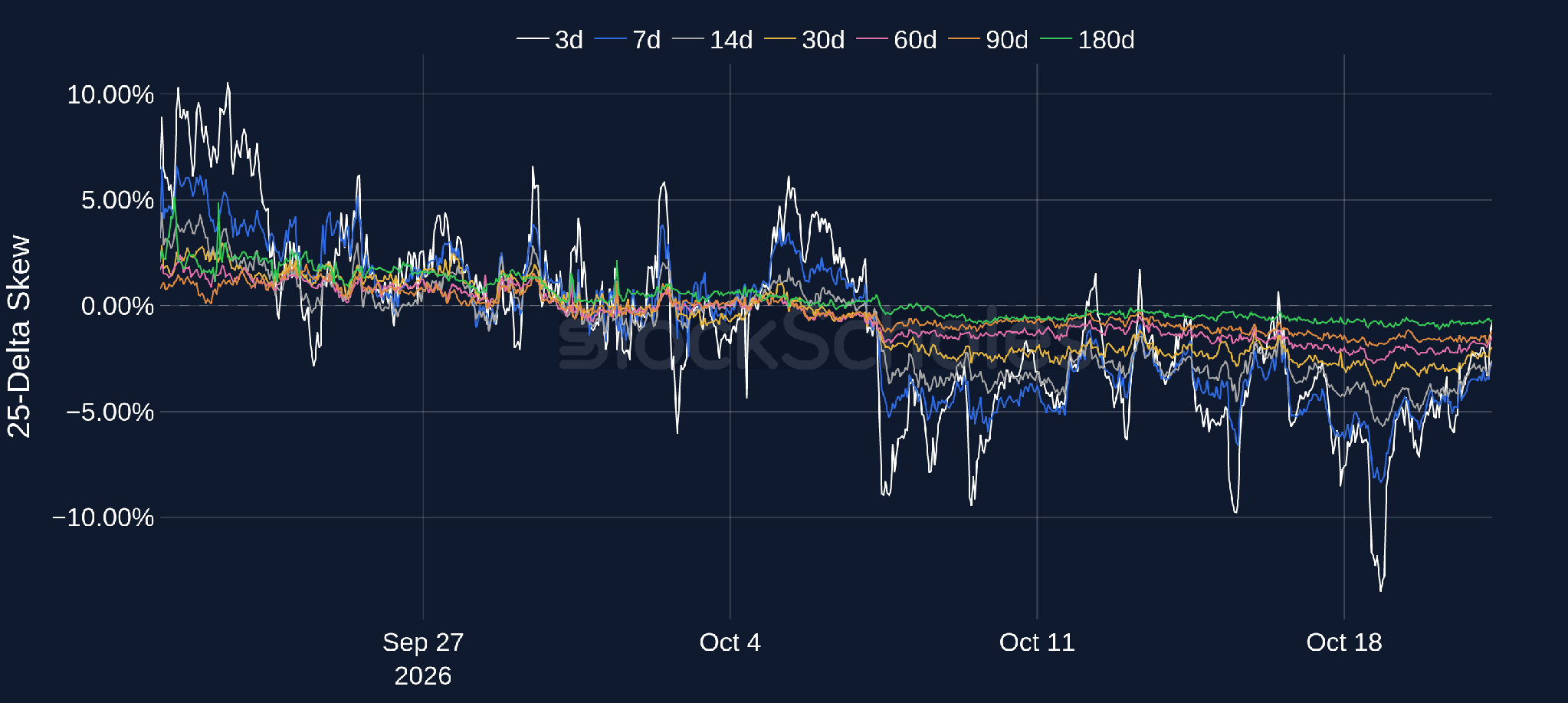
In ETH, 7-day ATM vol has climbed from 41.1% on Oct. 16 to 46.3%, while its 7-day put premium has halved from -5.3 to -2.8 vol points over the past three days as spot has climbed steadily higher.
Treasuries partially reversed Monday's selloff, with the 10-year yield falling 3bps to 5.12% and the 30-year 6bps to 5.42%, while the 2-year rose 2bps to 4.79%, flattening the 2s10s curve to around 33bps.
Treasury Secretary Scott Bessent said he does not expect turmoil in French government bonds to spill over into Treasuries, after the spread between French and German 10-year yields widened 8.5bps to 150.8bps on Tuesday. He also said Iran has "no oil on the water" and that its economy could go "nonlinear" within four to eight weeks.
Brent crude touched a five-month intraday high of $111.99 on Tuesday before settling 0.69% lower at $108.79, on reports that mediators are trying to bring the US and Iran to talks. It has since climbed back towards $110 this morning.
Defi/ Crypto
BlackRock has filed with the SEC to launch the iShares Bitcoin Managed Protection ETF, an options-based fund offering capped upside exposure to its existing spot Bitcoin ETF, IBIT, alongside downside protection.
The strategy involves buying in-the-money call options and selling out-of-the-money call options on IBIT or similar Bitcoin-linked assets, while holding short-term fixed-income investments to offset costs.
The fund will use three overlapping options tranches, each initially targeting approximately 10% downside protection, with the upside cap determined by the strike price of the sold calls.
J.P. Morgan Asset Management has published its first 10-year Bitcoin forecast, projecting 10% compounded annual returns, compared with 5.5% for gold.
The firm estimates Bitcoin's volatility at 55%, warning that its unpredictable correlations with other assets remain a barrier to broader inclusion in investment portfolios.
JPMorgan expects improving regulation, liquidity and market infrastructure to support institutional adoption, while Bitwise CIO Matt Hougan argued that the 55% volatility estimate is too high, given Bitcoin's declining historical volatility.
Switzerland’s financial regulator FINMA has approved the country’s first spot Bitcoin ETF for retail investors, allowing direct Bitcoin exposure through a regulated investment fund.
FINMA granted an exemption from standard diversification requirements, citing Bitcoin’s established trading history and liquidity, while imposing safeguards covering custody, operational risks and investor disclosures.
Unlike existing Swiss Bitcoin exchange-traded products (ETPs), which are structured as debt securities, the new ETF operates under Swiss investment fund regulations, although its issuer has not been disclosed.
The Blockchain Association, a US crypto industry advocacy group, has urged the Treasury to clarify its proposed GENIUS Act rules, which regulate the issuance and sale of payment stablecoins in the US.
The group wants clearer definitions of digital asset service providers and stricter liability standards, arguing that self-custody software, validators and ordinary secondary-market trading should not face the same obligations as stablecoin issuers.
It also called for simpler compliance requirements for foreign-issued stablecoins, proposing that service providers rely on regulatory prohibition lists rather than conduct extensive issuer checks or identify users beyond information they already possess.
Blockchain.com has launched cryptocurrency options trading for eligible users, offering call and put options on BTC, ETH, SOL, HYPE, AVAX, XRP and TRX, with expiries of up to one week.
Contracts are funded in USDC with a minimum premium of $5, and losses are limited to the premium paid, while the company pursues US regulatory licenses for crypto derivatives and prediction markets.
Injective, a Layer 1 blockchain focused on decentralized finance, has partnered with South Korean digital asset custodian BDACS to integrate its Korean won-pegged stablecoin, KRW1, into Injective's real-world asset (RWA) ecosystem.
The partnership aims to enable trading and settlement of tokenized assets directly in Korean won rather than US dollar stablecoins, with KRW1 issuance and redemption restricted to approved institutional partners and subject to regulatory approval.
Mastercard has opened early developer access to Agent Pay for Machines, a payment system enabling AI agents to autonomously purchase services using cards, bank accounts or stablecoins within predefined spending limits.
The platform uses Coinbase's x402 payment protocol, Coinbase Developer Platform for wallet infrastructure and Base for blockchain settlement, while Mastercard-owned BVNK supports fiat and stablecoin payments.
This Week's Calendar
Charts of the Day
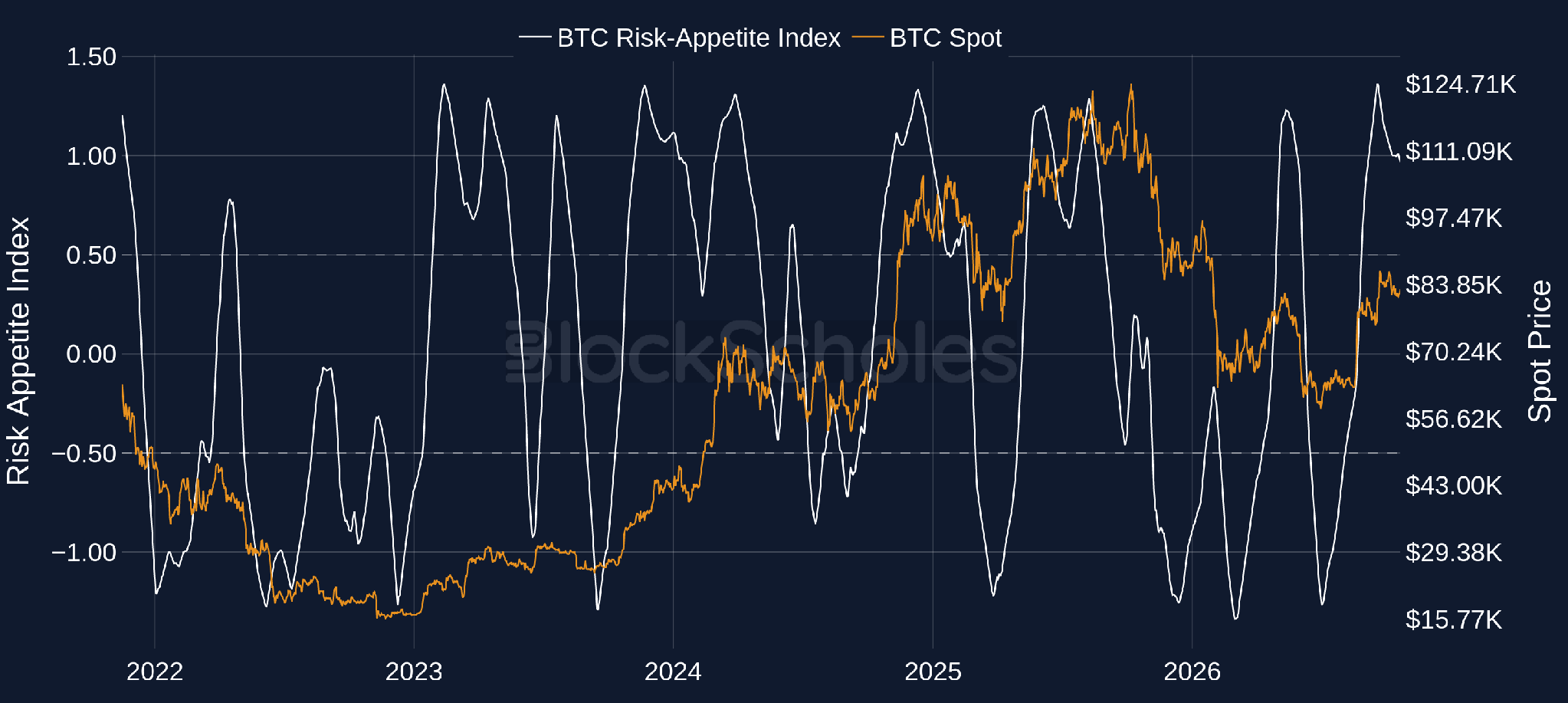
Figure 1. Block Scholes BTC Risk-Appetite Index (white, left-hand axis) and BTC spot price (orange, right-hand axis).
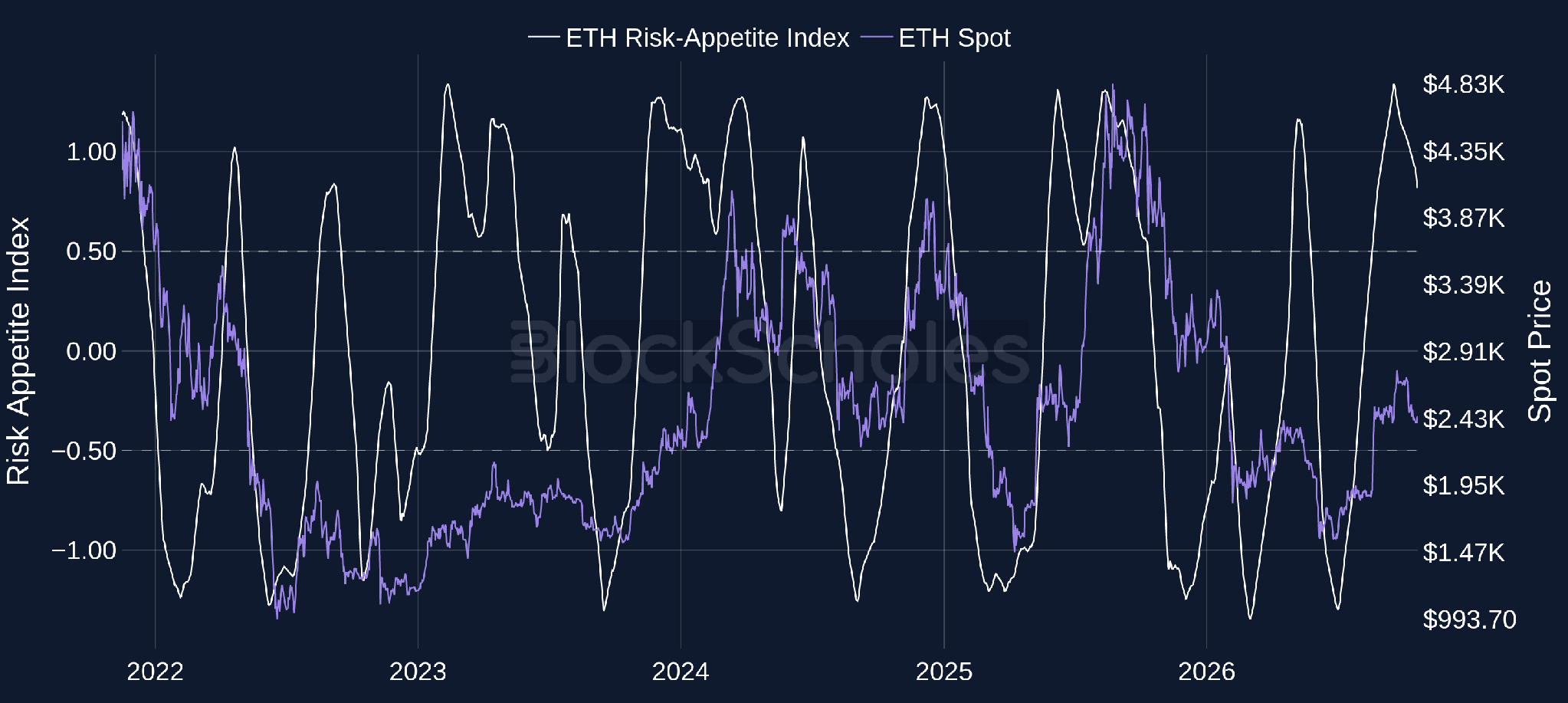
Figure 2. Block Scholes ETH Risk-Appetite Index (white, left-hand axis) and ETH spot price (purple, right-hand axis).
Block Scholes is an FCA-regulated institutional crypto derivatives analytics platform. Live data, IV surfaces, and backtesting available via blockscholes.com.
The US equity rebound broadened beyond tech as the Russell 2000 gained 1.65% and Treasury yields eased, while BTC rose 2.1% to $83.1K and ETH gained 2.9% to $2,451 overnight.
BlackRock filed for a Bitcoin Managed Protection ETF, J.P. Morgan forecast 10% annual BTC returns over a decade, and FINMA approved Switzerland's first spot Bitcoin ETF.
Market Snapshot: Overnight Moves
Macro & Markets
Monday's rebound in US equities broadened away from tech on Tuesday, with the Dow Jones rising 1.02% and the small-cap Russell 2000 gaining 1.65%, while the tech-heavy Nasdaq Composite ended flat (-0.02%) and the S&P 500 added 0.28%.
The Philadelphia Semiconductor sector index slipped 0.29%, a day after snapping its eight-session losing streak.
CoreWeave recovered from a 5.5% drop at the open, and a fresh 52-week low of $57.24, to close 1.7% higher, after Nvidia CEO Jensen Huang voiced support for the company but said Nvidia saw no need to backstop it.
Nasdaq-100 futures are nonetheless trading 0.6% higher this morning, with Tesla and Meta reporting earnings later today.
BTC jumped 2.2% in the two hours following the US equity open, from $81.4K at 12:00 UTC to $83.2K at 15:00 UTC, retesting the top of the $80K-$84K range it has held for the past two weeks.
Unlike Monday, the move does not appear to have been ETF-led. Inflows into US spot Bitcoin ETFs slowed to $23.2M on Tuesday (IBIT +$29.9M, BITB -$10.3M), far lower than Monday's $526.7M.
ETH outperformed in the same window, rising 3.7% from $2,381 to $2,470, despite US spot Ether ETFs recording a fifth consecutive day of outflows (-$26.1M on Tuesday and -$103.3M on Monday). That takes the streak to -$388.9M, led by redemptions from BlackRock's ETHA.
Don't miss what's next
Upgrade your Block Scholes account to unlock this article and other exclusive insights
Premium
$30/mo
Access previous and future reports, market insights & deep dives.
The US equity rebound broadened beyond tech as the Russell 2000 gained 1.65% and Treasury yields eased, while BTC rose 2.1% to $83.1K and ETH gained 2.9% to $2,451 overnight. BlackRock filed for a Bitcoin Managed Protection ETF, J.P. Morgan forecast 10% annual BTC returns over a decade, and FINMA approved Switzerland's first spot Bitcoin ETF.
US equities rebounded as chipmakers snapped an eight-session losing streak and Treasury yields rose with Brent above $110, while BTC slipped 1.6% to $81.4K and ETH fell 2.1% to $2,382 overnight. Strategy, Strive and Bitmine have accumulated more BTC and ETH, SkyAI liquidated its entire SOL treasury, and Mt. Gox extended its repayment deadline to October 2027.