Fed Minutes Show No Rush for October Hike as BTC Slips Below $83K
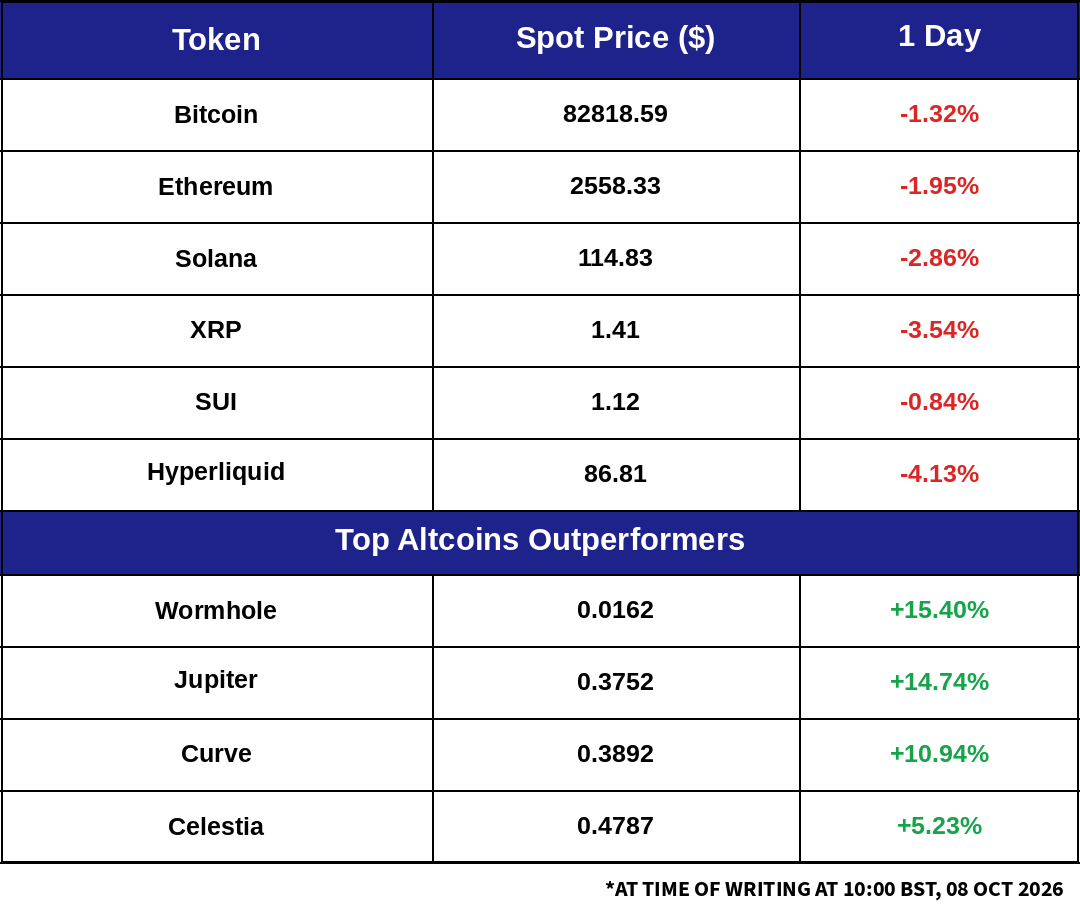
US equities eased from record highs as Fed minutes showed no urgency for an October hike, and BTC fell 1.3% to $82.8K while ETH dropped 2.0% to $2,558 overnight. Robinhood added $25M in BTC and plans US perpetuals, Samsung Wallet is integrating USDC on Solana and Sui, and Sui is launching Hashi, its native BTC collateral layer.
Block Scholes is an FCA-regulated institutional crypto derivatives analytics platform. Live data, IV surfaces, and backtesting available via blockscholes.com.
US equities eased from record highs as Brent topped $100 and Treasury yields rebounded, Fed minutes showed no urgency for an October hike, and BTC fell 1.3% to $82.8K while ETH dropped 2.0% to $2,558 overnight.
Robinhood added $25M in BTC and plans US perpetuals, Samsung Wallet is integrating USDC on Solana and Sui, and Sui is launching Hashi, its native BTC collateral layer.
Market Snapshot: Overnight Moves
Macro & Markets
The run in US equities to new all-time highs took a breather in Wednesday’s midweek session as BTC also fell below $83K, amidst still-elevated oil prices and a rebound in US Treasury yields.
Both the S&P 500 and Nasdaq-100 closed 0.22% and 0.21% lower, respectively, down from their all-time highs earlier in the week, while Brent crude has rallied 4% over the past 24 hours to settle back above $100 per barrel.
Meanwhile, ten-year US Treasuries bounced from their session lows after a $39B sale indicated solid demand for long-dated bonds, but yields nonetheless trade above 5.3%, near their highest levels since 2002.
Oil prices rebounded yesterday after it was reported that the US White House asked the Pentagon to consider a number of strike plans against Iran that could be executed before the midterm elections, and as output by oil producers in the Gulf of Mexico was affected by weather conditions.
The Atlantic cited two administration officials as saying that the size and targets of the potential strikes, and whether the strikes will even proceed, are still being debated.
According to the officials, even those in favour of the plan have acknowledged that limited strikes would not, by themselves, bring about a higher chance of any negotiating with Iran, nor reopen the Strait of Hormuz, or lower gas prices before the midterm elections, but instead could allow Trump to declare some sort of victory, giving the Republicans some momentum heading into the election.
Meeting minutes from the Fed’s September gathering indicated that “all participants supported” the decision to raise interest rates in September for the first time in three years, though policymakers did not believe there was an urgent need for another hike in the October meeting, backing comments made from Fed officials over the past three weeks.
According to the minutes, “almost all participants assessed that, while inflation risks were tilted to the upside, risks to the labor market had diminished and were now broadly balanced” and “most participants assessed that another increase in the target range for the federal funds rate would likely be appropriate by year end”, in line with the median projection from the September dot-plot.
Recent macroeconomic data may change the picture slightly, however, as core PCE rose by 3% in August, beating expectations for a rise of 3.3% and marking a decline from 3.3% in July, while September jobs data showed a gain of just 29,000 jobs and a rise in the unemployment rate.
Fed funds futures currently price in only a 19% chance of a rate hike this month, but a roughly 70% chance in December.
Speaking at a Central Bank of Turkey forum in Istanbul yesterday, Fed Governor Christopher Waller said that additional rate hikes will likely be needed to bring inflation down to 2%, but there is "flexibility" about the pace of increases.
"If the economic data continue to come in as expected, I anticipate additional hikes to support a timelier return of inflation to our 2% goal," Waller said in his remarks.
He then added, "But there is some flexibility about when those hikes will occur. The hikes do not need to come at consecutive meetings, but they should be in place in an acceptable period of time”, indicating the possibility for an October pause.
The Governor did not answer how much he feels the Fed may need to tighten its policy, but claimed that the need for higher rates had become clear from the strength of the US economy: "With evidence that economic activity is strengthening in the second half of this year, I am not greatly concerned that tighter monetary policy threatens a damaging slowdown in the economy. But I am concerned that the recent acceleration in inflation... will lead consumers, investors, and price-setting businesses to revise up their expectations for future inflation."
Defi/ Crypto
Robinhood, a U.S. brokerage and trading platform, added $25M in bitcoin to its balance sheet, with Senior Vice President Johann Kerbrat saying the purchase was intended to demonstrate the company's commitment to crypto rather than materially affect its finances, given its roughly $100B market capitalization.
Robinhood also plans to introduce perpetual futures trading for eligible U.S. customers, covering BTC, ETH, SOL, XRP, DOGE, ADA, LINK and HYPE, with contracts that have no expiration date and settle profits and losses every 15 minutes.
Robinhood Chain, the company's Ethereum Layer 2 blockchain built using Arbitrum technology, has reached approximately $1.05B in total value locked, while its 24/7 tokenized-stock offering and crypto wallet support a platform with 28M funded accounts and wallet availability in more than 120 countries.
Samsung, the South Korean electronics company, is integrating USDC, a U.S. dollar-backed stablecoin, into Samsung Wallet across 82M eligible Galaxy devices in the U.S., with support for transfers on Solana and Sui, two Layer 1 blockchains, and the initial Solana rollout scheduled for the last week of October.
Eligible users will be able to send USDC to compatible crypto wallets internationally and transfer funds to bank accounts in more than 60 countries, with Bastion, a regulated stablecoin infrastructure provider, operating the accounts and Coinbase Prime providing custody.
Sui, a Layer 1 blockchain, announced that Hashi, its native Bitcoin collateral infrastructure, will begin a phased mainnet launch in October with more than $500M in committed capital from a coalition of over 20 partners, including BitGo, Bullish, Cumberland, FalconX and Ledger.
Hashi allows users to deposit native BTC while the underlying Bitcoin remains secured on the Bitcoin network, minting a corresponding hBTC token on Sui that can serve as collateral for decentralized finance (DeFi) activities, including lending, borrowing, automated vaults and structured products.
Sui also announced its SUI Agent Pass at its Basecamp conference, introducing a permission system that lets users define policies governing which coins and non-coin digital assets AI agents can access or manage on their behalf.
The system is intended to let AI agents perform authorized onchain actions without unrestricted access to a user's assets.
Justin Drake, a researcher at the Ethereum Foundation, called for "bunker mode" preparations over the possibility that the Elliptic Curve Digital Signature Algorithm (ECDSA), a cryptographic system used by Bitcoin and Ethereum to verify transactions, could be broken, potentially allowing attackers to recover private keys within "months not years" in a worst-case scenario.
Drake recommended that major crypto holders gradually transfer funds to fresh addresses whose public keys have not been exposed through signed transactions, while emphasizing that existing cryptography has not been shown to be broken.
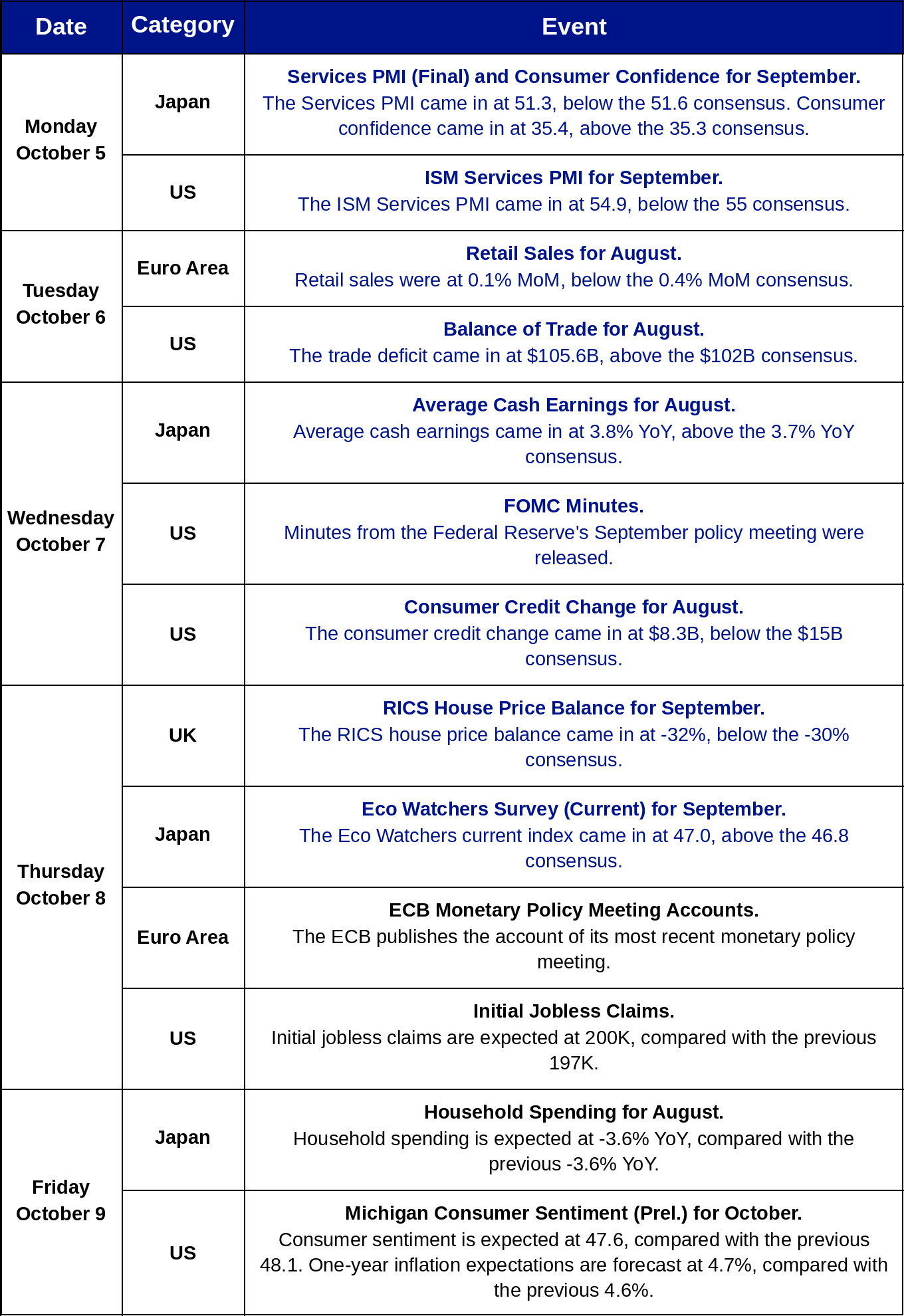
This Week's Calendar
Charts of the Day
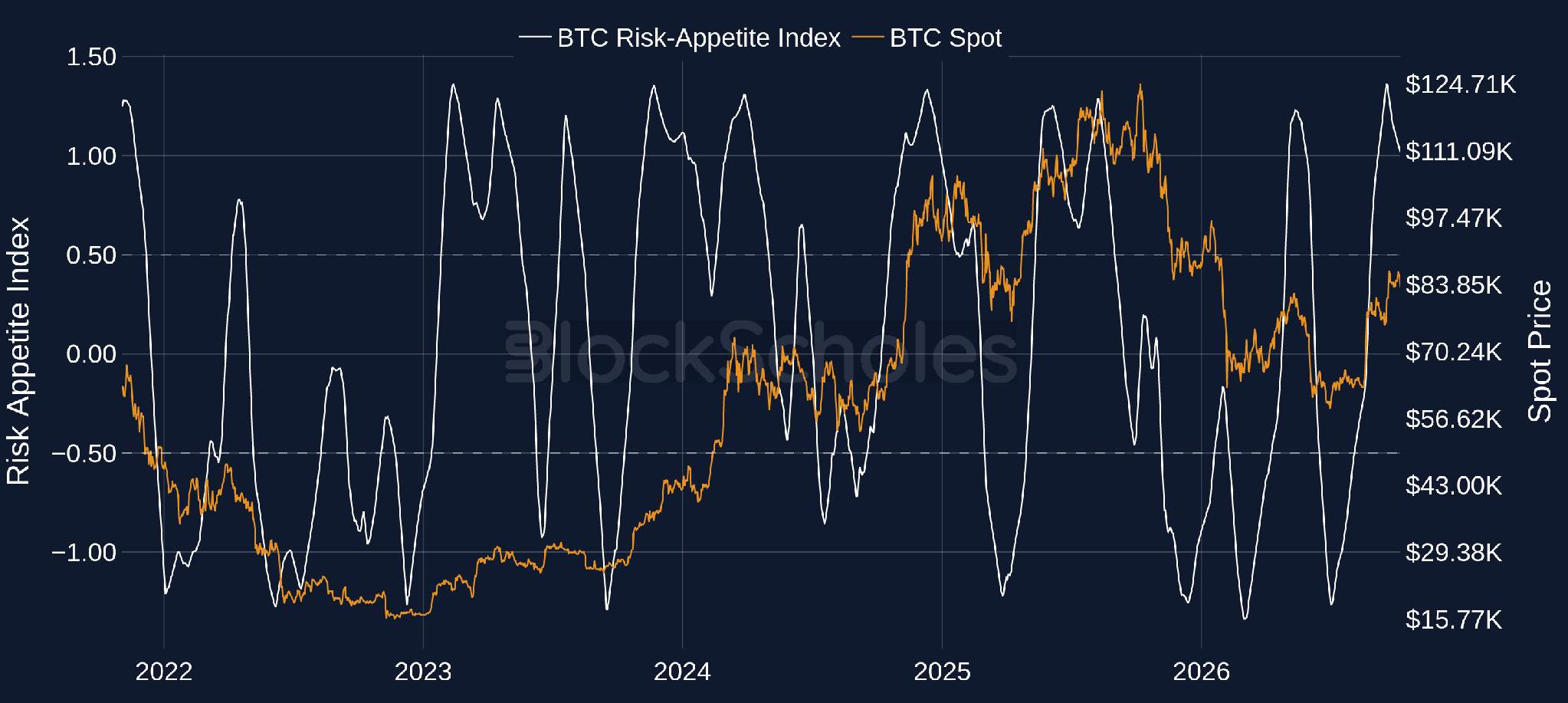
Figure 1. Block Scholes BTC Risk-Appetite Index (white, left-hand axis) and BTC spot price (orange, right-hand axis).
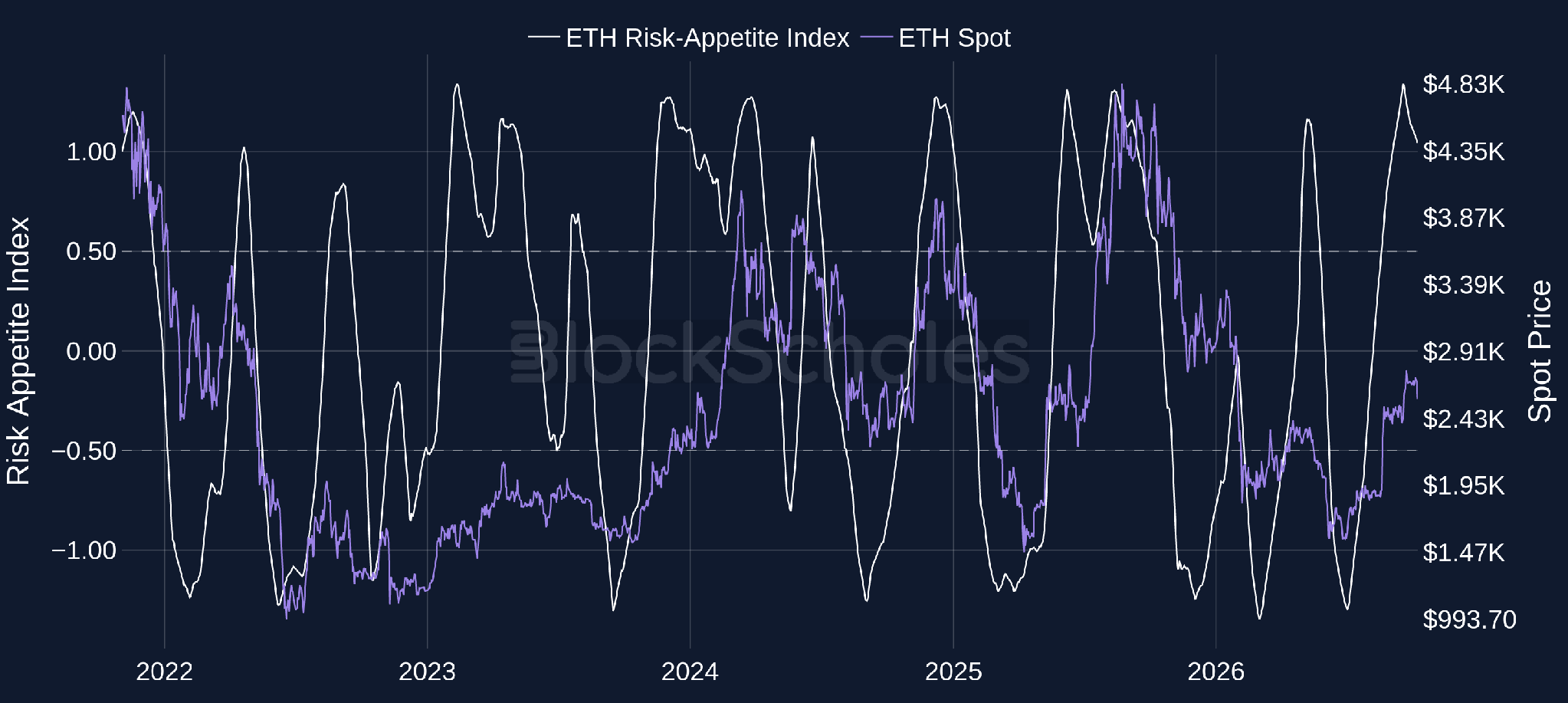
Figure 2. Block Scholes ETH Risk-Appetite Index (white, left-hand axis) and ETH spot price (purple, right-hand axis).
Block Scholes is an FCA-regulated institutional crypto derivatives analytics platform. Live data, IV surfaces, and backtesting available via blockscholes.com.
US equities eased from record highs as Brent topped $100 and Treasury yields rebounded, Fed minutes showed no urgency for an October hike, and BTC fell 1.3% to $82.8K while ETH dropped 2.0% to $2,558 overnight.
Robinhood added $25M in BTC and plans US perpetuals, Samsung Wallet is integrating USDC on Solana and Sui, and Sui is launching Hashi, its native BTC collateral layer.
Market Snapshot: Overnight Moves
Macro & Markets
The run in US equities to new all-time highs took a breather in Wednesday’s midweek session as BTC also fell below $83K, amidst still-elevated oil prices and a rebound in US Treasury yields.
Both the S&P 500 and Nasdaq-100 closed 0.22% and 0.21% lower, respectively, down from their all-time highs earlier in the week, while Brent crude has rallied 4% over the past 24 hours to settle back above $100 per barrel.
Meanwhile, ten-year US Treasuries bounced from their session lows after a $39B sale indicated solid demand for long-dated bonds, but yields nonetheless trade above 5.3%, near their highest levels since 2002.
Oil prices rebounded yesterday after it was reported that the US White House asked the Pentagon to consider a number of strike plans against Iran that could be executed before the midterm elections, and as output by oil producers in the Gulf of Mexico was affected by weather conditions.
The Atlantic cited two administration officials as saying that the size and targets of the potential strikes, and whether the strikes will even proceed, are still being debated.
According to the officials, even those in favour of the plan have acknowledged that limited strikes would not, by themselves, bring about a higher chance of any negotiating with Iran, nor reopen the Strait of Hormuz, or lower gas prices before the midterm elections, but instead could allow Trump to declare some sort of victory, giving the Republicans some momentum heading into the election.
Don't miss what's next
Upgrade your Block Scholes account to unlock this article and other exclusive insights
Block Scholes is an FCA-regulated institutional crypto derivatives analytics platform. Live data, IV surfaces, and backtesting available via blockscholes.com.
US equities eased from record highs as Brent topped $100 and Treasury yields rebounded, Fed minutes showed no urgency for an October hike, and BTC fell 1.3% to $82.8K while ETH dropped 2.0% to $2,558 overnight.
Robinhood added $25M in BTC and plans US perpetuals, Samsung Wallet is integrating USDC on Solana and Sui, and Sui is launching Hashi, its native BTC collateral layer.
Market Snapshot: Overnight Moves
Macro & Markets
The run in US equities to new all-time highs took a breather in Wednesday’s midweek session as BTC also fell below $83K, amidst still-elevated oil prices and a rebound in US Treasury yields.
Both the S&P 500 and Nasdaq-100 closed 0.22% and 0.21% lower, respectively, down from their all-time highs earlier in the week, while Brent crude has rallied 4% over the past 24 hours to settle back above $100 per barrel.
Meanwhile, ten-year US Treasuries bounced from their session lows after a $39B sale indicated solid demand for long-dated bonds, but yields nonetheless trade above 5.3%, near their highest levels since 2002.
Oil prices rebounded yesterday after it was reported that the US White House asked the Pentagon to consider a number of strike plans against Iran that could be executed before the midterm elections, and as output by oil producers in the Gulf of Mexico was affected by weather conditions.
The Atlantic cited two administration officials as saying that the size and targets of the potential strikes, and whether the strikes will even proceed, are still being debated.
According to the officials, even those in favour of the plan have acknowledged that limited strikes would not, by themselves, bring about a higher chance of any negotiating with Iran, nor reopen the Strait of Hormuz, or lower gas prices before the midterm elections, but instead could allow Trump to declare some sort of victory, giving the Republicans some momentum heading into the election.
Don't miss what's next
Upgrade your Block Scholes account to unlock this article and other exclusive insights
Premium
$30/mo
Access previous and future reports, market insights & deep dives.
US equities eased from record highs as Fed minutes showed no urgency for an October hike, and BTC fell 1.3% to $82.8K while ETH dropped 2.0% to $2,558 overnight. Robinhood added $25M in BTC and plans US perpetuals, Samsung Wallet is integrating USDC on Solana and Sui, and Sui is launching Hashi, its native BTC collateral layer.
The S&P 500 rose 0.58% to a record close of 7,818.93 on gains in AI and chip stocks as Treasury yields briefly eased from 2002-level highs, while BTC fell 2.4% to $83.9K and ETH dropped 3.9% to $2,609. Polymarket began testing its rebuilt Protocol V2, Brevan Howard selected Ripple Prime for multi-asset brokerage.




.jpg)