Binance Bought a $100M Stake in Circle and Signed a Five-Year Deal to Promote USDC
Binance bought a $100M stake in Circle through a private placement and signed a five-year agreement to promote USDC on its platform, replacing deals signed in 2024 and 2025. Boston Fed President Susan Collins and Richmond Fed President Tom Barkin backed last week's rate hike, with Barkin saying the risks to inflation outweigh those to employment, while Brent crude fell below $100 a barrel for a sixth straight day. Canada's six largest banks are jointly exploring a Canadian-dollar tokenised deposit system, and Raiffeisen Bank International will offer crypto to 18M customers through Bitpanda.
Boston Fed President Susan Collins backed last week's rate hike, saying a somewhat more restrictive policy rate will help return inflation durably to target, while Richmond Fed President Tom Barkin said the risks to inflation outweigh those to employment.
Canada's six largest banks, including RBC, TD and BMO, are jointly exploring a Canadian-dollar tokenised deposit system, starting with transfers of tokenised deposits between financial institutions.
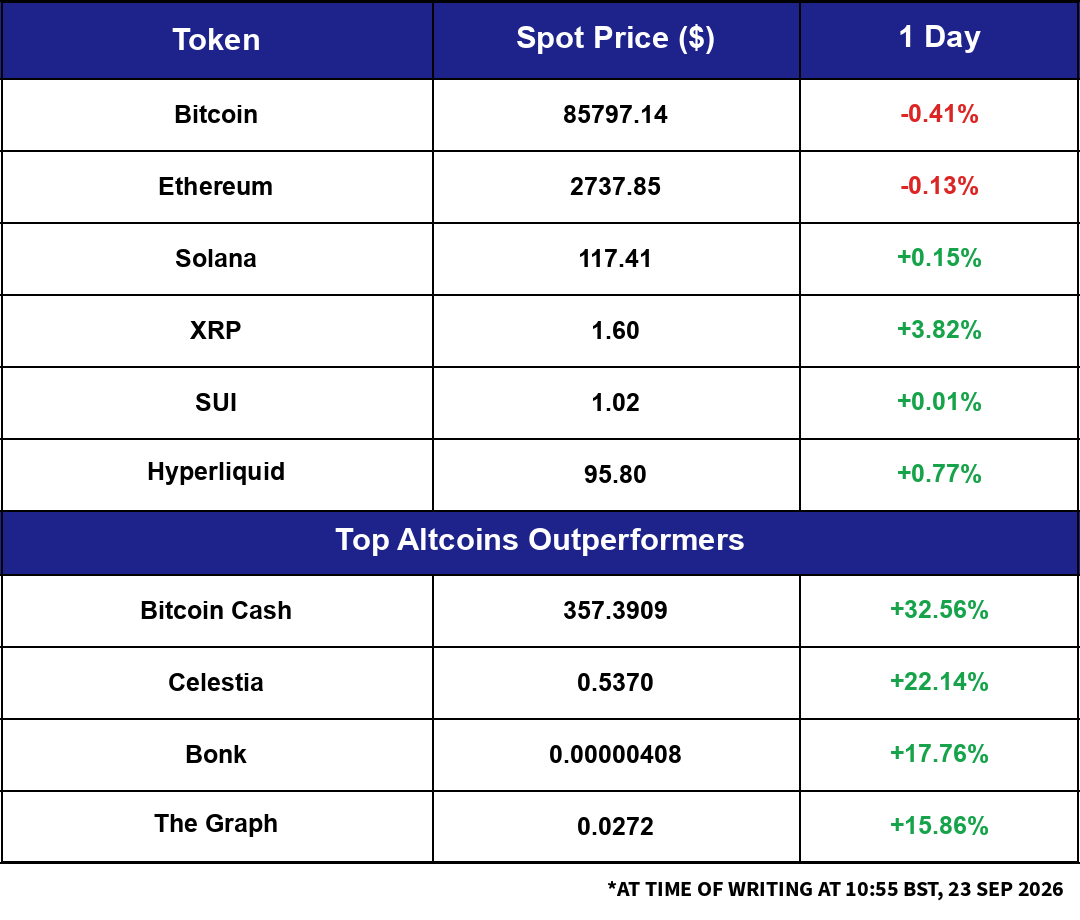
Market Snapshot: Overnight Moves
Macro & Markets
Risk momentum broadly consolidated as Brent crude fell for a sixth straight day, below $100 per barrel.
President Trump told reporters that US officials had a “very good” meeting with Iranian representatives “that lasted for three hours” on the sidelines of the United Nations General Assembly in New York.
The president further claimed that it was “very productive” and that there are plans to “have another one scheduled in the very near future.”
His comments came just hours after he delivered a speech to the UN, where he said “I have a big decision to make” and threatened "Will a deal be made with Iran that lets them rebuild and create a far greater country than it ever was before?... Or do I annihilate the Islamic Republic and do it quickly, never giving them a chance to kill and destroy people and countries again?"
Trump also accused Iran of purposely stalling a deal to fully reopen the Strait of Hormuz and negotiate an end to the war until after the US midterm elections.
Chipmakers extended their rally for another session pushing the Nasdaq-100 to a new record high, its first since June, as a number of semiconductor powerhouses including Micron Technology Inc. and Nvidia Corp. rallied for a sixth consecutive day.
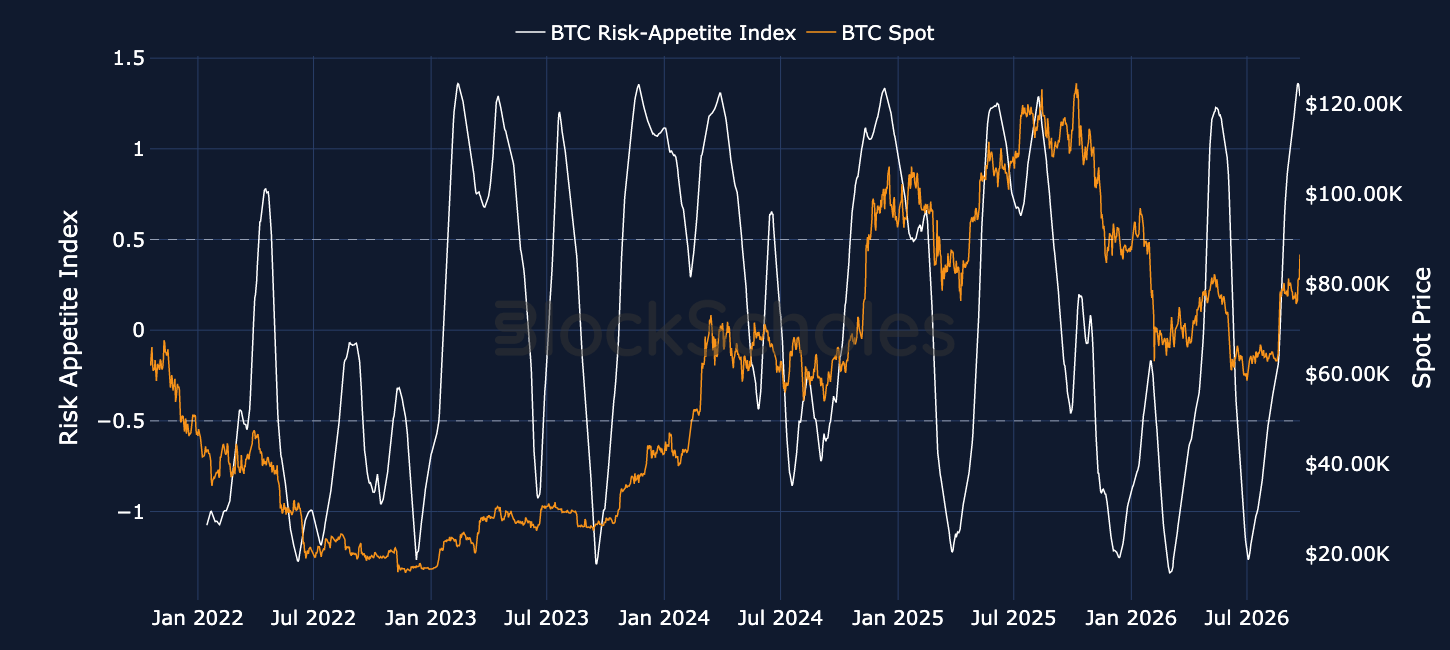
Meanwhile, the S&P 500 ended the day almost flat (down a very modest 0.00077%) but within 0.4% of its all-time high, while BTC ranged sideways between $86K and $87K, a level it was last trading at back in late January this year.
On the losing end of Wall Street were banking stocks which have continued their decline from last week after the Federal Reserve raised its overnight interest rate. JP Morgan Chase, Bank of America Corporation and Wells Fargo & Company declined more than 3% yesterday, while Citigroup fell close to 2%. Banking sector stocks can come under pressure as the spread between short-term interest rates and longer-term rates narrow.
Writing on LinkedIn, Boston Fed President Susan Collins, a nonvoting member of the FOMC, said she supported her colleagues’ decision to raise interest rates last week.
Collins claimed that "a somewhat more restrictive federal funds rate will help ensure that inflation durably returns to target”, especially since she foresees “an increased likelihood of future scenarios in which inflation remains notably above 2 percent”.
Collins further wrote that “with the labor market on a better footing, monetary policy can focus on a timely return to price stability, especially after five and a half years of too high inflation."
Her colleague Richmond Fed President Tom Barkin also mirrored her views on the strength of the US economy and labour market during comments yesterday.
According to Barkin, economic conditions "are, if anything, firming," driven by continued consumer spending and strength beyond the boom in artificial intelligence, allowing the Fed to focus squarely on inflation. As such, "The risks to inflation outweigh the risks to maximum employment. That's why we raised rates”.
Barkin, who is also not a voting member this year, left an open door on whether the first hike in over three years marks the beginning of a full tightening cycle, claiming "Will additional hikes be required, and how many? We'll see".
In what appears to now be a message shared by a number of FOMC policymakers, the Richmond President echoed the views that inflation appears not to be driven just by energy, tariff or other supply-side issues that could fade by themselves over time, “Even those ‘'passing' shocks aren't proving to be short-lived, or one-off events" but are instead producing more persistent price pressures than initially expected.
Additionally, while "It is tempting to try to blame high inflation on a handful of categories with particularly high exposure to the Middle East conflict or to tariffs”, Barkin claimed that much of the Personal Consumption Expenditures Price Index is increasing at greater than a 3% annual rate.
DeFi / Web3 / Altcoins / Crypto
Raiffeisen Bank International is partnering with Bitpanda to offer crypto investments to its 18M customers across Central and Eastern Europe.
Customers will be able to buy digital assets through Raiffeisen as the service is gradually rolled out across the bank’s regional subsidiaries.
Bitpanda will provide the crypto brokerage infrastructure behind the offering.
The partnership gives Raiffeisen a way to add crypto access without building its own trading platform from scratch.
The rollout will be phased rather than launching simultaneously across all markets.
The move further expands Bitpanda’s role as a crypto infrastructure provider for European banks and financial institutions.
Canada’s six largest banks are jointly exploring a Canadian-dollar tokenized deposit system aimed at making payments faster, more efficient and programmable.
The participating banks are BMO, CIBC, National Bank of Canada, RBC, Scotiabank and TD.
The first phase will focus on moving tokenized bank deposits efficiently between financial institutions.
Tokenized deposits are digital representations of regular bank deposits, meaning they remain claims on the issuing bank rather than becoming a separate crypto asset or stablecoin.
Canada’s banking regulator, OSFI, recently clarified that tokenized deposits are not legally distinct from traditional deposits.
The banks said the system is intended to modernize payments while preserving existing safeguards, financial stability and regulatory oversight.
The initiative could later expand to include other deposit-taking institutions.
It follows other Canadian tokenization projects, including Project Samara, which tested blockchain-based issuance and settlement of a C$100M government bond.
Solana is preparing two separate upgrades that would significantly reduce transaction latency.
The first is SIMD-0525, which cuts Solana’s target slot time from 400ms to 200ms in stages, allowing the network to produce blocks roughly twice as frequently. The 200ms stage is currently listed as pending activation on mainnet beta.
Separately, Solana is preparing Alpenglow, a new consensus protocol designed to reduce transaction finality from roughly 12.8 seconds today to around 150ms.
Alpenglow changes how validators reach agreement on finalized blocks, replacing the existing TowerBFT consensus process with a new voting system called Votor.
This means exchanges, bridges and payment applications could potentially treat transactions as irreversible much faster once the upgrade is deployed.
Alpenglow is listed as pending testnet activation in Agave v4.3.0, while its mainnet rollout is expected later in 2026 but does not yet have a specific activation date.
One important distinction: the 200ms figure refers to slot time, while the ~150ms figure refers to expected transaction finality under Alpenglow.
Bitget Wallet has integrated Reality, a regulated tokenized asset platform, giving users access to more than 1,700 tokenized U.S. stocks and ETFs directly from its self-custodial wallet.
Reality’s tokenized assets, called rTokens, are initially available on Arbitrum and Morph and include exposure to assets such as NVDA, TSLA, AAPL, AMZN, SPY and QQQ.
Each rToken is backed 1:1 by underlying U.S. shares held at Alpaca Securities, a FINRA-registered and SIPC-member broker-dealer.
During U.S. market hours, orders are routed to underlying Nasdaq and NYSE liquidity rather than relying only on isolated onchain liquidity or synthetic price exposure.
Eligible dividends are paid directly to users’ wallets in stablecoins, while corporate actions such as stock splits are reflected automatically.
The tokens are also DeFi-compatible, meaning supported rTokens can potentially be used as collateral or integrated into other onchain applications.
Bitget Wallet said RWA trading volume on its platform grew 27% quarter-on-quarter in Q2 2026, with Europe, South Asia and Southeast Asia among its leading markets.
Binance has purchased a $100M stake in Circle while expanding its long-term commercial partnership around USDC.
The exchange bought 1.24M Circle Class A shares at $80.84 per share through a private placement.
Alongside the investment, Binance and Circle signed a new five-year agreement to expand promotion of USDC on Binance’s platform.
Under the deal, Circle will pay Binance a monthly incentive fee based on the amount of USDC held through Circle’s Modular Smart Contract Wallet infrastructure.
The new agreement replaces earlier commercial arrangements between the two companies signed in 2024 and 2025.
Binance’s Circle shares are subject to a two-year lock-up, meaning the exchange generally cannot sell, transfer or hedge them during that period, although it retains voting rights.
CME Group plans to launch BCH and UNI futures on Oct. 19, pending regulatory review, expanding its lineup of single-asset crypto derivatives.
The exchange will offer both standard and Micro contracts, covering 250 BCH and 25 BCH, as well as 10,000 UNI and 1,000 UNI.
The new products will join CME’s existing crypto futures lineup, which includes BTC, ETH, XRP, SOL, ADA, LINK, XLM, AVAX and SUI.
CME said the contracts are designed to give market participants more regulated tools to manage crypto price risk and gain exposure within its 24/7 marketplace.
The exchange launched round-the-clock crypto futures and options trading in June, recording about $50M in trading volume during its opening weekend.
CME said its crypto futures and options averaged 279,800 contracts per day in H1 2026, representing around $8.3B in notional value.
Its newer altcoin futures products have also generated more than $1B in notional trading volume this year.
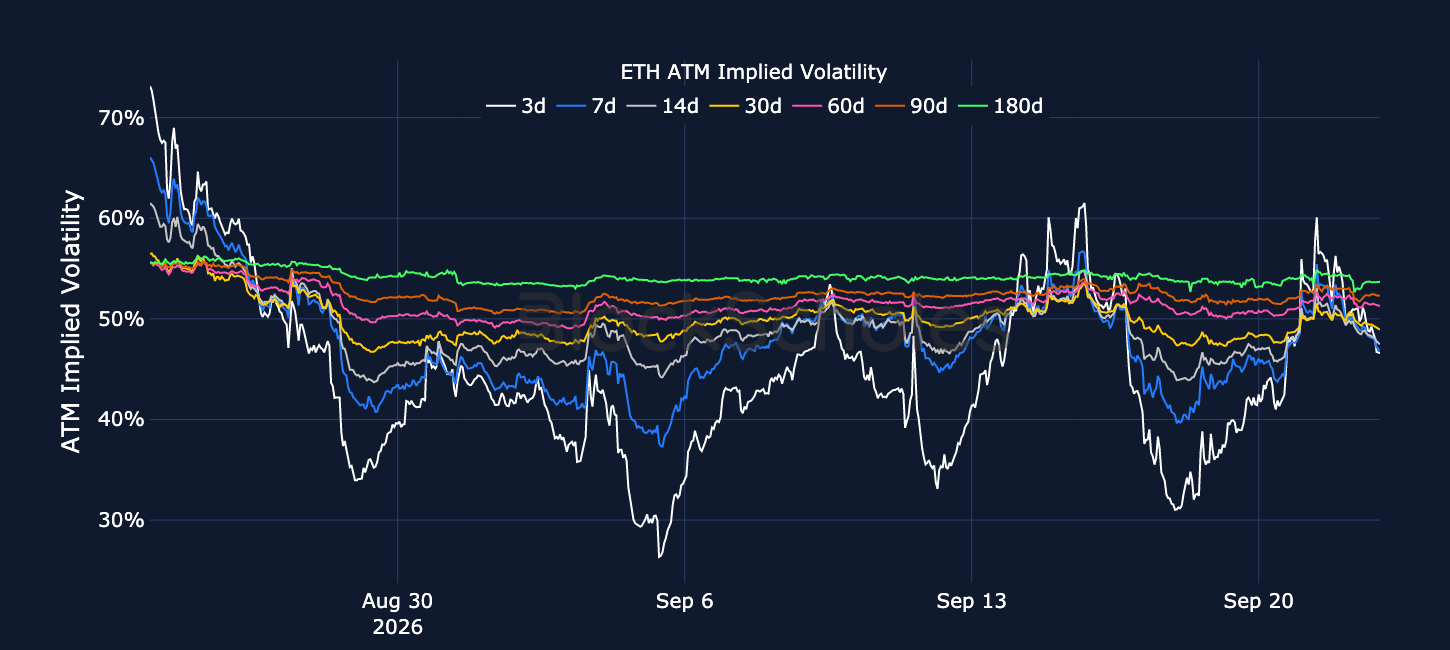
Figure 4. ETH at-the-money implied volatility across selected tenors. Source: Deribit, Block Scholes.
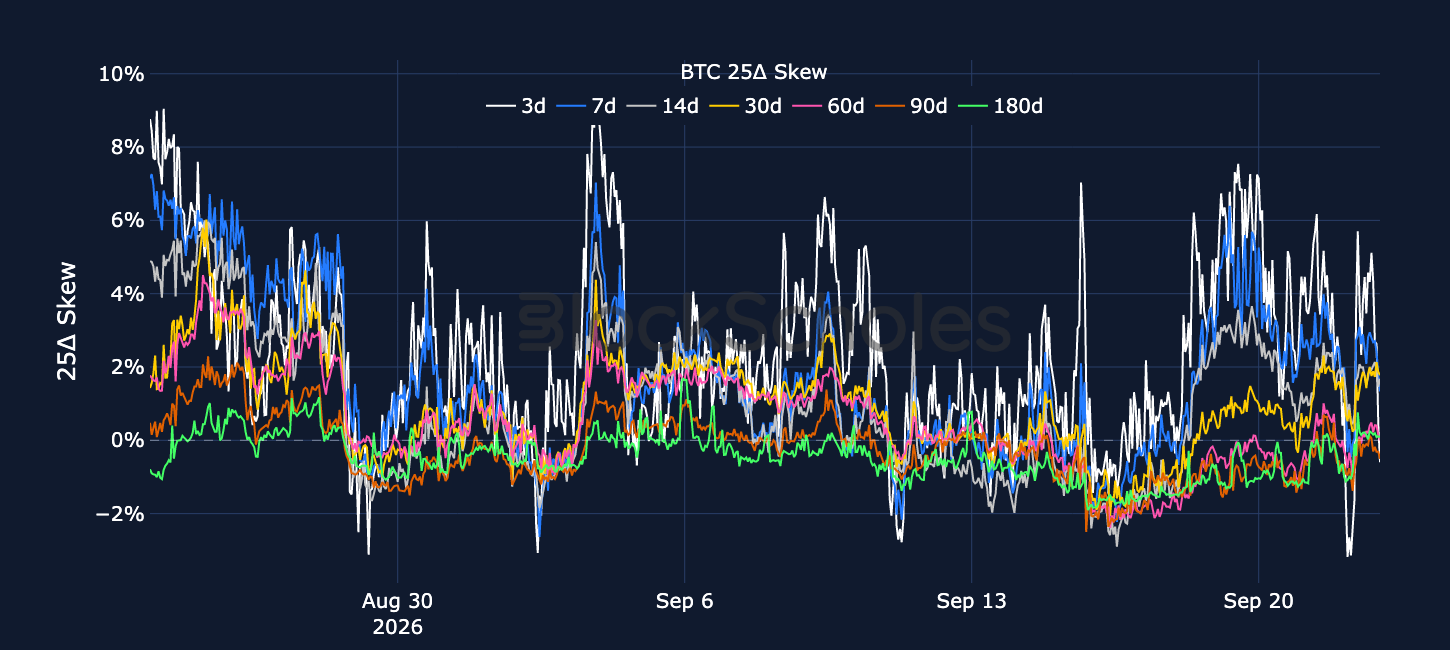
Figure 5. BTC 25-delta put-call skew ratio across selected tenors. Source: Deribit, Block Scholes.
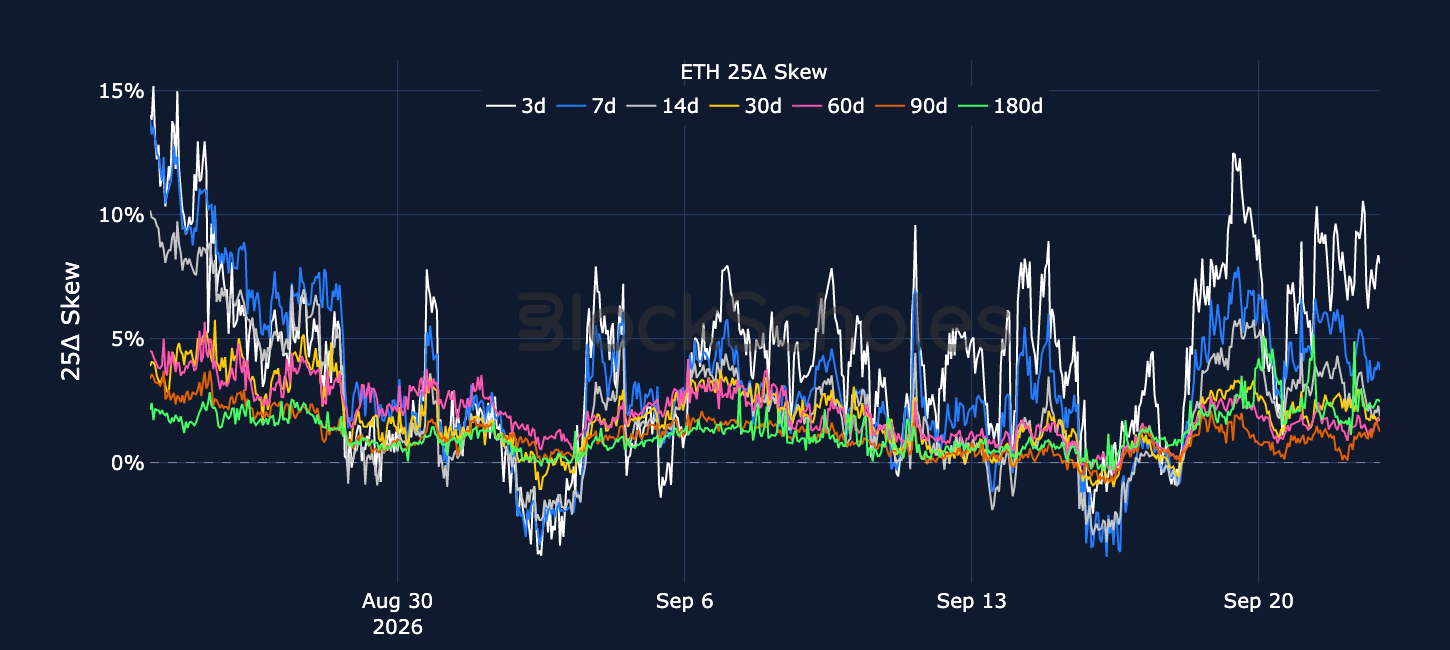
Figure 6. ETH 25-delta put-call skew ratio across selected tenors. Source: Deribit, Block Scholes.
Block Scholes is an FCA-regulated institutional crypto derivatives analytics platform. Live data, IV surfaces, and backtesting available via blockscholes.com.
Boston Fed President Susan Collins backed last week's rate hike, saying a somewhat more restrictive policy rate will help return inflation durably to target, while Richmond Fed President Tom Barkin said the risks to inflation outweigh those to employment.
Canada's six largest banks, including RBC, TD and BMO, are jointly exploring a Canadian-dollar tokenised deposit system, starting with transfers of tokenised deposits between financial institutions.
Market Snapshot: Overnight Moves
Macro & Markets
Risk momentum broadly consolidated as Brent crude fell for a sixth straight day, below $100 per barrel.
President Trump told reporters that US officials had a “very good” meeting with Iranian representatives “that lasted for three hours” on the sidelines of the United Nations General Assembly in New York.
The president further claimed that it was “very productive” and that there are plans to “have another one scheduled in the very near future.”
Don't miss what's next
Upgrade your Block Scholes account to unlock this article and other exclusive insights
Boston Fed President Susan Collins backed last week's rate hike, saying a somewhat more restrictive policy rate will help return inflation durably to target, while Richmond Fed President Tom Barkin said the risks to inflation outweigh those to employment.
Canada's six largest banks, including RBC, TD and BMO, are jointly exploring a Canadian-dollar tokenised deposit system, starting with transfers of tokenised deposits between financial institutions.
Market Snapshot: Overnight Moves
Macro & Markets
Risk momentum broadly consolidated as Brent crude fell for a sixth straight day, below $100 per barrel.
President Trump told reporters that US officials had a “very good” meeting with Iranian representatives “that lasted for three hours” on the sidelines of the United Nations General Assembly in New York.
The president further claimed that it was “very productive” and that there are plans to “have another one scheduled in the very near future.”
Don't miss what's next
Upgrade your Block Scholes account to unlock this article and other exclusive insights
Premium
$30/mo
Access previous and future reports, market insights & deep dives.
Binance bought a $100M stake in Circle through a private placement and signed a five-year agreement to promote USDC on its platform, replacing deals signed in 2024 and 2025. Boston Fed President Susan Collins and Richmond Fed President Tom Barkin backed last week's rate hike, with Barkin saying the risks to inflation outweigh those to employment, while Brent crude fell below $100 a barrel for a sixth straight day. Canada's six largest banks are jointly exploring a Canadian-dollar tokenised deposit system, and Raiffeisen Bank International will offer crypto to 18M customers through Bitpanda.
Spot bitcoin ETFs bought $999.0M of bitcoin on Monday, their largest single day of inflows since October 6, 2025, as BTC topped $86K and the S&P 500 closed up 1.49%, within 0.4% of its record high. St. Louis Fed President Alberto Musalem said the Fed may need to raise rates further, calling the 3.75% to 4% range still "on the accommodative side", while Chicago Fed President Austan Goolsbee warned persistent supply shocks warrant a response. In crypto, Bitmine now holds more than 4.9% of ETH's circulating supply, while Strive and Strategy added 1,355 BTC and 950 BTC respectively.