US Regulator Approves Trump-Backed World Liberty as a Stablecoin Issuer
The OCC conditionally approved a national trust bank charter for World Liberty Financial, letting it issue USD1 directly and hold the dollar reserves itself rather than relying on BitGo. USD1 has reached about $4B in market value, and final approval requires at least $20M of capital. US retail sales fell 0.6% in July, the first decline in nine months, and Michigan sentiment dropped to 51 against a 55 forecast, pushing the odds of a September pause to 69%.
Block Scholes is an FCA-regulated institutional crypto derivatives analytics platform. Live data, IV surfaces, and backtesting available via blockscholes.com.
The OCC conditionally approved a national trust bank charter for World Liberty Financial, letting it issue USD1 directly and hold the dollar reserves itself rather than relying on BitGo. USD1 has reached about $4B in market value, and final approval requires at least $20M of capital.
US retail sales fell 0.6% in July, the first decline in nine months, and Michigan sentiment dropped to 51 against a 55 forecast. Traders now put the odds of a September pause at 69%, up from 50% a week ago, while spot Bitcoin ETFs saw $389.7M of outflows, their largest since June.
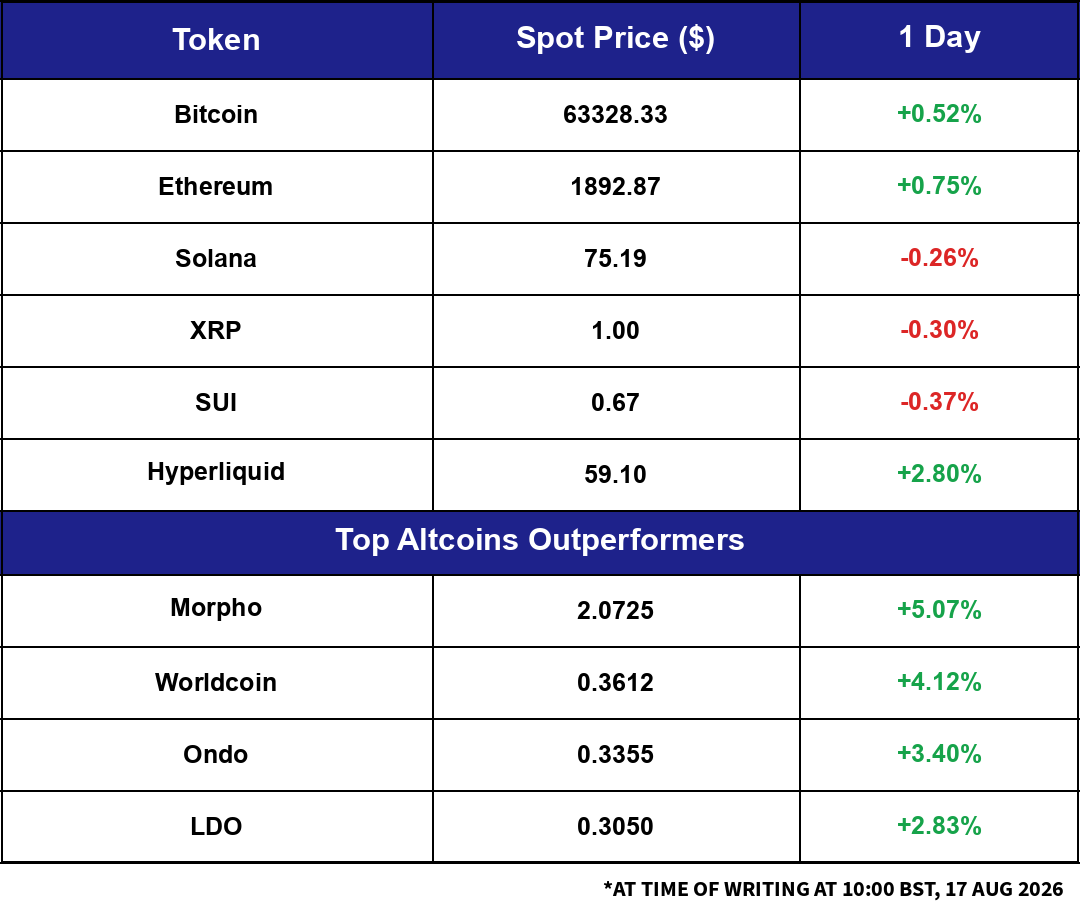
Market Snapshot: Overnight Moves
Macro & Markets
US equities sold off last Friday after closing at record highs a day earlier amidst a slowdown in consumer spending, the economy’s main engine for growth.
Meanwhile, BTC spent the weekend consolidating around $63K before rising up to $63.5K in line with the Asian equities open.
Exchange-traded funds that track spot Bitcoin recorded their largest outflows last week since the end of June as BTC has struggled to trade above $70K since June. The 13 US-listed funds saw net outflows of $389.7M last week, after inflows of $853.5M in the first week of August.
Macro data on Friday showed a decline in consumer sentiment and slowing retail sales which although further lowered expectations for a September rate hike, increased fears of a slowdown for Corporate America.
The S&P 500 ended the session down 0.17%, while the Nasdaq-100 fell 0.13% and the Semiconductor sector index declined 0.31%.
According to the University of Michigan’s preliminary August sentiment index, consumer sentiment fell to 51 in August, below the median forecast of 55 and down from the 55.2 reading in July, ending two straight months of improvement.
US retail sales fell in July by the most since May 2025 and for the first time in nine months.
The value of retail purchases decreased 0.6%, with five of 13 categories in the report posting declines (vs expectations of +0.1%). The decline in sales was led by a 2.2% decrease in receipts at nonstore retailers.
Taken alongside the most recent NFP report which showed unexpected job losses in July and two consecutive mild inflation readings for June and July, markets bolstered their expectations that the Fed will not raise interest rates in September (current implied-probability for a pause is 69% vs 50% last week).
Short-dated Treasuries briefly rose following the weak retail sales data, pushing the two US two-year yield below 4.10% to the lowest level since June 30.
The moves were limited to the front-end of the curve, with the 10-to 30-year yields all trading higher on the day.
Last week, a $42B auction of 10-year US Treasuries resulted in the highest yield for the security since the global financial crisis in 2007, as investors continue to demand more compensation to finance the US’s growing fiscal deficit and amidst inflation uncertainty.
Later in the week, the US government separately sold $35B of 30-year bonds at the highest interest rate since 2001.
The Treasury Department is slated to sell $16B of 20-year bonds on Wednesday this week.
Chicago Fed President Austan Goolsbee said he was encouraged by last week’s CPI report, but wants to see further evidence of a continuation in the trend.
In an interview with Bloomberg News he said, "Given, though, that we got five or six months going the wrong way, and the overall is way too high, I will say I'm encouraged by the last three months. If we get three, four months in a row like what we saw in June, I will be feeling much better that we are on path back to 2%."
The Chicago Fed chief said he supported the FOMC’s decision to hold interest rates steady at the July meeting, though claimed inflation is his primary concern currently, and that the US economy is "basically stable."
"Both of those I do think influence my thinking now about policy, to be a little more guarded and pay a little more attention to what's happening on the inflation side because we've seen in historic episodes, and in the last five years, once you get the inflation going it can be painful and hard to get rid of”.
DeFi / Web3 / Altcoins / Crypto3
The Office of the Comptroller of the Currency has conditionally approved a national trust bank charter for World Liberty Financial, the crypto company backed by President Donald Trump and his family.
The charter would allow World Liberty Trust Company to directly issue its USD1 stablecoin and hold the dollar reserves backing it.
The company currently relies on BitGo for these services.
The trust bank would also be able to custody customer assets and provide payment settlement services, but it would not operate like a traditional bank offering general deposits or loans.
The approval remains subject to several conditions, including maintaining at least $20M in capital and meeting regulatory requirements before final approval.
USD1 has grown to around $4B in market capitalization since launching in 2025.
Sports-focused prediction market Novig has filed a federal lawsuit against Wisconsin Attorney General Josh Kaul and gaming administrator John Dillett.
The company is seeking to prevent the state from taking action against its sports event contracts.
The lawsuit comes shortly after Novig began offering contracts to Wisconsin residents.
Through its subsidiary Ludlow Exchange, Novig argues that its federally regulated sports contracts fall under the Commodity Futures Trading Commission’s jurisdiction rather than state gambling laws.
Wisconsin has already taken legal action against Kalshi, Polymarket, Robinhood, Crypto.com and Coinbase over similar sports contracts.
State officials argue that these contracts constitute illegal gambling under Wisconsin law.
The Wisconsin case is part of a broader legal campaign by Novig.
The company has also filed lawsuits in New York, New Mexico, Massachusetts and Washington as it expands across the United States.
JPMorgan Chase ended its banking relationship with prediction market Polymarket in October 2025 over regulatory concerns, according to the Financial Times.
Polymarket has since moved its accounts to another lender, although the identity of the new bank was not disclosed.
Despite closing the accounts, JPMorgan reportedly continues to maintain business ties with Polymarket.
The bank is also interested in potentially serving as an underwriter if Polymarket eventually pursues an initial public offering.
Polymarket said it still has a close and active relationship with JPMorgan across several areas of its business.
The development comes as prediction markets face increasing regulatory scrutiny in the United States.
Polymarket is also reportedly in early discussions to raise around $1B at a valuation of more than $20B.
Harvard University’s endowment kept its position in BlackRock’s iShares Bitcoin Trust unchanged during Q2, ending two consecutive quarters of selling.
Harvard Management Company reported 3.04M IBIT shares worth $101.4M as of June 30.
The endowment had previously reduced its IBIT position by 21% in Q4 2025 and another 43% in Q1 2026.
Harvard also held $171.2M in gold-related ETFs, more than its $101.4M exposure to IBIT.
Abu Dhabi’s Mubadala Investment Company and Abu Dhabi Investment Council also kept their IBIT holdings unchanged, with a combined position worth about $764M.
JPMorgan increased its IBIT holdings to around 10.4M shares, while Morgan Stanley reduced its position to about 16.5M shares.
Tudor Investment Corporation also increased its IBIT stake, reporting 688,529 shares worth $22.9M at the end of Q2.
CBOE BZX Exchange has asked the U.S. Securities and Exchange Commission to approve a group of 3x leveraged commodity ETFs, including bitcoin and ether products.
The proposed funds include 3x Bitcoin, 3x Ether, 3x Gold, 3x Silver, 3x Crude Oil and 3x Natural Gas ETFs.
Each fund is designed to deliver three times the daily performance of its underlying asset, mainly through futures contracts.
Because the products use leverage, they do not qualify under Cboe’s standard listing rules and require specific SEC approval.
The funds would operate as commodity pools under Commodity Futures Trading Commission oversight rather than as traditional investment companies.
Volatility Shares LLC is expected to sponsor the funds.
If approved, the bitcoin and ether products would become the first 3x leveraged crypto ETFs in the U.S.
Bank Leumi, Israel’s largest bank, plans to offer cryptocurrency trading through its investment app starting in early 2027.
Customers of Leumi and its digital banking arm PEPPER will be able to trade BTC, ETH, SOL and other selected cryptocurrencies.
The bank is partnering with Galaxy Digital, which will provide institutional trading and custody infrastructure.
Bank Leumi said the move is part of its broader innovation strategy and will give customers regulated access to digital assets.
StablecoinX shares jumped more than 12% after the Ethena-focused treasury company reported its first quarterly results as a public company.
StablecoinX revealed that it holds about 3B ENA tokens, representing roughly 20% of the total ENA supply.
The company’s ENA holdings are worth more than $250M at current prices.
StablecoinX reported a $34.2M net loss for Q2, largely due to a $36.2M impairment related to its digital asset holdings.
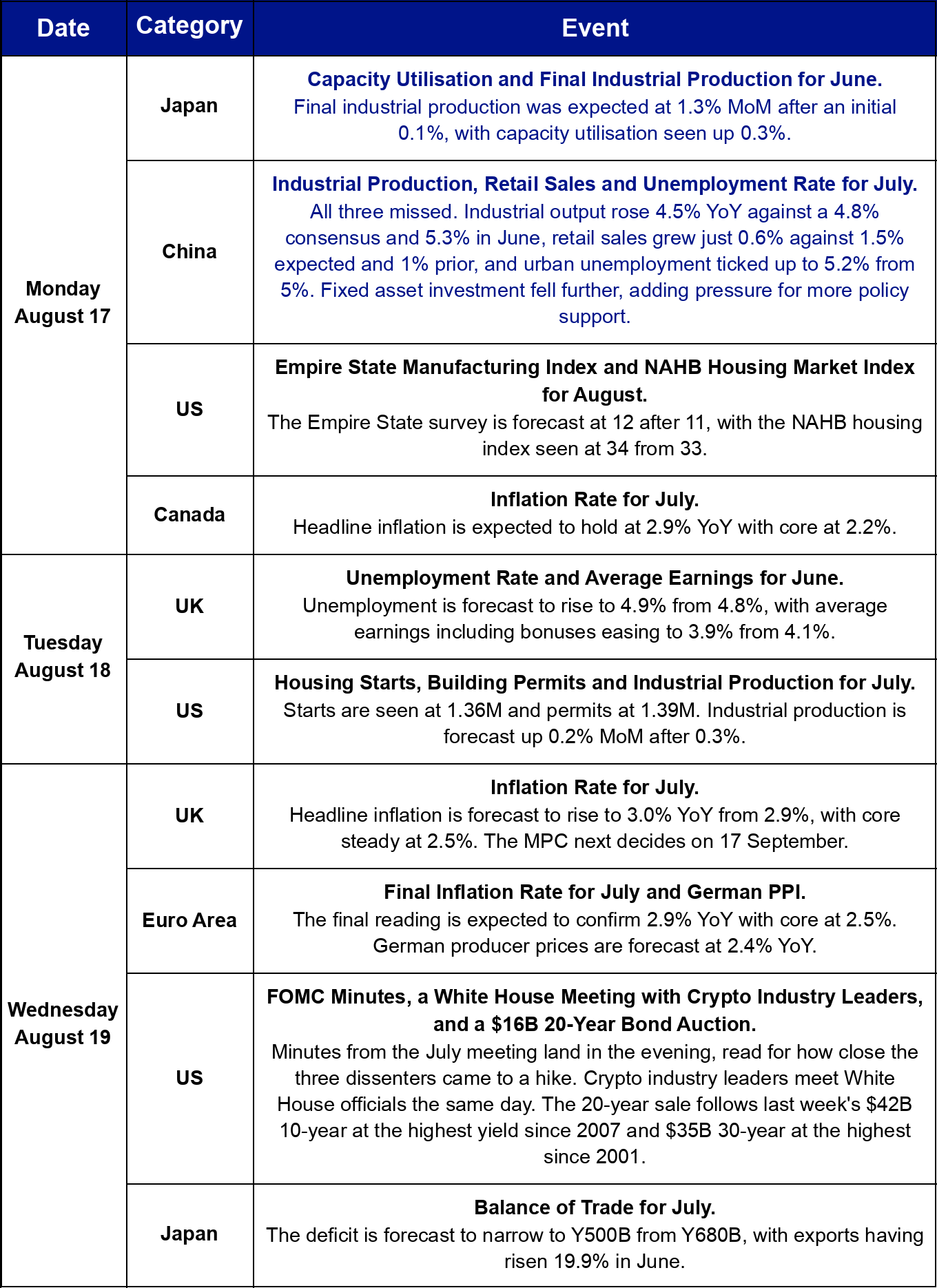
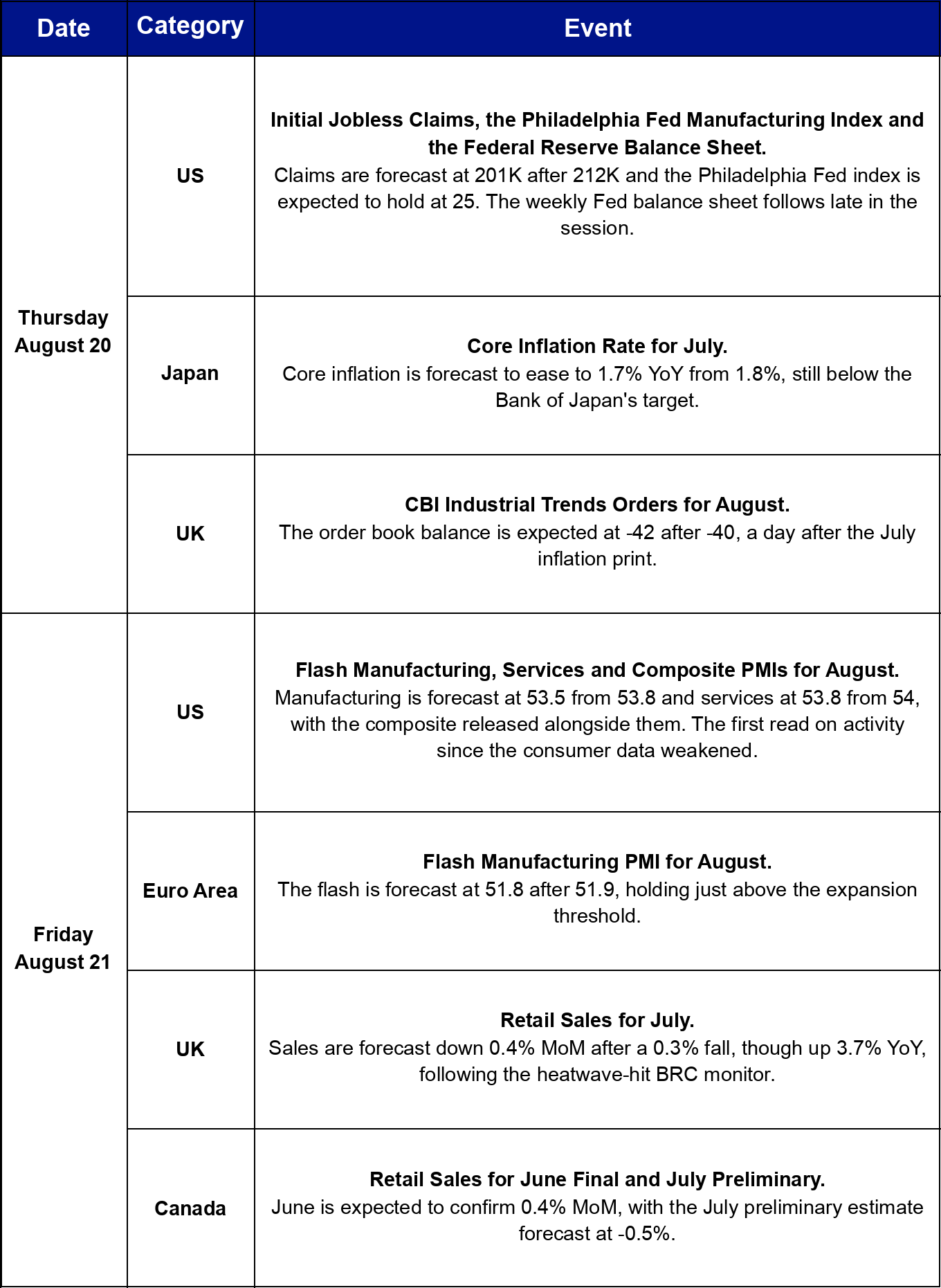
This Week's Calendar
Charts of the Day
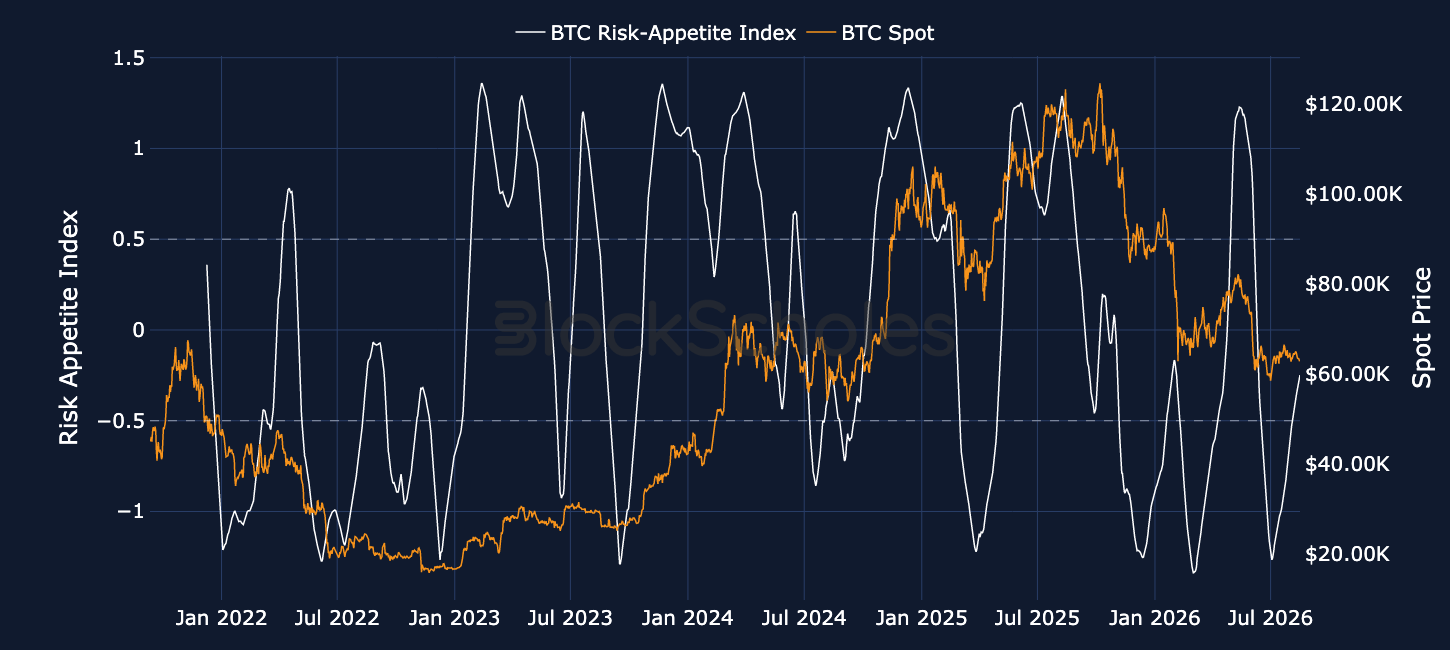
Figure 1. Block Scholes BTC Risk-Appetite Index (white, left-hand axis) and BTC spot price (orange, right-hand axis).
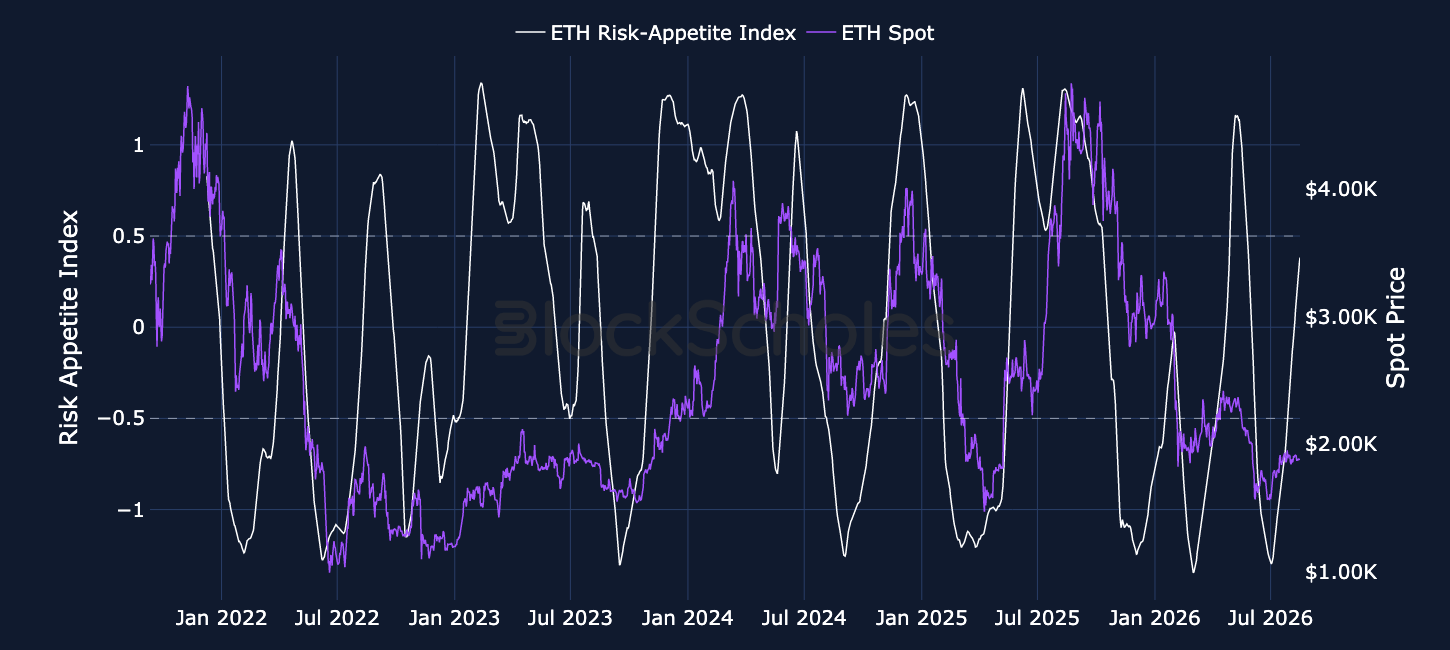
Figure 2. Block Scholes ETH Risk-Appetite Index (white, left-hand axis) and ETH spot price (purple, right-hand axis).
Block Scholes is an FCA-regulated institutional crypto derivatives analytics platform. Live data, IV surfaces, and backtesting available via blockscholes.com.
In Today's Note
The OCC conditionally approved a national trust bank charter for World Liberty Financial, letting it issue USD1 directly and hold the dollar reserves itself rather than relying on BitGo. USD1 has reached about $4B in market value, and final approval requires at least $20M of capital.
US retail sales fell 0.6% in July, the first decline in nine months, and Michigan sentiment dropped to 51 against a 55 forecast. Traders now put the odds of a September pause at 69%, up from 50% a week ago, while spot Bitcoin ETFs saw $389.7M of outflows, their largest since June.
Market Snapshot: Overnight Moves
Macro & Markets
US equities sold off last Friday after closing at record highs a day earlier amidst a slowdown in consumer spending, the economy’s main engine for growth.
Meanwhile, BTC spent the weekend consolidating around $63K before rising up to $63.5K in line with the Asian equities open.
Exchange-traded funds that track spot Bitcoin recorded their largest outflows last week since the end of June as BTC has struggled to trade above $70K since June. The 13 US-listed funds saw net outflows of $389.7M last week, after inflows of $853.5M in the first week of August.
Don't miss what's next
Upgrade your Block Scholes account to unlock this article and other exclusive insights
Block Scholes is an FCA-regulated institutional crypto derivatives analytics platform. Live data, IV surfaces, and backtesting available via blockscholes.com.
In Today's Note
The OCC conditionally approved a national trust bank charter for World Liberty Financial, letting it issue USD1 directly and hold the dollar reserves itself rather than relying on BitGo. USD1 has reached about $4B in market value, and final approval requires at least $20M of capital.
US retail sales fell 0.6% in July, the first decline in nine months, and Michigan sentiment dropped to 51 against a 55 forecast. Traders now put the odds of a September pause at 69%, up from 50% a week ago, while spot Bitcoin ETFs saw $389.7M of outflows, their largest since June.
Market Snapshot: Overnight Moves
Macro & Markets
US equities sold off last Friday after closing at record highs a day earlier amidst a slowdown in consumer spending, the economy’s main engine for growth.
Meanwhile, BTC spent the weekend consolidating around $63K before rising up to $63.5K in line with the Asian equities open.
Exchange-traded funds that track spot Bitcoin recorded their largest outflows last week since the end of June as BTC has struggled to trade above $70K since June. The 13 US-listed funds saw net outflows of $389.7M last week, after inflows of $853.5M in the first week of August.
Don't miss what's next
Upgrade your Block Scholes account to unlock this article and other exclusive insights
Premium
$30/mo
Access previous and future reports, market insights & deep dives.
US inflation rose less than expected in August, with the PCE Price Index up 0.3% on the month and 3.4% over the year against expectations of 0.4% and 3.7%, partly reflecting changes to the BEA's methodology. Fed funds futures now price a 37% probability of an October rate move, down from 70% on Monday, while the BEA revised Q2 GDP growth up to a 2.2% annualised rate from 1.5%, sending long-end Treasury yields higher. The S&P 500 ended 0.25% lower to close out its worst month since June 2026, while BTC briefly jumped past $85K before falling back to $83K.
US equities and long-dated Treasuries sold off together for a second session, sending the 30-year Treasury yield past 5.6%, its highest level since 2002, even as Brent crude fell back to around $96 a barrel. New York Fed President John Williams said there is no need for urgency on rates, and fed funds futures now price a 44.8% probability of a 25bps hike in October, down from 70.9% at the start of the week. The CFTC approved Coinbase Clearing as a derivatives clearing organization, while HSBC named its planned Hong Kong dollar stablecoin HSBC RedCoin.
US stocks fell as the Treasury selloff deepened, S&P 500 -0.77%, Nasdaq-100 -1.08%, with the 10Y yield briefly hitting 5.27% and the 30Y reaching 5.55%, its highest since 2004, as BTC held steady at $83.8K (+1.1%) and ETH rose 2.2% to $2,708. Strategy added 1,665 BTC to lift its holdings to 847,666 BTC and Bitmine bought 17,362 ETH to hold over 6M ETH.