US Inflation Held at 3.4%, Easing Bets on a September Rate Hike
Headline CPI rose 3.4% YoY and 0.1% on the month, with core at 2.5%, matching the slowest annual pace since March 2021. Fed funds futures moved from roughly even odds on a September hike to a 64% implied probability of a pause. Goldman Sachs agreed to buy Neos Investments for up to $2.25B, bringing its Bitcoin and Ethereum high-income ETFs under Goldman Sachs Asset Management.
Block Scholes is an FCA-regulated institutional crypto derivatives analytics platform. Live data, IV surfaces, and backtesting available via blockscholes.com.
Headline CPI rose 3.4% YoY and 0.1% on the month, with core at 2.5%, matching the slowest annual pace since March 2021. Fed funds futures moved from roughly even odds on a September hike to a 64% implied probability of a pause.
Goldman Sachs agreed to buy Neos Investments for up to $2.25B, bringing its Bitcoin and Ethereum high-income ETFs under Goldman Sachs Asset Management. The funds hold no crypto directly, taking exposure through exchange-traded products and options strategies.
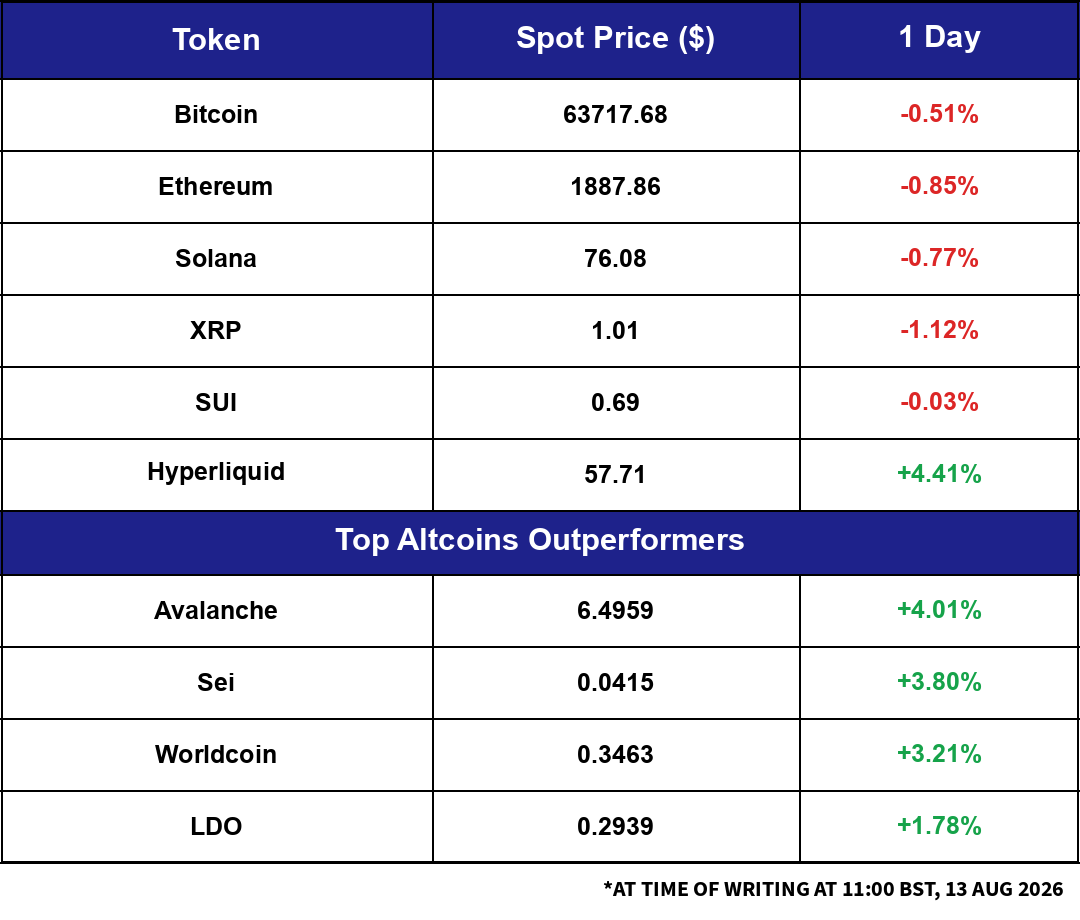
Market Snapshot: Overnight Moves
Macro & Markets
US equities closed within inches of their record all-time high yesterday after an in-line CPI report helped temper expectations around an imminent September rate hike from the Federal Reserve.
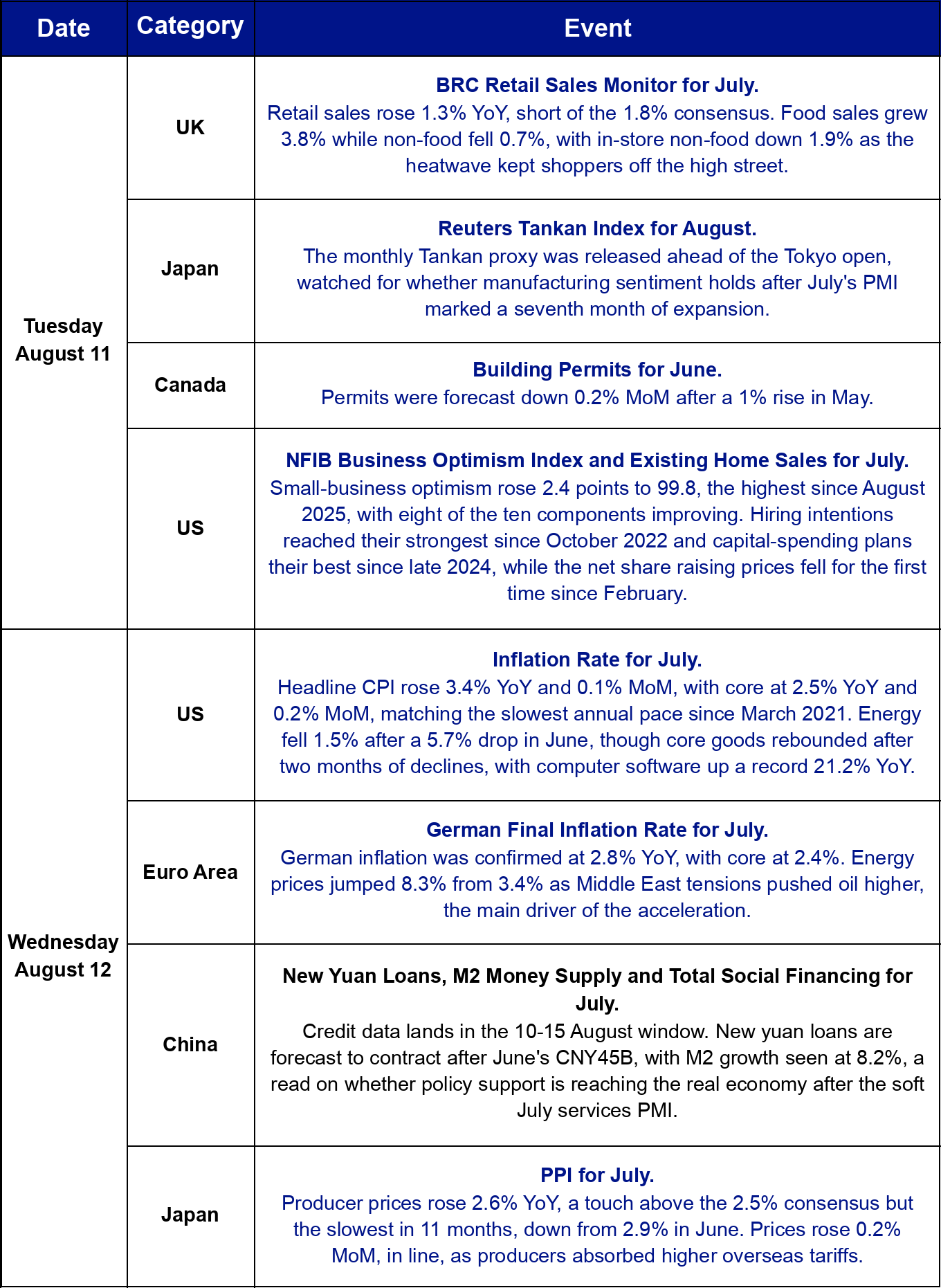
The BLS’s CPI report showed that headline inflation in the US rose at an annual rate of 3.4% and 0.1% from a month earlier, while the core inflation metric advanced 2.5% from a year ago, matching the slowest pace since March 2021 and 0.2% month-over-month.
Energy prices declined for a second consecutive month, down 1.5% in July after a 5.7% decrease in the month prior.
There were some signs of inflationary pressure in the report however, core goods prices (i.e., excluding food and energy commodities), rebounded after two months of declines. Computer software and accessories prices rose by a record 21.2% from a year earlier, while computers, peripherals and smart home assistants advanced by the most in more than four years.
Overall however, taken alongside last Friday’s weaker than expected jobs report, both macro releases have caused markets to price out odds of an interest rate increase in September, hours before the CPI report, Fed funds futures implied roughly 50-50 odds for a pause and a hike. That has since shifted to 64% implied probability for a pause.
While the data helped drag sentiment higher on Wall Street, crypto prices largely traded rangebound. BTC wavered around $63K and ETH struggled to jump above $1,900.
Chipmakers rallied with the Semiconductor sector index rising 2.49% which helped drive the Nasdaq-100 up 0.74%. The S&P 500 closed 0.26% higher.
The outperformance in artificial-intelligence related stocks was driven by a series of strong profit reports from large semiconductor and chipmaking firms that helped bolster hopes around huge AI-related capital expenditure.
Super Micro Computer, which sells servers and other equipment, jumped 19.02% after reporting earnings per share for the latest quarter that were 84% higher than market expectations.
CoreWeave, a provider of AI computing power, rallied 19.28% after reporting better revenue for the latest quarter than analysts expected.
Equities were also boosted by an easing in US treasury yields, with the yield on the two-year note and 10-year bond both down around 4bps.
DeFi / Web3 / Altcoins / Crypto3
President Donald Trump and several White House officials have been sued over Truth API, a paid service from Trump Media’s Truth Social that gives subscribers faster access to potentially market-moving posts, with more than 10 customers, primarily high-frequency trading firms, paying roughly $60,000-$100,000 per month.
The Intercept and Freedom of the Press Foundation allege the arrangement is unconstitutional because Trump uses Truth Social to make official government announcements, meaning paying customers could receive government information before the general public.
Trump Media is also exploring licensing Truth Social data to prediction-market operators, potentially creating another revenue stream, although the company has not specified what data would be provided or how prediction platforms would use it.
Goldman Sachs has agreed to acquire Neos Investments, an asset manager specializing in options-based income ETFs, for up to $2.25B, bringing the Bitcoin High Income ETF (BTCI), Boosted Bitcoin High Income ETF (XBCI) and Ethereum High Income ETF (NEHI) under Goldman Sachs Asset Management when the deal closes, expected in Q1 2027.
The three funds do not hold bitcoin or ether directly, instead gaining crypto exposure through exchange-traded products and using options strategies, with BTCI the largest at more than $1B in net assets.
The New York City Council opened an investigation into Kalshi, Polymarket, Coinbase and Gemini Titan, examining allegations that prediction-market platforms used false, deceptive or abusive marketing tactics, particularly toward younger users.
The probe will examine claims including that Polymarket paid social-media creators to stage fake bets and wins on replica websites, while the Council is considering consumer-protection legislation targeting how prediction markets advertise to New Yorkers.
The investigation adds to mounting regulatory pressure on the sector, as New York State separately alleges some prediction markets constitute illegal gambling, while the Commodity Futures Trading Commission (CFTC), the federal derivatives regulator, maintains that federally regulated prediction markets fall under its exclusive jurisdiction.
Standard Chartered-backed Anchorpoint has begun the institutional rollout of HKDAP (Hong Kong Dollar At Par), an HKMA-regulated stablecoin redeemable 1:1 for Hong Kong dollars, initially targeting cross-border payments and settlement of tokenized real-world assets.
HKDAP is 100% reserve-backed, with reserves legally segregated from Anchorpoint and held in trust for token holders, using high-quality, liquid assets such as cash, short-term bank deposits and qualifying government debt.
The stablecoin is currently available on Ethereum mainnet during its beta phase, with additional public blockchains under consideration, while distribution is initially limited to institutions and professional investors before a planned broader launch.
The SEC has cleared Franklin Templeton’s traditional funds, such as mutual funds and ETFs, to place cash in its OnChain U.S. Government Money Fund (FOBXX), known as BENJI, a roughly $726M tokenized money-market fund that invests mainly in U.S. government securities, without meeting certain old custody rules designed for physical securities certificates stored in vaults.
The decision came through a no-action letter, an SEC staff assurance that it would not recommend enforcement under the specified arrangement, allowing Franklin’s conventional funds to use BENJI’s blockchain-based infrastructure, where ownership records are maintained partly onchain for faster processing and more frequent pricing, while Franklin’s transfer agent still controls the private keys and official shareholder record.
The Blockchain Association, a U.S. crypto industry advocacy group, filed an amicus brief, a court filing from a non-party offering arguments relevant to a case, supporting Custodia Bank’s request for the Supreme Court to review the Federal Reserve’s denial of its master account application.
A Fed master account, an account that gives eligible financial institutions direct access to the Federal Reserve’s core payment infrastructure for settling dollar transactions without relying on an intermediary bank, is deemed important for operations by Custodia, a Wyoming-chartered crypto-focused bank that has been seeking access since 2020.
The dispute centers on whether regional Federal Reserve Banks can choose to deny otherwise eligible state-chartered institutions access, with the Blockchain Association arguing that such discretion could allow regulators to effectively exclude lawful crypto businesses from essential banking infrastructure; Custodia lost in lower courts and is now asking the Supreme Court to hear the case.
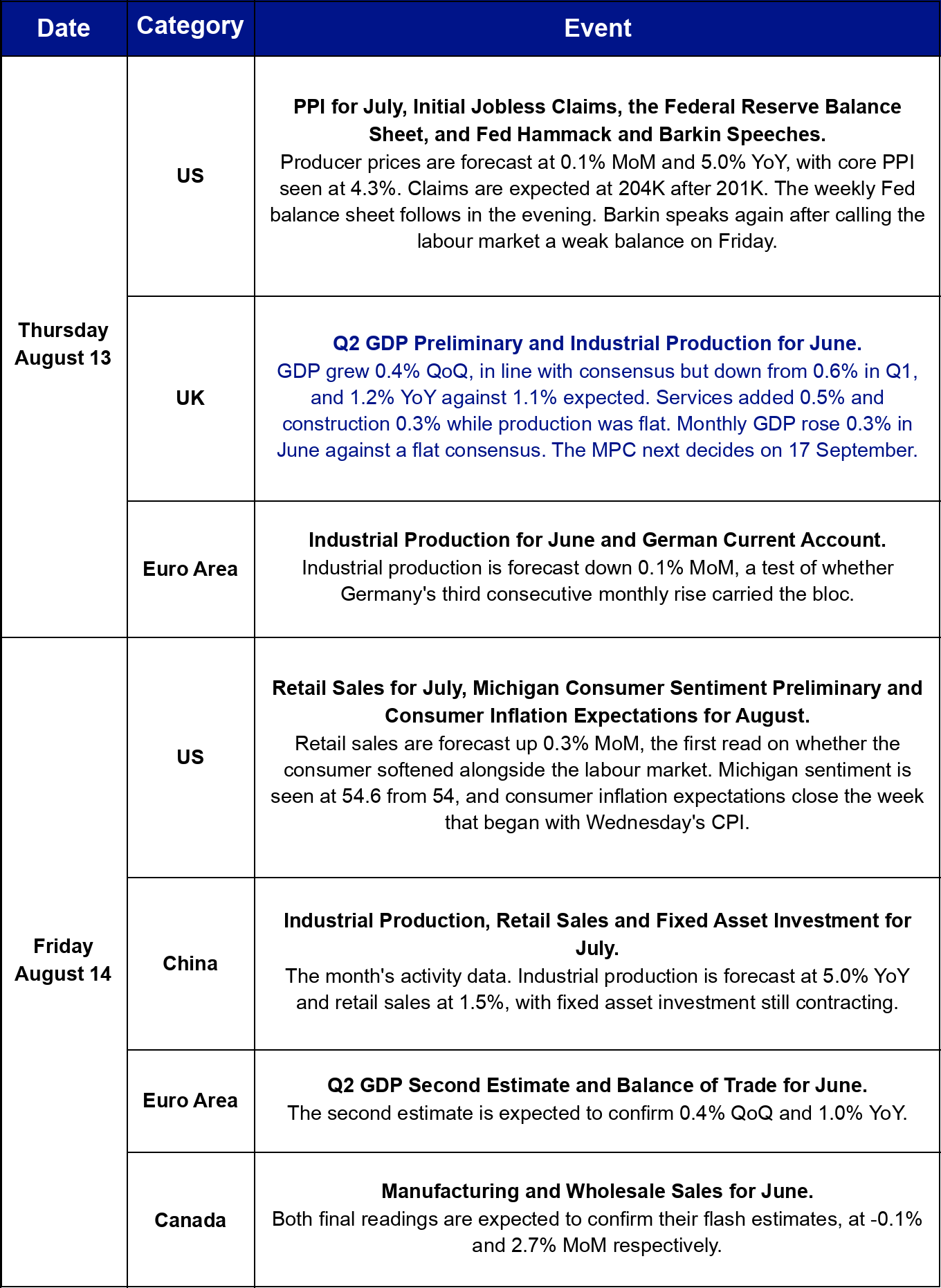
This Week's Calendar
Charts of the Day
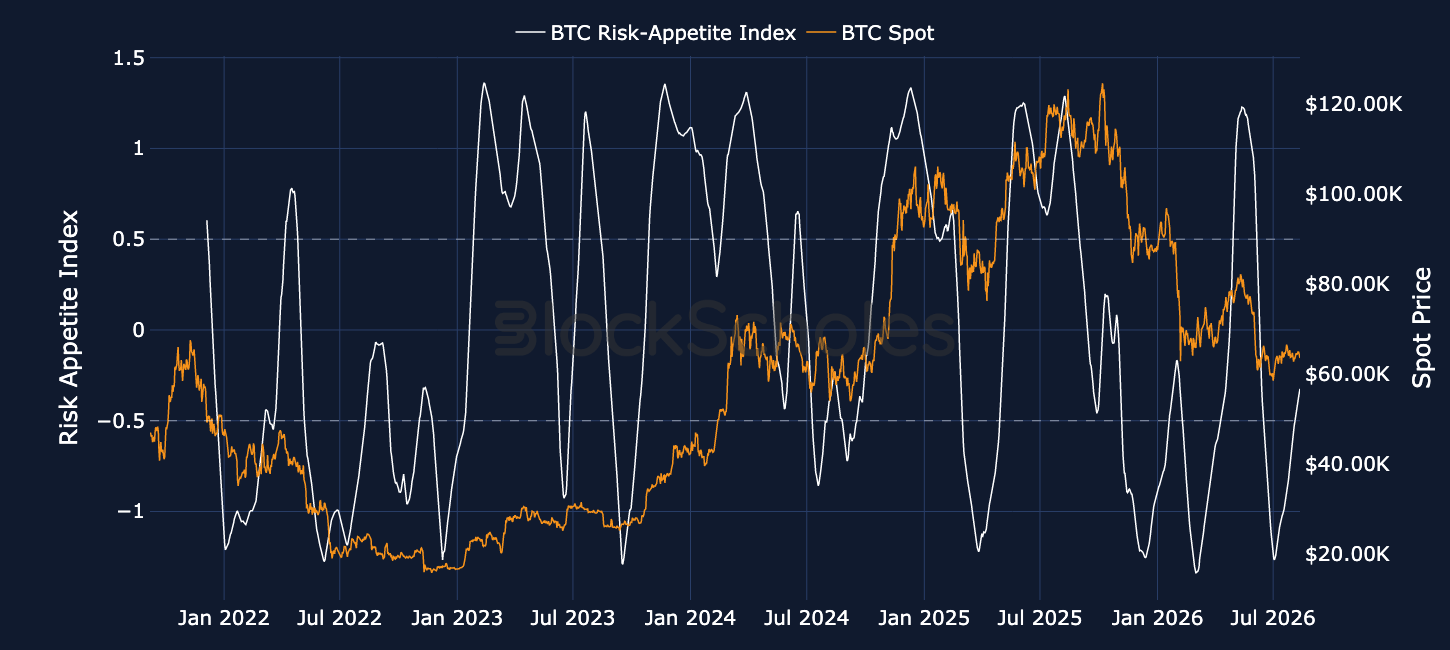
Figure 1. Block Scholes BTC Risk-Appetite Index (white, left-hand axis) and BTC spot price (orange, right-hand axis).
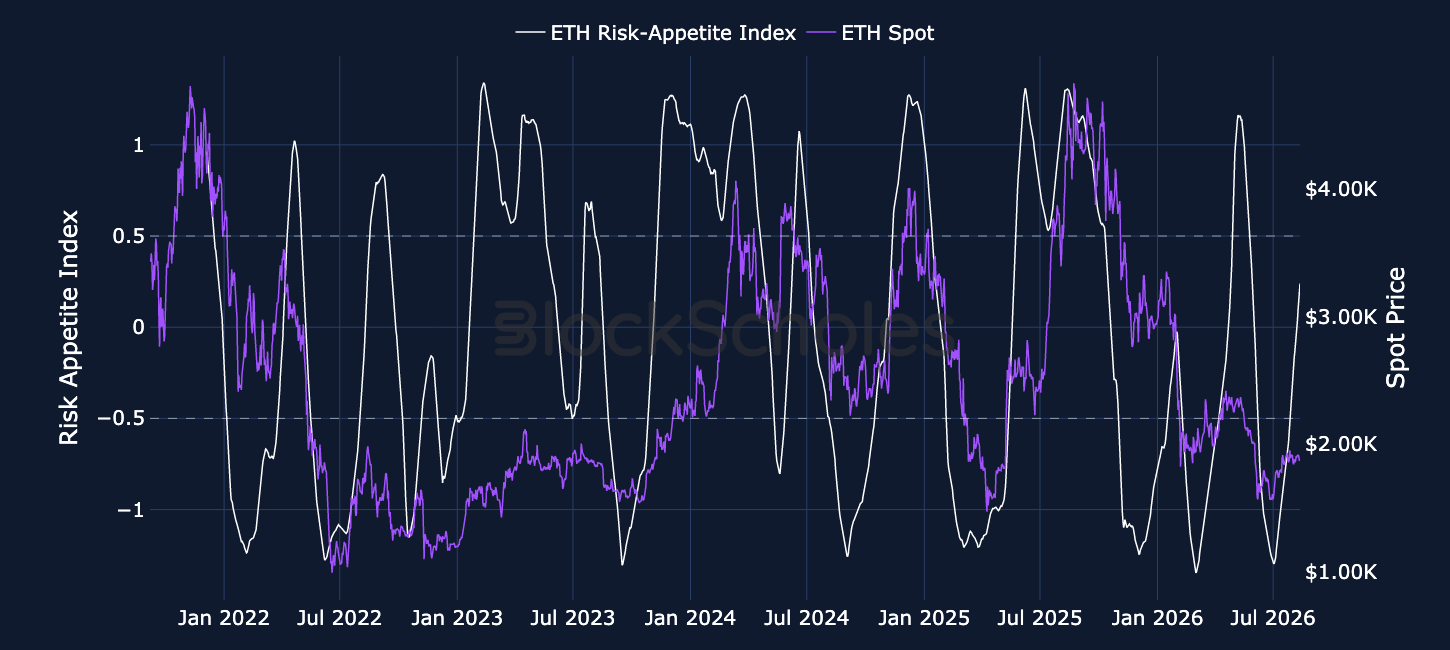
Figure 2. Block Scholes ETH Risk-Appetite Index (white, left-hand axis) and ETH spot price (purple, right-hand axis).
Block Scholes is an FCA-regulated institutional crypto derivatives analytics platform. Live data, IV surfaces, and backtesting available via blockscholes.com.
In Today's Note
Headline CPI rose 3.4% YoY and 0.1% on the month, with core at 2.5%, matching the slowest annual pace since March 2021. Fed funds futures moved from roughly even odds on a September hike to a 64% implied probability of a pause.
Goldman Sachs agreed to buy Neos Investments for up to $2.25B, bringing its Bitcoin and Ethereum high-income ETFs under Goldman Sachs Asset Management. The funds hold no crypto directly, taking exposure through exchange-traded products and options strategies.
Market Snapshot: Overnight Moves
Macro & Markets
US equities closed within inches of their record all-time high yesterday after an in-line CPI report helped temper expectations around an imminent September rate hike from the Federal Reserve.
The BLS’s CPI report showed that headline inflation in the US rose at an annual rate of 3.4% and 0.1% from a month earlier, while the core inflation metric advanced 2.5% from a year ago, matching the slowest pace since March 2021 and 0.2% month-over-month.
Energy prices declined for a second consecutive month, down 1.5% in July after a 5.7% decrease in the month prior.
Don't miss what's next
Upgrade your Block Scholes account to unlock this article and other exclusive insights
Block Scholes is an FCA-regulated institutional crypto derivatives analytics platform. Live data, IV surfaces, and backtesting available via blockscholes.com.
In Today's Note
Headline CPI rose 3.4% YoY and 0.1% on the month, with core at 2.5%, matching the slowest annual pace since March 2021. Fed funds futures moved from roughly even odds on a September hike to a 64% implied probability of a pause.
Goldman Sachs agreed to buy Neos Investments for up to $2.25B, bringing its Bitcoin and Ethereum high-income ETFs under Goldman Sachs Asset Management. The funds hold no crypto directly, taking exposure through exchange-traded products and options strategies.
Market Snapshot: Overnight Moves
Macro & Markets
US equities closed within inches of their record all-time high yesterday after an in-line CPI report helped temper expectations around an imminent September rate hike from the Federal Reserve.
The BLS’s CPI report showed that headline inflation in the US rose at an annual rate of 3.4% and 0.1% from a month earlier, while the core inflation metric advanced 2.5% from a year ago, matching the slowest pace since March 2021 and 0.2% month-over-month.
Energy prices declined for a second consecutive month, down 1.5% in July after a 5.7% decrease in the month prior.
Don't miss what's next
Upgrade your Block Scholes account to unlock this article and other exclusive insights
Premium
$30/mo
Access previous and future reports, market insights & deep dives.
The 30-year Treasury yield rose around 8bps to just shy of 5.5%, a level last seen in 2004, and the 10-year yield climbed 10bps to 5.21%, its highest since 2007, even as the Treasury bought back $4.08B of the $6B it had targeted. BTC ranged between $83K and $85K, Brent crude slipped to around $105 a barrel on reports of a phased US-Iran deal, and New York Fed President John Williams said another rate hike may be appropriate by year-end. New York State sued Polymarket, alleging it runs an illegal gambling business, and Ondo Finance launched onchain portfolio tokens built on BlackRock model portfolios.