The Senate Delays the CLARITY Act Vote Until September
The Senate postponed the CLARITY Act until lawmakers return from the August recess, pushing the procedural vote into September. Polymarket traders now put the odds of it being signed into law by the end of 2026 at 14%. The FT reported that Fed Chair Kevin Warsh will stick with his stripped-back communications despite last week's backlash, and is prepared to back a rate increase in September if the coming inflation data comes in above expectations.
Block Scholes is an FCA-regulated institutional crypto derivatives analytics platform. Live data, IV surfaces, and backtesting available via blockscholes.com.
The Senate postponed the CLARITY Act until lawmakers return from the August recess, pushing the procedural vote into September. Polymarket traders now put the odds of it being signed into law by the end of 2026 at 14%; the bill still needs 60 Senate votes.
The FT reported that Fed Chair Kevin Warsh will stick with his stripped-back communications despite last week's backlash, and is prepared to back a rate increase in September if the coming inflation data comes in above expectations.
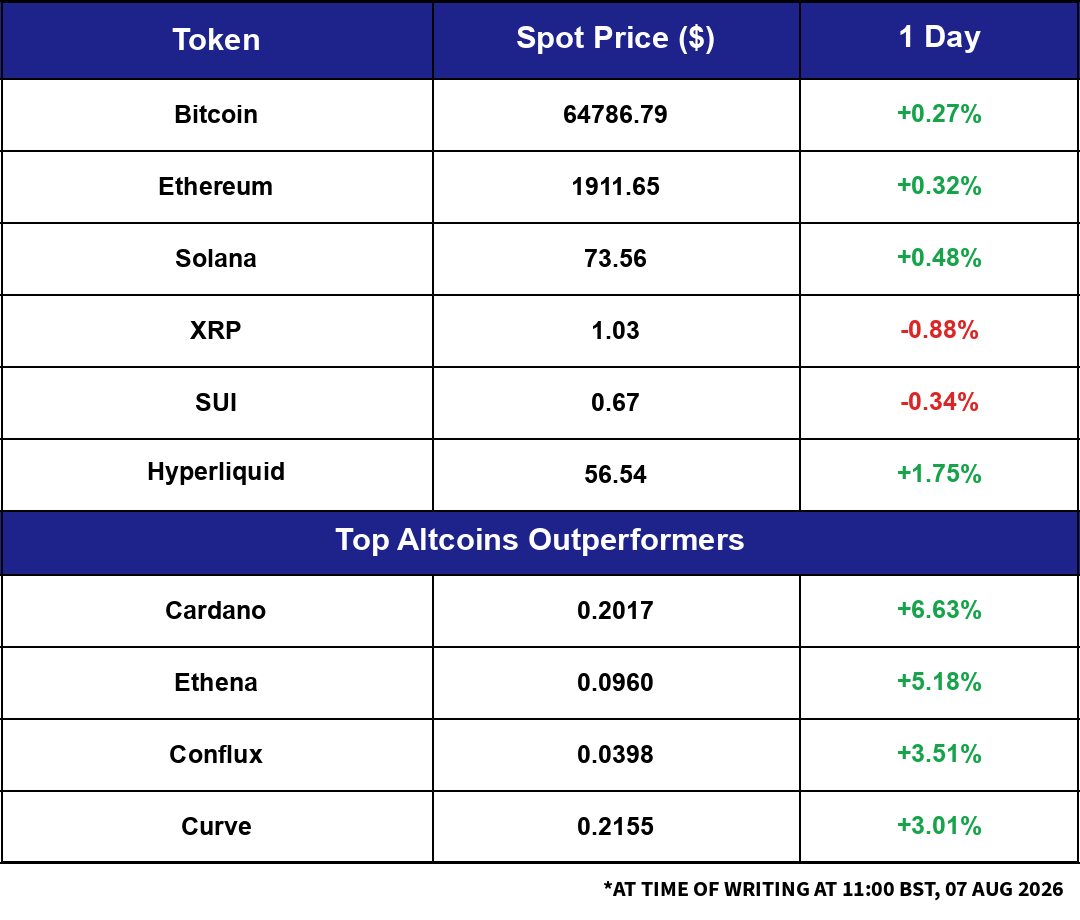
Market Snapshot: Overnight Moves
Macro & Markets
BTC traded at $64,547 this morning, roughly flat over the past 24 hours while ETH held around $1,909.
Gold has continued to rally, trading at $4,295 per ounce, up 5% on the week and marking a fourth consecutive daily advance through Thursday.
This comes as the World Gold Council published its Q2 2026 Gold Demand Trends report on 30 July, showing that central banks purchased a record 289 tonnes of gold in the second quarter, a 74% increase year-on-year and more than five times the revised Q1 total of 57 tonnes.
Poland was the largest buyer at 51 tonnes, followed by the People's Bank of China at 33 tonnes, the latter's biggest quarterly addition since Q4 2023.
US equities ended lower on Thursday, with all three major indices closing in negative territory. The Dow Jones Industrial Average lost 0.85% over the session, to 53,885.10, ending both a five-day winning streak and a three-session run of record closes.
The S&P 500 finished 0.18% lower at 7,709.96, just below Tuesday's all-time high, while the Nasdaq Composite was down 0.06% at 26,348.35. Individual company earnings drove much of the action once again.
Brent for October delivery gained 3.8% on Thursday now trading at around $82.49 per barrel and WTI for September rose 2.8% Thursday now trading around $77.29. Despite this, both remain on track for a weekly loss of roughly 5% to 8% despite the bounce.
Iran's semi-official Fars news agency published a draft parliamentary bill on Thursday setting out restrictive terms for shipping through the Strait of Hormuz.
Under the draft, US and Israeli vessels would be banned from transiting, other nations deemed hostile would need to pay war compensation before being granted passage, violators would face penalties of up to 20% of cargo value, and full reopening would be contingent on the lifting of the US maritime blockade.
Reports from Reuters and Yahoo Finance indicated that Iran is separately seeking transit fees of 5% to 7% of cargo value, Oman is proposing around 3%, and Washington wants no fees at all.
Industry sources described the proposed framework as not easily workable given existing US sanctions and shipping-insurance clauses. Trump maintains his position that the war in Iran will end "pretty soon".
The Financial Times reported that Fed Chair Kevin Warsh plans to stick with his stripped-back communications style despite the market backlash that followed last week's FOMC meeting, when 30-year Treasury yields spiked to their highest level since 2007.
People close to Warsh told the FT that he had acknowledged mistakes during his first 10 weeks at the helm, "including failing to reinforce his key messages on price stability", but that he is not backing down from his push to reduce forward guidance.
The same sources said Warsh is prepared to back a rate increase at the September FOMC meeting if inflation data due in the coming weeks comes in above expectations.
Warsh is expected to use his first Jackson Hole speech later this month to lay out the framework in more detail.
DeFi / Web3 / Altcoins / Crypto3
The U.S. Senate has postponed consideration of the CLARITY Act until lawmakers return from the August recess, pushing a key procedural vote on the crypto market structure bill into September.
The delay has weighed heavily on expectations for passage this year, with Polymarket traders now assigning just a 14% probability that the CLARITY Act will be signed into law by the end of 2026.
The delay gives lawmakers additional time to build the bipartisan support required to advance the legislation, which will need 60 votes in the Senate.
Negotiations remain focused on several unresolved issues, including stablecoin rewards, illicit-finance safeguards, consumer protection measures and ethics provisions related to public officials’ digital-asset interests.
September is now expected to be a critical window for the bill’s progress.
If approved by the Senate, the legislation would still need to return to the House before it could be sent to the president.
Sui is preparing to integrate two NIST-approved post-quantum signature schemes designed to protect accounts and high-value assets against future quantum computing risks.
The network plans to use ML-DSA-65 for native accounts and SLH-DSA-SHA2-128s within Move smart contracts for higher-value vaults.
The two approaches rely on different cryptographic foundations, reducing the risk that a single vulnerability could compromise both.
A notable feature of the upgrade is that users will not need to create new recovery phrases or move funds to new addresses.
Quantum-resistant keys can be derived from existing seed phrases, while Sui’s address-aliasing system can allow accounts to update their authorization keys without transferring assets.
The rollout will be optional and incremental.
Quantum-safe vaults are targeted for mainnet deployment in 2026, with native ML-DSA-65 accounts expected on testnet by year-end and mainnet authentication planned for Q1 2027.
Wintermute has registered its U.S. subsidiary as a broker-dealer with the SEC and FINRA, marking a significant expansion beyond its core crypto market-making business.
The New York-based entity will be able to provide liquidity across U.S. securities markets, trade stocks and options for its own account, self-clear certain digital asset securities transactions and act as an Authorized Participant for exchange-traded products, including crypto-linked ETFs.
The move reflects the increasing convergence between digital assets and traditional financial markets, particularly as tokenization brings more securities activity onchain.
Wintermute has already been broadening its market presence through tokenized gold and prediction-market liquidity.
The broker-dealer registration gives the firm a regulated framework to operate across a wider set of asset classes in the U.S.
Bitcoin miners MARA Holdings and CleanSpark reported materially weaker quarterly results, underscoring continued pressure on mining economics even as both companies expand further into high-performance computing and AI infrastructure.
MARA’s second-quarter revenue fell 27% year over year to $174.9M, while CleanSpark reported $138.0M for its fiscal third quarter, down 30.5% from the prior-year period.
Both companies also moved from profitability to substantial net losses, partly reflecting mark-to-market declines in the value of their bitcoin holdings.
Despite the weaker financial performance, infrastructure expansion remains central to both strategies.
MARA is advancing acquisitions and site development that could significantly increase its power capacity, while CleanSpark continues to position its grid-connected assets for long-term data-center and AI-related commercial use.
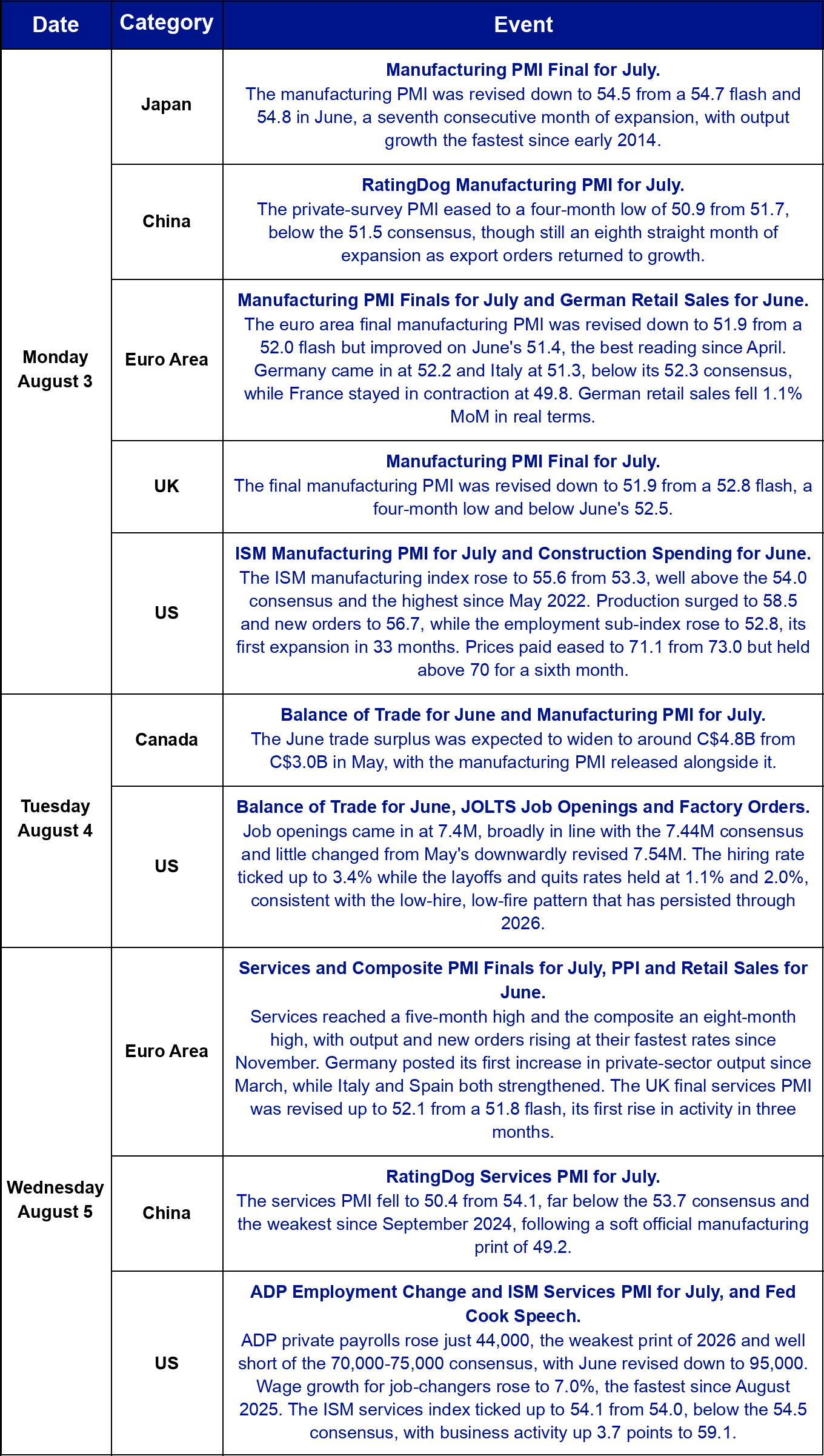
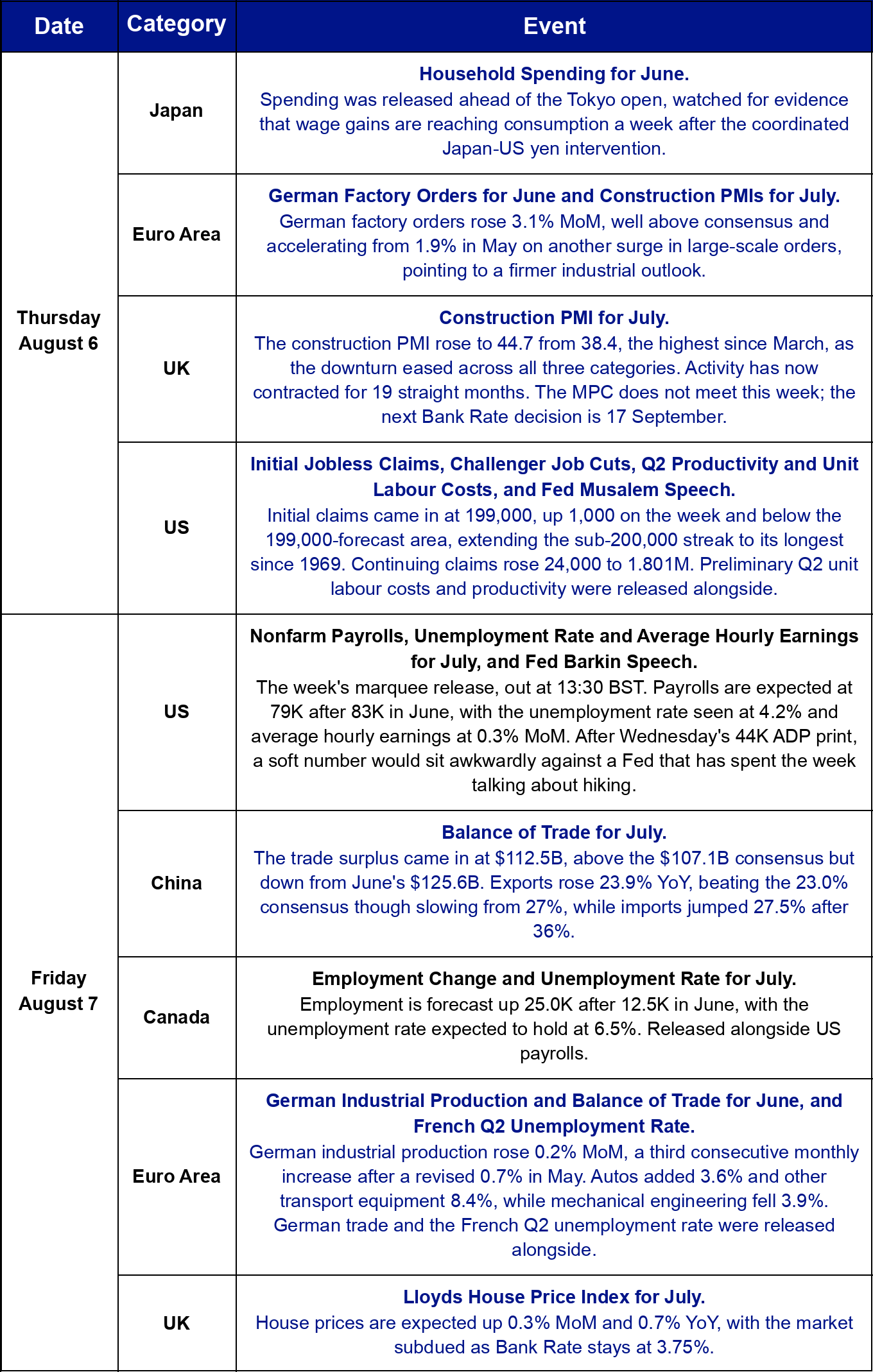
This Week's Calendar
Charts of the Day
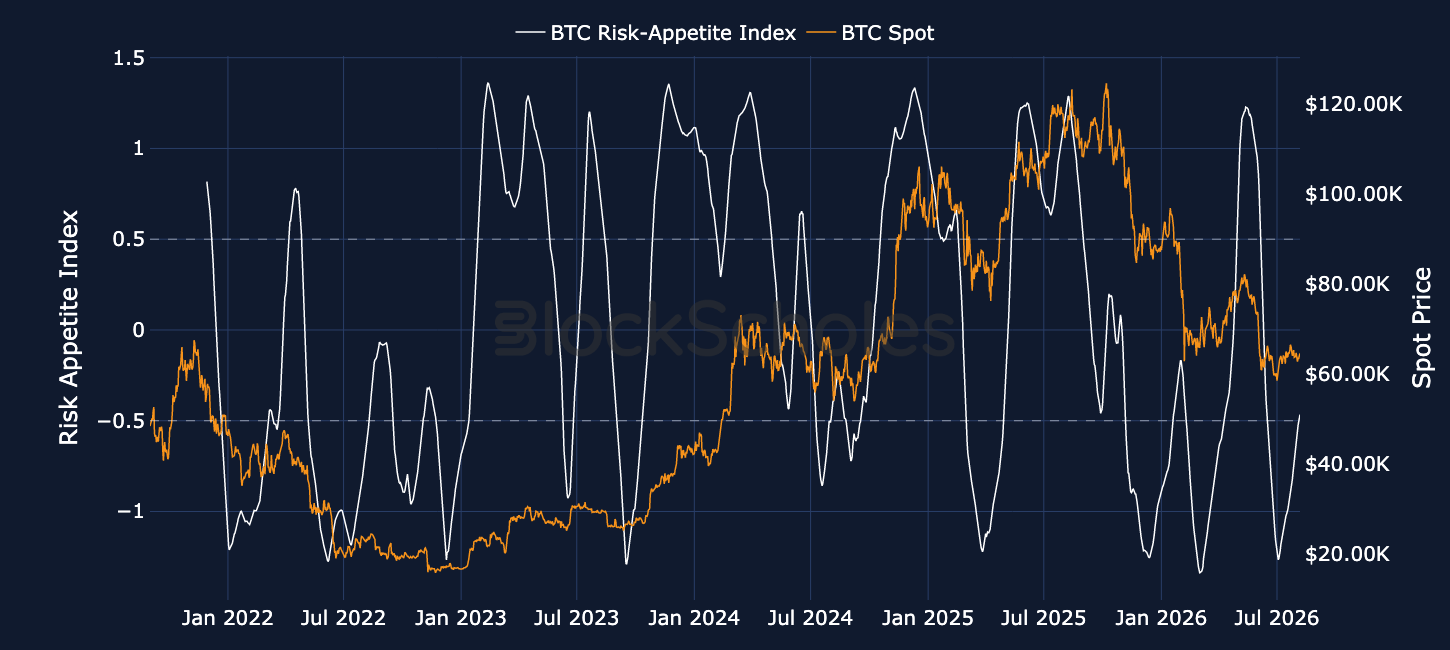
Figure 1. Block Scholes BTC Risk-Appetite Index (white, left-hand axis) and BTC spot price (orange, right-hand axis).
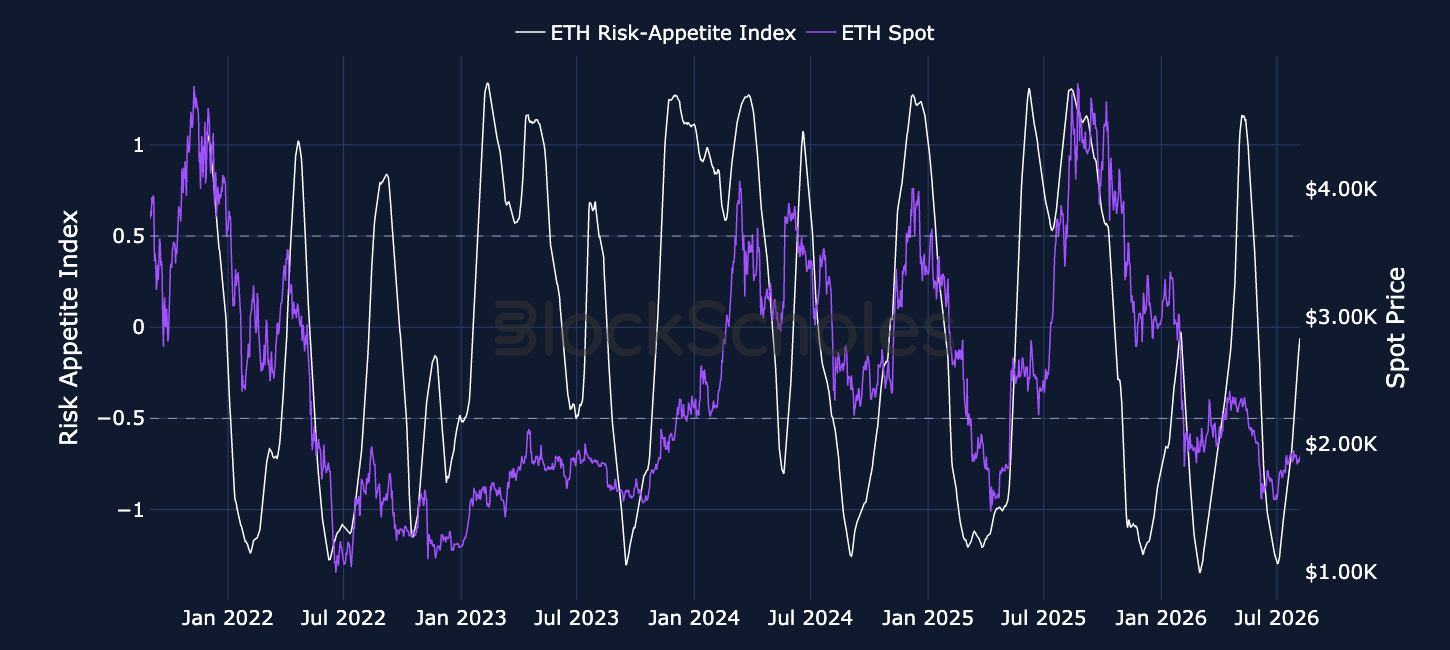
Figure 2. Block Scholes ETH Risk-Appetite Index (white, left-hand axis) and ETH spot price (purple, right-hand axis).
Block Scholes is an FCA-regulated institutional crypto derivatives analytics platform. Live data, IV surfaces, and backtesting available via blockscholes.com.
In Today's Note
The Senate postponed the CLARITY Act until lawmakers return from the August recess, pushing the procedural vote into September. Polymarket traders now put the odds of it being signed into law by the end of 2026 at 14%; the bill still needs 60 Senate votes.
The FT reported that Fed Chair Kevin Warsh will stick with his stripped-back communications despite last week's backlash, and is prepared to back a rate increase in September if the coming inflation data comes in above expectations.
Market Snapshot: Overnight Moves
Macro & Markets
BTC traded at $64,547 this morning, roughly flat over the past 24 hours while ETH held around $1,909.
Gold has continued to rally, trading at $4,295 per ounce, up 5% on the week and marking a fourth consecutive daily advance through Thursday.
This comes as the World Gold Council published its Q2 2026 Gold Demand Trends report on 30 July, showing that central banks purchased a record 289 tonnes of gold in the second quarter, a 74% increase year-on-year and more than five times the revised Q1 total of 57 tonnes.
Poland was the largest buyer at 51 tonnes, followed by the People's Bank of China at 33 tonnes, the latter's biggest quarterly addition since Q4 2023.
Don't miss what's next
Upgrade your Block Scholes account to unlock this article and other exclusive insights
Block Scholes is an FCA-regulated institutional crypto derivatives analytics platform. Live data, IV surfaces, and backtesting available via blockscholes.com.
In Today's Note
The Senate postponed the CLARITY Act until lawmakers return from the August recess, pushing the procedural vote into September. Polymarket traders now put the odds of it being signed into law by the end of 2026 at 14%; the bill still needs 60 Senate votes.
The FT reported that Fed Chair Kevin Warsh will stick with his stripped-back communications despite last week's backlash, and is prepared to back a rate increase in September if the coming inflation data comes in above expectations.
Market Snapshot: Overnight Moves
Macro & Markets
BTC traded at $64,547 this morning, roughly flat over the past 24 hours while ETH held around $1,909.
Gold has continued to rally, trading at $4,295 per ounce, up 5% on the week and marking a fourth consecutive daily advance through Thursday.
This comes as the World Gold Council published its Q2 2026 Gold Demand Trends report on 30 July, showing that central banks purchased a record 289 tonnes of gold in the second quarter, a 74% increase year-on-year and more than five times the revised Q1 total of 57 tonnes.
Poland was the largest buyer at 51 tonnes, followed by the People's Bank of China at 33 tonnes, the latter's biggest quarterly addition since Q4 2023.
Don't miss what's next
Upgrade your Block Scholes account to unlock this article and other exclusive insights
Premium
$30/mo
Access previous and future reports, market insights & deep dives.
BTC rallied more than 6% on Friday and now trades near $85K, its highest level since January, even as 10-year Treasury yields hit 5% and markets price a 53% chance of another Fed hike. Fed's Kashkari and Schmid backed last week's hike, warning inflation has spread well beyond the oil shock, while the Bank of Japan lifted rates to 1.25% and a reported 'rate check' helped the yen pare its losses. In crypto, ZetaChain holders voted to shut down its Layer 1 and move ZETA to Solana, and Visa is closing a loophole that let memecoin card purchases be coded as digital media.
The Bank of Japan raised its policy rate by 25bp to around 1.25%, its highest level since 1995, in a split 7-2 vote, though the yen still fell 1.3% to 157.95 against the dollar. Sixteen of eighteen FOMC dots now sit at 4.1% or higher for end-2026, and markets price an 87% chance of another hike this year, while BTC climbed to $78.2K, its highest since 9 September. In crypto, S&P Global agreed to acquire smart-contract security firm OpenZeppelin, and the CFTC broadened no-action relief for developers routing users to regulated derivatives markets.