Block Scholes Volatility Oracle Powers Launch of Sui's Prediction Market
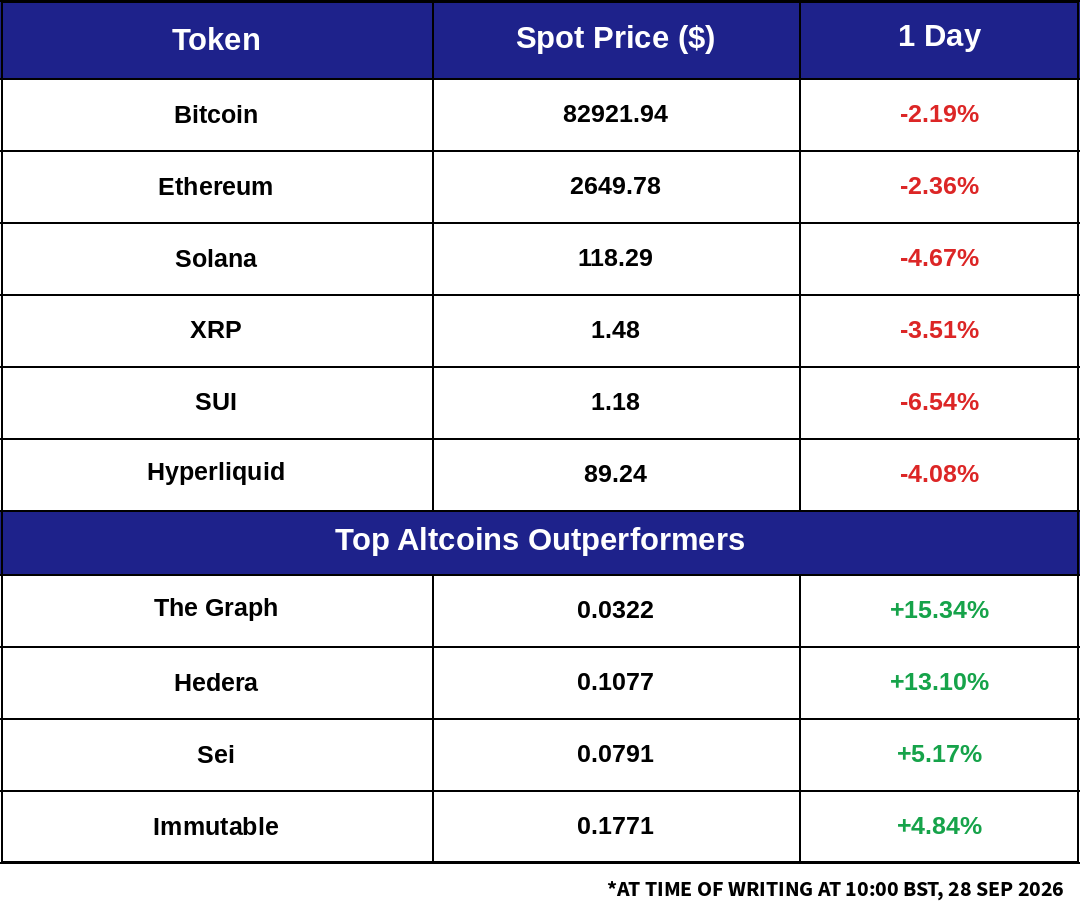
DeepBook Predict, an onchain options product on Sui powered by Block Scholes’ volatility oracle, launched on mainnet. US stock futures slipped after President Trump rejected Iran’s latest peace proposal over the weekend, reversing Friday’s relief rally that lifted the S&P 500 +0.51%, while Brent crude rose around 2% to just under $107, the 2-year Treasury yield climbed 5 bps to 4.9% and the 10-year topped 5.20%, as BTC fell 2.2% to $82.9K and ETH dropped 2.4% to $2,650.
Block Scholes is an FCA-regulated institutional crypto derivatives analytics platform. Live data, IV surfaces, and backtesting available via blockscholes.com.
US stock futures slipped after President Trump rejected Iran’s latest peace proposal over the weekend, reversing Friday’s relief rally that lifted the S&P 500 +0.51%, while Brent crude rose around 2% to just under $107, the 2-year Treasury yield climbed 5 bps to 4.9% and the 10-year topped 5.20%, as BTC fell 2.2% to $82.9K and ETH dropped 2.4% to $2,650.
DeepBook Predict, an onchain options product on Sui powered by Block Scholes’ volatility oracle, launched on mainnet with BTC markets, while Bitget began restoring withdrawals after a $387.5M hot-wallet exploit and the Sixth Circuit ruled against Kalshi in its sports-contract appeal against Ohio and Tennessee.
Market Snapshot: Overnight Moves
Macro & Markets
Hopes of a diplomatic breakthrough between the US and Iran on Friday helped drive a recovery in US equities and pushed oil prices lower, only for President Trump to announce that he rejected Iran’s latest peace deal over the weekend.
Brent crude oil settled around $104 on Friday as the New York Times reported Iran had proposed a seven-day plan to end the conflict, reopen the Strait of Hormuz if the US lifted its blockade of Iranian ports, and renew conversations around the country’s plan for nuclear weapons.
The S&P 500 finished 0.51% higher on the day while BTC consolidated around $84K.
On Saturday however, President Trump told reporters that Iran “made a proposal, but I rejected it. They want to make a deal where they open the strait immediately because they’re losing so badly.”
Iranian Foreign Minister Abbas Araghchi responded however by stating that the country was aware of Trump’s remarks, but would be officially waiting on either a definitive response from Washington or from Qatari and Pakistani mediators.
In any case, Araghchi said Iran wouldn’t soften its conditions despite Trump’s rejection and that “The US president has made some good remarks as well as many contradictory ones, which unfortunately we hear from him frequently.”
Citing a phone interview with President Trump yesterday, Axios News however reported that the president expects talks with Iran to resume this week and that the deal proposed by Iran may have been something the US agreed to a year ago, but not anymore.
As such, markets have shifted back towards a risk-off environment with US stock futures declining and BTC falling to $82K.
Brent crude oil rallied around 2% and trades just shy of $107 per barrel, while US Treasuries continued to sell off across the curve.
The yield on the two-year Treasury note is up 5 bps from Friday to 4.9%, while the 10-year yield is up 6 bps to over 5.20%.
Today’s selloff comes after longer-dated yields reached multi-year highs last week amidst a skew of hawkish comments from Fed officials, signalling the potential for further rate hikes to come.
At a conference hosted by the Cleveland Fed on Friday, Beth Hammack, President of the regional bank stated that long-term Treasury yields are being driven higher by a stronger growth outlook, fiscal concerns, the US government competing for funding with AI projects and market expectations of further interest-rate increases by the Fed.
“I think there are a number of things at play. One is I think that the growth numbers have come in pretty solid, and I think that it’s expectations of continued performance”, said Hammack.
While the Cleveland President named investor expectations for Fed policy as another driver, Chairman Kevin Warsh fell short of including that point in his list of why bond yields have risen recently.
In his press conference on Sep 16, Warsh said “I’d say three things. First is economic strength. Part of the reason why we’ve seen over the course of 2026, long-term yields go up, is the economy has strengthened. Second reason, a competition for capital … The third is geopolitics … I think those are the three leading explanations, but certainly not an exclusive list.”
Meanwhile, Treasury Secretary Scott Bessent said policymakers at the Fed should keep an “open mind” on interest rates, referencing decisions made by a previous Fed Chair Alan Greenspan.
According to the Treasury Secretary, productivity gains from artificial intelligence and the US government’s fiscal deregulation policies will help control US inflation.
On Fox News’ Sunday Morning Futures program Bessent said, Kevin Warsh is “well aware” that the US economy is seeing gains similar to “if not more substantial” than when Greenspan was Fed chair during the 1990s internet boom.
Back then, under Greenspan’s leadership, the Fed “let things run,” and “the board and the voters on the Fed should have an open mind because, again, it’s the deregulatory aspect”.
Defi/ Crypto
DeepBook Predict, an onchain prediction and options trading product on the Sui blockchain powered by Block Scholes’ purpose-built high-frequency volatility oracle, launched on mainnet as part of the DeepBook App on Sept. 24.
The product will initially support BTC markets, where traders can choose their own price level or range across expiries from one minute to two weeks, rather than being limited to predefined yes-or-no markets.
Predict uses a peer-to-pool options model, where a shared liquidity pool takes the other side of users’ positions, while BlockScholes supplies the real-time volatility and pricing data used to calculate quotes for user-selected BTC price levels and ranges.
Because the Block Scholes oracle values the broader BTC options curve across multiple strikes and expiries, DeepBook can generate a quote when a trader selects a specific price or range on demand, with trades and settlement handled onchain through Sui and additional assets planned beyond BTC.
Bitget began restoring withdrawals on Sept. 28 at 08:00 UTC, starting with BTC on the Bitcoin network, after suspending withdrawals when attackers removed around $387.5M from portions of its hot and warm wallet infrastructure on Sept. 24.
Bitget said customer account balances were not reduced and its cold wallets were unaffected; the exchange’s Protection Fund, which held more than $464M when the incident was disclosed, is being used to absorb the financial impact of the stolen assets.
The exchange said the vulnerability has been fixed and will restore services in stages, with ETH withdrawals on Sept. 29, USDT on Sept. 30, and other tokens, fiat and P2P services on Oct. 2, while Mandiant and SlowMist continue tracing and recovery work.
Kalshi, a CFTC-regulated prediction market, lost its appeal against Ohio and Tennessee, with the U.S. Court of Appeals for the Sixth Circuit, a federal appeals court covering Kentucky, Michigan, Ohio and Tennessee, ruling that Kalshi had not shown its sports event contracts qualify as “swaps” under federal commodities law.
The court said Ohio and Tennessee can enforce their sports-betting laws against Kalshi even if the contracts were considered swaps, upholding Ohio’s earlier victory while removing the injunction that had prevented Tennessee from taking action.
The decision adds to conflicting federal appeals-court rulings over prediction-market sports contracts, with the Sixth Circuit siding against Kalshi, while further litigation could determine how authority is divided between federal commodities regulation and state gambling laws.
On Sept. 25, 2026, in an updated crypto FAQ published by the SEC’s Division of Corporation Finance, staff said token buybacks, continued network development and marketing statements do not automatically make a crypto asset a security, particularly where the network is already functional and communications focus on utility rather than investor returns.
In the same Sept. 25 SEC FAQ, staff said work to secure, maintain or improve an operational crypto network generally would not count as the type of managerial effort considered under the Howey test, while buybacks could raise different issues if a project is not yet functional and they are promoted as a source of returns.
Separately, the U.S. Commodity Futures Trading Commission (CFTC) have said, in an updated crypto FAQ, regulated firms may invest customer funds in tokenized versions of otherwise permitted assets and can keep required records onchain, provided they meet custody rules and can still produce those records if the blockchain or block explorer becomes unavailable.
Strategy, the world’s largest corporate bitcoin holder, is asking shareholders to approve daily dividend record dates for its STRC, STRD, STRF and STRK preferred stocks, with the proposal scheduled for a shareholder vote on Oct. 28.
The change would not alter dividend rates or increase Strategy’s total regular dividend obligations; STRC would adopt daily record dates beginning Nov. 1, while STRF, STRD and STRK would adopt them in January.
Strategy said more frequent payments could improve price stability, liquidity and investor demand for its preferred securities, which form the core of its “Digital Credit” platform and are used to raise capital for its bitcoin treasury strategy.
Blockchain Association, a U.S. crypto industry trade group that represents more than 100 companies including financial institutions, crypto businesses, software developers and investment firms in policy and regulatory discussions, said CEO Summer Mersinger will step down on Oct. 16 and remain an adviser through the end of 2026, with former CEO Kristin Smith returning as interim CEO.
Smith, president of the Solana Policy Institute (SPI), will take on the additional Blockchain Association role starting Oct. 17, while SPI said her existing position at the organization will remain unchanged.
The Clearing House, a U.S. bank-owned payments operator has selected Quant, a blockchain interoperability technology company, to provide the transaction-management infrastructure for its On-Chain Money Initiative, a planned U.S. network allowing financial institutions to clear and settle tokenized bank deposits.
The network will connect tokenized deposits, with existing payment systems including RTP and CHIPS, with participating financial institutions expected to receive access in the first half of 2027.
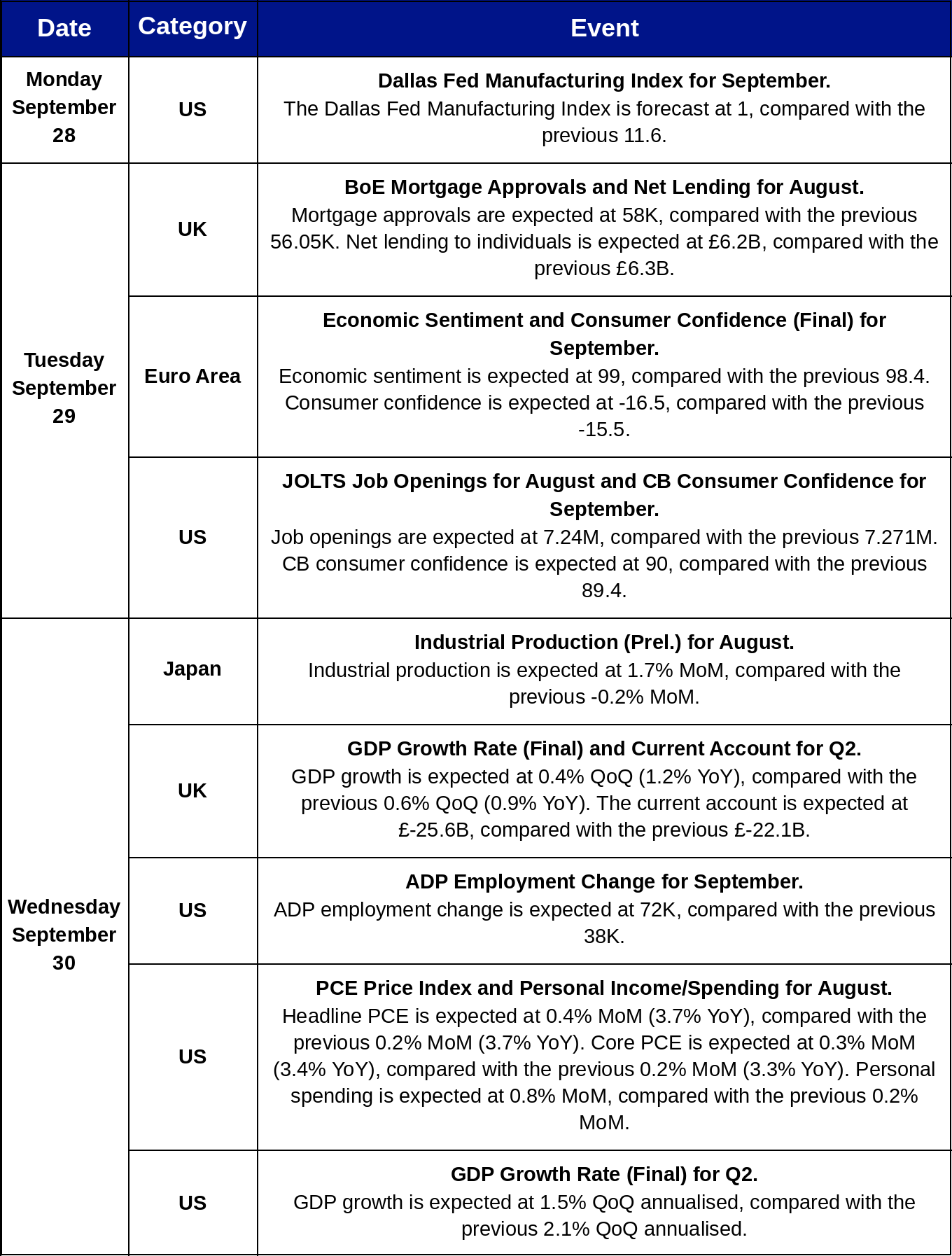
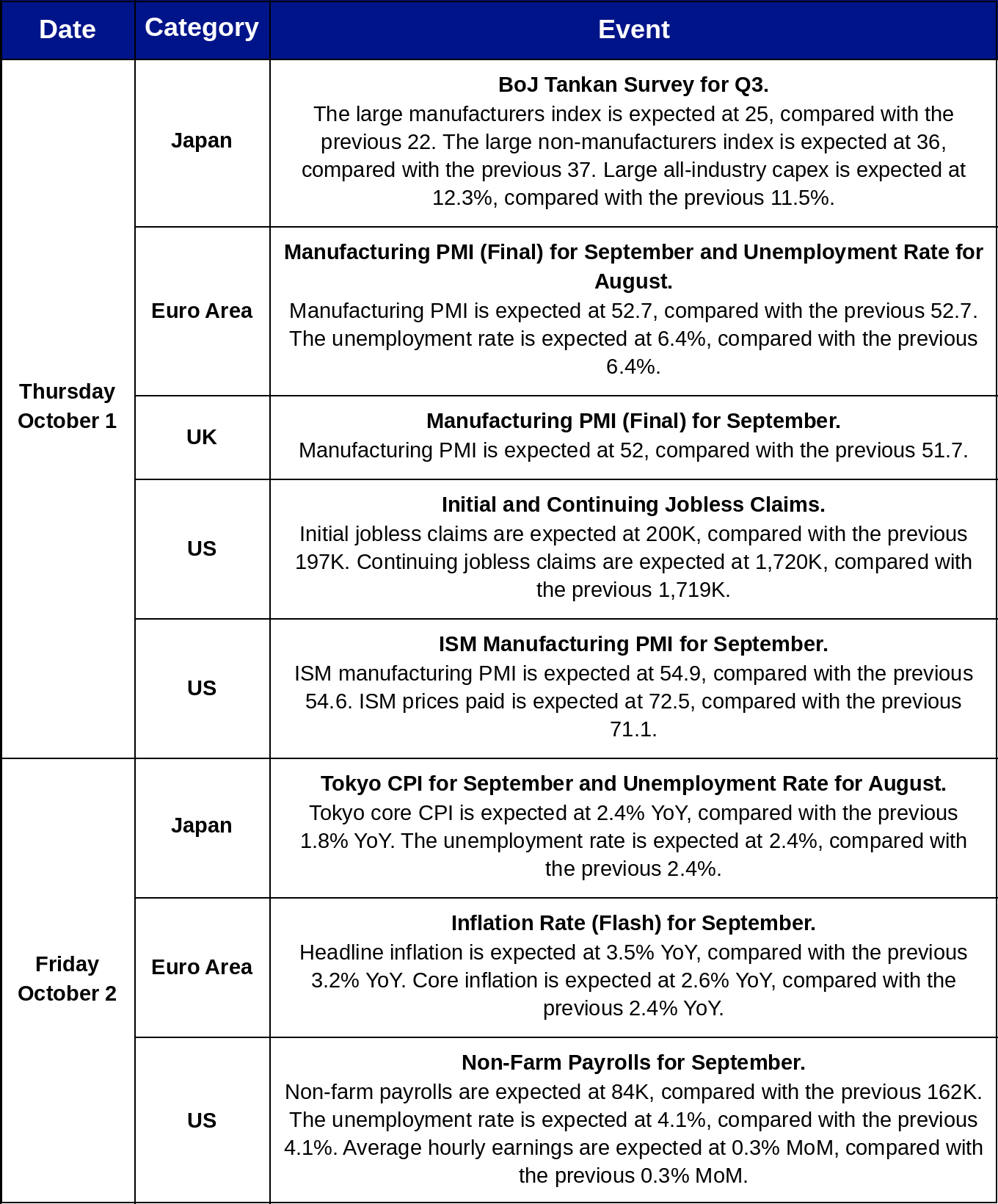
This Week's Calendar
Charts of the Day
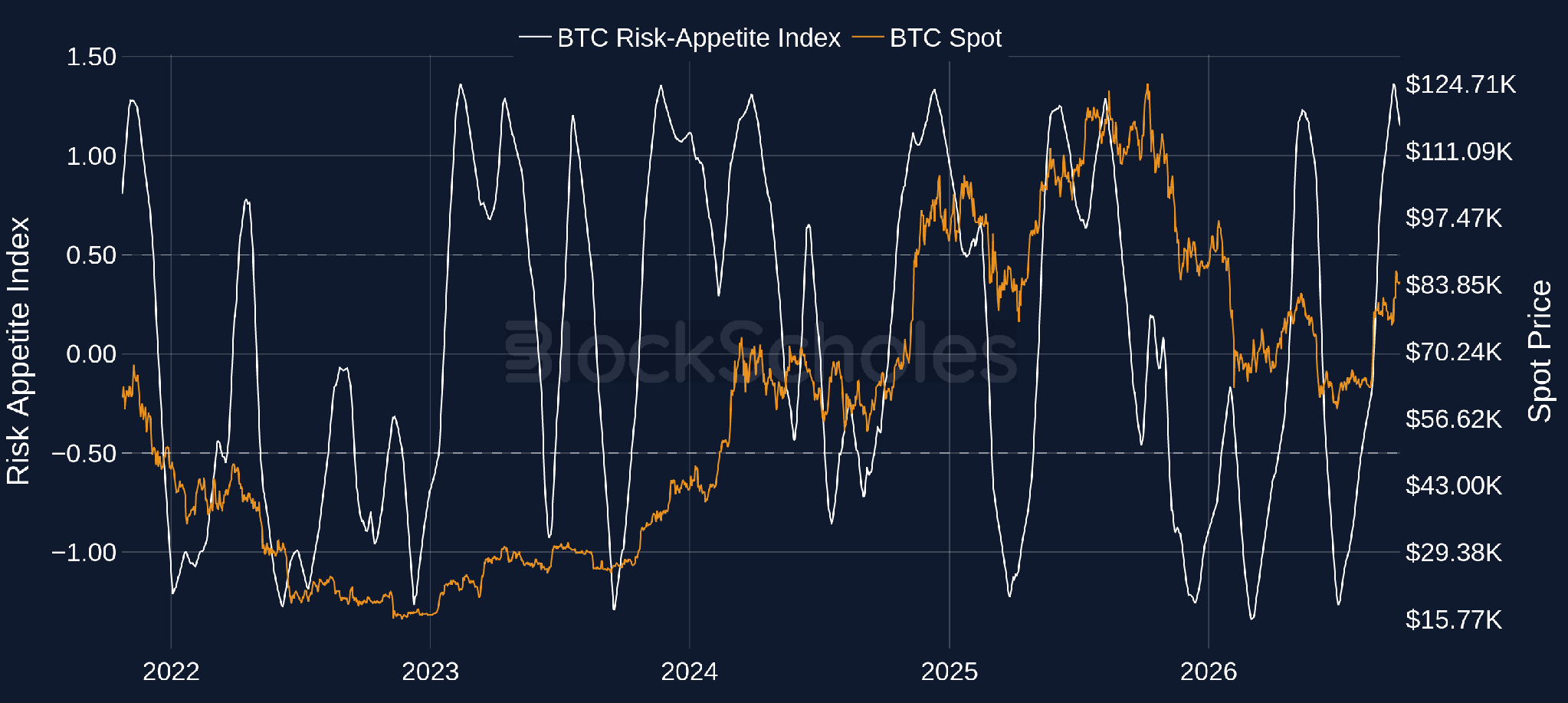
Figure 1. Block Scholes BTC Risk-Appetite Index (white, left-hand axis) and BTC spot price (orange, right-hand axis).
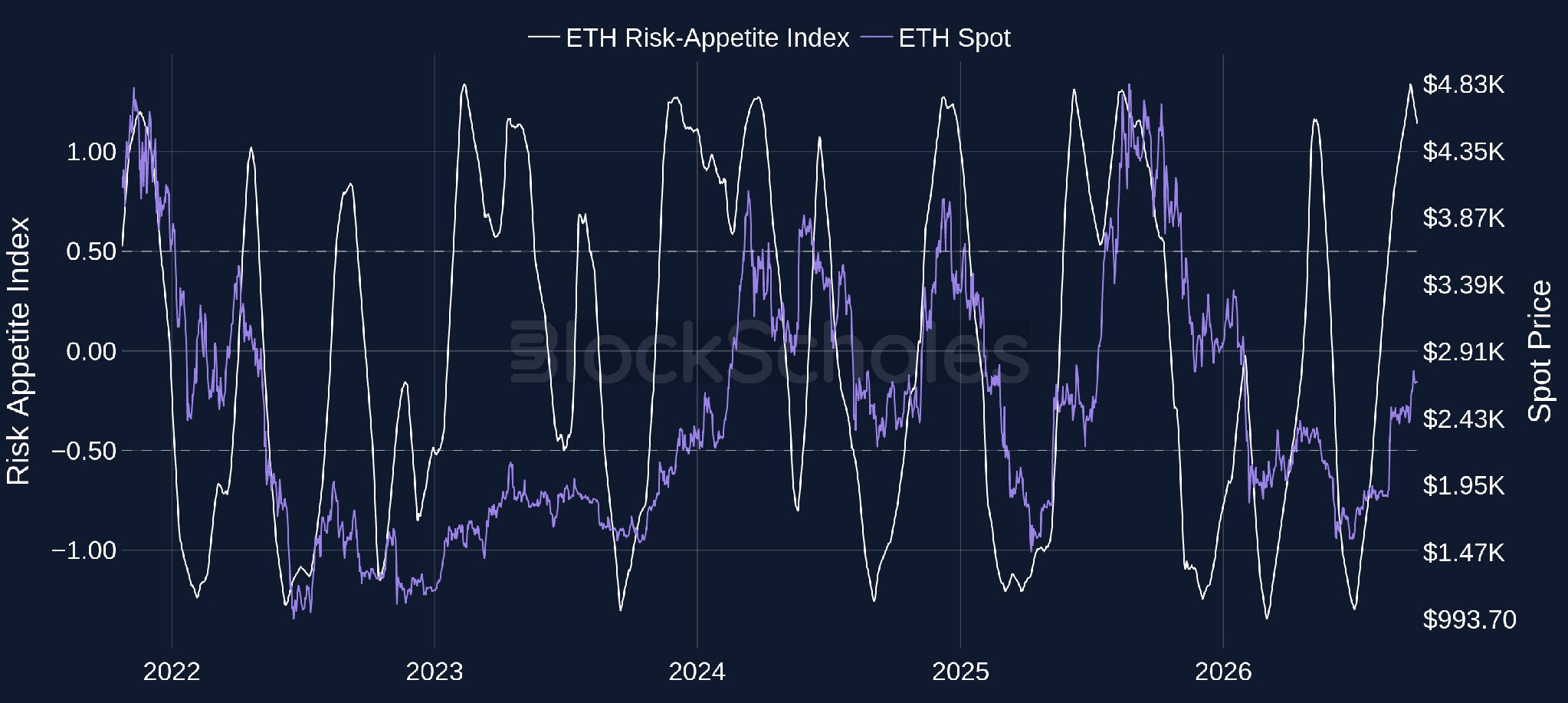
Figure 2. Block Scholes ETH Risk-Appetite Index (white, left-hand axis) and ETH spot price (purple, right-hand axis).
US stock futures slipped after President Trump rejected Iran’s latest peace proposal over the weekend, reversing Friday’s relief rally that lifted the S&P 500 +0.51%, while Brent crude rose around 2% to just under $107, the 2-year Treasury yield climbed 5 bps to 4.9% and the 10-year topped 5.20%, as BTC fell 2.2% to $82.9K and ETH dropped 2.4% to $2,650.
DeepBook Predict, an onchain options product on Sui powered by Block Scholes’ volatility oracle, launched on mainnet with BTC markets, while Bitget began restoring withdrawals after a $387.5M hot-wallet exploit and the Sixth Circuit ruled against Kalshi in its sports-contract appeal against Ohio and Tennessee.
Market Snapshot: Overnight Moves
Macro & Markets
Hopes of a diplomatic breakthrough between the US and Iran on Friday helped drive a recovery in US equities and pushed oil prices lower, only for President Trump to announce that he rejected Iran’s latest peace deal over the weekend.
Brent crude oil settled around $104 on Friday as the New York Times reported Iran had proposed a seven-day plan to end the conflict, reopen the Strait of Hormuz if the US lifted its blockade of Iranian ports, and renew conversations around the country’s plan for nuclear weapons.
The S&P 500 finished 0.51% higher on the day while BTC consolidated around $84K.
On Saturday however, President Trump told reporters that Iran “made a proposal, but I rejected it. They want to make a deal where they open the strait immediately because they’re losing so badly.”
Iranian Foreign Minister Abbas Araghchi responded however by stating that the country was aware of Trump’s remarks, but would be officially waiting on either a definitive response from Washington or from Qatari and Pakistani mediators.
In any case, Araghchi said Iran wouldn’t soften its conditions despite Trump’s rejection and that “The US president has made some good remarks as well as many contradictory ones, which unfortunately we hear from him frequently.”
Citing a phone interview with President Trump yesterday, Axios News however reported that the president expects talks with Iran to resume this week and that the deal proposed by Iran may have been something the US agreed to a year ago, but not anymore.
Don't miss what's next
Upgrade your Block Scholes account to unlock this article and other exclusive insights
US stock futures slipped after President Trump rejected Iran’s latest peace proposal over the weekend, reversing Friday’s relief rally that lifted the S&P 500 +0.51%, while Brent crude rose around 2% to just under $107, the 2-year Treasury yield climbed 5 bps to 4.9% and the 10-year topped 5.20%, as BTC fell 2.2% to $82.9K and ETH dropped 2.4% to $2,650.
DeepBook Predict, an onchain options product on Sui powered by Block Scholes’ volatility oracle, launched on mainnet with BTC markets, while Bitget began restoring withdrawals after a $387.5M hot-wallet exploit and the Sixth Circuit ruled against Kalshi in its sports-contract appeal against Ohio and Tennessee.
Market Snapshot: Overnight Moves
Macro & Markets
Hopes of a diplomatic breakthrough between the US and Iran on Friday helped drive a recovery in US equities and pushed oil prices lower, only for President Trump to announce that he rejected Iran’s latest peace deal over the weekend.
Brent crude oil settled around $104 on Friday as the New York Times reported Iran had proposed a seven-day plan to end the conflict, reopen the Strait of Hormuz if the US lifted its blockade of Iranian ports, and renew conversations around the country’s plan for nuclear weapons.
The S&P 500 finished 0.51% higher on the day while BTC consolidated around $84K.
On Saturday however, President Trump told reporters that Iran “made a proposal, but I rejected it. They want to make a deal where they open the strait immediately because they’re losing so badly.”
Iranian Foreign Minister Abbas Araghchi responded however by stating that the country was aware of Trump’s remarks, but would be officially waiting on either a definitive response from Washington or from Qatari and Pakistani mediators.
In any case, Araghchi said Iran wouldn’t soften its conditions despite Trump’s rejection and that “The US president has made some good remarks as well as many contradictory ones, which unfortunately we hear from him frequently.”
Citing a phone interview with President Trump yesterday, Axios News however reported that the president expects talks with Iran to resume this week and that the deal proposed by Iran may have been something the US agreed to a year ago, but not anymore.
Don't miss what's next
Upgrade your Block Scholes account to unlock this article and other exclusive insights
Premium
$30/mo
Access previous and future reports, market insights & deep dives.
DeepBook Predict, an onchain options product on Sui powered by Block Scholes’ volatility oracle, launched on mainnet. US stock futures slipped after President Trump rejected Iran’s latest peace proposal over the weekend, reversing Friday’s relief rally that lifted the S&P 500 +0.51%, while Brent crude rose around 2% to just under $107, the 2-year Treasury yield climbed 5 bps to 4.9% and the 10-year topped 5.20%, as BTC fell 2.2% to $82.9K and ETH dropped 2.4% to $2,650.
The 30-year Treasury yield rose around 8bps to just shy of 5.5%, a level last seen in 2004, and the 10-year yield climbed 10bps to 5.21%, its highest since 2007, even as the Treasury bought back $4.08B of the $6B it had targeted. BTC ranged between $83K and $85K, Brent crude slipped to around $105 a barrel on reports of a phased US-Iran deal, and New York Fed President John Williams said another rate hike may be appropriate by year-end. New York State sued Polymarket, alleging it runs an illegal gambling business, and Ondo Finance launched onchain portfolio tokens built on BlackRock model portfolios.