An Attacker Minted 4 Billion Tokens on the Harmony Blockchain
An attacker minted roughly 4 billion ONE, Harmony's native token, reportedly through empty blocks, and about 97% has already reached exchanges or deposit wallets. ONE fell 34% over 24 hours to around $0.0008, and Harmony is working with exchanges to freeze the funds while weighing a rollback. Brent traded just below $90 with the Strait of Hormuz still shut, and July CPI is due this afternoon with core expected at 2.5% YoY.
Block Scholes is an FCA-regulated institutional crypto derivatives analytics platform. Live data, IV surfaces, and backtesting available via blockscholes.com.
An attacker minted roughly 4 billion ONE, Harmony's native token, reportedly through empty blocks, and about 97% has already reached exchanges or deposit wallets. ONE fell 34% over 24 hours to around $0.0008, and Harmony is working with exchanges to freeze the funds while weighing a rollback.
Brent traded just below $90 with the Strait of Hormuz still shut and Trump claiming the US has total control of it. July CPI is due this afternoon, with core expected at 2.5% YoY, which would be the smallest annual rise since February.
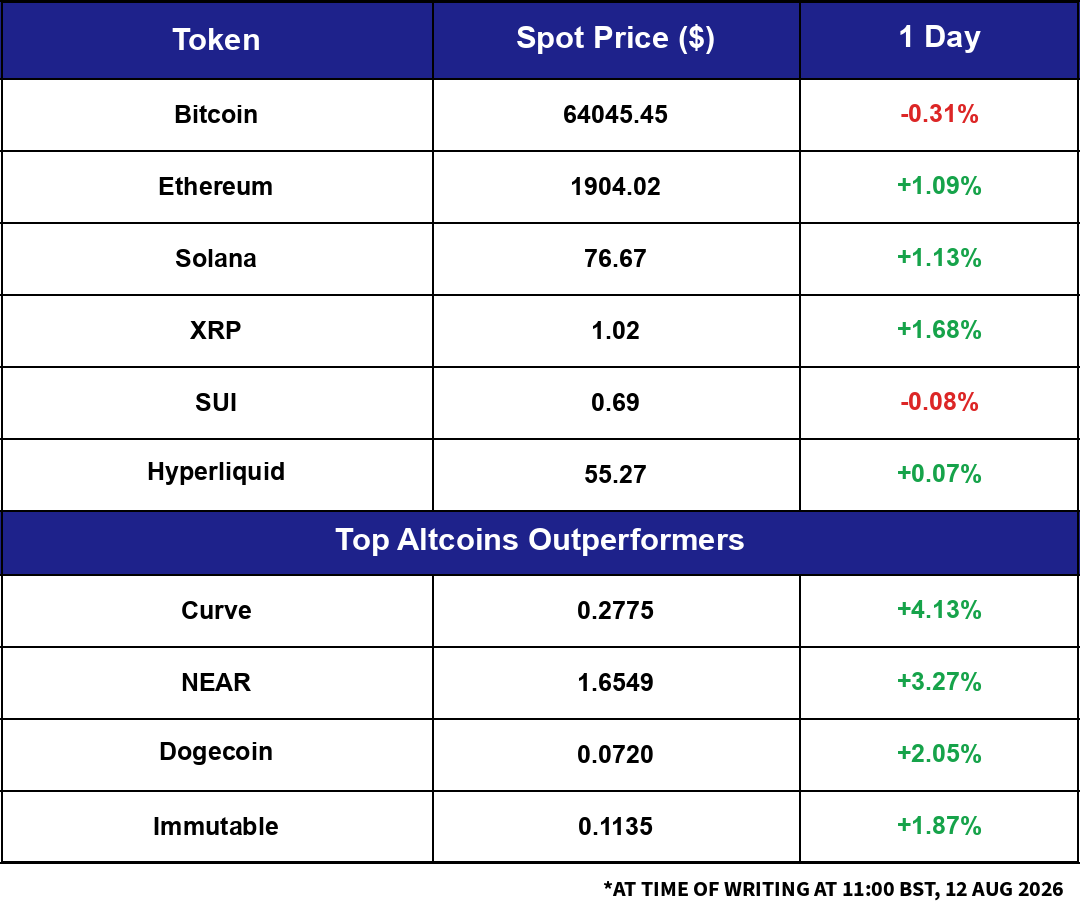
Market Snapshot: Overnight Moves
Macro & Markets
Risk-on assets all traded lower in Tuesday’s session as a lack of a deal to restore the flow of energy through the Strait of Hormuz continued to slowly push oil prices higher.
Brent crude oil is trading just below $90 per barrel amidst mixed messages regarding the status of the Strait.
President Trump claimed the US had “total control over the Hormuz Strait”, telling reporters outside Washington that “We own it … And at some point, maybe they’ll do something, and then they get blown away.”
His comments came after the defense minister of Pakistan told reporters in the capital that the US and Iran were “close to some sort of arrangement”.
Iranian officials have also signaled that Tehran and Oman are close to an agreement that has been negotiated without US counterparts, however it is unclear whether such a deal will result in an immediate and full reopening of the waterway.
After reaching record highs on Friday last week, the S&P 500 extended its Monday decline and closed 0.32% lower yesterday. The Nasdaq-100 equally fell by 0.33%.
BTC trades below $65K while ETH has settled just under $1,900.
Both assets have however been supported by a recent run of inflows into their spot exchange-traded funds.
BTC spot ETFs have seen inflows in six of the last seven trading sessions.
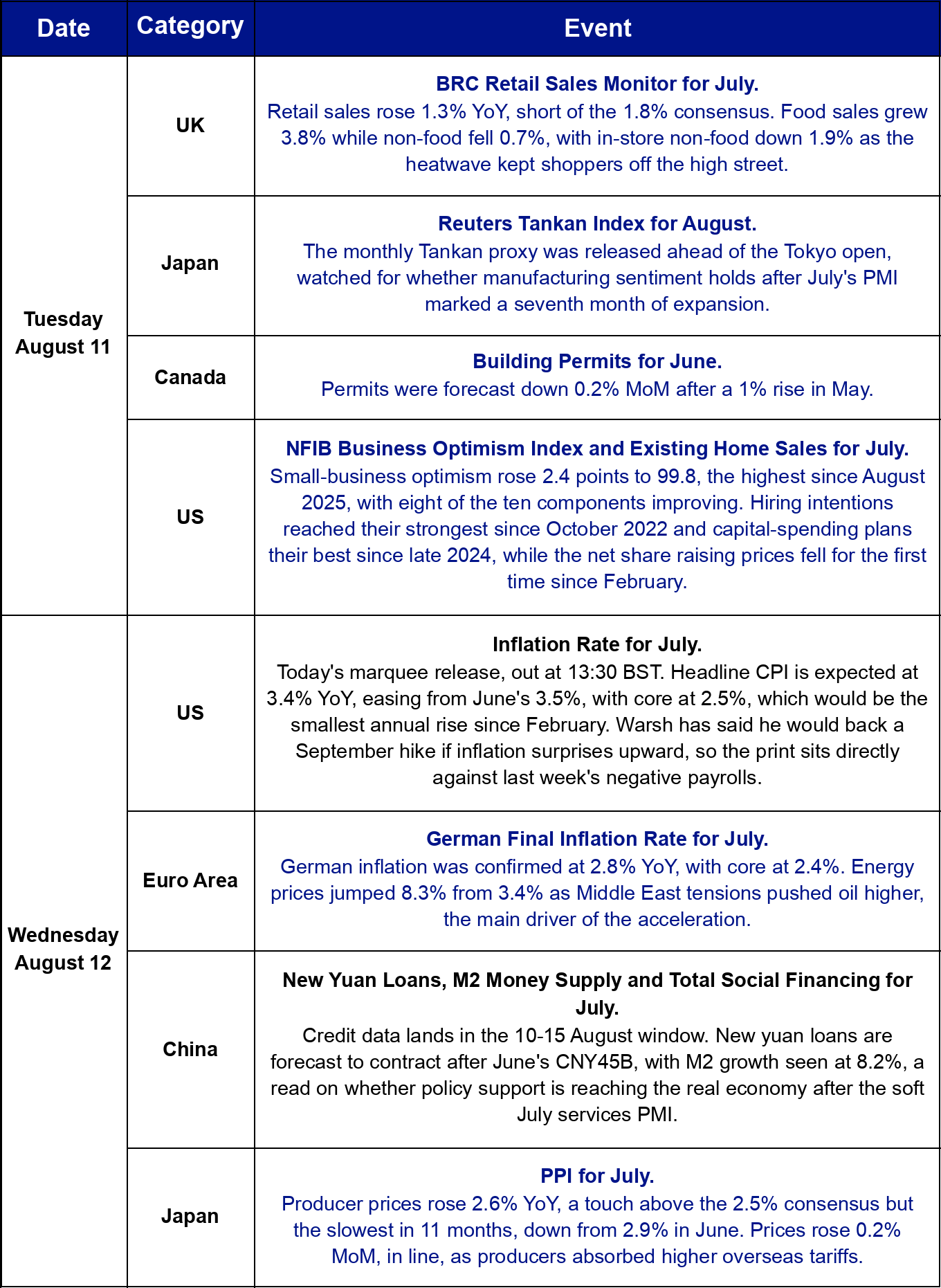
Markets are currently awaiting today’s consumer price index report which is likely to show a cooling of energy-related pressures.
Year-over-year, core CPI is estimated to have risen 2.5% from July 2025, the smallest annual increase since February while headline CPI is expected to rise 3.4% in July down slightly from June's 3.5% annual increase.
US small-business optimism rose in July to the highest level in almost a year according to the National Federation of Independent Business survey.
The small-business optimism index increased 2.4 points to 99.8, the highest level since August 2025 as eight of the ten components that make up the gauge improved.
The net share of US small businesses planning to add jobs jumped to the highest level since October 2022 while the share planning to make capital outlays in the months ahead advanced to the strongest reading since the end of 2024.
Additionally, the net share of firms that reported raising prices fell for the first time since February, just before the Middle East conflict.
DeFi / Web3 / Altcoins / Crypto3
The U.S. Securities and Exchange Commission (SEC) could propose tailored rules for crypto investment contracts, giving projects a clearer route to raise capital without having to comply with the full traditional securities framework, according to TD Cowen.
The regime may include a safe harbor, a legal exemption for early-stage token sales, paired with disclosures on token economics, governance, development plans, custody and risks while the underlying network is being built.
It could also define when a sufficiently decentralized token can move outside SEC securities oversight and be treated as a commodity, though the upcoming SEC vote would only determine whether to publish the proposal for public consideration.
Twenty One Capital, a Tether-backed publicly traded Bitcoin treasury company, reported a $413.5M Q2 net loss, with $401.5M stemming from declines in the value of its digital assets, while holding 43,514 BTC worth roughly $2.78B.
Newly appointed CEO Raphael Zagury plans to move Twenty One beyond simply holding Bitcoin by building or acquiring operating businesses, expanding into M&A and capital markets, and eventually launching Bitcoin-backed lending and credit, citing Berkshire Hathaway’s diversified operating model as a blueprint.
Harmony, a Layer 1 proof-of-stake blockchain, confirmed an exploit involving the unauthorized minting of roughly 4 billion ONE, its native token used for transaction fees, staking and governance, with the attacker reportedly creating the tokens through empty blocks; the precise technical vulnerability remains under investigation.
Around 97% of the newly minted ONE was reportedly already transferred to exchanges or exchange deposit wallets, leaving about 115 million ONE onchain, while ONE fell roughly 34% over 24 hours to around $0.0008 following the exploit.
Harmony is working with exchanges to freeze the attacker’s funds while developing a software patch and evaluating a rollback, a potential reversal of blockchain state to undo transactions associated with the exploit.
The CFTC, the US derivatives markets regulator, invoked its emergency authority to direct prediction-market platform Kalshi to continue operating under federal rules, after New York sued the company for allegedly offering illegal gambling and sought a temporary restraining order to halt its operations in the state.
Kalshi had warned the CFTC that being forced out of New York could create an “imminent market emergency,” arguing that removing participants from a major state could reduce liquidity, disrupt pricing and affect its federally regulated market nationwide.
The intervention escalates the federal-versus-state jurisdiction dispute, with CFTC Chair Michael Selig arguing that federally registered prediction markets fall under the agency’s exclusive authority, while New York and other states maintain that sports-related event contracts can constitute gambling subject to state gaming laws.
FlightAware, a flight-tracking and aviation-data provider, voluntarily dismissed its lawsuit against prediction-market platform Kalshi just one day after filing it, having accused Kalshi of improperly using its data and trademark to settle markets on flight cancellations.
Kalshi subsequently changed its market language from saying outcomes were “verified from FlightAware” to “verified from Primary Source Agency,” while explicitly stating that FlightAware does not endorse or have an affiliation with the products.
Neither company has disclosed why the case was dropped, although corporate lawyer Ariel Givner suggested the unusually rapid dismissal after FlightAware had sought a TRO, a temporary restraining order intended to immediately halt specified activity, could indicate the parties reached a private resolution.
Robinhood Chain, Robinhood’s Ethereum Layer 2 network built using Arbitrum technology, averaged a record 11.6 million daily transactions last week, up roughly 30% week-over-week, while TVL, the value of assets deposited in onchain protocols, rose 32% to $473M.
Growth is being driven partly by USDe, Ethena’s yield-bearing synthetic dollar, whose supply on Robinhood Chain surged from about $17M to $253M in one month, giving it roughly 43% of the network’s stablecoin supply.
However, daily active accounts increased only 3.3% and remains 11% below their July peak, suggesting the surge in transactions and TVL is primarily coming from existing users trading more frequently.
Ethereum Name Service (ENS), the decentralized naming protocol for human-readable .eth addresses, has executed its “Next Era of ENS DAO” governance overhaul, giving the ENS Foundation a five-member board and administrative control of its roughly $65M Endowment, funded by .eth registration fees, to handle off-chain operations, policy and institutional engagement.
The ENS DAO retains protocol-level authority and roughly 54.6% of the ENS token supply, while transferring 1 million ENS to fund Foundation employee compensation; tokenholders can appoint or remove directors, and Endowment transactions face a nine-day timelock with Security Council cancellation powers.
This Week's Calendar
Charts of the Day
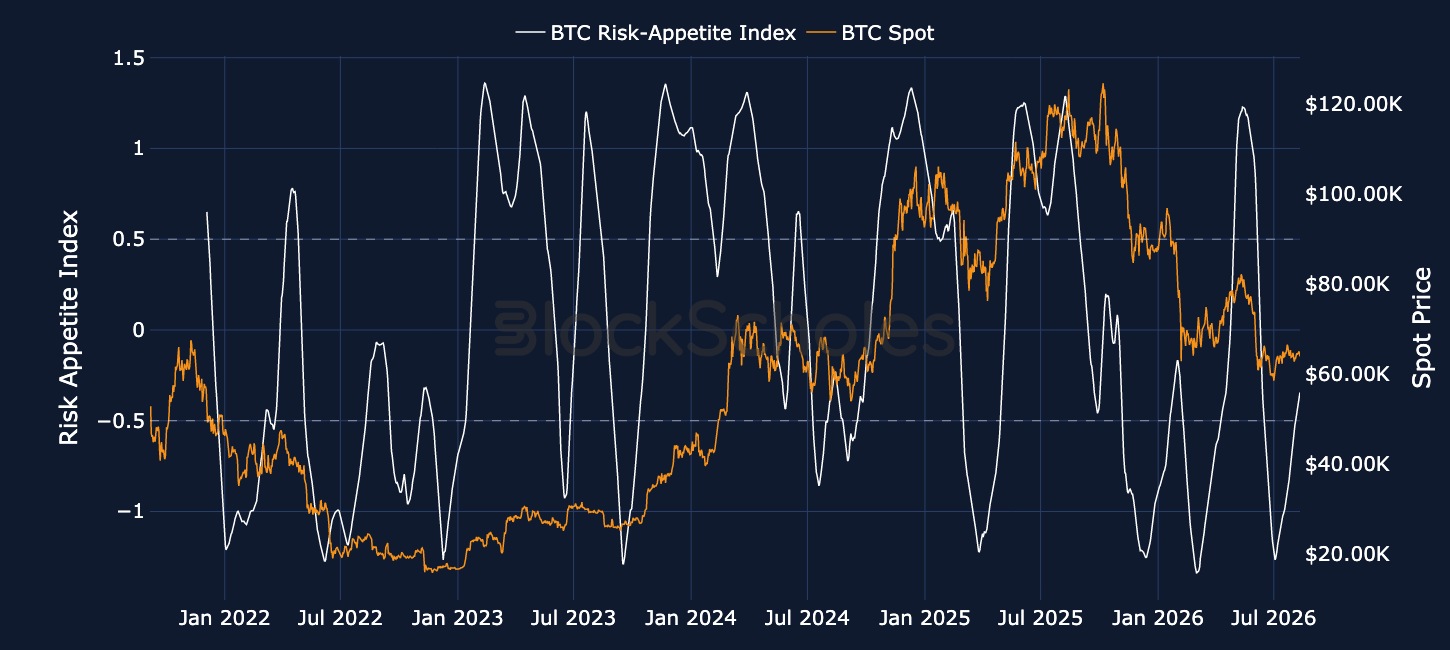
Figure 1. Block Scholes BTC Risk-Appetite Index (white, left-hand axis) and BTC spot price (orange, right-hand axis).
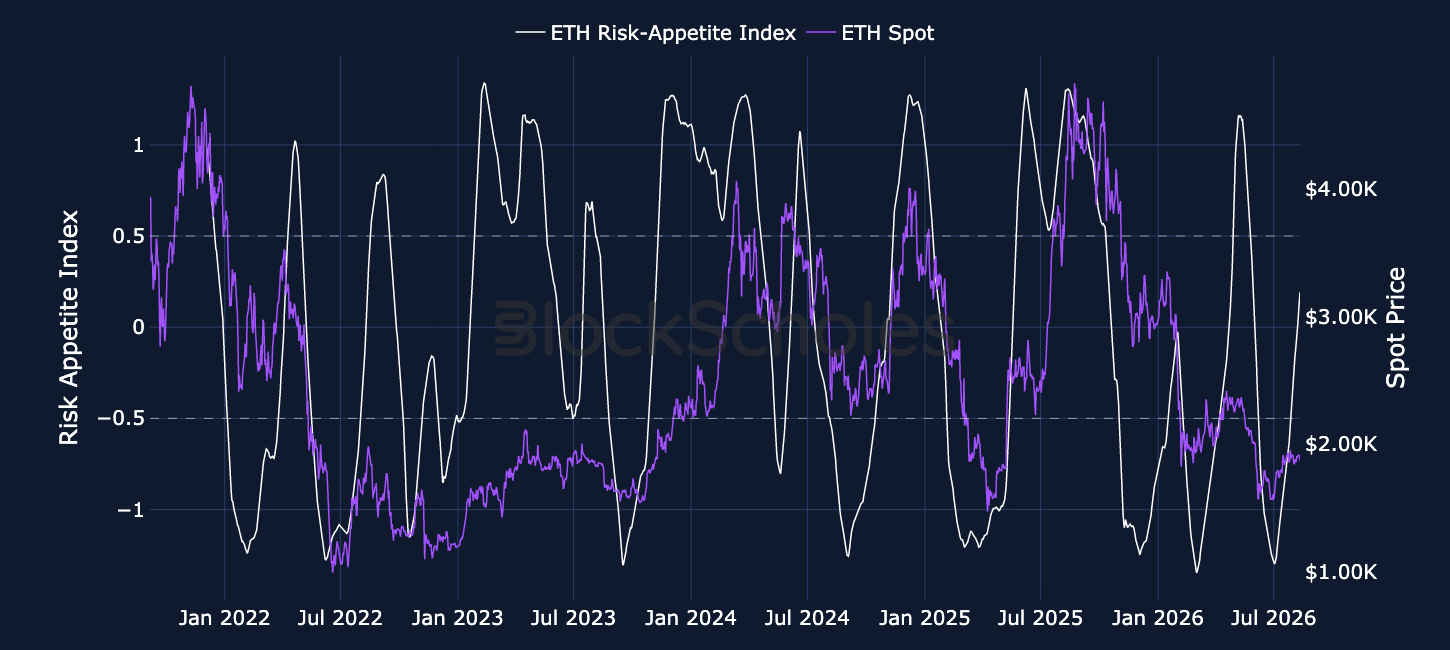
Figure 2. Block Scholes ETH Risk-Appetite Index (white, left-hand axis) and ETH spot price (purple, right-hand axis).
Block Scholes is an FCA-regulated institutional crypto derivatives analytics platform. Live data, IV surfaces, and backtesting available via blockscholes.com.
In Today's Note
An attacker minted roughly 4 billion ONE, Harmony's native token, reportedly through empty blocks, and about 97% has already reached exchanges or deposit wallets. ONE fell 34% over 24 hours to around $0.0008, and Harmony is working with exchanges to freeze the funds while weighing a rollback.
Brent traded just below $90 with the Strait of Hormuz still shut and Trump claiming the US has total control of it. July CPI is due this afternoon, with core expected at 2.5% YoY, which would be the smallest annual rise since February.
Market Snapshot: Overnight Moves
Macro & Markets
Risk-on assets all traded lower in Tuesday’s session as a lack of a deal to restore the flow of energy through the Strait of Hormuz continued to slowly push oil prices higher.
Brent crude oil is trading just below $90 per barrel amidst mixed messages regarding the status of the Strait.
President Trump claimed the US had “total control over the Hormuz Strait”, telling reporters outside Washington that “We own it … And at some point, maybe they’ll do something, and then they get blown away.”
His comments came after the defense minister of Pakistan told reporters in the capital that the US and Iran were “close to some sort of arrangement”.
Iranian officials have also signaled that Tehran and Oman are close to an agreement that has been negotiated without US counterparts, however it is unclear whether such a deal will result in an immediate and full reopening of the waterway.
Don't miss what's next
Upgrade your Block Scholes account to unlock this article and other exclusive insights
Block Scholes is an FCA-regulated institutional crypto derivatives analytics platform. Live data, IV surfaces, and backtesting available via blockscholes.com.
In Today's Note
An attacker minted roughly 4 billion ONE, Harmony's native token, reportedly through empty blocks, and about 97% has already reached exchanges or deposit wallets. ONE fell 34% over 24 hours to around $0.0008, and Harmony is working with exchanges to freeze the funds while weighing a rollback.
Brent traded just below $90 with the Strait of Hormuz still shut and Trump claiming the US has total control of it. July CPI is due this afternoon, with core expected at 2.5% YoY, which would be the smallest annual rise since February.
Market Snapshot: Overnight Moves
Macro & Markets
Risk-on assets all traded lower in Tuesday’s session as a lack of a deal to restore the flow of energy through the Strait of Hormuz continued to slowly push oil prices higher.
Brent crude oil is trading just below $90 per barrel amidst mixed messages regarding the status of the Strait.
President Trump claimed the US had “total control over the Hormuz Strait”, telling reporters outside Washington that “We own it … And at some point, maybe they’ll do something, and then they get blown away.”
His comments came after the defense minister of Pakistan told reporters in the capital that the US and Iran were “close to some sort of arrangement”.
Iranian officials have also signaled that Tehran and Oman are close to an agreement that has been negotiated without US counterparts, however it is unclear whether such a deal will result in an immediate and full reopening of the waterway.
Don't miss what's next
Upgrade your Block Scholes account to unlock this article and other exclusive insights
Premium
$30/mo
Access previous and future reports, market insights & deep dives.
The 30-year Treasury yield rose around 8bps to just shy of 5.5%, a level last seen in 2004, and the 10-year yield climbed 10bps to 5.21%, its highest since 2007, even as the Treasury bought back $4.08B of the $6B it had targeted. BTC ranged between $83K and $85K, Brent crude slipped to around $105 a barrel on reports of a phased US-Iran deal, and New York Fed President John Williams said another rate hike may be appropriate by year-end. New York State sued Polymarket, alleging it runs an illegal gambling business, and Ondo Finance launched onchain portfolio tokens built on BlackRock model portfolios.