
Thahbib Rahman
Research Analyst
Crypto sentiment has weakened sharply since mid-May 2026, despite traditional risk assets continuing to rally. While US equities have pushed to record highs, supported by strong earnings and AI-led optimism, BTC has sold off to a four-month low near $60K and ETH has hit a thirteen-month low near $1.8k. Despite the recent pullback in stocks, this divergence began manifesting even prior. This suggests that crypto is being driven less by broader risk appetite and more by sector-specific headwinds. ETF flows have been a major source of pressure. Since May 15, 2026, spot Bitcoin ETFs have recorded 13 consecutive sessions of outflows, with cumulative redemptions around $4.4B.

Crypto sentiment has weakened sharply since mid-May 2026, despite traditional risk assets continuing to rally. While US equities have pushed to record highs, supported by strong earnings and AI-led optimism, BTC has sold off to a four-month low near $60K and ETH has hit a thirteen-month low near $1.8k
Despite the recent pullback in stocks, this divergence began manifesting even prior.
This suggests that crypto is being driven less by broader risk appetite and more by sector-specific headwinds.
ETF flows have been a major source of pressure. Since May 15, 2026, spot Bitcoin ETFs have recorded 13 consecutive sessions of outflows, with cumulative redemptions around $4.4B.
This marks the longest streak of outflows for US-listed Bitcoin ETFs, while spot Bitcoin prices are set for its 5th straight day of declines – their longest losing streak since late-July/early-August.
ETH ETF outflows began even earlier, reinforcing the view that institutional demand has softened across the two largest crypto assets.
Options markets show that the selloff has materially changed risk pricing.
BTC short-dated ATM implied volatility has more than doubled from its YTD low, while ETH has seen a similar jump. Both assets now show inverted volatility term structures, indicating elevated demand for near-term protection.
Put-call skew has also moved aggressively in favor of puts across maturities, confirming that downside hedging demand is not confined to short-dated options.
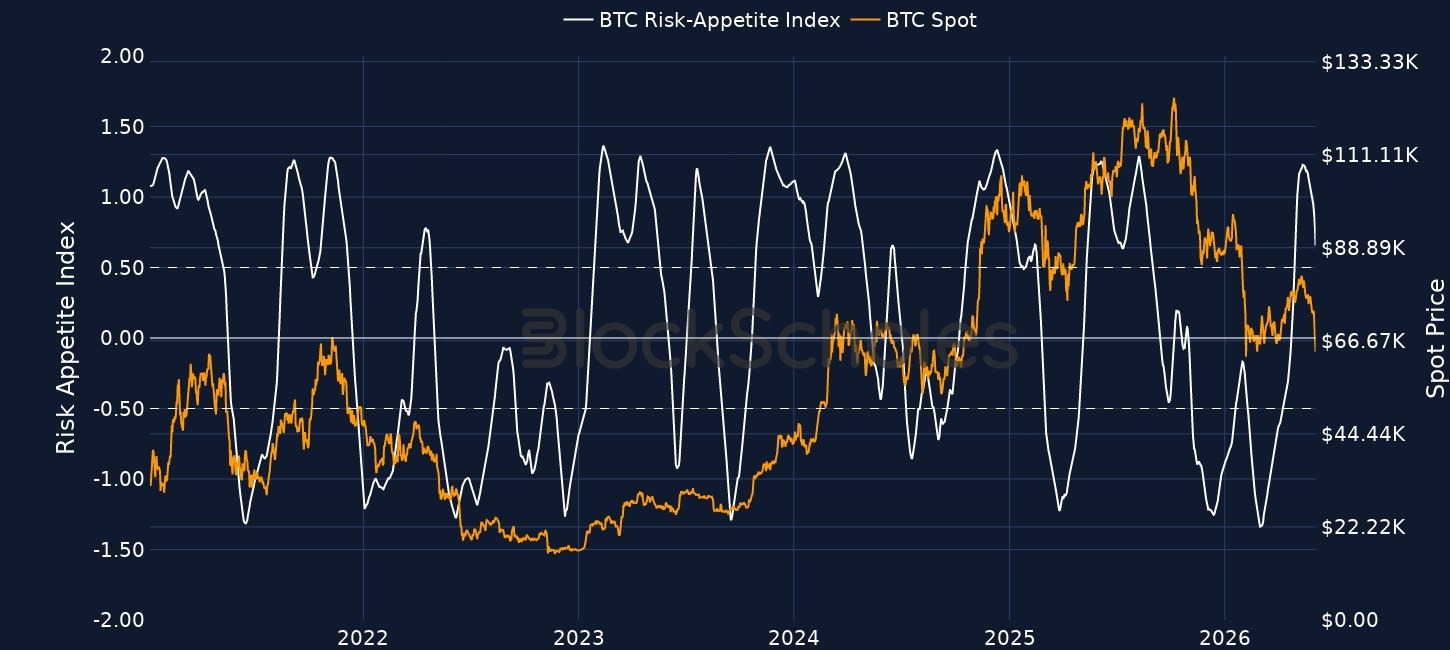
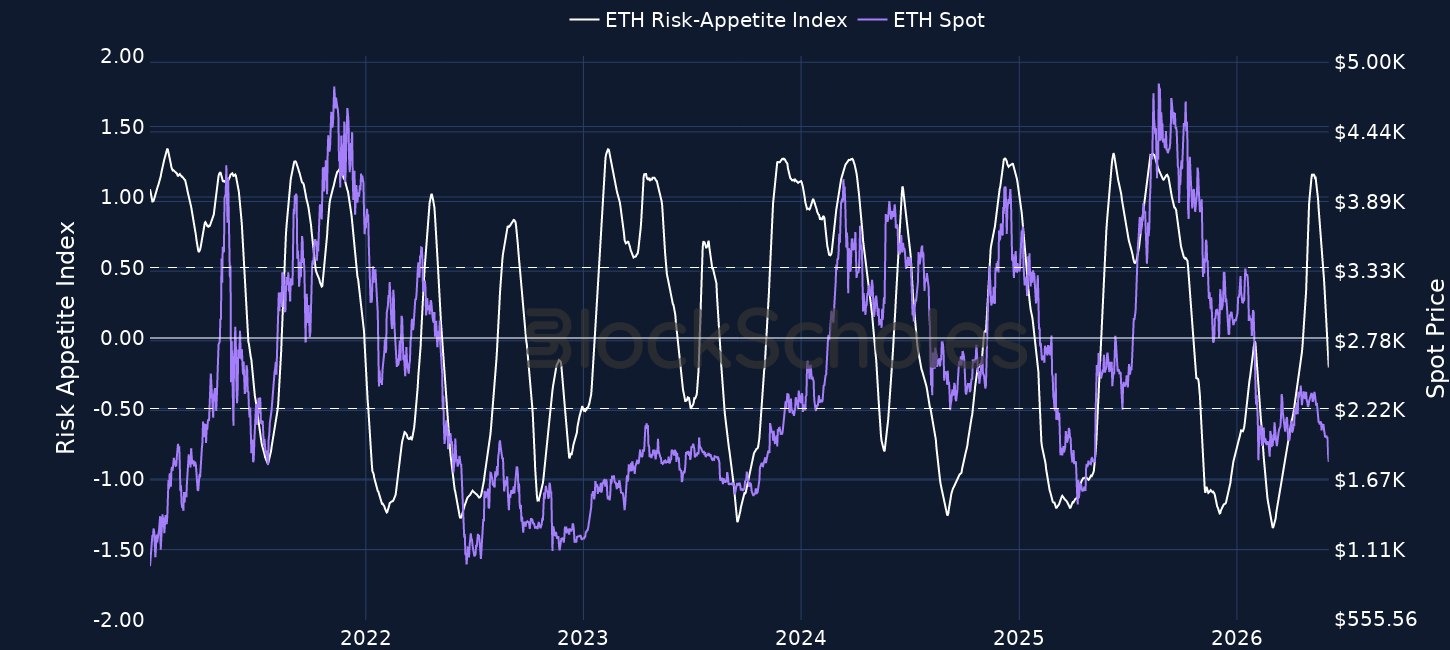
Sentiment in crypto has weakened significantly since mid-May 2026, as flagged by the shift downwards in our in-house Risk Appetite Index for BTC.
This has been in sharp contrast to recent moves in US equities, which have traded to record highs over the same period. The S&P 500 recorded its 9th straight daily gain on Monday, its strongest run since May 2025, while the tech-heavy Nasdaq-100 is up 21% year-to-date (prior to the US cash open on Thursday, June 4th), with both indexes being bolstered by optimism around artificial intelligence.
On the other hand, after falling below $70K at the start of the week, Bitcoin has continued its selloff, falling to a 4-month low of around $61.3K.
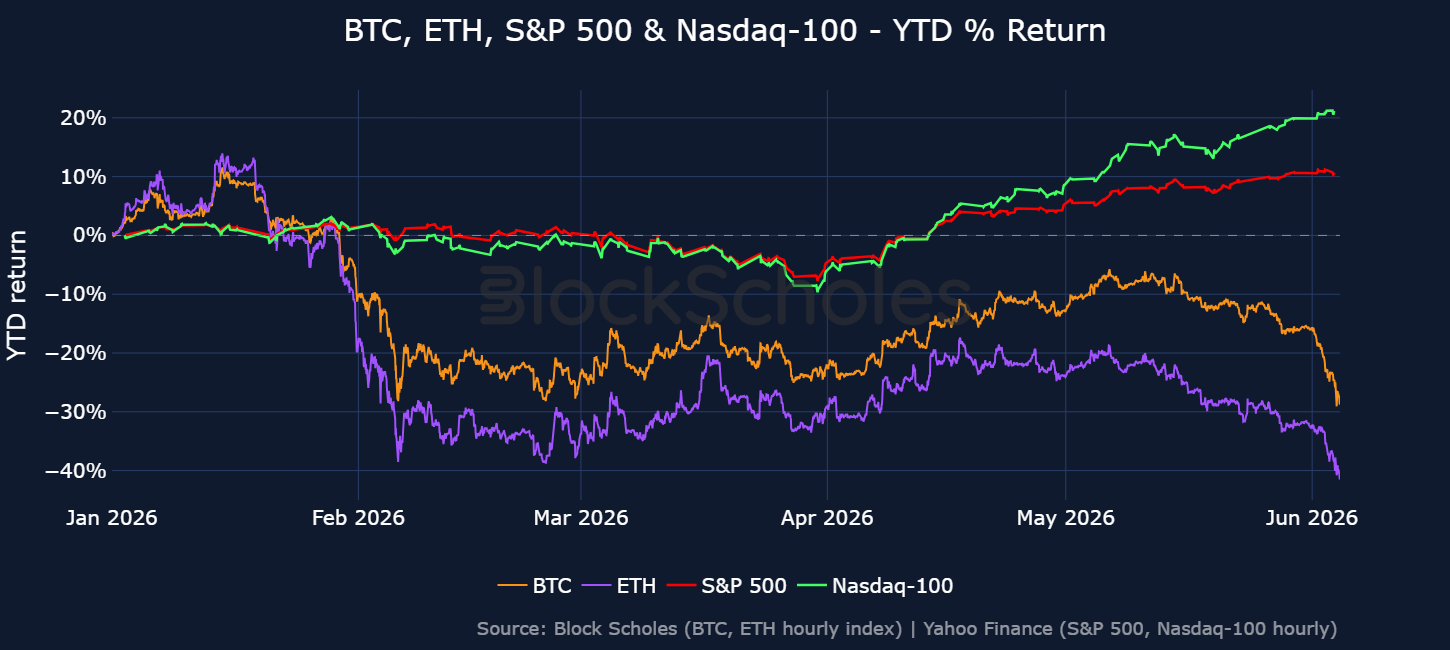
While in general risk-on assets have been whipsawed by geopolitical headlines as the US-Iran conflict enters its fourth month, US equities appear to have weathered that storm far better than crypto, with factors such as strong corporate earnings and the boom in AI infrastructure investment to support prices.
In contrast, idiosyncratic factors for BTC and ETH have played a role in their comparatively poor YTD performance. Since 15 May 2026, spot Bitcoin ETFs have seen 13 consecutive sessions of outflows, with more than $4.4B in cumulative redemptions.
That marks their longest losing streak since the products first debuted back in January 2024.
Additionally, the largest Bitcoin digital asset treasury, Strategy, disclosed its first Bitcoin sale since late 2022, offloading 32 BTC for approximately $2.5M. While only a fraction of the firm's 843,706 BTC holdings, the sale marked a stark departure from Michael Saylor's long-held mantra: "Sell a kidney if you must, but keep the Bitcoin."
For Ethereum, the outflow streak in spot ETFs began even earlier than that in Bitcoin spot ETFs, with the products being net sellers since May 11, 2026.
The most recent leg of BTC’s selloff towards $60K (around 50% below its all-time high), has had its clearest impact in crypto options markets.
At-the-money implied volatility, a forward-looking view of the volatility traders expect, has more than doubled from 28%, the year-to-date low it traded at only last week, to 60%.
That’s now resulted in an inverted term structure of volatility.
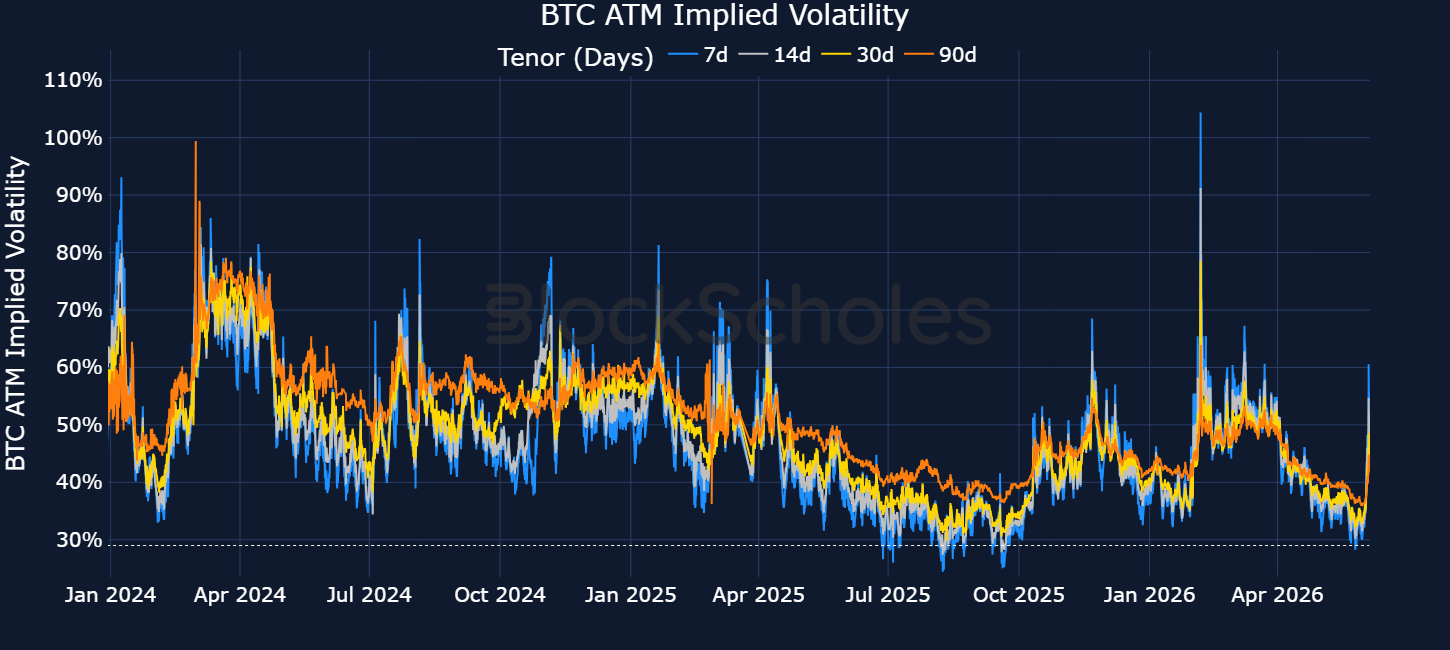
DECODE: An inverted term structure of volatility means short-dated options trade with a higher implied volatility than longer-dated contracts.
In other words, the risk premium priced in by BTC options has quickly moved from its lowest level all year, to now signaling elevated demand for downside protection in the near-term.
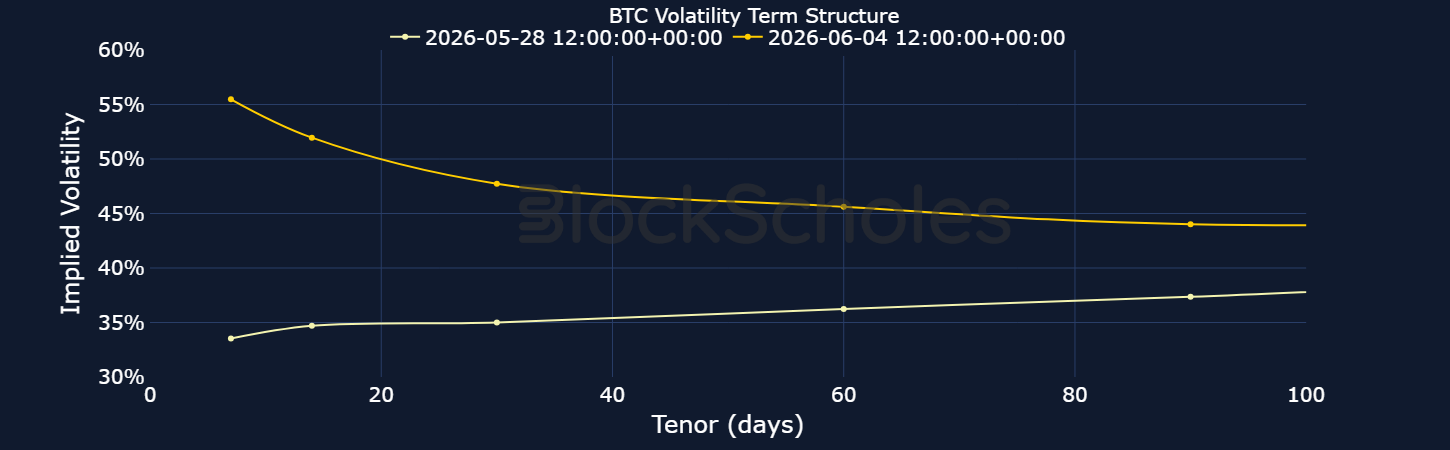
That same term structure inversion can also be seen in ETH, where short-dated IV has jumped from a YTD low of 36% to 67%.
The jump higher in implied volatility has also been accompanied by an aggressive skew in favor of out-of-the-money put options.
Put-call skew for 7-day BTC and ETH options is currently trading around -14%, a sharp move from the -3% and -4% level in late May – a clear sign of demand from traders to pay much higher premiums for downside protection.
That increased demand for put options is not just limited to short-dated options either, rather in line with the drop in spot price, put-call skew has increased in favor of puts across maturities: 7-, 14-, 30-, and 90-day.
HYPE is one of the only major tokens outperforming the broader crypto market slump, up around 160% YTD, though it too has been subject to the risk-off moves at the time of writing (4 June 2026).
The rally earlier this week saw it break into the top 10 by market cap at around $17B, surpassing Dogecoin's then $15B market cap.
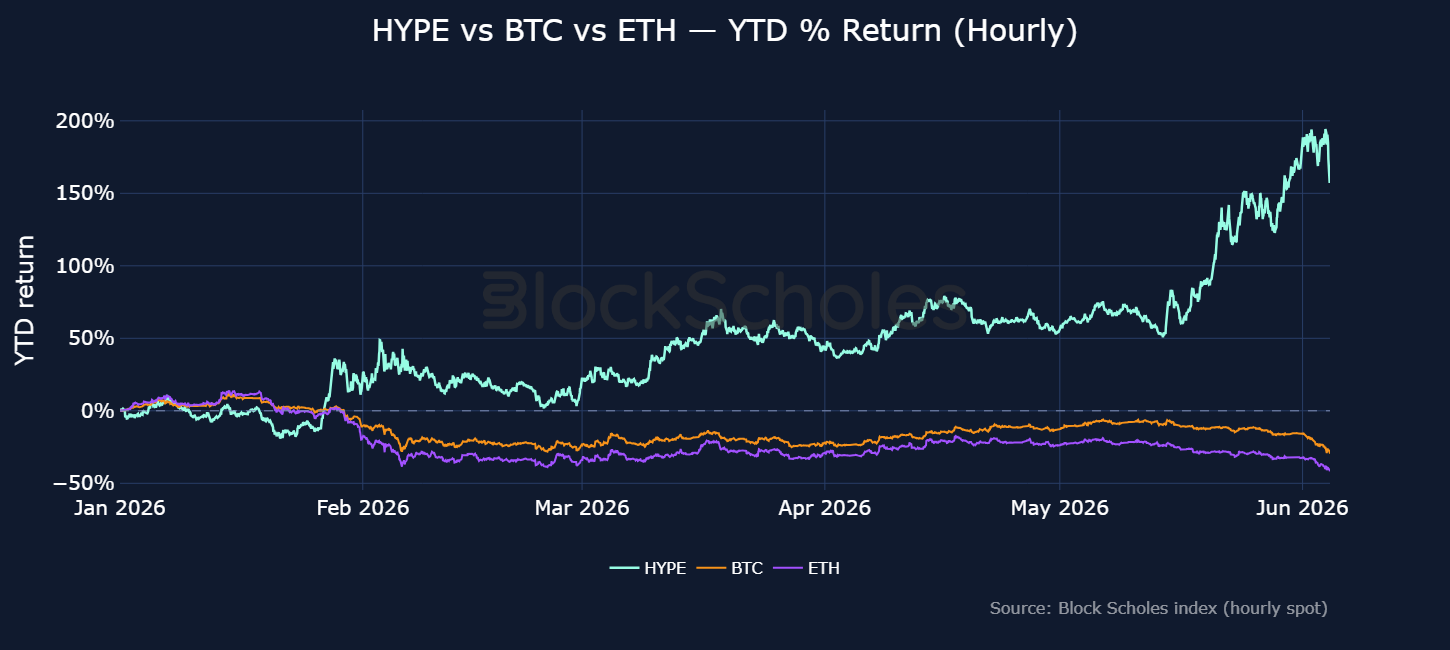
Both BTC and ETH are in negative territory over the same timeline – Bitcoin traded at a four-month low of around $61.3K on 4 June 2026, down 50% from its October 2025 peak, as ETF outflows and geopolitical risk weighed on market sentiment. ETH has reflected the same cautious tone.
Altcoins with strong fundamental use-cases and value-driven tokenomics are uniquely positioned to benefit from the improved regulatory position in the US, particularly those that solve trading infrastructure problems for institutional market participants.
HYPE is one of the clearest examples in the market of a protocol generating real usage and value, and has seen this reflected in strong token performance YTD as a result of its pass-through of revenue to its token through systematic token buybacks.
DefiLlama data show Hyperliquid with $190.4B in 30-day perpetuals volume and protocol revenue at $218.3M in Q1 2026. With an estimated 97–99% of trading-fee revenue routed through the Assistance Fund to buy back HYPE on the open market, stronger protocol activity translates more directly into structural buying pressure for the token.
DECODE: Assistance Fund: an on-chain wallet that recycles Hyperliquid's trading-fee revenue into open-market purchases of HYPE.
Despite token buybacks hailed as a key reason for much of HYPE’s outperformance, the most recent acceleration in HYPE’s rally has come in line with the launch of the first US-listed spot HYPE ETFs in May 2026.
21Shares’ THYP launched on Nasdaq on 12 May 2026, followed by Bitwise’s BHYP on the New York Stock Exchange on 15 May 2026. Both products hold spot HYPE tokens directly, giving investors regulated exposure to Hyperliquid’s native token.
Both HYPE ETFs have recorded combined consistent and consecutive inflows since launch. Over the same period, Bitcoin spot ETFs saw net outflows every trading day from May 15, 2026 to June 3, 2026, a 13-session losing streak. Ethereum was weaker still, recording outflows across 15 consecutive trading days from May 11, 2026 through June 3, 2026, with its previous net daily inflow dating back to May 8, 2026 - almost one month ago.
The divergence was clearest on June 2, 2026, when Bitcoin ETFs shed $519.1M and Ethereum ETFs lost $90.2M, while HYPE ETFs still posted a positive $1.3M.
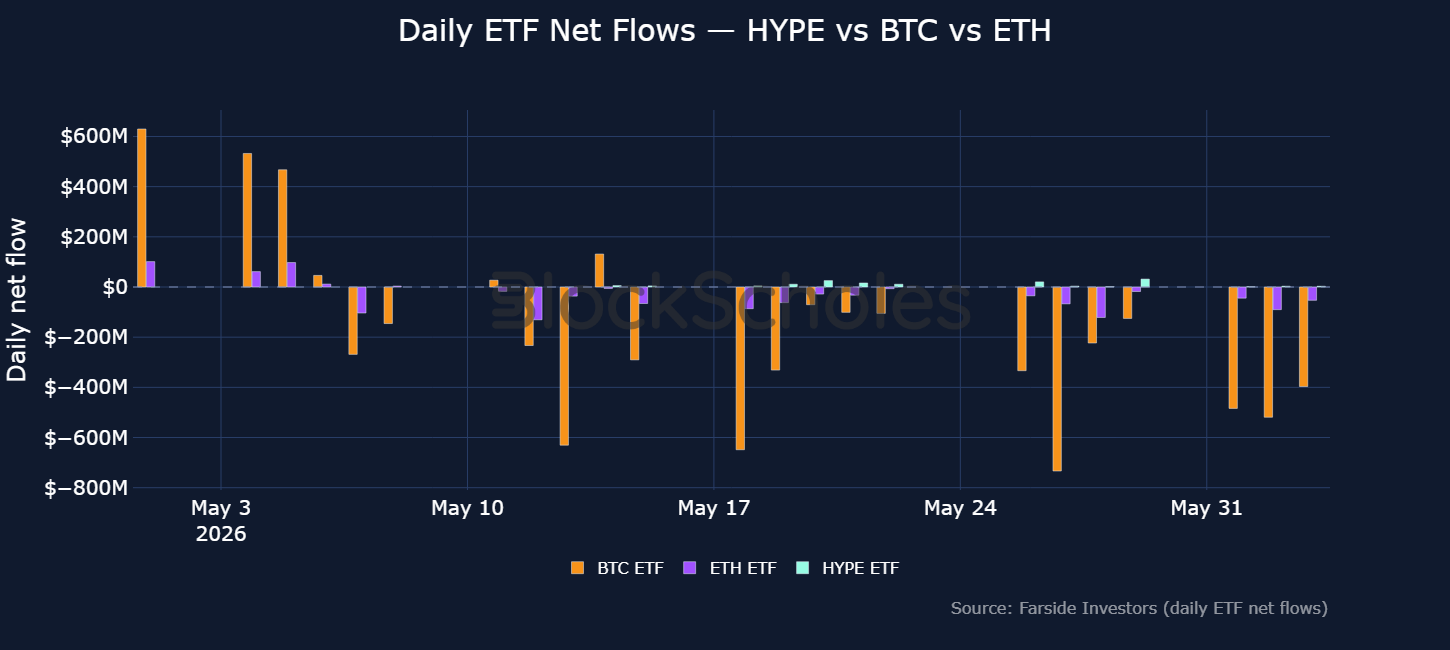
The stark contrast between ETF inflows into HYPE ETFs and outflows from ETH and BTC ETFs raises the question of whether an institutional investor capital rotation is at play.
By June 1, 2026, HYPE’s cumulative ETF net inflow had reached roughly $133M since launching on May 12, 2026, while BTC and ETH spot ETFs saw roughly $4.2B and $760M in net outflows respectively over the same period.
However, given the difference in scale of the flows, it is difficult to make the case that this is a direct capital rotation.
HYPE’s spot price history has also followed a separate trajectory to other crypto large-caps throughout 2026, indicating that this rally is one accelerated by the ETF launch, not created by it.
We have seen this ETF effect clearly in both BTC and ETH, where the introduction of spot ETFs resulted in an immediate rally across both tokens. This was driven by the argument that ETFs opened crypto exposure to institutional investors through a regulated vehicle.
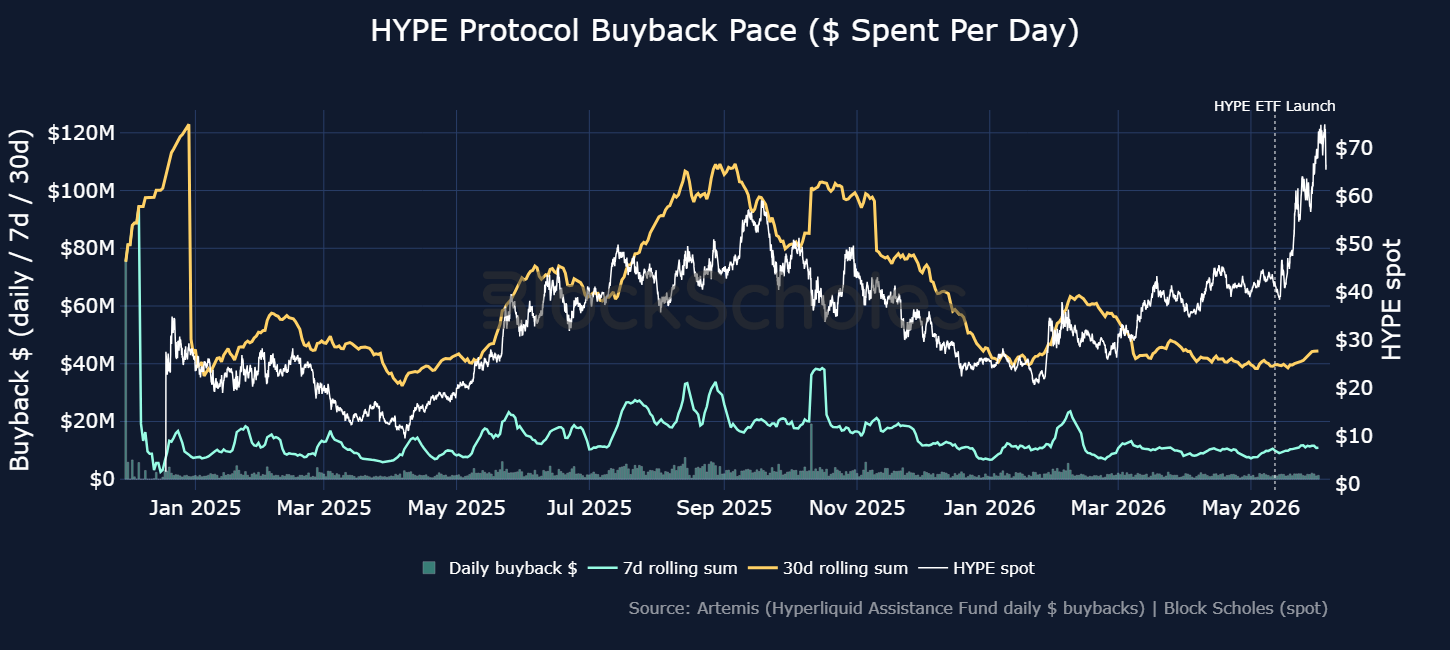
Historically, HYPE’s spot price was responsive to its 30-day rolling buybacks, as seen in the chart below. Across the most recent period from April 2026, token buybacks on both a 7-day and 30-day rolling basis remained relatively flat, directly reflecting protocol revenue. However, the acceleration in HYPE spot from mid-May did not coincide with higher buybacks, but instead with the introduction of the HYPE ETF.
ETF demand is not the only form of institutional buying and interest in HYPE – Bitwise announced on 18 May 2026 that it would allocate 10% of management fees generated from its new Bitwise Hyperliquid ETF (NYSE: BHYP) toward holding HYPE on its corporate balance sheet. Not only does this add another net buyer to the HYPE spot market, but it also reflects wider positive sentiment, with Bitwise seeking exposure to the token itself rather than only earning revenue from others trading it.
Alongside institutional buyers, HYPE also has dedicated publicly listed digital asset companies that accumulate HYPE tokens in their treasury – an almost “token” symbol of institutional interest in crypto assets.
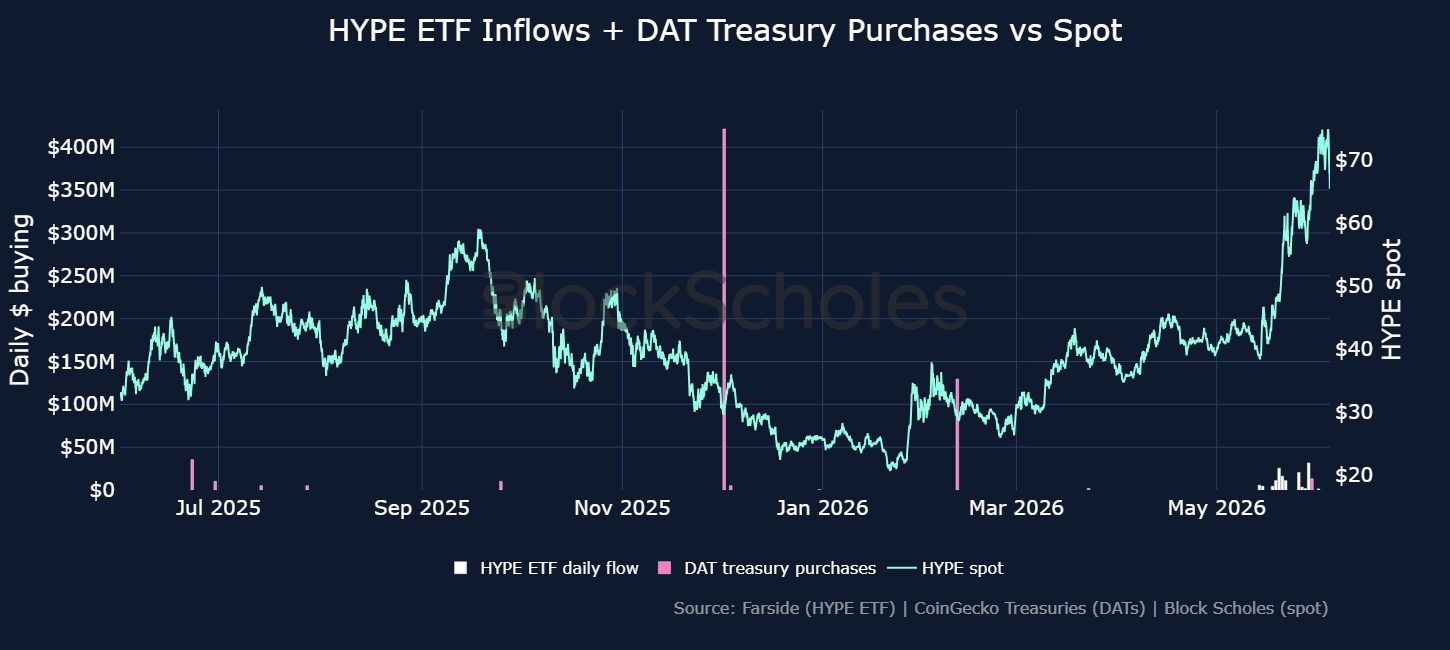
The largest HYPE treasury, and the largest publicly traded vehicle built entirely around Hyperliquid’s HYPE token, is Hyperliquid Strategies Inc. (PURR), listed on Nasdaq. As of 29 April 2026, PURR held an estimated 20.0M HYPE tokens, valued close to $1.3B at current prices and representing over 6% of circulating supply. As seen below, PURR bought 12.5M tokens in a single day in December 2025, equivalent to over $400M. This completely overshadows the daily HYPE ETF inflows, which have all remained below $50M.
What is interesting is the distinction in market reaction.
Following PURR’s significant purchase, HYPE continued to tumble alongside the broader crypto market downturn. By contrast, the recent ETF effect, although much smaller in purchase magnitude, has amplified HYPE’s independent token rally, also against a weak broader market backdrop.
While HYPE ETFs remain small, sustained daily inflows could become a meaningful source of token absorption over time, compared with DATs’ larger but less frequent purchases.
Other reasons for HYPE’s outperformance include the recent and broad-based push towards 24/7 trading.
The CME Group recently announced that it had launched “24/7 trading for Cryptocurrency futures and options”. According to its press release, the move will help in “meeting client demand and bridging the gap between traditional regulated venues and the 24/7 nature of crypto assets”. Separately, last week, the US Commodity Futures Trading Commission (CFTC) approved Bitcoin perpetual futures contracts for trading on regulated US exchanges for the first time.
Additionally, ICE CEO Jeffrey Sprecher said the exchange operator has met with Hyperliquid “multiple times”, to better understand where their businesses may overlap, particularly as 24/7 onchain derivatives markets gain traction. The focus appears to be on how traditional exchanges could participate in or compete with perpetual futures trading, especially in areas such as commodities exposure outside standard market hours.
Both of these moves are direct validations of the 24/7 trading model associated with Hyperliquid.
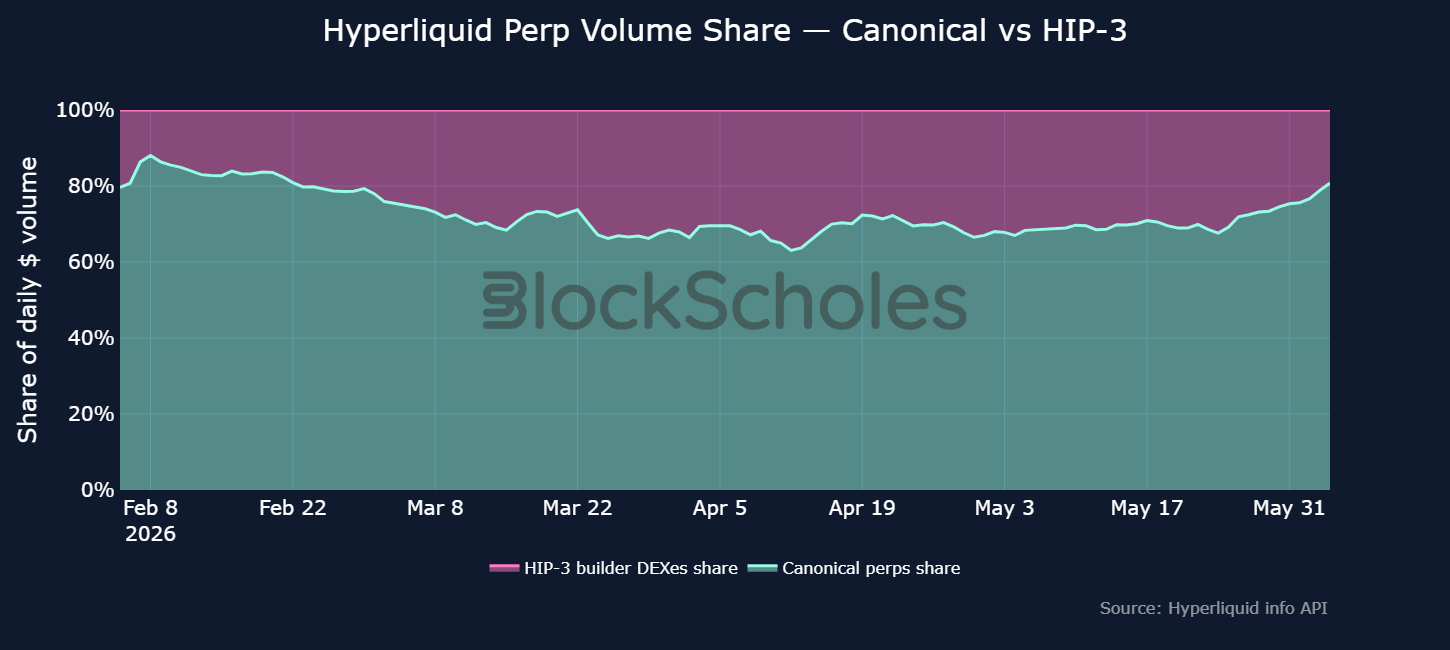
Hyperliquid has positioned itself as a key venue where traders have been able to hedge against geopolitical headlines and in price discovery outside of traditional market hours through its HIP-3 upgrade. The HIP-3 upgrade lets third-party builders permissionlessly list their own perpetual-futures markets, for example, tracking real-world assets.
We can see just how important HIP-3 and RWA perp contracts have been for the platform too. Looking at total perp volume from regular crypto-asset perps on Hyperliquid and RWA perp contracts via HIP-3, the latter has consistently accounted for over 20% of volumes since March.
HYPE is increasingly trading as an asset with its own fundamental and market-structure drivers, rather than simply as a high-beta expression of the broader crypto market. It has entered the top 10 tokens by market cap, now has dedicated ETF products, and is attracting institutional attention through both ETF demand and treasury accumulation.
The underlying protocol, Hyperliquid, is also establishing itself as a venue for meaningful price discovery outside of traditional market hours.
This gives the token a stronger value proposition than many other crypto assets: protocol usage generates revenue, revenue can be directed toward buybacks, and those buybacks create a link between Hyperliquid’s growth and HYPE’s tokenomics.
1) Galaxy Digital has launched an institutional OTC prediction markets trading desk, expanding its trading business into event-contract markets and enabling large investors to execute prediction market positions off-exchange.
The offering initially supports contracts listed on Kalshi and Polymarket, with Galaxy acting as principal counterparty and allowing clients to pair prediction market exposure with hedges across equities, commodities and other asset classes.
Galaxy said it has already facilitated a $10M trade with crypto hedge fund Arca tied to the outcome of the CLARITY Act, providing institutional-scale liquidity for a market that has historically been dominated by retail traders.
2) CME Group’s 24/7 crypto derivatives market launched last Friday and recorded a strong first weekend of activity.
On Saturday and Sunday, more than 7,200 contracts were traded, representing around $50M in notional value, according to the company.
3) TON is reviving the Gram name for its native token, bringing back the branding first proposed in Telegram’s original blockchain white paper.
TON will remain the name of the blockchain, while Gram will become the name of its native currency.
Telegram CEO Pavel Durov said the move marks a return to the project’s roots and forms part of his wider “Make TON Great Again” campaign.
The rebrand follows recent network upgrades, lower transaction fees and plans for Telegram to take a larger role in TON governance.
4) Strategy’s disclosure of its first sale of BTC in years sparked controversy in Polymarket’s “MicroStrategy sells any Bitcoin by May 31, 2026?” market, which has generated more than $120M in trading volume and is currently pricing a 99% probability of “No” as traders debate how the market should be resolved.
5) Bitmine Immersion Technologies, the largest publicly-listed ETH DAT, announced that it had acquired 26,497 ETH over the past week, bringing its total holdings to 5.42M ETH, equivalent to approximately 4.49% of Ethereum’s circulating supply and moving closer to its stated goal of accumulating 5% of all ETH.
Bitmine also disclosed that 4.72M ETH is currently staked through its validator operations, representing roughly 87% of its ETH treasury and approximately $9.5B in staked assets, with the firm projecting annualized staking revenue of around $258M based on current yields.
6) The CFTC issued an order for approval to KalshiEX LLC for the listing of the BTCPERP contract, making Kalshi the first CFTC-registered designated contract market to officially list a BTCPERP contract with no expiration date.
Ambiguity surrounding 24/7 CFTC-registered exchanges has been partially addressed, with the CFTC providing guidance for 24/7 trading, clearing and settlement.
7) Wintermute, a crypto market maker and algorithmic trading firm with more than $3.5T in annual trading volume, said it has entered the prediction markets sector as a liquidity provider across leading event-contract venues.
The firm is now quoting continuous two-sided markets on prediction contracts, reflecting its view that prediction markets are emerging as a significant asset class for trading and hedging real-world event risk.
8) Falcon Finance and Anchorage Digital Bank have launched fUSD, a new “GENIUS-ready” stablecoin issued by Anchorage Digital Bank and designed for institutional trading desks, treasury operations, and regulated collateral use cases.
The stablecoin is based on Ceffu’s institutional custody and collateral infrastructure and is backed 1:1 by cash, short-dated U.S. Treasuries, and Treasury-backed repo exposure, with reserves held under OCC supervision and attested monthly by Deloitte.
9) Samsung Securities, Samsung SDS, and Samsung Card are set to acquire a combined 4% stake in Dunamu, the operator of Upbit, in a deal valued at roughly $408M.
The investment follows Hana Bank’s recent $670M move into Dunamu and signals a broader strategic shift.
10) President Trump has intensified the conversation around prediction market regulation by publicly endorsing CFTC Chair Michael Selig’s position on the agency’s authority over the sector.
In a post on Truth Social, Trump said: “It is critically important that the CFTC’s exclusive authority over Prediction Markets is maintained, and that they will thrive.”
He also framed the issue as part of a broader competition for financial-market leadership, stating that other countries are pursuing this “new form of Financial Market” while the US seeks to remain at the top.
11) Base, the Coinbase-incubated Ethereum Layer 2 network designed to support faster, lower-cost onchain applications and payments across the Ethereum ecosystem, has introduced Base MCP, a new gateway designed to connect AI interfaces with Base wallet infrastructure.
Base MCP acts as a secure bridge between users’ Base Accounts in the Base App and AI interfaces that support the open Model Context Protocol standard, including Claude, ChatGPT, and Cursor.
The integration will allow users to interact with Base applications through natural language prompts, including swapping tokens, transferring funds, and accessing DeFi applications across lending, swaps, perpetuals, and token launches.
12) Pump.fun is expanding beyond Solana with the launch of multi-chain trading functionality in its app, according to their announcement on X.
The update will allow users to trade tokens across multiple blockchains, including Ethereum, Base, BNB Chain, Monad, and other supported networks.
13) OKX’s X Layer, the exchange’s EVM-compatible Layer 2 blockchain, has introduced Exchange OS, an upgrade designed to let developers, institutions, and ecosystem participants create custom crypto markets using a shared exchange infrastructure stack.
The upgrade moves core trading functions such as matching, margin, liquidation, settlement, and risk management to the protocol layer, reducing the need for builders to recreate complex exchange systems from scratch or rely entirely on centralized infrastructure.
14) Tether and the Government of Georgia plan to launch GEL₮, a Georgian lari-backed stablecoin designed to bring the country’s national currency onto blockchain-based payment rails under a dedicated stablecoin regulatory framework.
The initiative aims to support faster and lower-cost digital payments, remittances, cross-border transfers, and programmable financial infrastructure, while building on Georgia’s broader push to position itself as a crypto-friendly jurisdiction with regulatory clarity around reserve management, redemption rights, and AML compliance.
The Latest Listings - DELLUSDT
DELL is a publicly traded, US-based technology company focused on enterprise infrastructure, personal computing, data storage, networking, cloud solutions and IT services.
The company has been active in the technology hardware market for decades and is one of the most recognised names in global computing.
While Dell is often associated with PCs, an important part of its business today is linked to enterprise infrastructure.
This refers to the physical systems that companies use to store data, run applications, manage workloads and support internal technology operations. These systems include servers, storage platforms, networking equipment and related services.
This has become more relevant because of the rapid growth of artificial intelligence.
AI applications require large amounts of computing power, especially when companies are training models, running inference, processing large datasets or deploying AI tools across their businesses. As a result, demand has grown for advanced data-centre infrastructure that can support heavier and more complex workloads.
Dell is connected to this trend through its infrastructure business. The company provides servers and systems that can be used in AI data centres, including infrastructure designed to work with high-performance chips and accelerated computing platforms. In simple terms, Dell is not building the AI models themselves, but it provides some of the equipment that helps companies run AI-related workloads.
This matters because the AI market is not only about software or semiconductors. Behind every AI application is a large physical infrastructure layer: servers, storage, cooling, networking and data-centre capacity. Companies expanding into AI often need to upgrade their existing technology systems, and Dell is one of the established providers in that area.
Dell’s relevance also comes from its existing relationships with large businesses, cloud providers, public-sector clients and technology buyers.
Many organisations already use Dell systems across their IT infrastructure, which gives the company a practical role in helping customers expand or modernise their computing environments. This is particularly relevant as AI adoption moves from early experimentation into broader enterprise deployment.
For market participants, Dell is relevant because it sits at the intersection of traditional enterprise technology and the growing demand for AI infrastructure. Its role is more about enabling computing capacity than developing AI software directly.