Nasdaq Is Investing $100M in Kraken's Parent Company at a Reported $21B Valuation
August US CPI, due at 8:30 a.m. ET, is the last major inflation release before next week's FOMC, with headline prices expected to rise 0.4% MoM and 3.3% YoY after Thursday's PPI lifted the annual rate to 5.4%; Fed funds futures now imply a 67% chance of a 25bps hike. The 30-year Treasury yield hit 5.36%, its highest since 2007, while the 10-year tests 5%. Stacks launched Bitcoin Staking, paying BTC-denominated yield while holders keep self-custody on Bitcoin L1, and Nasdaq agreed to invest $100M in Kraken's parent Payward at a reported $21B valuation.
August US CPI, due at 8:30 a.m. ET, is the last major inflation release before next week's FOMC decision, with headline prices expected to rise 0.4% MoM and 3.3% YoY. Fed funds futures imply a 67% chance of a 25bps hike, up from 62% before Thursday's PPI release.
Stacks launched Bitcoin Staking, which pays BTC-denominated yield while holders keep their bitcoin on the Bitcoin network under their own keys, starting with a roughly six-month Genesis Bond whose participants include 21Shares.
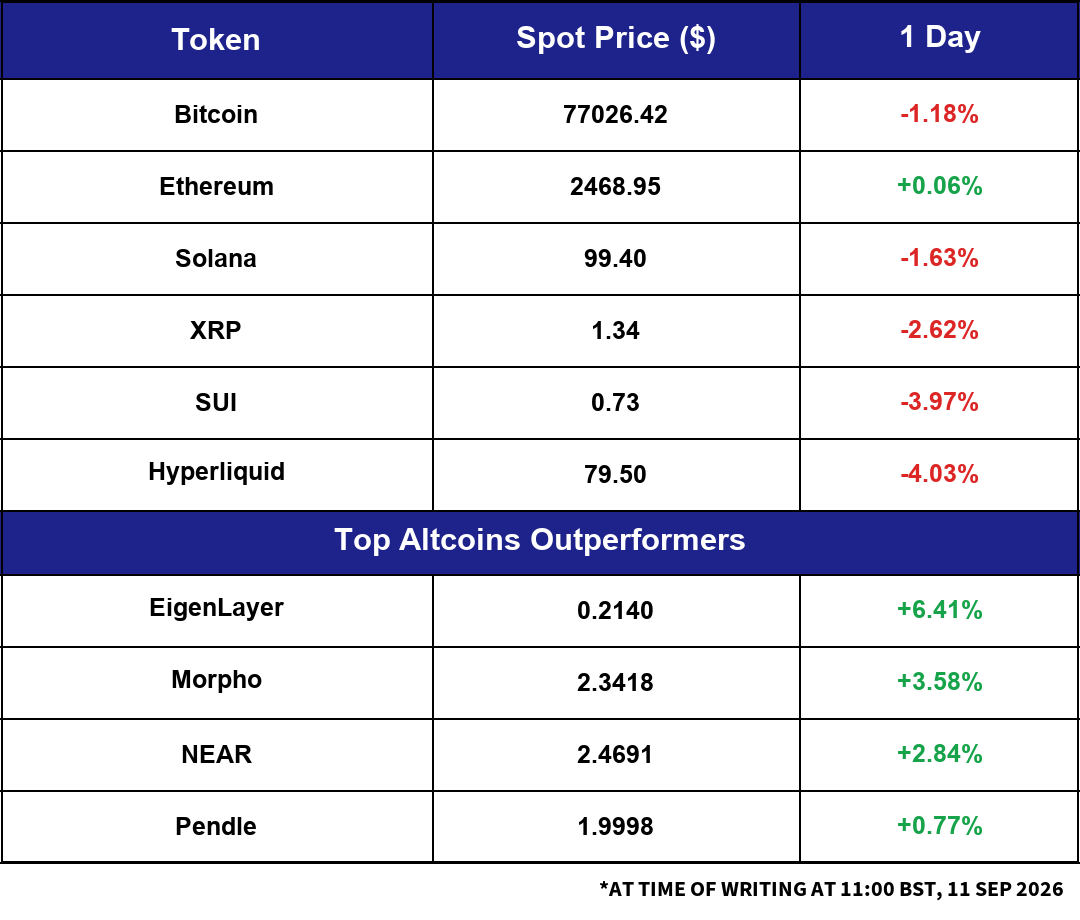
Market Snapshot: Overnight Moves
Macro & Markets
With Brent crude remaining above $100 per barrel and the 10-year US Treasury yield approaching 5%, today’s CPI report is the final major macro release before next week’s crucial FOMC decision.
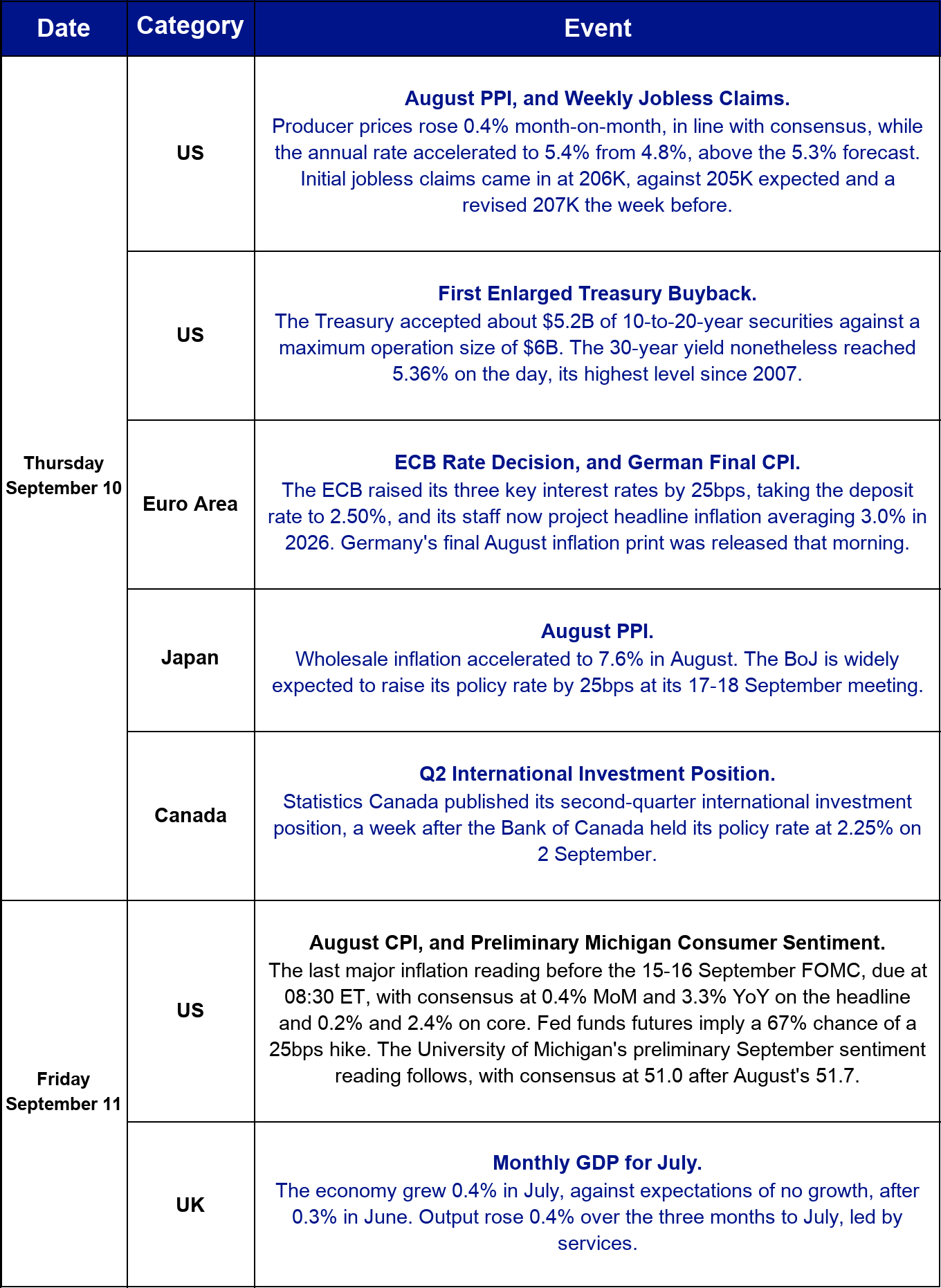
The BLS will release the CPI figures for August 8:30 a.m. ET, with headline prices expected to have risen 0.4% MoM and 3.3% YoY. Core inflation is forecast at 0.2% and 2.4%, respectively.
Much of the latest oil-price shock occurred in September and will not be captured in today’s August data, meaning that the core reading (stripped of energy cost rises) may carry more weight for next week’s decision.
Yesterday’s Producer Price Index rose 0.4% month-on-month, matching consensus, while the annual rate accelerated from 4.8% to 5.4%, slightly above the 5.3% forecast.
The increase was concentrated in goods and energy: final-demand energy prices rose 4.2% and diesel prices jumped 24.1%. The index excluding food, energy and trade services rose a more moderate 0.3% month-on-month, but remained elevated at 4.7% year-on-year.
Fed funds futures now imply a 67% probability of a 25bps rate increase next week, up from 62% before the PPI release.
Longer-dated Treasury yields have retreated modestly ahead of CPI. The 10Y was around 4.94% this morning, approximately 3bps below Thursday’s high, after rising 10.7bps in the previous session. The yield has increased by roughly 18bps this week and is now testing the psychologically important 5% threshold.
The 30Y yield reached 5.36% on Thursday, its highest level since 2007, demonstrating that the selloff extends beyond a reprice of the immediate Fed outlook.
The rise came despite the Treasury completing its first enlarged 10Y-to-20Y liquidity-support buyback. It accepted approximately $5.2B of securities against a maximum operation size of $6B.
Treasury had announced on 19 August that it would raise the maximum size of longer-dated buybacks from $2B to at least $4B per operation. The 10Y initially fell from 4.68% to 4.65% on that announcement, but now trades roughly 26bps above its pre-announcement level.
Wednesday’s FOMC decision also has direct implications for the yen following the coordinated US-Japan intervention on 31 July.
Treasury Secretary Scott Bessent intensified his verbal intervention on Tuesday, telling traders that “I am the house now” and that they could “bet against me if you want”, while pointing to his informational advantage regarding Japanese policy.
The Fed’s two-day meeting concludes at 2 p.m. ET (6 p.m. UTC) on Wednesday 16 September. The BoJ meets on Thursday and Friday, 17-18 September, with its decision expected on Friday.
The BoJ is widely expected to raise its policy rate by 25bps after Japanese wholesale inflation accelerated to 7.6% in August. Bessent has publicly urged the central bank to take “decisive” monetary action to support the yen.
The immediate risk is therefore a Fed hike without a matching BoJ move, or unexpectedly dovish BoJ guidance. Equal 25bps increases from both central banks would leave the headline policy-rate differential unchanged.
Japanese investors remain the largest foreign holders of US Treasuries, with $1.12T held as of June. Washington’s preference for higher Japanese rates partly reflects its desire to reduce the need for Japan’s Ministry of Finance to sell reserve assets, including Treasuries, to finance repeated yen purchases.
US equities declined for a fourth consecutive session on Thursday. The S&P 500 fell 0.58%, the Dow lost 0.60% and the Nasdaq-100 dropped 1.08%, as higher discount rates weighed most heavily on growth and tech stocks.
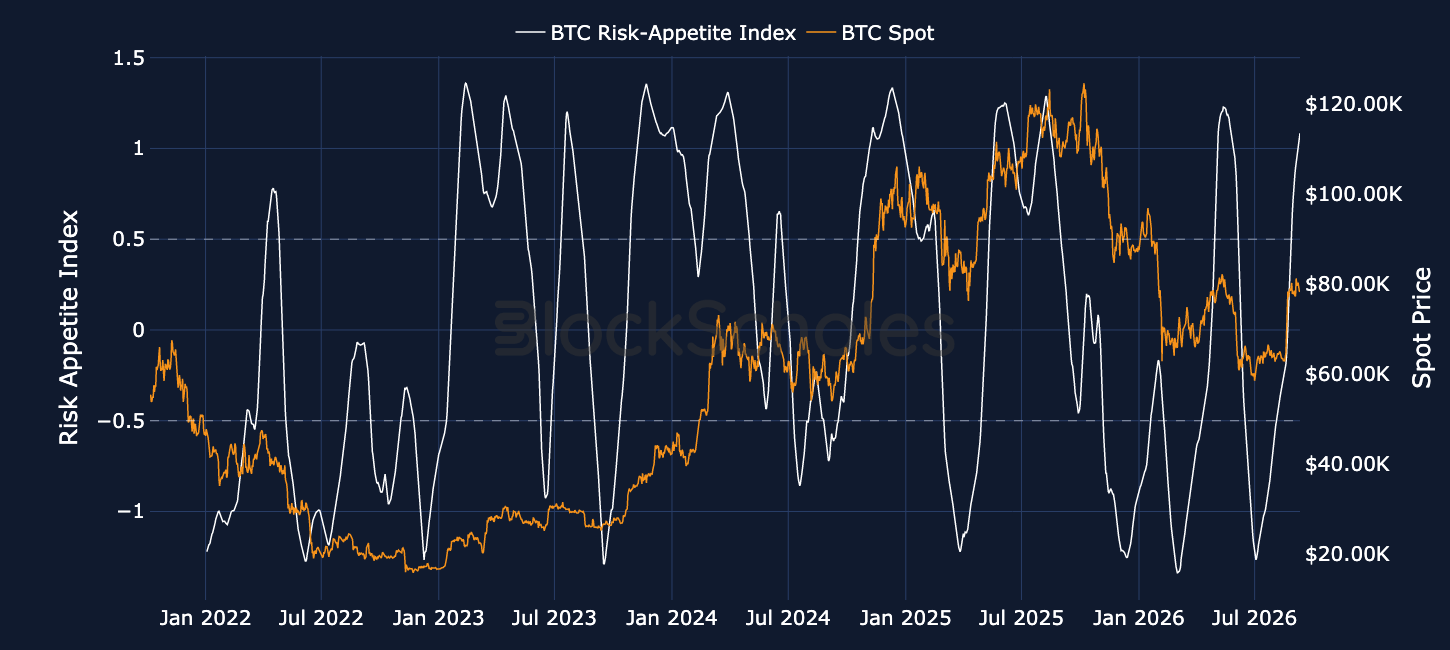
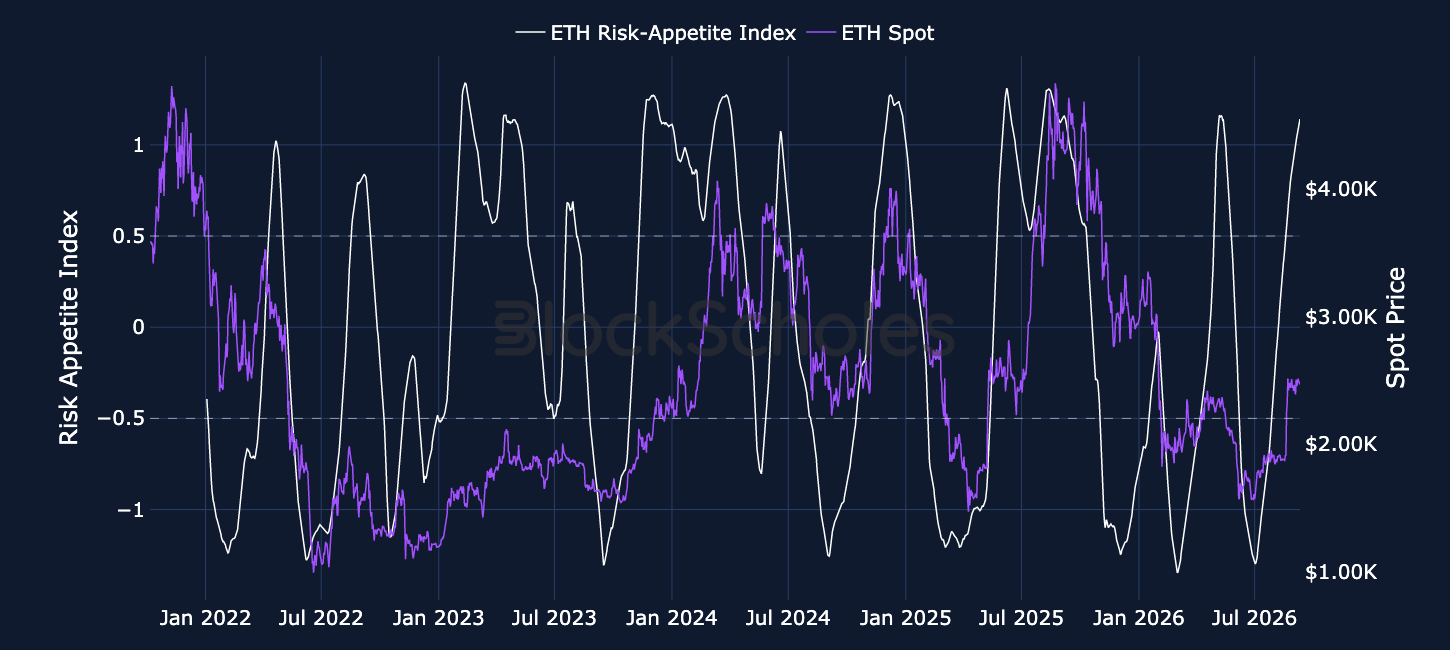
Crypto spot markets have remained comparatively resilient despite the renewed bond and equity volatility. BTC trades around $76.9K and ETH near $2,465, leaving both close to the levels reached during their sharp rally alongside gold in the second half of August.
DeFi / Web3 / Altcoins / Crypto
Stacks has launched Bitcoin Staking, a self-custodial mechanism that allows BTC holders to earn BTC-denominated yield while keeping their bitcoin on Bitcoin L1 under their own keys.
The launch begins with the Genesis Bond, the first protocol bond on Stacks, with participants including 21Shares, UTXO Management and HashKey Cloud.
Users lock BTC on Bitcoin through a standard timelock and pair it with STX locked on Stacks for the same period.
The BTC is not bridged, wrapped or transferred to a custodian, and the position remains verifiable on the Bitcoin blockchain.
Each bond lasts around six months, with rewards paid in BTC on a weekly basis.
The yield comes from Stacks miners, who spend BTC to compete for STX block rewards and transaction fees, with that BTC then distributed to eligible participants.
Stacks said its Proof of Transfer system has distributed more than 4,200 BTC to participants since 2021.
Canary Capital has launched the Canary Staked TRX ETF, ticker TRXS, giving U.S. investors spot exposure to TRX alongside potential staking rewards.
The fund tracks the spot price of TRX, the native token of the TRON network.
It also participates in TRON’s delegated proof-of-stake validation process, with net staking rewards reflected in the ETF’s net asset value.
The launch gives investors a regulated exchange-traded way to gain exposure to TRON without holding TRX directly.
TRON currently supports more than $94B in circulating USDT and has processed about $5.6T in USDT transfer volume year to date.
Canary Capital said the product is designed to broaden investor access beyond BTC and ETH into blockchain networks with significant real-world payments and settlement activity.
Bitwise is shutting down its Dogecoin ETF, BWOW, less than a year after launch.
Trading in the fund is expected to end on October 14, with remaining shareholders receiving cash distributions the following week.
The closure will make BWOW the 10th ETF liquidation of 2026.
Bitwise said the decision is part of an effort to streamline its product lineup around investor demand.
The report said assets in the fund had fallen by roughly 40% from launch.
DOGE was trading around $0.083, down 2.5% over 24 hours and 4.2% over the previous week.
The shutdown reflects weaker demand for smaller altcoin exposure through ETF products.
Citadel Securities has urged the SEC and CFTC to reaffirm that the SEC should be the primary regulator for event contracts tied to U.S. public companies and their securities.
The firm argued that trading venues should not be able to use the CFTC’s self-certification process to avoid SEC oversight of equity-linked products.
Citadel pointed to contracts based on company key performance indicators, saying these products can create insider-trading risks because outcomes may depend on non-public information about corporate metrics and disclosures.
The firm said certain KPI-linked binary options should be treated as securities and could also qualify as security-based swaps when tied to events affecting a single public company’s financial condition or obligations.
Citadel also asked the SEC to review new product filings promptly and provide clearer classification rules for equity-linked event contracts and perpetual derivatives.
The company said new products should compete on their merits rather than benefit from differences between the SEC and CFTC regulatory frameworks.
MoneyGram has launched its first stablecoin-backed Visa card, initially available to eligible customers in Colombia.
The card allows users to hold a stable-dollar balance, spend wherever Visa is accepted and convert funds into local currency for pickup at MoneyGram locations.
It supports USDC at launch, with MoneyGram planning to add its own MGUSD stablecoin in the near future.
The card is available digitally through the MoneyGram app and can be added to mobile wallets for online and tap-to-pay purchases.
To qualify, customers must be in an active market and complete MoneyGram’s KYC process.
The product was developed with stablecoin infrastructure firm Rain and also uses Crossmint wallet technology and the Stellar network.
Coinbase and payments infrastructure provider Moov have partnered to bring stablecoin payment infrastructure to more than 1,000 community banks and credit unions.
The integration will use Coinbase’s Payments API and custodial wallets inside Moov’s existing payments platform.
This will allow smaller financial institutions to offer stablecoin-based consumer payments, merchant acceptance, settlement, payouts and real-time funding without building their own crypto infrastructure.
The partnership is designed to help community banks and credit unions offer faster payments and potentially lower transaction costs while using their existing banking systems.
Coinbase has rebranded the Base App back to Coinbase Wallet just over a year after changing the name, as the company shifts the self-custodial app toward trading and broader multichain access.
Coinbase said the wallet will serve as a testing ground for products and assets that may not yet be available on its centralized exchange.
The app supports perpetual futures powered by Hyperliquid, prediction markets, tokenized stocks and long-tail crypto assets.
Coinbase Wallet now supports more than 10 networks, including Base, Solana, Bitcoin, Ethereum, BNB Chain, Robinhood Chain and Monad.
The wallet will remain self-custodial, meaning users keep control of their own keys, while Coinbase filters malicious tokens and reviews newer product categories before listing them.
Coinbase said the Wallet name now better reflects the product’s role as its self-custodial entry point to what it calls the “everything exchange.”
Nasdaq has agreed to invest $100M in Payward, the parent company of Kraken, as the two firms deepen their partnership around tokenized equities and market infrastructure.
The investment, made through Nasdaq Ventures, reportedly values Payward at $21B.
As part of the expanded partnership, Payward will adopt Nasdaq’s market surveillance technology across its trading venues, including crypto, equities, tokenized equities, futures and options.
The companies are also developing Nasdaq Equity Tokens, or NETs, which are expected to launch in Q2 2027.
The tokenized equity framework will connect with Payward’s xStocks ecosystem and is designed to support onchain settlement while preserving shareholder rights.
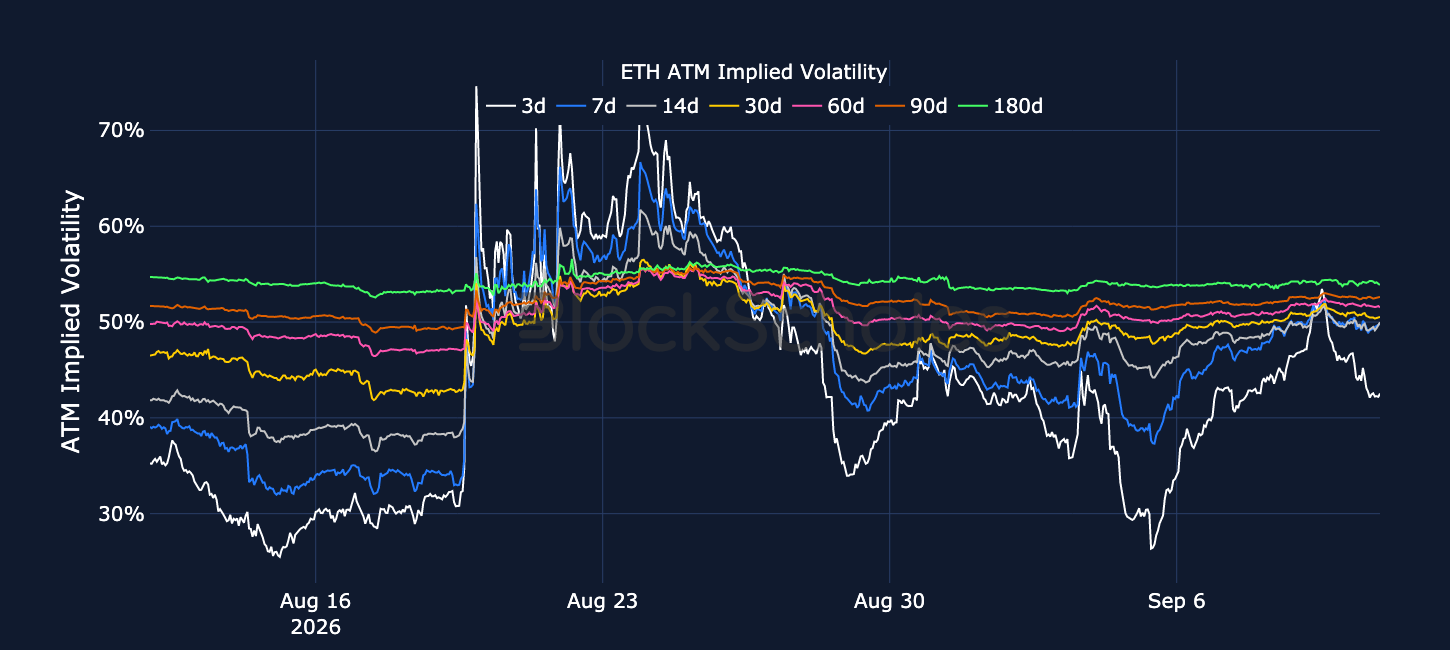
Figure 4. ETH at-the-money implied volatility across selected tenors. Source: Deribit, Block Scholes.
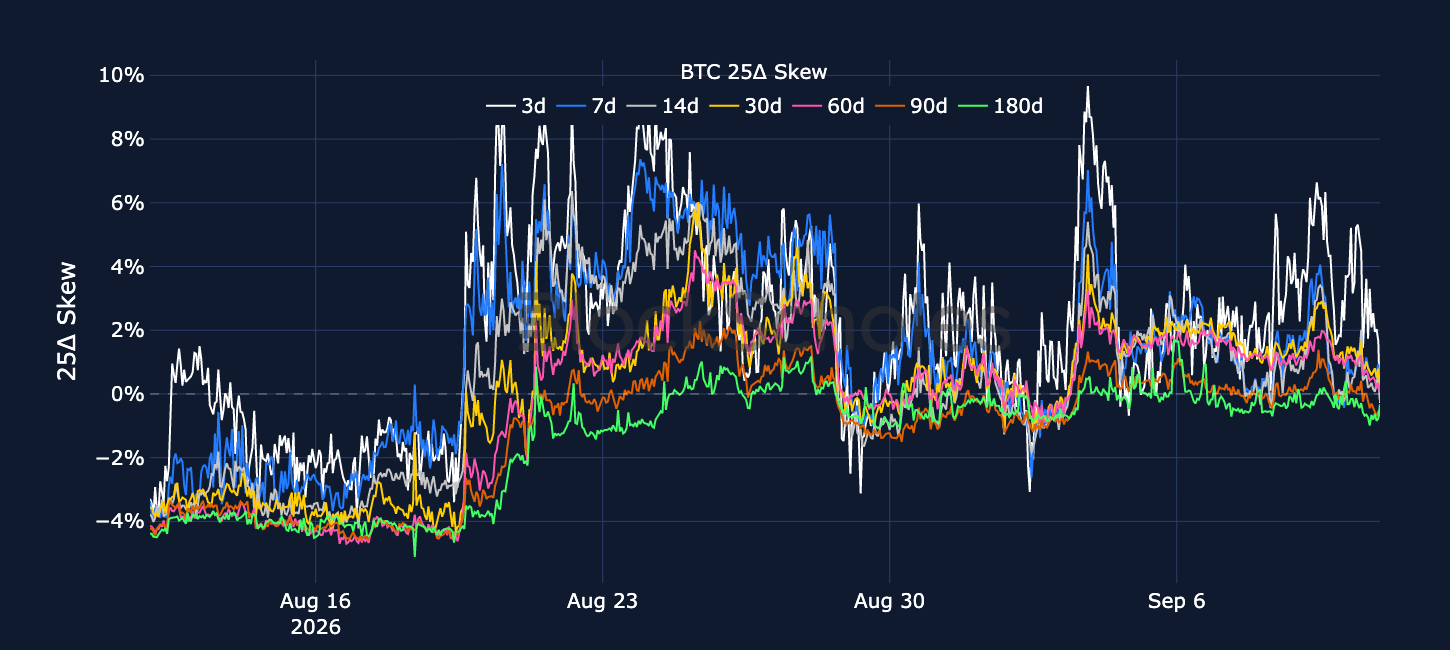
Figure 5. BTC 25-delta put-call skew ratio across selected tenors. Source: Deribit, Block Scholes.
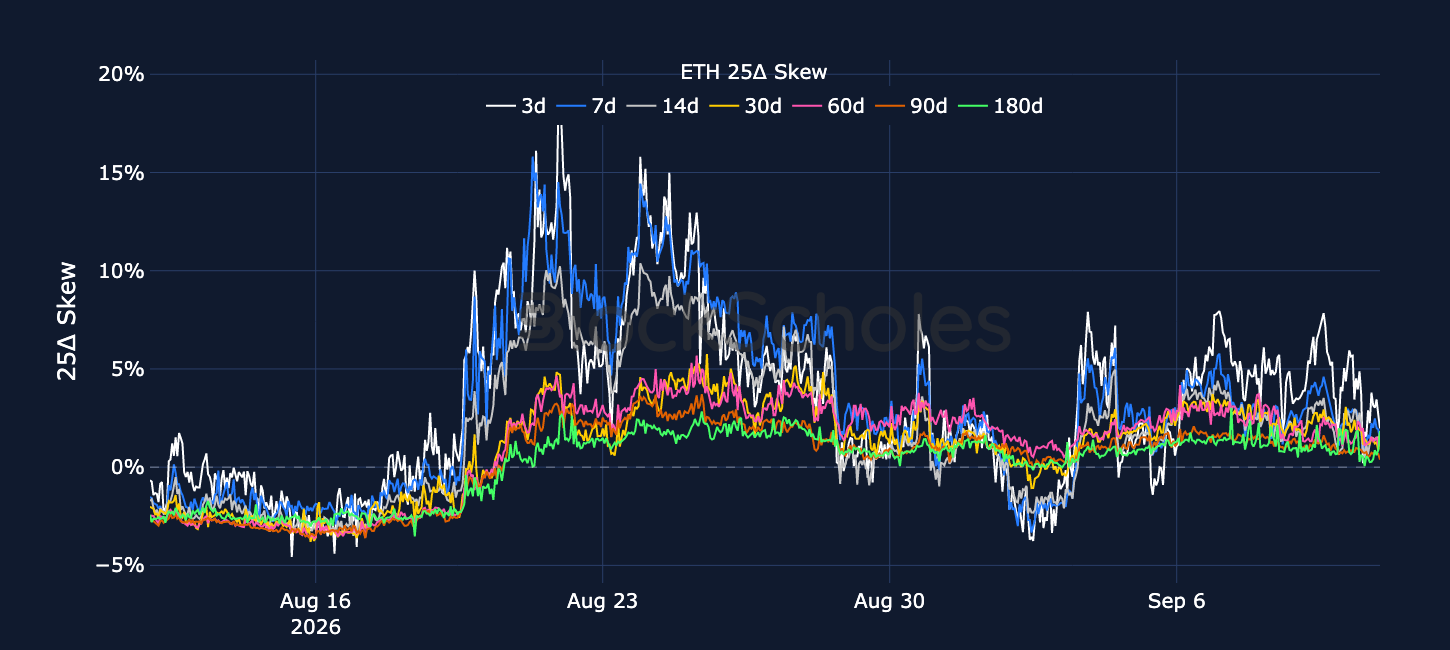
Figure 6. ETH 25-delta put-call skew ratio across selected tenors. Source: Deribit, Block Scholes.
Block Scholes is an FCA-regulated institutional crypto derivatives analytics platform. Live data, IV surfaces, and backtesting available via blockscholes.com.
August US CPI, due at 8:30 a.m. ET, is the last major inflation release before next week's FOMC decision, with headline prices expected to rise 0.4% MoM and 3.3% YoY. Fed funds futures imply a 67% chance of a 25bps hike, up from 62% before Thursday's PPI release.
Stacks launched Bitcoin Staking, which pays BTC-denominated yield while holders keep their bitcoin on the Bitcoin network under their own keys, starting with a roughly six-month Genesis Bond whose participants include 21Shares.
Market Snapshot: Overnight Moves
Macro & Markets
With Brent crude remaining above $100 per barrel and the 10-year US Treasury yield approaching 5%, today’s CPI report is the final major macro release before next week’s crucial FOMC decision.
The BLS will release the CPI figures for August 8:30 a.m. ET, with headline prices expected to have risen 0.4% MoM and 3.3% YoY. Core inflation is forecast at 0.2% and 2.4%, respectively.
Much of the latest oil-price shock occurred in September and will not be captured in today’s August data, meaning that the core reading (stripped of energy cost rises) may carry more weight for next week’s decision.
Yesterday’s Producer Price Index rose 0.4% month-on-month, matching consensus, while the annual rate accelerated from 4.8% to 5.4%, slightly above the 5.3% forecast.
The increase was concentrated in goods and energy: final-demand energy prices rose 4.2% and diesel prices jumped 24.1%. The index excluding food, energy and trade services rose a more moderate 0.3% month-on-month, but remained elevated at 4.7% year-on-year.
Fed funds futures now imply a 67% probability of a 25bps rate increase next week, up from 62% before the PPI release.
Don't miss what's next
Upgrade your Block Scholes account to unlock this article and other exclusive insights
August US CPI, due at 8:30 a.m. ET, is the last major inflation release before next week's FOMC decision, with headline prices expected to rise 0.4% MoM and 3.3% YoY. Fed funds futures imply a 67% chance of a 25bps hike, up from 62% before Thursday's PPI release.
Stacks launched Bitcoin Staking, which pays BTC-denominated yield while holders keep their bitcoin on the Bitcoin network under their own keys, starting with a roughly six-month Genesis Bond whose participants include 21Shares.
Market Snapshot: Overnight Moves
Macro & Markets
With Brent crude remaining above $100 per barrel and the 10-year US Treasury yield approaching 5%, today’s CPI report is the final major macro release before next week’s crucial FOMC decision.
The BLS will release the CPI figures for August 8:30 a.m. ET, with headline prices expected to have risen 0.4% MoM and 3.3% YoY. Core inflation is forecast at 0.2% and 2.4%, respectively.
Much of the latest oil-price shock occurred in September and will not be captured in today’s August data, meaning that the core reading (stripped of energy cost rises) may carry more weight for next week’s decision.
Yesterday’s Producer Price Index rose 0.4% month-on-month, matching consensus, while the annual rate accelerated from 4.8% to 5.4%, slightly above the 5.3% forecast.
The increase was concentrated in goods and energy: final-demand energy prices rose 4.2% and diesel prices jumped 24.1%. The index excluding food, energy and trade services rose a more moderate 0.3% month-on-month, but remained elevated at 4.7% year-on-year.
Fed funds futures now imply a 67% probability of a 25bps rate increase next week, up from 62% before the PPI release.
Don't miss what's next
Upgrade your Block Scholes account to unlock this article and other exclusive insights
Premium
$30/mo
Access previous and future reports, market insights & deep dives.
While last Thursday’s selloff in AI-related shares eased on Friday, a rally in oil prices dragged down risk assets, with Brent crude settling around $114 a barrel after nearing $118, the S&P 500 down 0.52% and the Dow Jones 1.2% lower. President Trump said it is “getting to be decision time” on an Iran deal, while the Fed, ECB and BoJ all meet this week alongside earnings from Alphabet, Microsoft and Amazon. BTC fell below $80,000 after investors pulled $772.4M from US spot Bitcoin ETFs across Thursday and Friday, while Senator Blumenthal demanded records from Tether over payments to Bo Hines’ consulting firm.
The selloff in AI-related shares returned on Thursday after disappointing earnings from Meta, Tesla and Lam Research, with the Philadelphia Semiconductor index plunging 6.72% and all 30 of its members ending lower. The 10-year US Treasury yield fell around 17bps to 4.96%, its biggest one-day decline since March 2023, even as Brent crude rose 4.0% to its highest close since May. Uniswap launched aggregator hooks that let v4 route trades through liquidity on Fluid, Curve and PancakeSwap, while SoFi launched a tokenised bank deposit paying 4.4% APY.