A Microsoft Beat Reignites AI Optimism as the KOSPI Leaps 18%
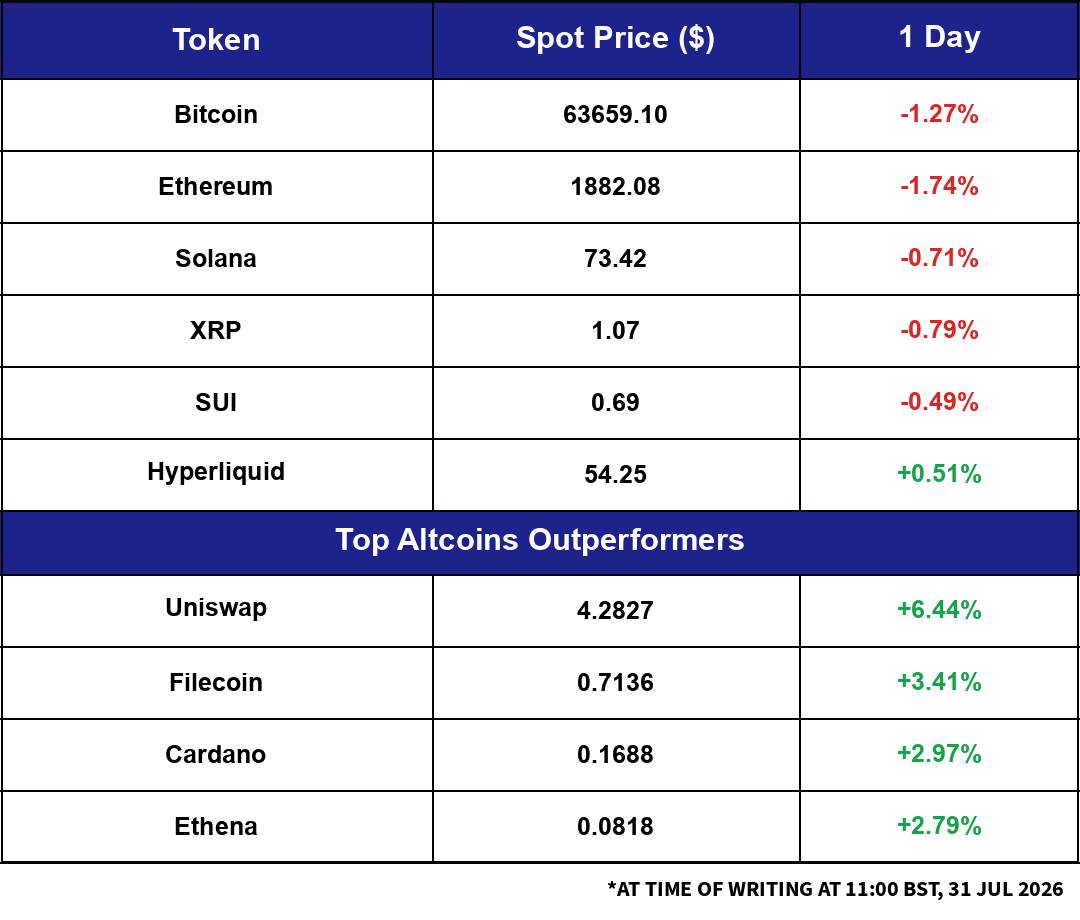
US equities rebounded sharply as Microsoft surged more than 16% on strong earnings, lifting the Nasdaq-100 3.36% and reviving the AI trade, while South Korea's KOSPI leapt 18%. Central banks held as expected, the Bank of Japan at 1.00% and the Bank of England at 3.75%, and BTC touched $65K before easing back to $63.7K. Quantum Solutions sold another 1,000 ETH to fund AI data-centre expansion, while Hyperscale Data sold 100 BTC to back a 20 MW AI compute project.
Block Scholes is an FCA-regulated institutional crypto derivatives analytics platform. Live data, IV surfaces, and backtesting available via blockscholes.com.
US equities rebounded sharply as Microsoft surged more than 16% on strong earnings, lifting the Nasdaq-100 3.36% and reviving the AI trade, while South Korea's KOSPI leapt 18%. Central banks held as expected, the Bank of Japan at 1.00% and the Bank of England at 3.75%, and BTC touched $65K before easing back to $63.7K.
Quantum Solutions sold another 1,000 ETH to fund AI data-centre expansion, ceding its spot as Japan's largest listed corporate ETH holder, while Hyperscale Data sold 100 BTC to back a 20 MW AI compute project. New York sued prediction-market platform Kalshi over alleged illegal gambling, and Uniswap nearly tripled daily protocol revenue after extending its fee switch to v4 pools across seven chains.
Market Snapshot: Overnight Moves
Macro & Markets
After Wednesday’s selloff in risk-on assets, US equities rebounded significantly on Thursday, led by gains in Microsoft and semiconductors.
All major US stock benchmarks closed the session higher: the S&P 500 rallied 1.66%, the Nasdaq-100 advanced 3.36% and a gauge of the largest semiconductors rose the most in a single-day since April 2025 (8.19%). Even with that near 10% gain however, the Philadelphia Semiconductor Sector Index remains down 20% since the beginning of the month.
Microsoft Corp. led the rally, surging more than 16% after a stronger-than-expected earnings report which helped re-bolster confidence in the AI-trade, the stock added around $450B to its value in one day, the most by any stock ever in a single day period.
A number of individual heavyweight names in the memory and chipmaker sector all rose double digits: Micron was up 18%, SanDisk up 26%, AMD up 13%, and TSMC up more than 7%.
South Korea's benchmark KOSPI leapt 18%, partly reversing some of the major losses in the index earlier in the week, while Japan's Nikkei-225 advanced close to 4%.
BTC followed suit in the rally, rising to as much as $65K before reversing to trade back around $63K.
The rally was nonetheless supported by a second day of inflows into spot Bitcoin exchange-traded funds which purchased $233.1M worth of Bitcoin.
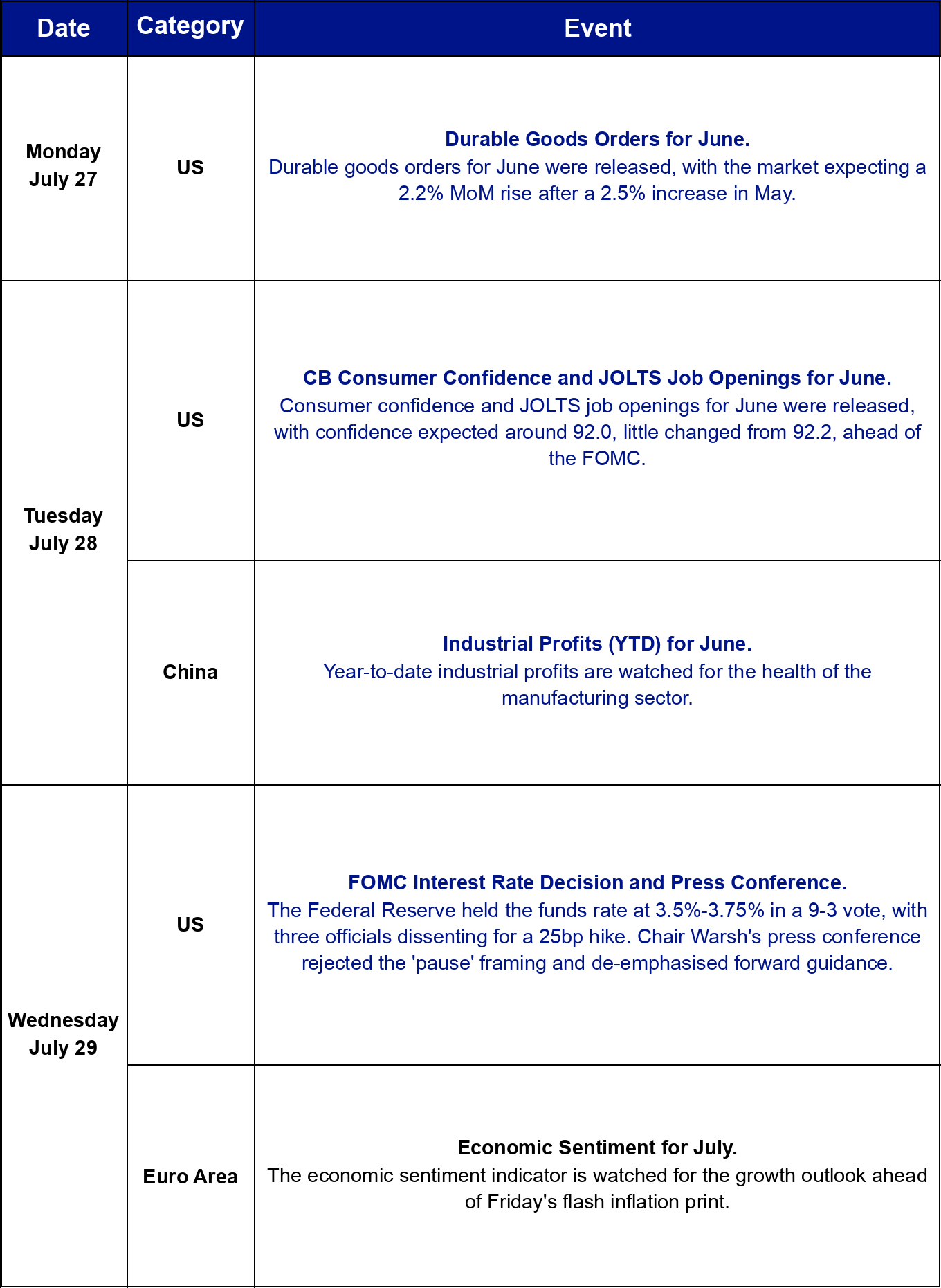
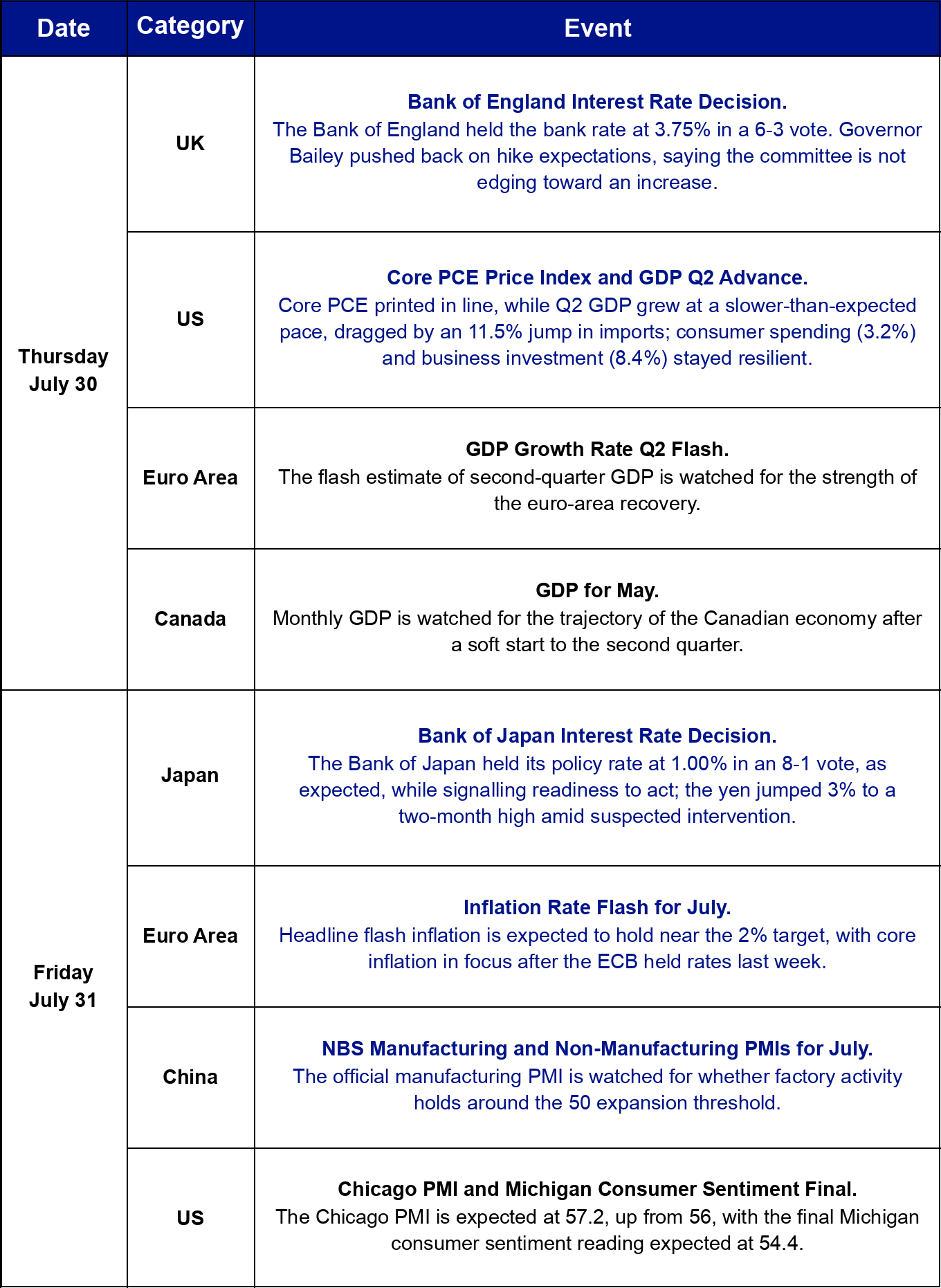
The Bank of Japan kept its short-term policy target rate at 1% by an 8-1 vote, a move expected by markets, while policymakers emphasised their readiness to continue hiking interest rates amidst mounting inflation risks.
Ahead of the rate decision, the Japanese yen jumped by 3% to a two-month high against the US dollar and currently trades around 158.81 per US dollar.
Reuters reported that the rally may have been a byproduct of a yen-buying, dollar-selling market intervention from the Japanese government to prop up the currency after it recently fell to a 40-year low.
Last week Japanese Finance Minister Satsuki Katayama claimed, “Our policy stance has not changed at all. We stand ready to take appropriate and decisive action at any time if necessary”.
The Bank of England also kept the bank rate unchanged at 3.75% in a 6-3 split yesterday.
Governor Andrew Bailey insisted that his committee is not getting closer to a hike despite three members voting for a quarter-point increase.
During his press conference, Bailey said “please do not leave this room thinking the Bank of England is edging towards a hike, because frankly, there’s nothing in what I said, and I think any of us have said, along those lines.”
In response to another question, the governor said “If you come out of this session thinking that we’ve talked about an insurance hike, you obviously I’m afraid not understood what we’ve said.”
That insistence that the policy rate is at a good place was driven by the fact that “There is little as yet to suggest that higher energy prices are becoming embedded in broad-based inflationary pressures in the UK economy” and that higher inflation in the coming months “needs to be considered alongside whether the underlying disinflation in the domestic economy will continue”.
Markets subsequently cut back expectations for a hike in the September meeting and currently price 32 basis points of tightening by the end of the year, down from 42 points prior to the meeting.
Short-dated UK gilts rallied following the conference, with the two-year yield falling more than 13 basis points to 4.33%.
According to data released by the BEA yesterday, the US economy grew at a slower pace than expected in the three months from April through June. On an annualised basis, GDP, the nation’s output of goods and services, grew 1.5% in Q2 2026, decelerating from 2.1% in Q1 and below expectations of 2.0%.
While the slowdown in growth was driven by an 11.5% increase in imports, consumer spending (which makes up 70% of US economic activity) grew at a 3.2% annualised pace, up 0.5% from the January to March period.
Additionally, the report showed that business investment rose at an 8.4% pace, down from 10.6% in Q1 but still strong.
Together, the report indicated that both business investment in artificial intelligence and consumer spending remains resilient.
DeFi / Web3 / Altcoins / Crypto3
Quantum Solutions, a Japan-listed technology company, sold another 1,000 ETH for about $1.9M to help fund its AI data centre expansion, reducing its Ethereum treasury holdings by 28.6% since mid-June.
The sale leaves the company with approximately 4,765 ETH, causing it to lose its position as Japan's largest publicly listed corporate Ethereum holder to Def consulting, which holds 4,976 ETH.
Quantum has also increased the amount of ETH it is authorised to sell to 4,375 ETH through Oct 30, 2026 although much of its remaining holdings are pledged as collateral for an existing loan.
Hyperscale Data, a publicly traded data centre operator, sold about 100 BTC, worth roughly $6.48M at current prices, and opened a bitcoin-backed credit facility to finance construction of its Michigan AI data centre campus.
The company is redeploying part of its $71M bitcoin treasury into the project while using remaining holdings as collateral for loans carrying expected variable interest rates of 4.5% to 5%.
The initial customer agreement covers 20 MW of AI computing capacity and could generate more than $1.2B over its maximum term, rising above $3B if an option for an additional 32 MW is exercised.
Sens. Thom Tillis and Ruben Gallego have reportedly sent the White House a new bipartisan compromise on ethics rules intended to unblock the Clarity Act, although the details have not been disclosed.
Ethics provisions remain the main obstacle, with Democrats seeking stronger restrictions on public officials’ crypto interests and critics objecting that the current draft excludes some family members, relies on Justice Department enforcement and expires in January 2029.
The bill still lacks the 60 Senate votes needed to advance and faces additional disagreement over stablecoin rewards, making passage before the Aug. 7 recess increasingly unlikely.
New York has sued Kalshi, a CFTC-regulated prediction market platform, alleging it operates an illegal gambling business by offering sports, election and other event contracts without a state gaming licence, and is seeking at least $36B in damages.
The lawsuit also seeks to block Kalshi from operating in the state, force it to return customer funds, surrender profits and pay additional civil penalties, while arguing the platform exposed underage users to gambling risks and failed to pay required taxes.
The case intensifies the jurisdictional dispute between state regulators and the Commodity Futures Trading Commission (CFTC), which argues it has exclusive authority to oversee federally regulated prediction markets.
Uniswap, a decentralized exchange protocol, has nearly tripled its daily protocol revenue since extending its fee switch to v4 pools, a mechanism that directs part of each trade’s fees to the protocol and uses that revenue to support UNI token burns, with about $325,000 now flowing toward UNI burns each day as the token rose roughly 16% over the week.
The update applies across seven chains and generated more than half of the latest revenue from Robinhood Chain, while total burn-linked revenue since the mechanism launched has reached about $28M.
The rollout has sparked debate over who ultimately bears the cost. Critics argue that competition could pressure liquidity providers to migrate to lower-fee pools or pools without a protocol fee, potentially reducing their fee income over time.
Uniswap founder Hayden Adams rejected those claims, saying v4 protocol fees are added on top of trader costs rather than deducted from liquidity providers' earnings, and that a 5-basis-point fee on a 30-basis-point pool represents about 14% of total swap fees rather than a cut to LP profits.
This Week's Calendar
Charts of the Day
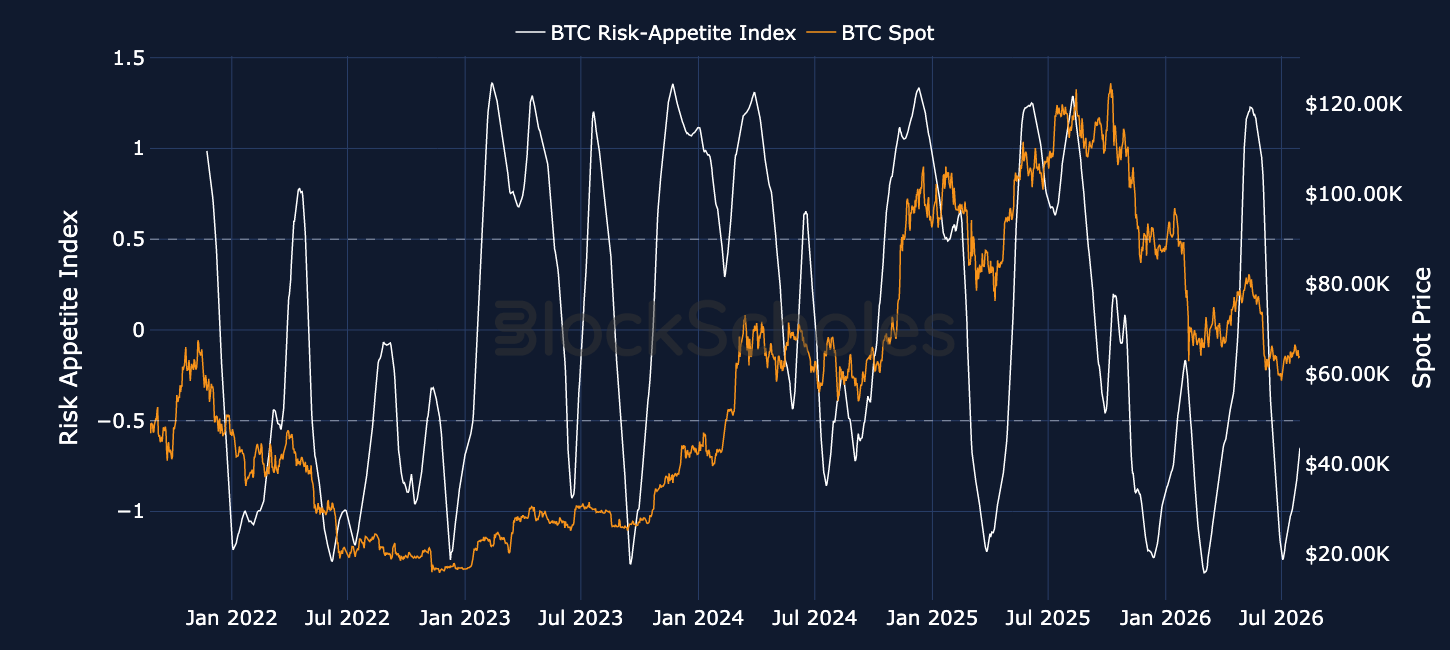
Figure 1. Block Scholes BTC Risk-Appetite Index (white, left-hand axis) and BTC spot price (orange, right-hand axis).
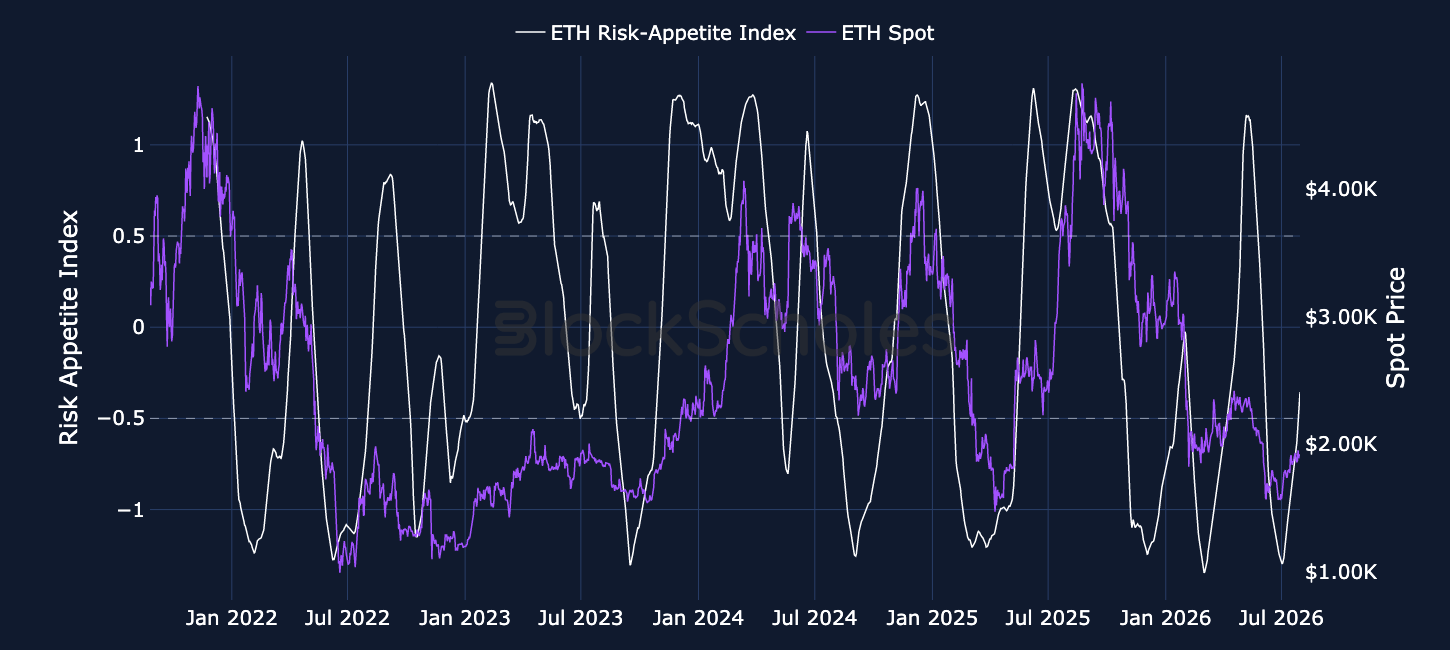
Figure 2. Block Scholes ETH Risk-Appetite Index (white, left-hand axis) and ETH spot price (purple, right-hand axis).
Block Scholes is an FCA-regulated institutional crypto derivatives analytics platform. Live data, IV surfaces, and backtesting available via blockscholes.com.
In Today's Note
US equities rebounded sharply as Microsoft surged more than 16% on strong earnings, lifting the Nasdaq-100 3.36% and reviving the AI trade, while South Korea's KOSPI leapt 18%. Central banks held as expected, the Bank of Japan at 1.00% and the Bank of England at 3.75%, and BTC touched $65K before easing back to $63.7K.
Quantum Solutions sold another 1,000 ETH to fund AI data-centre expansion, ceding its spot as Japan's largest listed corporate ETH holder, while Hyperscale Data sold 100 BTC to back a 20 MW AI compute project. New York sued prediction-market platform Kalshi over alleged illegal gambling, and Uniswap nearly tripled daily protocol revenue after extending its fee switch to v4 pools across seven chains.
Market Snapshot: Overnight Moves
Macro & Markets
After Wednesday’s selloff in risk-on assets, US equities rebounded significantly on Thursday, led by gains in Microsoft and semiconductors.
All major US stock benchmarks closed the session higher: the S&P 500 rallied 1.66%, the Nasdaq-100 advanced 3.36% and a gauge of the largest semiconductors rose the most in a single-day since April 2025 (8.19%). Even with that near 10% gain however, the Philadelphia Semiconductor Sector Index remains down 20% since the beginning of the month.
Microsoft Corp. led the rally, surging more than 16% after a stronger-than-expected earnings report which helped re-bolster confidence in the AI-trade, the stock added around $450B to its value in one day, the most by any stock ever in a single day period.
A number of individual heavyweight names in the memory and chipmaker sector all rose double digits: Micron was up 18%, SanDisk up 26%, AMD up 13%, and TSMC up more than 7%.
Don't miss what's next
Upgrade your Block Scholes account to unlock this article and other exclusive insights
Block Scholes is an FCA-regulated institutional crypto derivatives analytics platform. Live data, IV surfaces, and backtesting available via blockscholes.com.
In Today's Note
US equities rebounded sharply as Microsoft surged more than 16% on strong earnings, lifting the Nasdaq-100 3.36% and reviving the AI trade, while South Korea's KOSPI leapt 18%. Central banks held as expected, the Bank of Japan at 1.00% and the Bank of England at 3.75%, and BTC touched $65K before easing back to $63.7K.
Quantum Solutions sold another 1,000 ETH to fund AI data-centre expansion, ceding its spot as Japan's largest listed corporate ETH holder, while Hyperscale Data sold 100 BTC to back a 20 MW AI compute project. New York sued prediction-market platform Kalshi over alleged illegal gambling, and Uniswap nearly tripled daily protocol revenue after extending its fee switch to v4 pools across seven chains.
Market Snapshot: Overnight Moves
Macro & Markets
After Wednesday’s selloff in risk-on assets, US equities rebounded significantly on Thursday, led by gains in Microsoft and semiconductors.
All major US stock benchmarks closed the session higher: the S&P 500 rallied 1.66%, the Nasdaq-100 advanced 3.36% and a gauge of the largest semiconductors rose the most in a single-day since April 2025 (8.19%). Even with that near 10% gain however, the Philadelphia Semiconductor Sector Index remains down 20% since the beginning of the month.
Microsoft Corp. led the rally, surging more than 16% after a stronger-than-expected earnings report which helped re-bolster confidence in the AI-trade, the stock added around $450B to its value in one day, the most by any stock ever in a single day period.
A number of individual heavyweight names in the memory and chipmaker sector all rose double digits: Micron was up 18%, SanDisk up 26%, AMD up 13%, and TSMC up more than 7%.
Don't miss what's next
Upgrade your Block Scholes account to unlock this article and other exclusive insights
Premium
$30/mo
Access previous and future reports, market insights & deep dives.
The US Treasury will at least double its buyback operations for longer-dated debt from 9 September, taking the 30-year yield down more than 10bps to 5.18% and the dollar to a three-month low. BTC gained 11% to trade through $70K for the first time since June and ETH rose 19% to just under $2,300, ending the August volatility lull as 7-day BTC implied volatility jumped from 24% to over 40%.
Better Mortgage and Coinbase opened their token-backed mortgage to Coinbase One members, letting eligible borrowers post BTC or USDC as down-payment collateral with the first lien conforming under Fannie Mae guidelines, against a waitlist representing more than $260M in projected loan volume. Headline PCE held at 3.7% in July against expectations of a dip, driving the dollar's biggest rise in over two weeks, while Nvidia beat estimates with $96.22B in Q2 revenue.