Back to Research
Last Updated:  
April 6, 2026
7 mins

A Needle in a Haystack

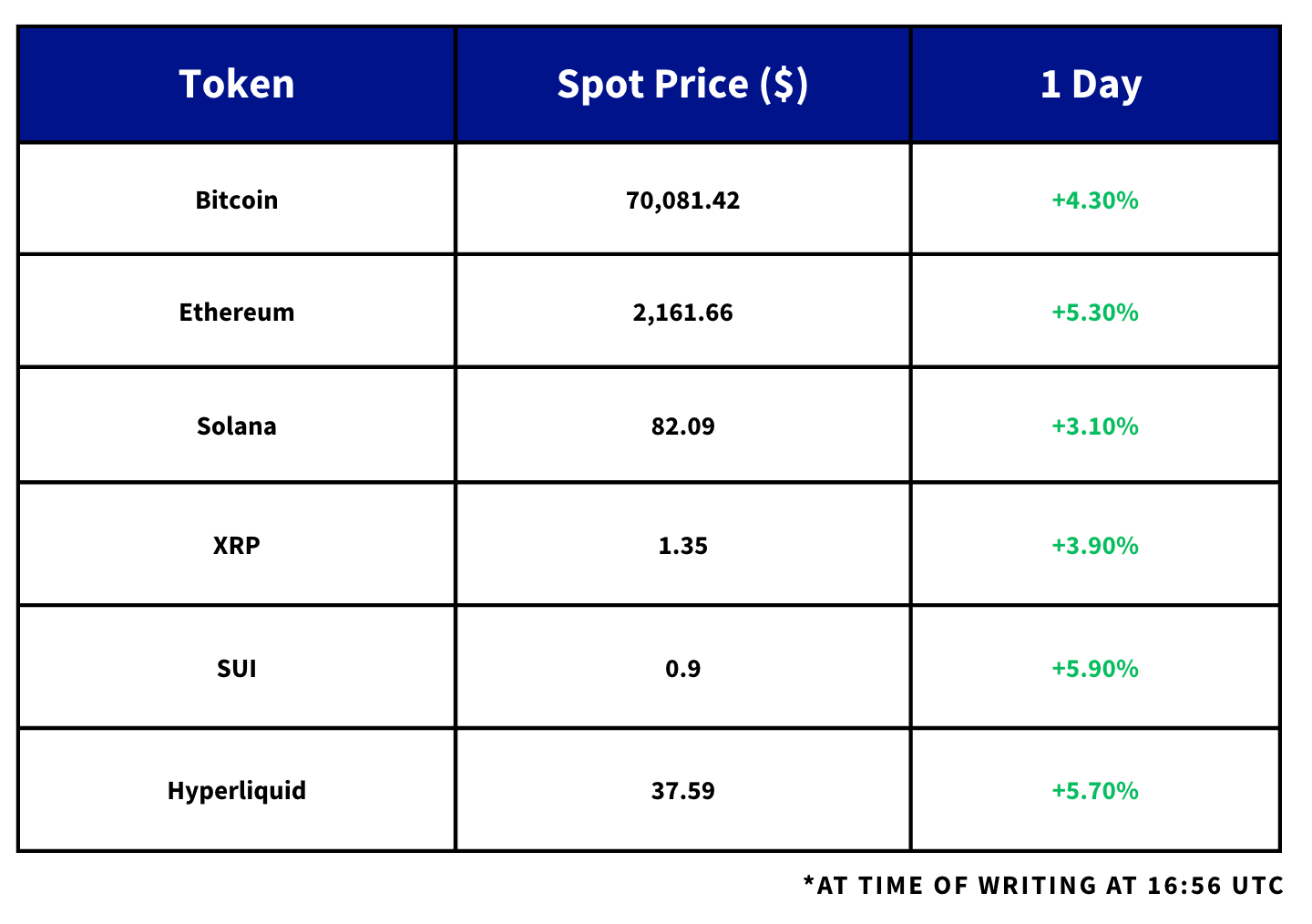
Trump's Tuesday 8PM deadline for Iran to reopen the Strait of Hormuz looms as the week's defining catalyst, with Tehran rejecting ceasefire proposals and Trump warning that "the entire country can be taken out in one night." US equities opened cautiously higher (S&P +0.3%, Nasdaq +0.4%) while gold pulled back to ~$4,700. BTC bounced 4.3% to ~$70K late Sunday after spending much of the weekend at ~$66K, with ETH climbing to ~$2,150 alongside a broader altcoin rally — though SOL remains under pressure at ~$82 as Drift Protocol's $285M exploit, now attributed to DPRK-linked actors, continues to weigh on Solana sentiment.

Find out our latest reports, listed below:

Market Snapshot: Overnight Moves

Daily Updates:

  • Trump extended an original deadline by two days to expire 8PM ET on Tuesday for Iran to reopen the Strait of Hormuz, threatening to strike power plants and bridges ("Tuesday will be Power Plant Day, and Bridge Day, all wrapped up in one").
  • The ceasefire would have required Iran to reopen the Strait of Hormuz immediately and allowed for 15-20 days for a broader settlement.
  • However, Iran officials have rejected proposals for a ceasefire and instead demand a "definitive" end to the war and reparations for damages. Tehran warned of a "more severe and expansive" response if infrastructure strikes proceed.

  • In a White House speech on Monday night, Trump said "The entire country can be taken out in one night, and that night might be tomorrow night". Much of Trump's comments focused on the US's mission to recover a downed airman from Iran, a mission that Trump has labelled as "historic" and "like finding a needle in a haystack".
  • However, US Secretary of War Pete Hegseth reiterated that Iran should "choose wisely" and come back to the table.

  • With European markets closed for Easter Monday, the US open revealed the market's thoughts on the ongoing negotiations – the S&P 500 has so far recorded +0.3% and the Nasdaq +0.4% — cautiously optimistic on ceasefire hopes.
  • Gold opened at ~$4,700, down from ~$4,900 last week following NFP strongly beating expectations and further (whipsawing) hopes of ceasefire.
  • Speakers at the Federal Reserve were quiet over the Easter break. The FOMC's blackout begins April 18, meaning that we look to the week ahead as the last speaker window before blackout.

  • BTC bounced ~4.3% late on Sunday to ~$70K, briefly touching the level for the first time in ~10 days having traded much of Good Friday and the weekend lower at the ~$66K level. ETH has climbed 4.8% to ~$2,150 alongside a wider rally in altcoins (that we usually see move with BTC with a stronger beta).

  • SOL is at ~$82 as Drift Protocol fallout continues to weigh on Solana ecosystem sentiment.
  • TRM Labs and Elliptic attributed the $285M Drift Protocol exploit to DPRK-linked threat actors. Attackers posed as a trading firm for six months, meeting Drift contributors in person across multiple countries.
  • They exploited Solana's "durable nonces" feature to pre-sign administrative transfers weeks before execution, bypassing multisig security, and manufactured a fake token (CarbonVote Token) with wash-traded price history that oracles accepted as legitimate collateral.

  • Coinbase was granted a conditional national trust bank charter by the OCC on April 2.
  • While Coinbase does not intend to convert their business into a “full-service commercial bank, and will not engage in fractional reserve lending” the charter does allow the exchange to “operate payment products, in addition to its custody business, under federal supervision”.

  • Bitcoin ETF flows were lacklustre in the first two active trading sessions of April. Between April 1–2, BTC ETFs saw $164.7M in net outflows (April 1: -$173.7M led by IBIT at -$86.5M and FBTC at -$78.6M; April 2: +$9.0M).
  • However, these outflows must be weighed against demand for bitcoins from the largest Bitcoin Digital Asset Treasury (DAT), Strategy.
  • Michael Saylor’s DAT bought another 4,871 BTC for ~$330M at an average price of $67,718, below its overall cost basis of ~$75,648 per coin — to bring total holdings to 766,970 BTC. .
  • In Q1 2026 alone, Strategy purchased 88,594 BTC for $7.25B, making it the second-largest quarterly acquisition in the company's history.
  • For context, US spot Bitcoin ETFs have seen cumulative net inflows of ~$65B since inception (Jan 2024) and hold ~$128B in AUM — Strategy's 766,970 BTC treasury is now worth roughly 42% of total ETF AUM.

  • Similarly, ETH DAT Bitmine Immersion Technologies (NYSE: BMNR) announced its treasury has reached 4.803M ETH — roughly 3.98% of circulating supply — as the company uplists to the New York Stock Exchange from NYSE American, effective April 9.
  • The company acquired 71,252 ETH in the past week alone, its fastest pace since late December. Chairman Tom Lee framed the buying as a bet that ETH is in "the final stages of the mini-crypto winter."

  • France's Lise exchange is set to host the world's first fully on-chain IPO on April 9 — aerospace manufacturer ST Group (Airbus/Dassault supplier) will list shares issued, traded, and settled entirely on blockchain, approved under the EU DLT pilot regime and backed by BNP Paribas.

  • Chaos Labs is stepping down as Aave's risk manager after three years, making it the third major contributor to walk away from the largest onchain lending platform in quick succession. 
  • Founder Omer Goldberg cited three reasons: the engagement has been loss-making for three years; fundamental misalignment with Aave Labs on how risk should be managed as V4 expands Aave's scope; and the departure of the other core contributors leaving Chaos as "the last remaining technical contributor".
  • Aave Labs reportedly offered $5M to retain Chaos, but Goldberg said the misalignment on risk prioritisation would remain regardless of budget.

  • A Third Circuit Court of Appeals panel ruled 2-1 that New Jersey cannot shut down Kalshi's sports prediction markets, holding that the CFTC has exclusive jurisdiction over Kalshi's event contracts. This follows the CFTC's announcement that we flagged in Thursday's comment, in which the CFTC took legal action against Arizona, Connecticut, and Illinois for attempting to regulate prediction markets at the state level. A separate appeals court in San Francisco is set to hear arguments on the same issue next week.

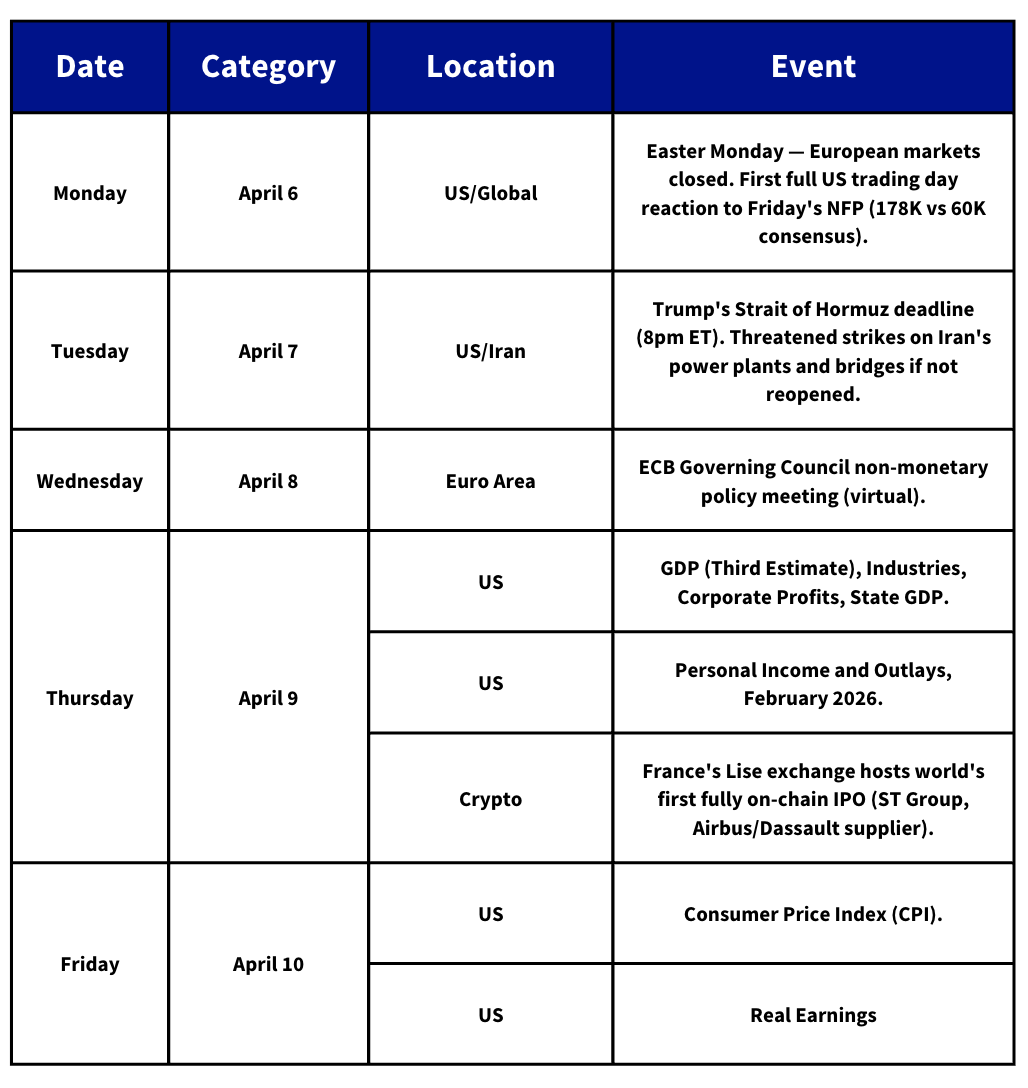
This Week’s Calendar:

Charts of the Day:

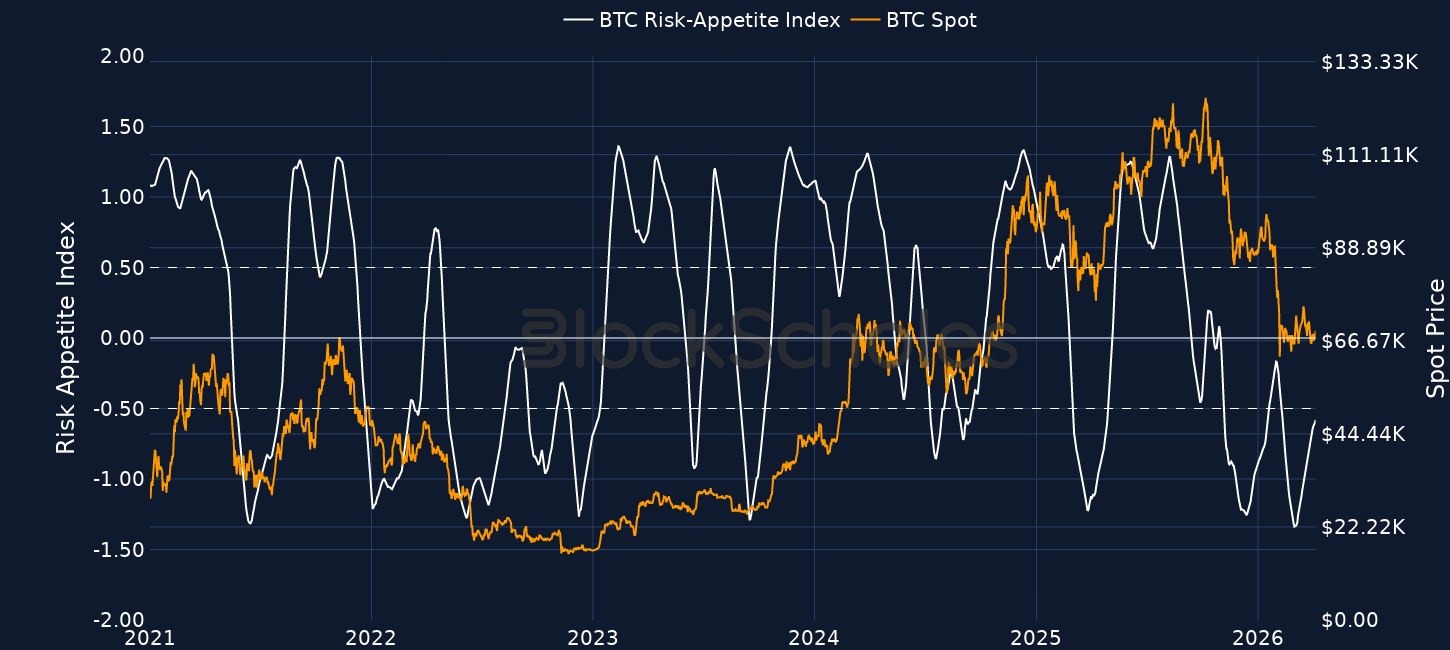
Figure 1. Block Scholes BTC Risk-Appetite Index (white, left-hand axis) and BTC spot price (orange, right-hand axis)

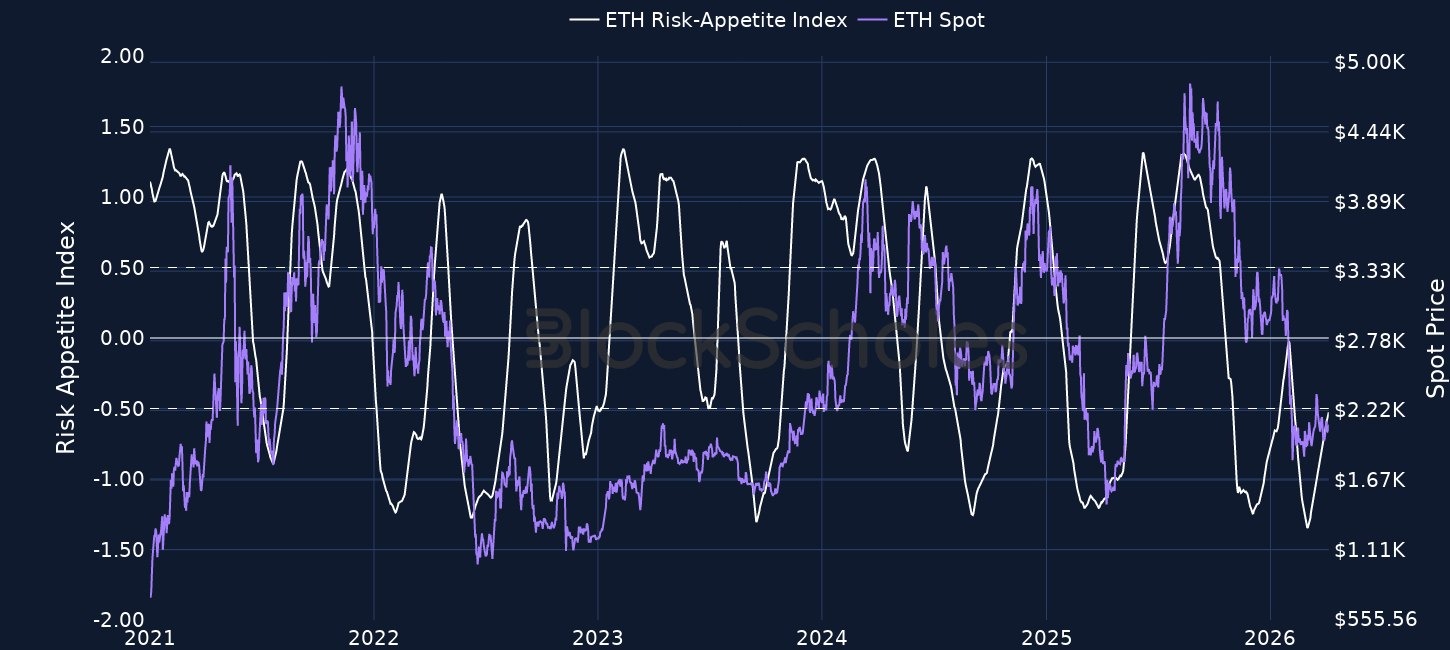
Figure 2. Block Scholes ETH Risk-Appetite Index (white, left-hand axis) and ETH spot price (purple, right-hand axis)

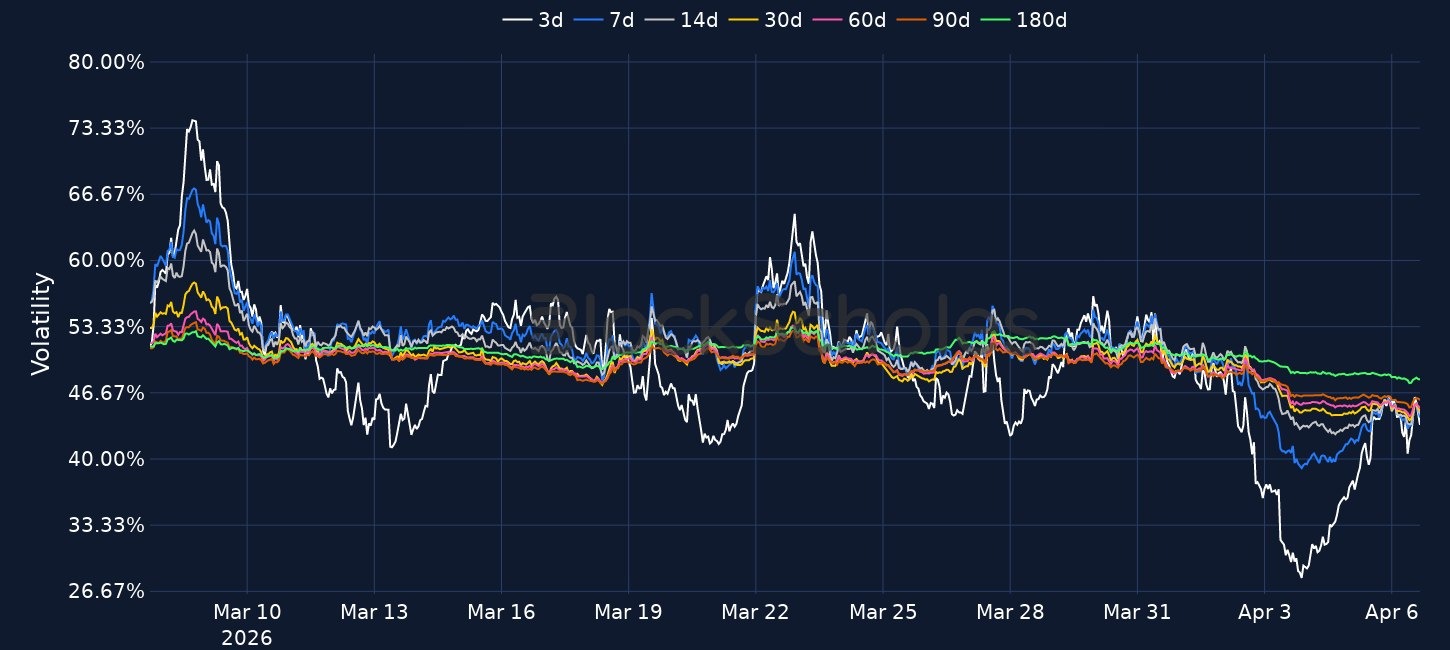
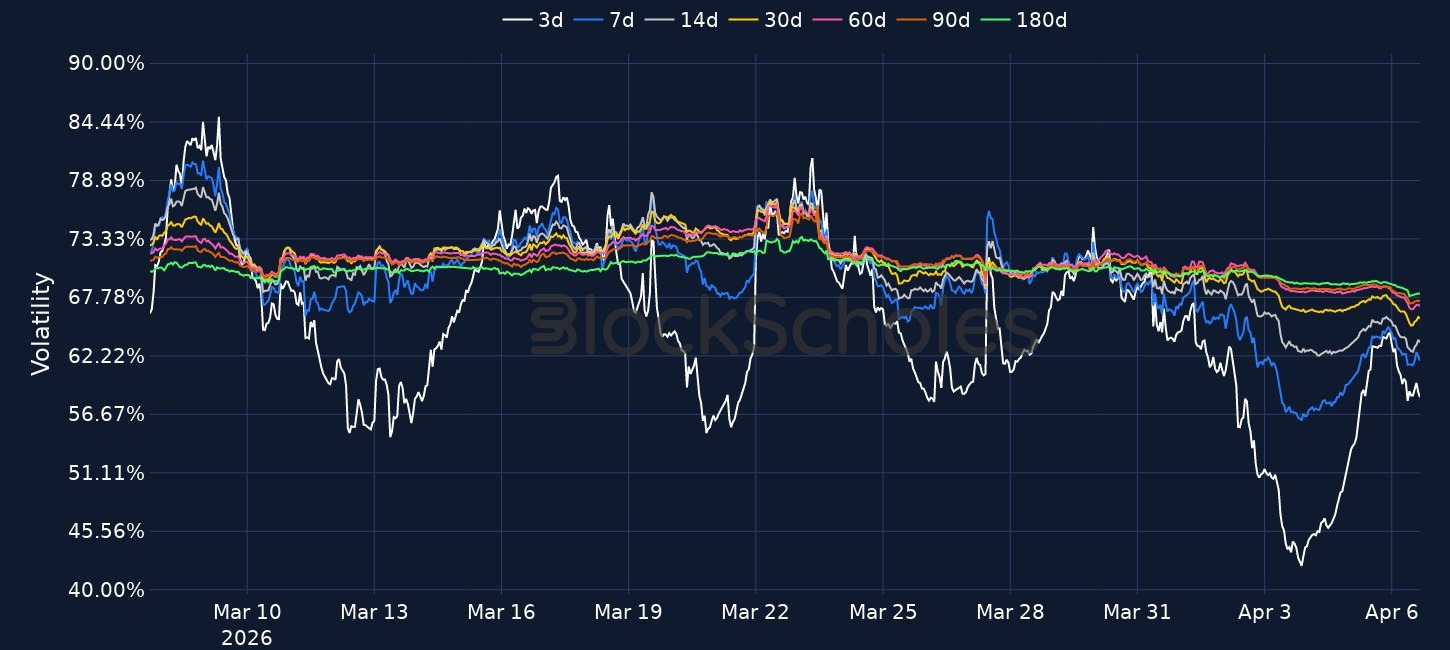
Figure 3. BTC at-the-money implied volatility across selected tenors. Source: Deribit, Block Scholes

Figure 4. ETH at-the-money implied volatility across selected tenors. Source: Deribit, Block Scholes

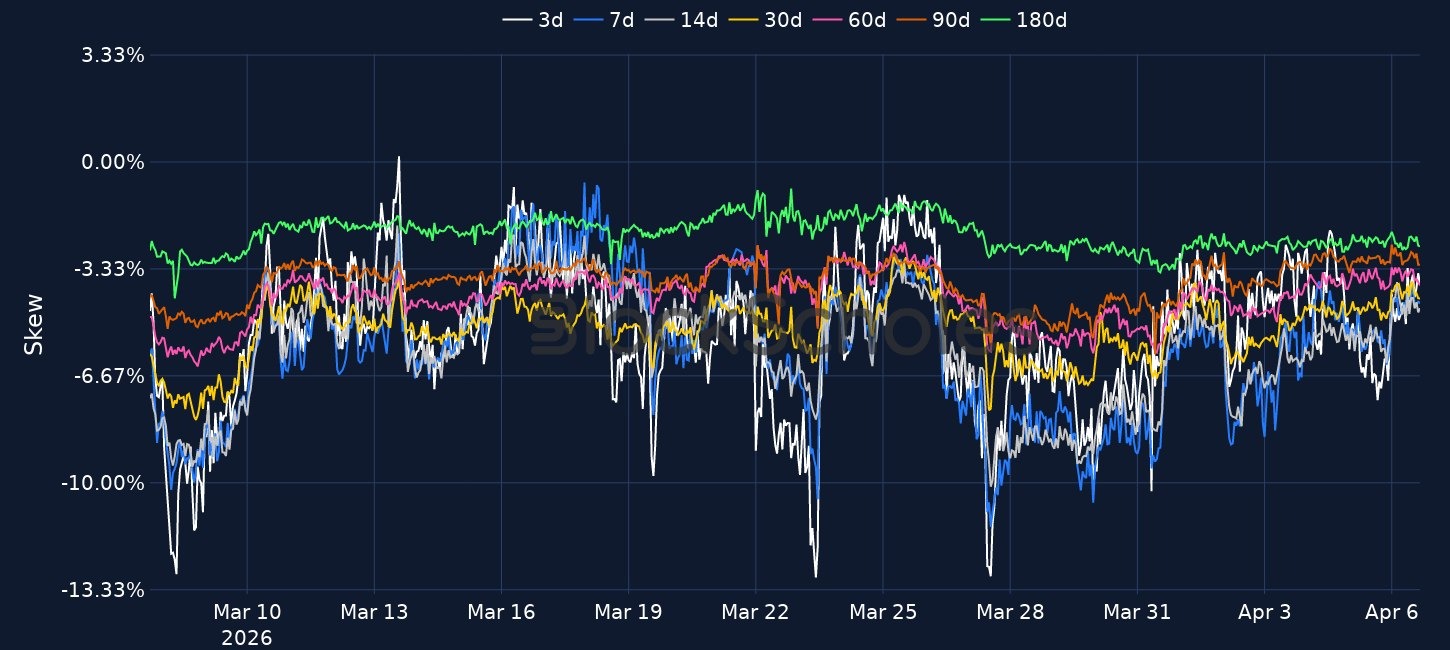
Figure 5. BTC 25-delta put-call skew ratio across selected tenors. Source: Deribit, Block Scholes

Figure 6. ETH 25-delta put-call skew ratio across selected tenors. Source: Deribit, Block Scholes

Share this post
Copy URL
www.blockscholes.com/premium-research/a-neddle-in-a-haystack

Find out our latest reports, listed below:

Market Snapshot: Overnight Moves

Daily Updates:

  • Trump extended an original deadline by two days to expire 8PM ET on Tuesday for Iran to reopen the Strait of Hormuz, threatening to strike power plants and bridges ("Tuesday will be Power Plant Day, and Bridge Day, all wrapped up in one").
  • The ceasefire would have required Iran to reopen the Strait of Hormuz immediately and allowed for 15-20 days for a broader settlement.
  • However, Iran officials have rejected proposals for a ceasefire and instead demand a "definitive" end to the war and reparations for damages. Tehran warned of a "more severe and expansive" response if infrastructure strikes proceed.

Find out our latest reports, listed below:

Market Snapshot: Overnight Moves

Daily Updates:

  • Trump extended an original deadline by two days to expire 8PM ET on Tuesday for Iran to reopen the Strait of Hormuz, threatening to strike power plants and bridges ("Tuesday will be Power Plant Day, and Bridge Day, all wrapped up in one").
  • The ceasefire would have required Iran to reopen the Strait of Hormuz immediately and allowed for 15-20 days for a broader settlement.
  • However, Iran officials have rejected proposals for a ceasefire and instead demand a "definitive" end to the war and reparations for damages. Tehran warned of a "more severe and expansive" response if infrastructure strikes proceed.