Back to Research
Last Updated:  
March 19, 2026
9 mins

“We'll Just Have to Wait and See”

The FOMC held rates steady at 3.5%–3.75%, with Powell striking a cautious tone as inflation risks remain tied to energy and tariffs, while rate cut expectations were pared back. At the same time, regulatory and market structure developments are accelerating, with progress on US crypto legislation and the SEC approving a Nasdaq pilot for tokenised equities trading. Institutional momentum in digital assets continues to build, with firms expanding into tokenised RWAs, structured crypto treasuries and 24/7 trading infrastructure. Alongside this, convergence between crypto, AI and payments is deepening, as new platforms, acquisitions and infrastructure launches signal a shift towards always-on, programmable financial systems.

Find out our latest reports, listed below:

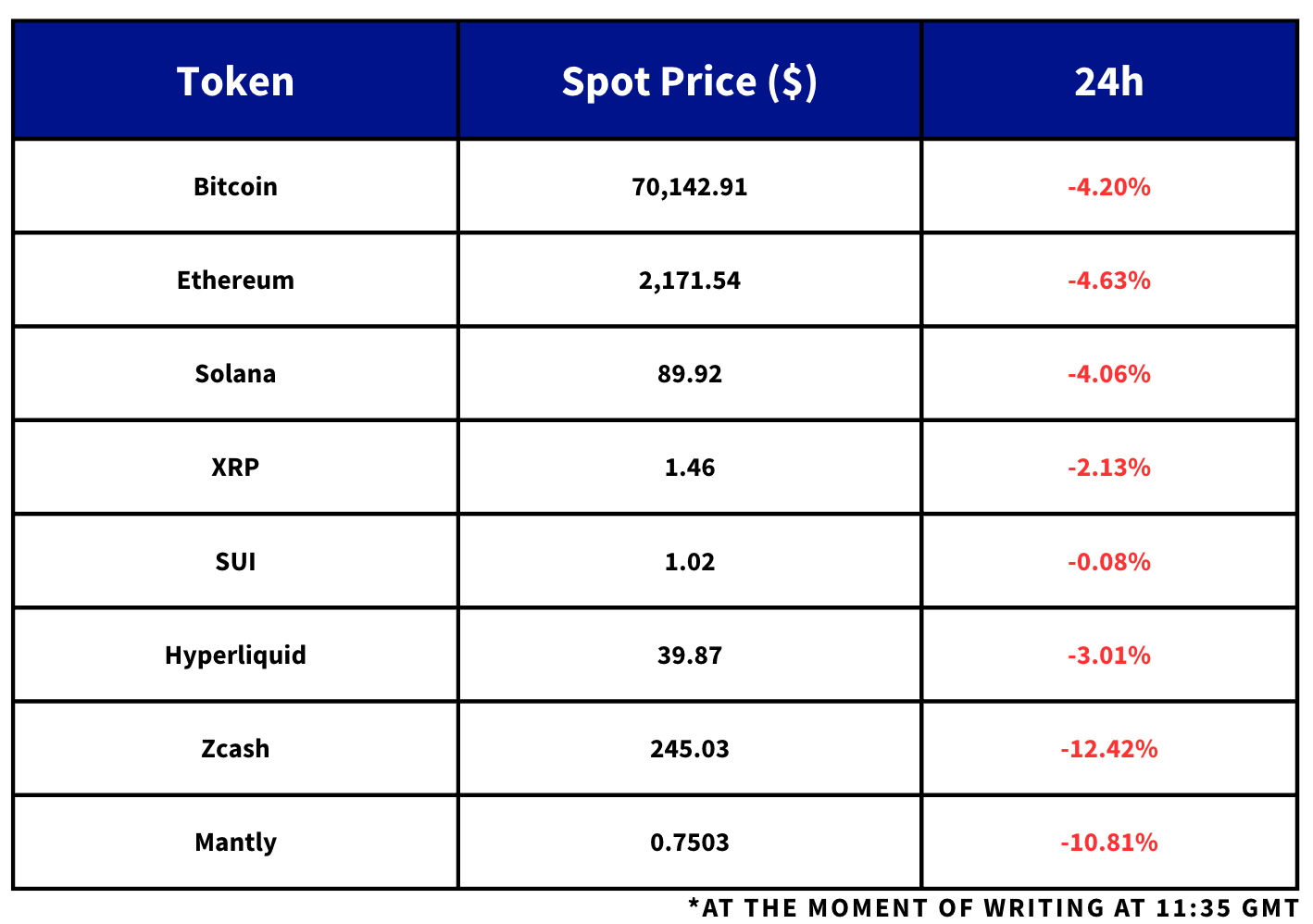
Market Snapshot: Overnight Moves

Daily Updates:

  • As was widely expected, the FOMC left the target range for the federal funds rate unchanged at 3.5%-3.75%. The accompanying Summary of Economic Projections (SEP) showed the median participant still expecting the funds rate to end 2026 at 3.4% and 2027 at 3.1% — both unchanged since December — though notably 4 out of 5 participants who previously pencilled in two cuts this year shifted down to just one.
  • Chair Powell's presser struck a cautious tone, centred on a Middle East-driven oil shock layered on top of still-sticky tariff inflation. Powell repeated some variation of "no one knows" or "we have to wait and see" throughout the Q&A, going so far as to say that "if ever skip an SEP, then this would be a good one."
  • He was also blunt about the conditions required for further cuts, repeating that  the Fed's forecast is conditional on continued disinflation, with tariff-related price pass-through expected to show up "in the middle of the year."
  • While Powell stated he is willing to look through one-time energy price increases resulting from the oil shock (as textbooks would suggest), that strategy is "conditional on inflation expectations remaining anchored." A key theme of reporters’ questions was that the shock to oil prices is the latest in a string of supply shocks stretching back five years — pandemic, tariffs, now energy — and that "it's a repeated set of things that makes you worry that can cause trouble for inflation expectations."
  • When asked what the Fed would do if oil remained above $100 per barrel through the next meeting, Powell declined to speculate, saying only that "six weeks from now we will learn a lot" and that it will "be very important for how the outlook evolves." He closed by reaffirming the Fed's commitment to price stability and its independence: "Independence allows us to do our job. Every economy that looks like the US — a market economy in a democracy — you see central bank independence. It is critical to do the things when we need to do them to preserve price stability."
  • On the labour market, he revealed that Fed staff estimate zero net private sector job creation over the past six months — "something we've never seen in history" — describing it as an equilibrium driven partly by immigration policy but one that "has a feel of downside risk and not a comfortable balance." He also confirmed that the possibility of a rate hike "did come up" in discussions, though the "vast majority don't see that as the next case."
  • Senate Republicans are targeting an April committee vote on a crypto market structure bill, with Cynthia Lummis signalling that lawmakers want to move quickly after the Easter recess.
  • The legislation would aim to clarify how digital assets are regulated, including the split in oversight between the SEC and CFTC, but negotiations remain politically sensitive around stablecoin yield, DeFi and ethics concerns. 
  • TradeXYZ – a HIP-3 deployer on Hyperliquid – announced the first official S&P 500 perpetual contract launched in collaboration with SPDJI, made exclusively available on Hyperliquid. 
  • This venue is available 24/7/365 and anchored by official index data from SPDJI. 
  • While SPDJI licensing is common in traditional financial products, the introduction of licensing in the crypto world strongly signals the shift in institutional interest in Real-World Assets and tokenisation which was detailed in our yearly 2026 market outlook.
  • The SEC has approved a Nasdaq pilot that will allow eligible participants to settle equity trades in tokenised form, marking a notable step towards bringing traditional market infrastructure onchain, according to a filing.
  • Under the programme, tokenised shares will trade on the same order book and with the same execution priority as conventional equities, while preserving the same shareholder rights. 
  • American Bitcoin, the bitcoin mining and treasury company backed by Eric Trump and majority-owned by Hut 8, according to Eric’s X post, states its holdings have risen to around 6,899 BTC, making it the 16th largest public bitcoin treasury company.
  • Flow Traders, a leading global technology-enabled principal trading firm and liquidity provider, is expanding its 24/7 OTC desk into tokenised assets, offering two-way liquidity in products such as Franklin Templeton’s BENJI and Tether Gold (XAUT).
  • The development allows institutional clients to trade and hedge exposure outside traditional market hours using either fiat or stablecoins.
  • Evernorth, a crypto treasury firm focused on building institutional exposure to XRP, has filed an S-4 with the SEC to go public via a $1B SPAC merger with Armada Acquisition Corp. II.
  • The company’s strategy focuses on holding and actively deploying XRP, and the combined entity is expected to launch with at least 473M XRP on its balance sheet.
  • If completed, the Nasdaq listing would position Evernorth as a dedicated vehicle for both price exposure and yield generation.
  • Polymarket has acquired crypto payments startup Brahma in a move aimed at improving the platform’s trading experience and deepening liquidity, particularly in thinner, niche prediction markets, according to its statement on Wednesday.
  • HIVE Digital Technologies announced yesterday that its first AI GPU cluster in Paraguay is now live, marking an early move beyond bitcoin mining and into high-performance computing.
  • The Asunción-based deployment, part of its BUZZ AI Cloud platform, is already running large language model training workloads and will serve as a proof-of-concept for scaling AI infrastructure across the company’s hydro-powered footprint in the country.
  • Tempo, a payment infrastructure startup building a Layer 1 blockchain for high-volume payment flows, has launched its mainnet alongside the Machine Payments Protocol, an open standard co-authored with Stripe that enables autonomous payments between AI agents and services.
  • The rollout includes a directory of more than 100 integrated providers, including Alchemy, Dune Analytics, and Shopify, highlighting Tempo’s push to become core infrastructure for machine-to-machine commerce.

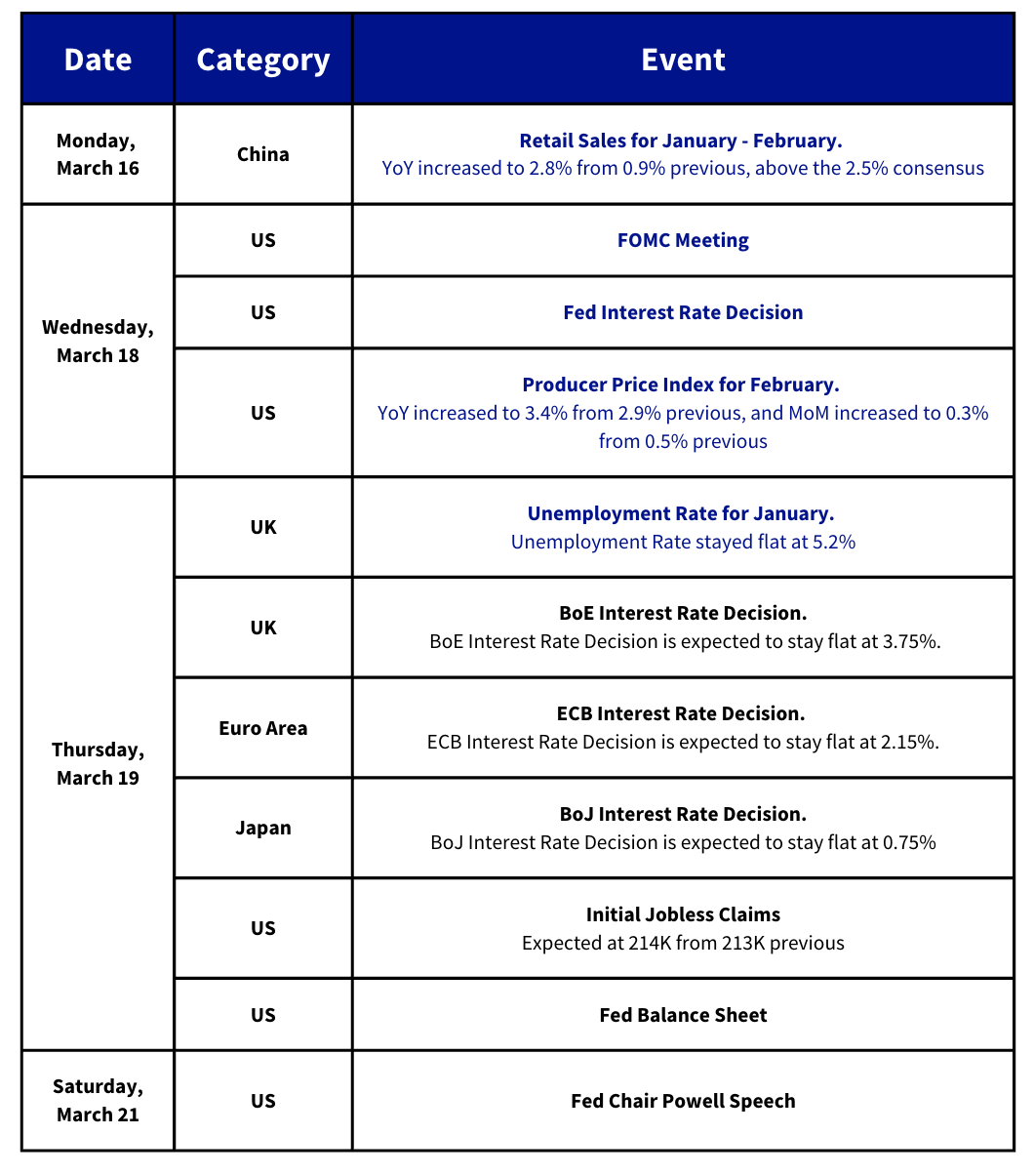
This Week’s Calendar:

Charts of the Day:

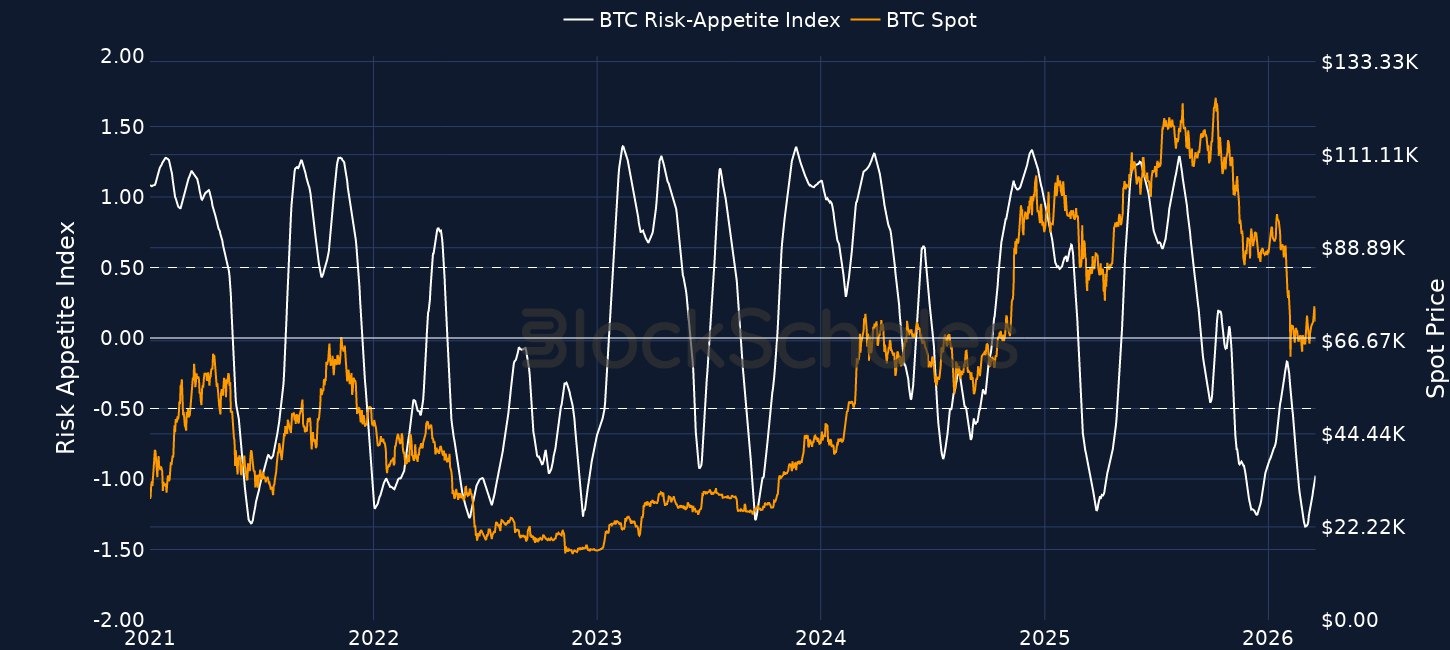
Figure 1. Block Scholes BTC Risk-Appetite Index (white, left-hand axis) and BTC spot price (orange, right-hand axis)
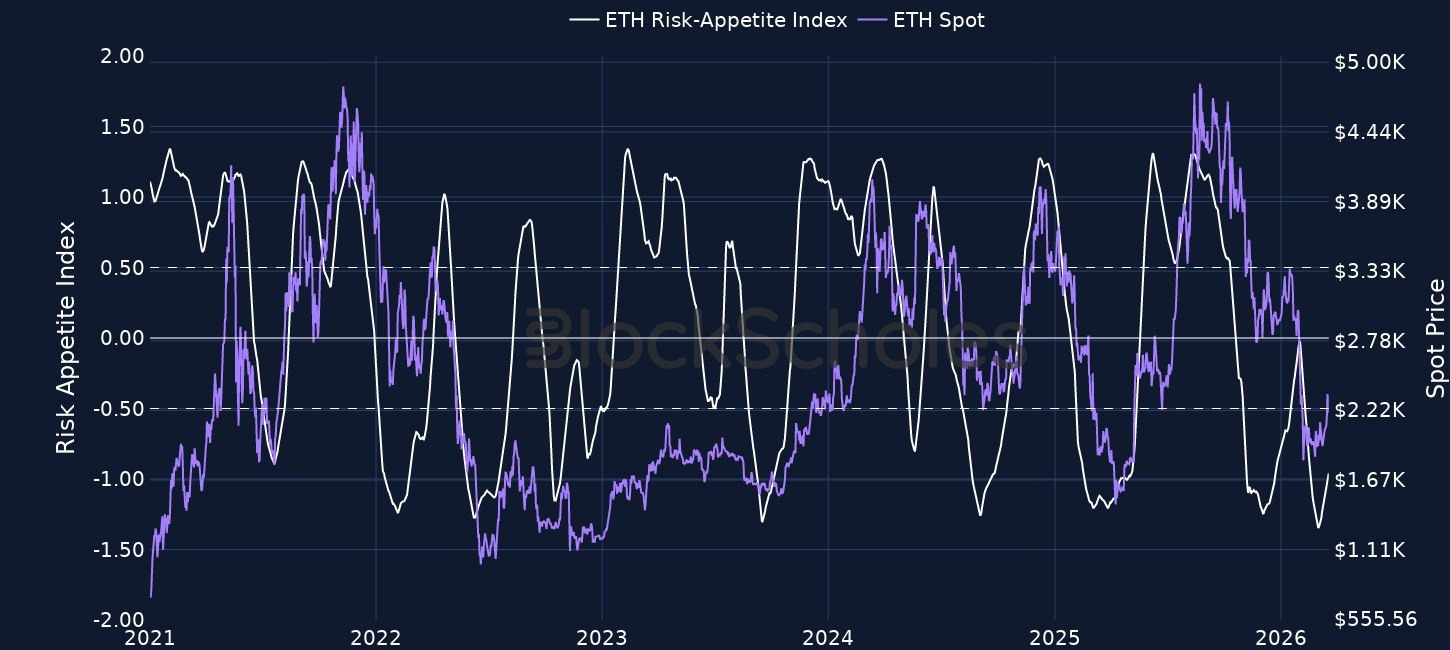
Figure 2. Block Scholes ETH Risk-Appetite Index (white, left-hand axis) and ETH spot price (purple, right-hand axis)
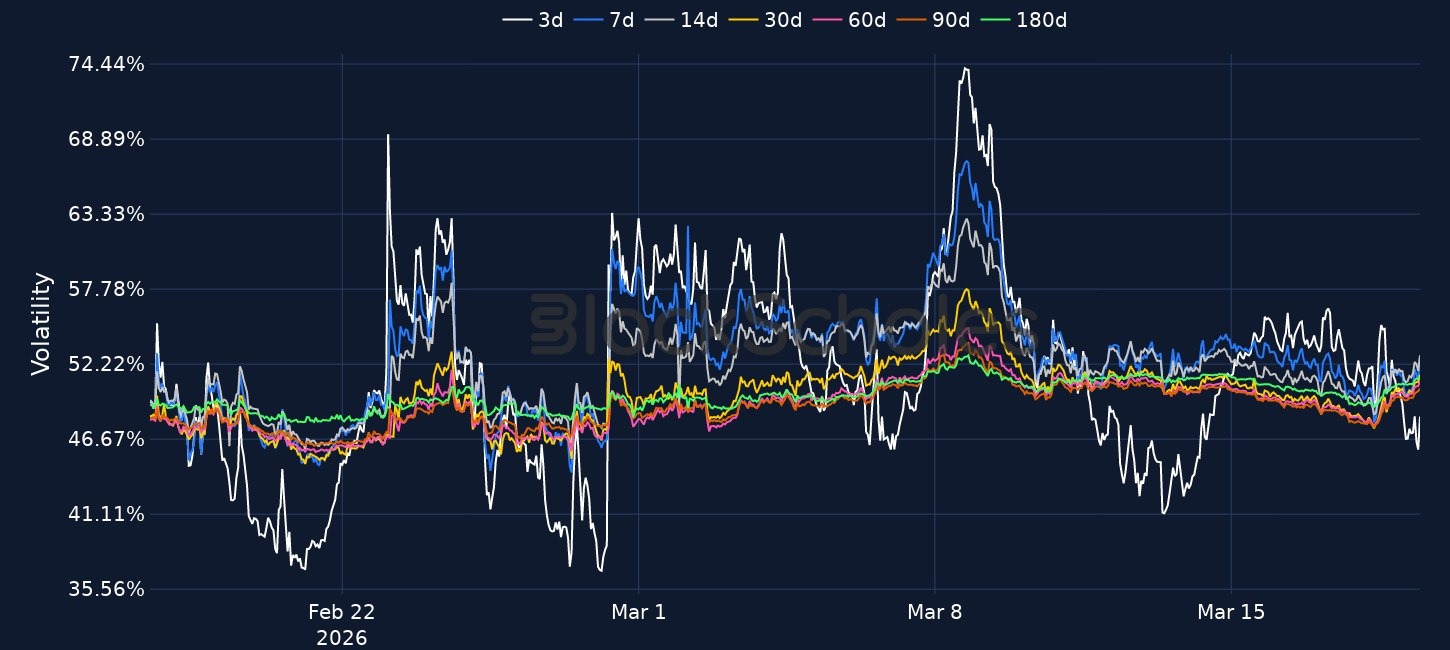
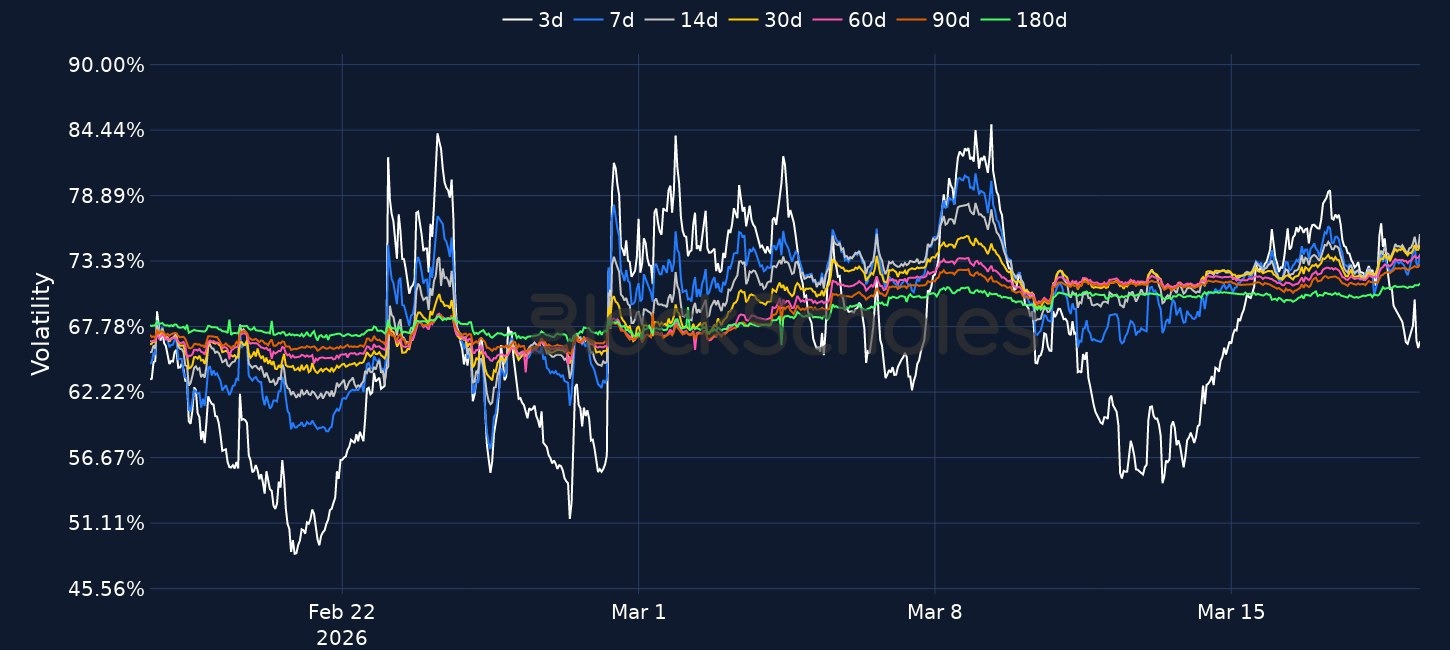
Figure 3. BTC at-the-money implied volatility across selected tenors. Source: Deribit, Block Scholes
Figure 4. ETH at-the-money implied volatility across selected tenors. Source: Deribit, Block Scholes
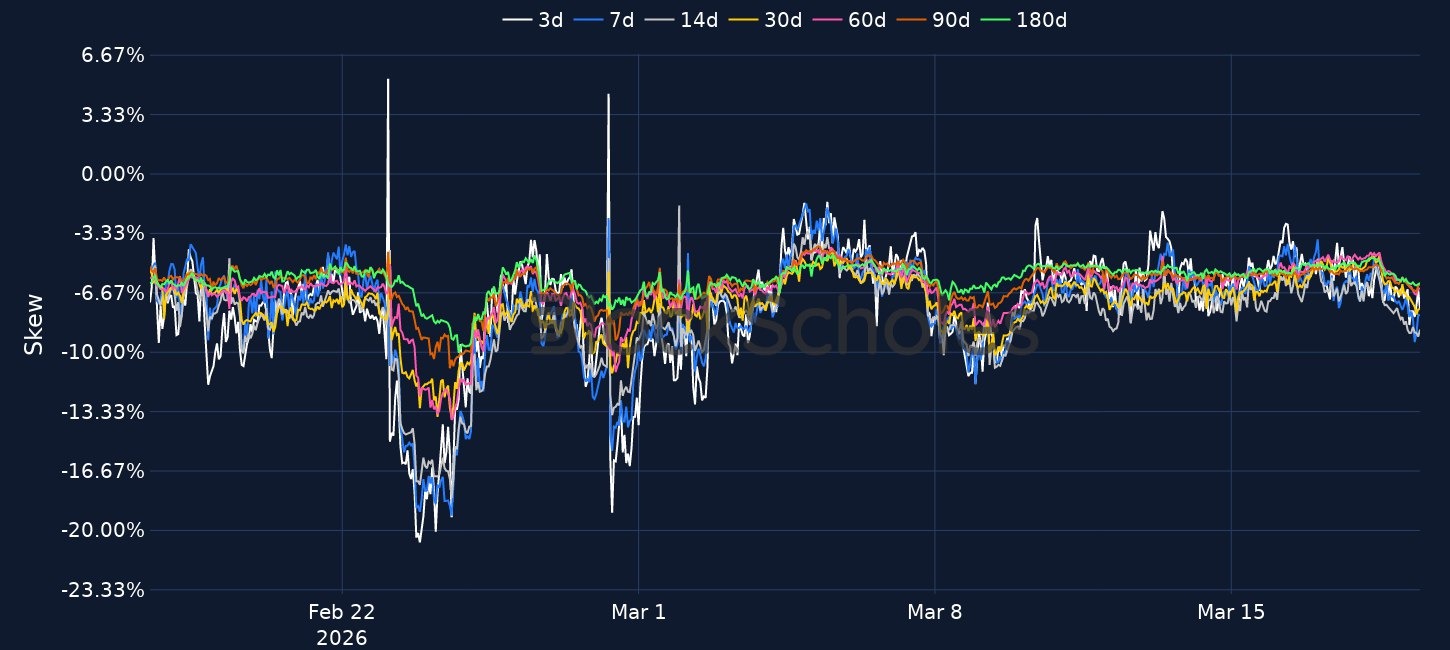
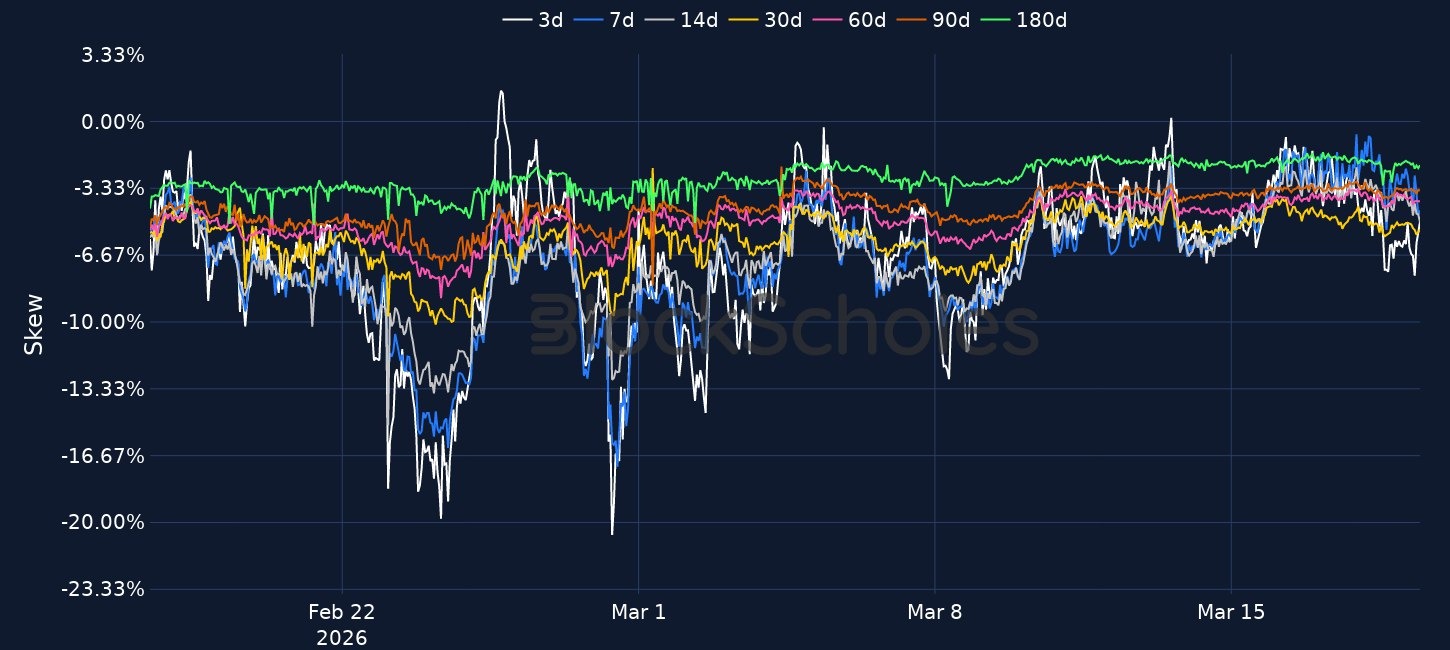
Figure 5. BTC 25-delta put-call skew ratio across selected tenors. Source: Deribit, Block Scholes
Figure 6. ETH 25-delta put-call skew ratio across selected tenors. Source: Deribit, Block Scholes.
Share this post
Copy URL
www.blockscholes.com/premium-research/well-just-have-to-wait-and-see

Find out our latest reports, listed below:

Daily Updates:

  • As was widely expected, the FOMC left the target range for the federal funds rate unchanged at 3.5%-3.75%. The accompanying Summary of Economic Projections (SEP) showed the median participant still expecting the funds rate to end 2026 at 3.4% and 2027 at 3.1% — both unchanged since December — though notably 4 out of 5 participants who previously pencilled in two cuts this year shifted down to just one.
  • Chair Powell's presser struck a cautious tone, centred on a Middle East-driven oil shock layered on top of still-sticky tariff inflation. Powell repeated some variation of "no one knows" or "we have to wait and see" throughout the Q&A, going so far as to say that "if ever skip an SEP, then this would be a good one."
  • He was also blunt about the conditions required for further cuts, repeating that  the Fed's forecast is conditional on continued disinflation, with tariff-related price pass-through expected to show up "in the middle of the year."
  • While Powell stated he is willing to look through one-time energy price increases resulting from the oil shock (as textbooks would suggest), that strategy is "conditional on inflation expectations remaining anchored." A key theme of reporters’ questions was that the shock to oil prices is the latest in a string of supply shocks stretching back five years — pandemic, tariffs, now energy — and that "it's a repeated set of things that makes you worry that can cause trouble for inflation expectations."

Market Snapshot: Overnight Moves

Find out our latest reports, listed below:

Daily Updates:

  • As was widely expected, the FOMC left the target range for the federal funds rate unchanged at 3.5%-3.75%. The accompanying Summary of Economic Projections (SEP) showed the median participant still expecting the funds rate to end 2026 at 3.4% and 2027 at 3.1% — both unchanged since December — though notably 4 out of 5 participants who previously pencilled in two cuts this year shifted down to just one.
  • Chair Powell's presser struck a cautious tone, centred on a Middle East-driven oil shock layered on top of still-sticky tariff inflation. Powell repeated some variation of "no one knows" or "we have to wait and see" throughout the Q&A, going so far as to say that "if ever skip an SEP, then this would be a good one."
  • He was also blunt about the conditions required for further cuts, repeating that  the Fed's forecast is conditional on continued disinflation, with tariff-related price pass-through expected to show up "in the middle of the year."
  • While Powell stated he is willing to look through one-time energy price increases resulting from the oil shock (as textbooks would suggest), that strategy is "conditional on inflation expectations remaining anchored." A key theme of reporters’ questions was that the shock to oil prices is the latest in a string of supply shocks stretching back five years — pandemic, tariffs, now energy — and that "it's a repeated set of things that makes you worry that can cause trouble for inflation expectations."

Market Snapshot: Overnight Moves