Invesco is Preparing to Launch a Tokenized Money Market Fund
BTC broke below $60K, falling from $61K to $58K as spot ETF outflows reached $691.7M, the largest single-day outflow in a month. Options markets repriced downside risk aggressively, with 7-day ATM BTC and ETH implied vol each rising 10 vols, while 25-delta BTC puts moved to a 15-vol premium over calls. Macro risk remained choppy: Magnificent Seven weakness, mixed U.S. equity closes, hotter-but-expected PCE, weaker consumer-spending revisions, and renewed Strait of Hormuz tensions kept risk assets under pressure.
Block Scholes is an FCA-regulated institutional crypto derivatives analytics platform. Live data, IV surfaces, and backtesting available via blockscholes.com.
BTC fell back below $60K, with spot Bitcoin ETFs seeing their largest single-day outflow in a month and BTC/ETH implied volatility moving higher.
US equities were mixed despite tech weakness, as Apple dragged on the Magnificent Seven, while in-line PCE inflation and stronger revised Q1 GDP helped support sentiment.
Brent moved higher after fresh Strait of Hormuz disruption, while CLARITY Act timing tightened in the Senate, Invesco prepared a tokenised money market fund for stablecoin reserves, SharpLink reportedly bought ETH, Sophon moved to Base, and Base suffered a mainnet outage.
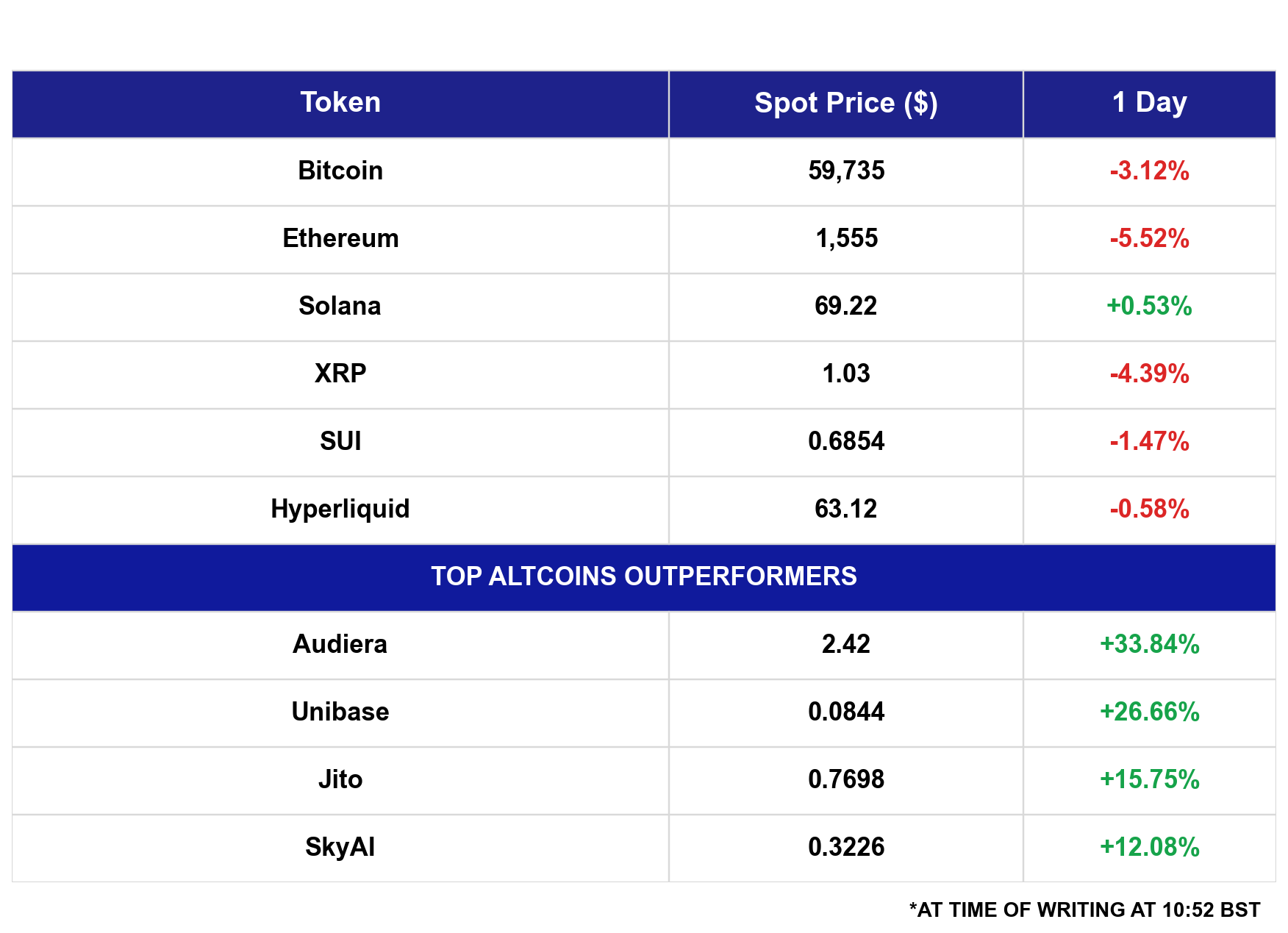
Market Snapshot: Overnight Moves
Macro & Markets
Another wave of volatility in major US tech equities coincided with BTC falling through $60K once again.
Bitcoin fell from $61K to $58K, while its spot ETFs saw outflows of $691.7M — the largest single-day outflow in a month.
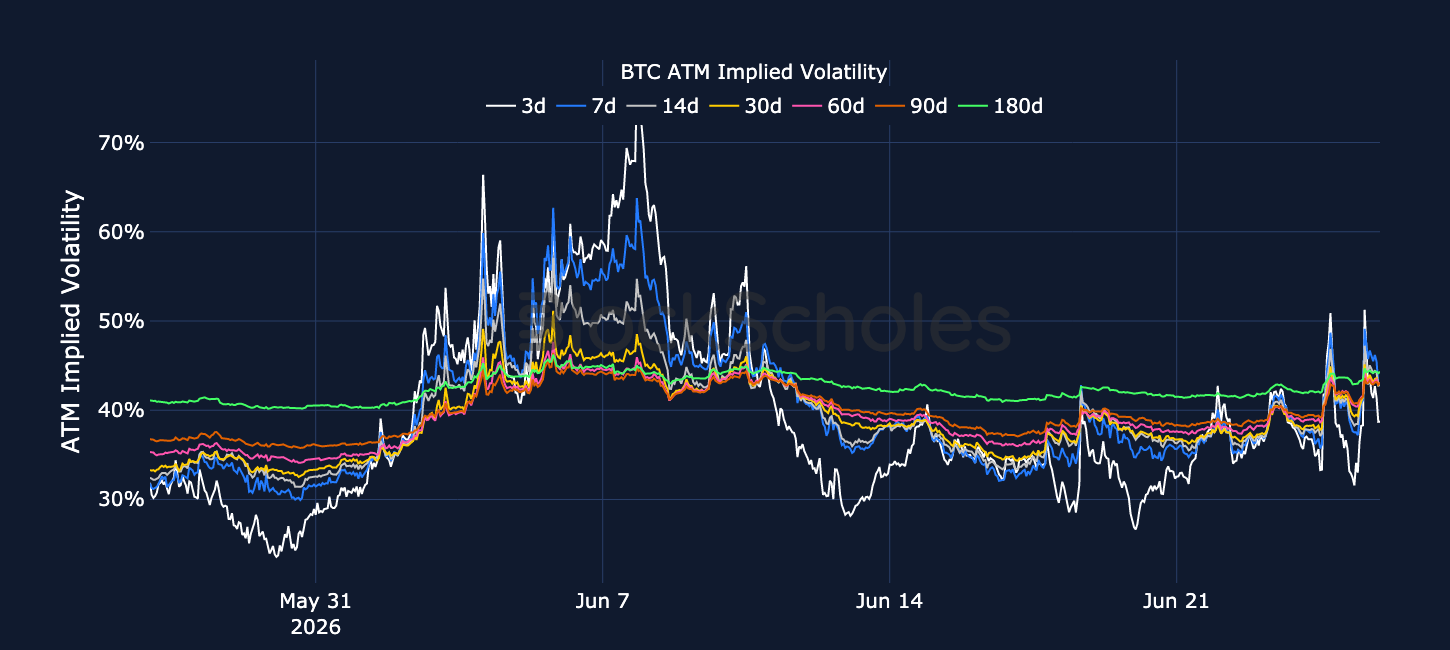
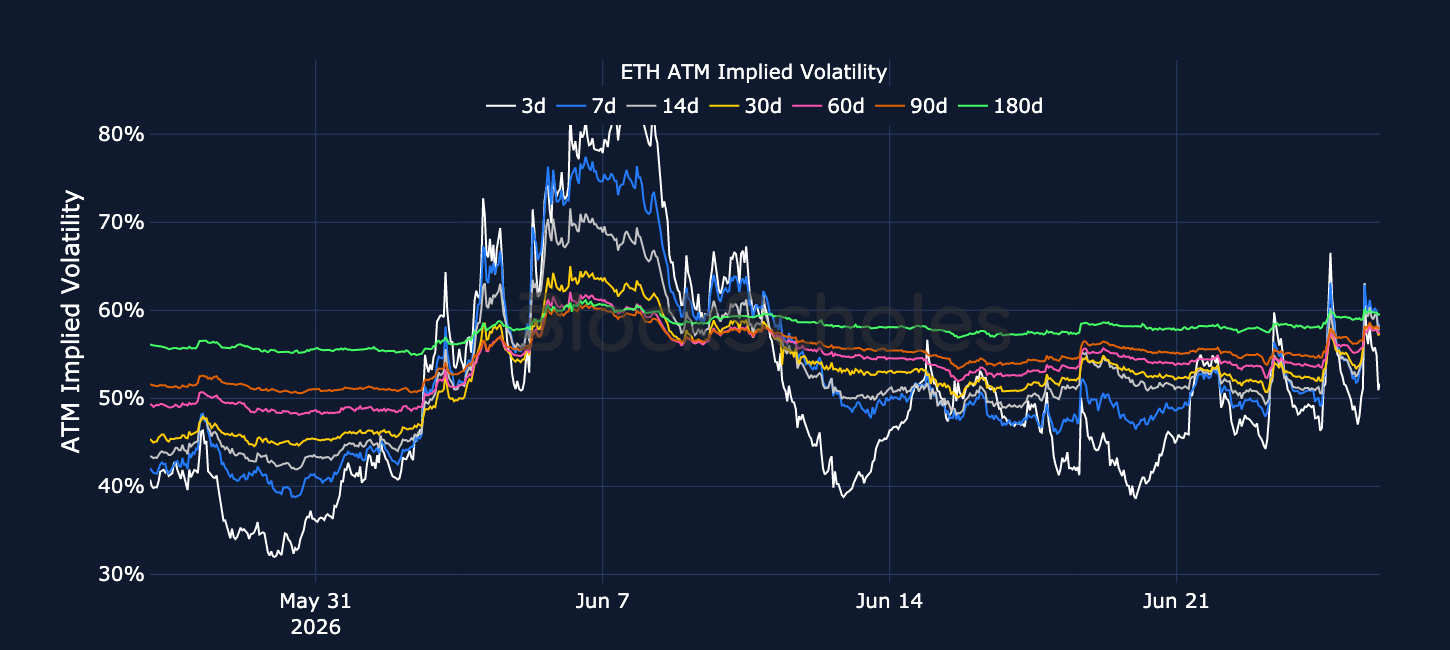
Implied volatility for BTC and ETH options have jumped considerably higher since last week as spot price continues to struggle in finding upside momentum.
On Monday 15 June, 7-day ATM BTC IV was trading around 35% and has since increased 10pp to 45%. Similar-dated ETH implied vol has equally jumped 10-vol points, from 48% to 58%.
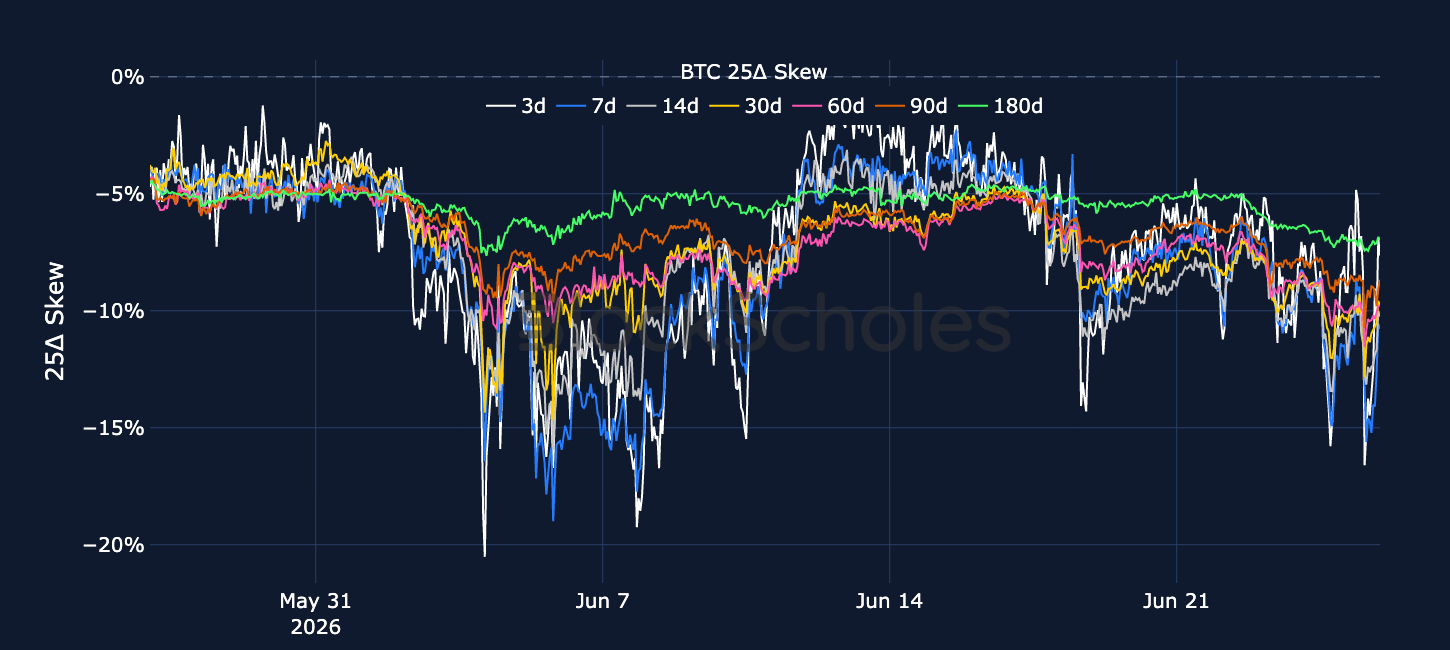
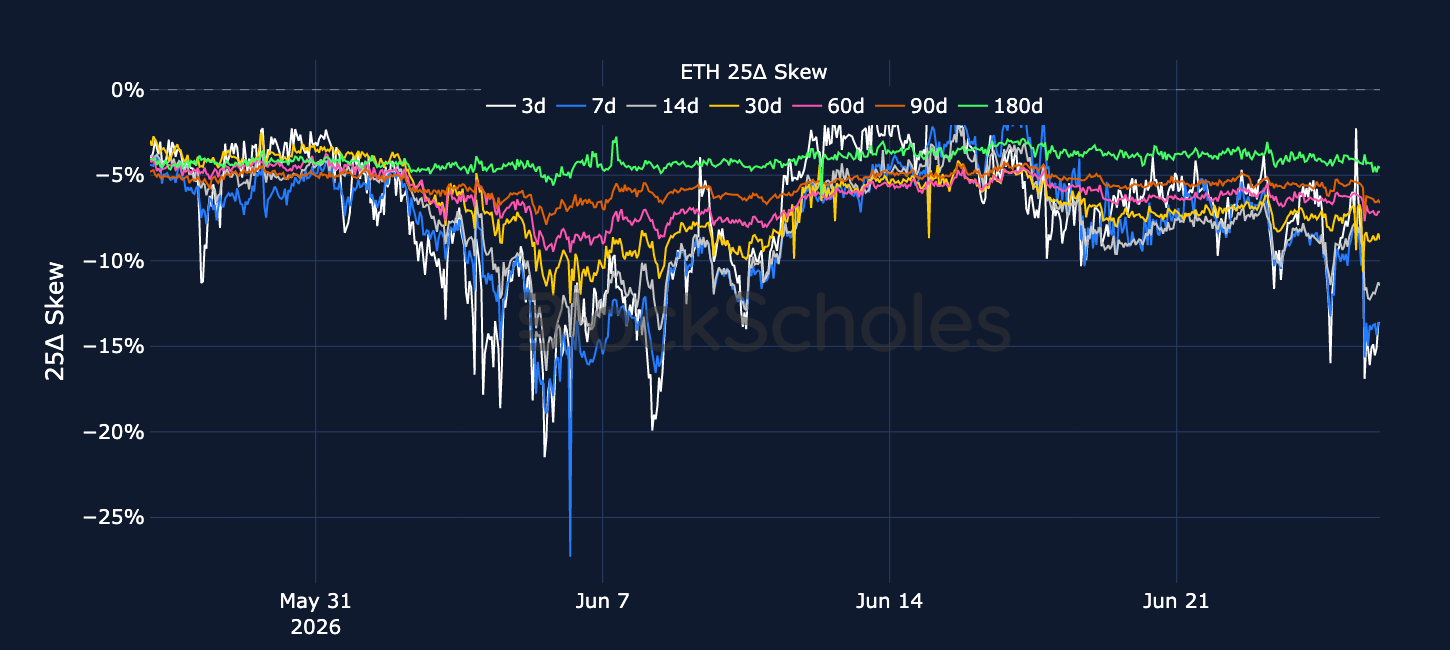
Volatility smiles have skewed further towards puts over the same period of time, with 25-delta OTM BTC puts trading at a 15-vol point premium to out-the-money calls.
All 7 of the tech stocks in the Magnificent Seven traded lower yesterday, driven by a 6% drop in Apple shares as the company announced a wide-ranging increase in the prices of its products (citing higher memory and storage chip costs). Sentiment was, however, bolstered by a strong earnings from Micron Technologies on Wednesday evening.
As such, the equity market closed in a mixed manner — the S&P 500 ended the day flat, while the Nasdaq-100 squeezed out a 0.75% rally.
Sentiment was lifted by a PCE inflation report earlier in the day which, despite showing prices rising at the fastest pace over three years, was in line with market expectations.
The personal consumption expenditures (PCE) price index rose 4.1% from a year earlier in May, its highest level since April 2023, according to data from the Bureau of Economic Analysis, while core PCE advanced at 3.4% year-on-year.
However, with oil prices close to pre-war levels following the US-Iran peace deal earlier this month, some economists believe inflation likely peaked last month or is close to doing so.
Additionally, according to the report, goods prices rose 0.4% on the month, following a 0.7% increase in April, while the price of gasoline and other energy goods shot up 6.5%.
A separate report from the BEA showed the US economy grew faster than expected — in Q1 2026, the economy grew at an annualised 2.1% pace, above the previously estimated 1.6%.
That growth was driven by a downward revision to imports however, with consumer spending, which accounts for 2/3s of the US economy, was marked down to 0.5% from 1.4%.
Following the inflation release, Chicago Fed President Austan Goolsbee claimed it showed a "glimmer of hope" on services inflation, but underlying inflation was still too high and trending the wrong way.
Speaking on CNBC, Goolsbee said, "If we look at core inflation, it's still well too high and it's trending the wrong way, and we've got to see improvement on that. Right now, as between the two sides of the Fed's mandate, the inflation side and the job market side, clearly the problem's on the inflation side."
Oil prices have jumped slightly over the past 24 hours, with Brent trading at $73 a barrel following a report that the Iranian military struck a container ship in the Strait of Hormuz yesterday. Intraday, Brent jumped to as much as $76 a barrel.
The Singapore-flagged container ship named the ‘Ever Lovely’, was struck while travelling along a recommended route and only a week after Tehran had agreed to let shipping pass through the strait safely.
Earlier in the day, at least three commercial ships, including two oil supertankers reportedly U-turned at the Strait after getting warnings from the Iranian Navy to not pass through.
DeFi / Web3 / Altcoins / Crypto3
A major U.S. crypto market structure bill is facing a narrowing path in the Senate as lawmakers juggle a packed July agenda.
The CLARITY Act, which would create a federal regulatory framework for digital assets and divide oversight between the SEC and CFTC, remains a priority for both parties. Sen. Cynthia Lummis said lawmakers expect to release updated text around July 4 and move toward a vote later in the month.
However, the Senate is also dealing with the defense authorization bill, farm bill renewal, and a major housing package, leaving crypto legislation competing with several high-profile priorities before the August recess.
Democrats are pushing for ethics provisions covering federal officials’ crypto activity, while lawmakers are also debating illicit finance rules and protections for non-custodial software developers.
Industry groups support the developer safe harbor, but law enforcement and some religious leaders have raised concerns.
Lawmakers have made progress on stablecoin reward language, though banks continue to oppose parts of the bill.
JPMorgan CEO Jamie Dimon has also said banks plan to push back against the legislation in its current form.
While a July vote remains possible, several sources say the window is closing quickly. If the Senate cannot act before recess, the bill may be pushed into the lame-duck session after the November elections.
Invesco is preparing to launch a tokenized money market fund designed for stablecoin issuers, according to an amended SEC filing.
The proposed Invesco Stablecoin Reserves Onchain Fund would invest mainly in short-term, high-quality assets such as U.S. Treasuries, repo agreements, and cash equivalents while seeking to maintain a stable $1 net asset value.
The fund is intended to help stablecoin issuers hold compliant reserves, earn yield, and maintain daily liquidity under the GENIUS Act’s reserve framework.
Superstate will serve as the fund’s sub-transfer agent and support tokenized shares on designated public blockchains. Invesco and Superstate have worked together before, including on the tokenized U.S. Treasury fund USTB.
SharpLink has reportedly purchased 5,000 ETH worth about $7.85M, marking its first known Ethereum acquisition since October 2025, according to onchain analyst EmberCN.
Blockchain data cited by EmberCN shows the ETH was received from FalconX. SharpLink has not yet publicly confirmed the transaction.
As of June 21, the company held 876,285 ETH, making it the second-largest public Ethereum treasury firm behind Bitmine Immersion.
The reported purchase comes as Ethereum trades under pressure, falling around 5% over the past 24 hours.
SharpLink, formerly SharpLink Gaming, rebranded earlier this year as it expanded beyond staking into broader onchain yield strategies.
Sophon is shutting down its Layer 2 blockchain and moving to Base as it shifts from infrastructure to consumer app development.
The project said maintaining its own chain no longer makes economic sense, with annual infrastructure costs of about $3.4M. By sunsetting the chain, Sophon expects to cut roughly $3M in yearly burn and redirect capital toward products.
Its SOPH token will also move away from being used as a gas token. Instead, Sophon plans to link the token to app revenue through buyback-and-burn mechanics.
The first major product under the new strategy is Pyre, a gamified neofinance app launching next month.
Pyre will let users earn game entries from payments while also offering DeFi vaults, trading features, prediction markets for non-U.S. users, and subscription-based tools.
Other planned products include Sophon Earn, Sophon Play, XP.app, and SophAI. The move reflects Sophon’s view that crypto’s next value driver will come from consumer-facing applications rather than standalone blockchain infrastructure.
Base, the Ethereum Layer 2 network incubated by Coinbase, experienced a major mainnet outage on Thursday after a problematic block disrupted block production.
According to Base’s status page, block production became unhealthy around 16:03 UTC, causing new blocks to be produced unreliably. Transactions were delayed or stalled, while deposits and withdrawals were also affected.
Base said it had identified the issue and was working on several remediation efforts. The incident occurred on the same day as the network’s scheduled Beryl upgrade, though it appeared separate from the planned maintenance.
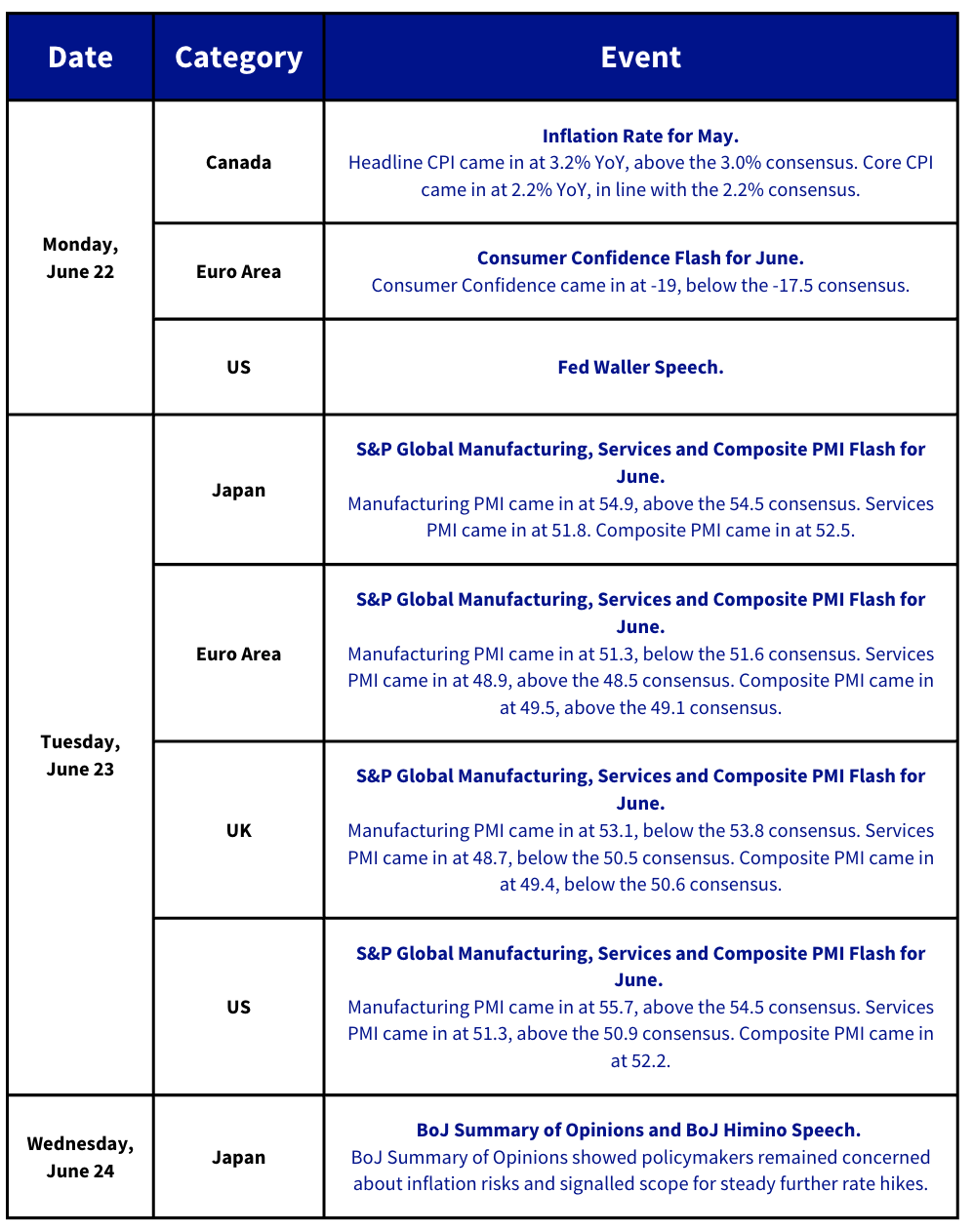
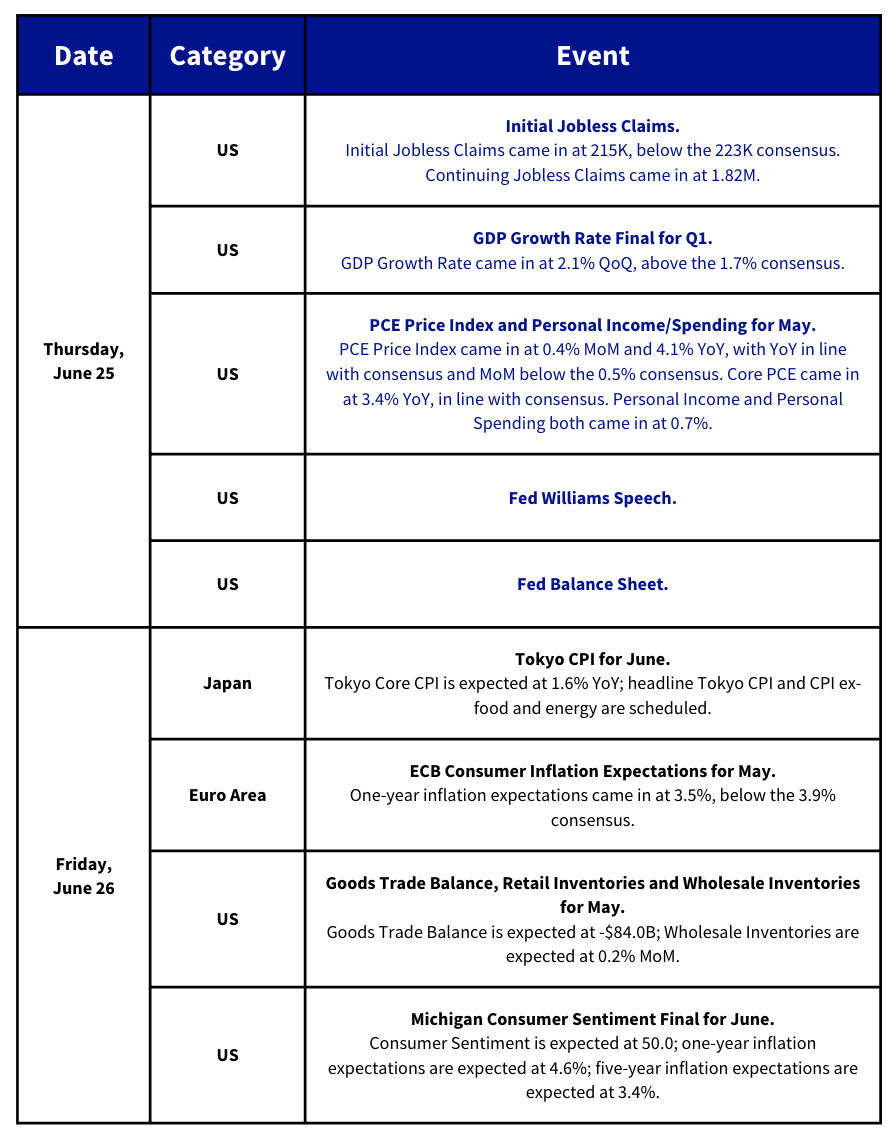
This Week's Calendar
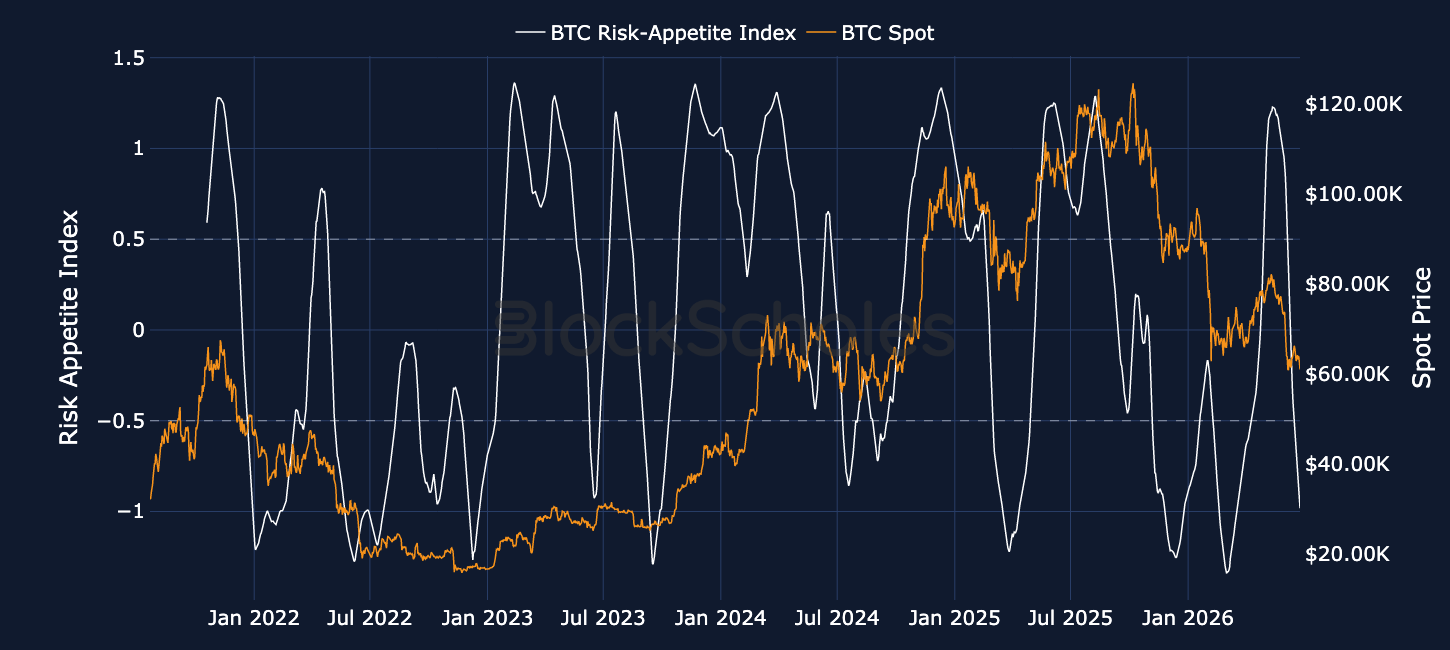
Charts of the Day
Figure 1. Block Scholes BTC Risk-Appetite Index (white, left-hand axis) and BTC spot price (orange, right-hand axis).
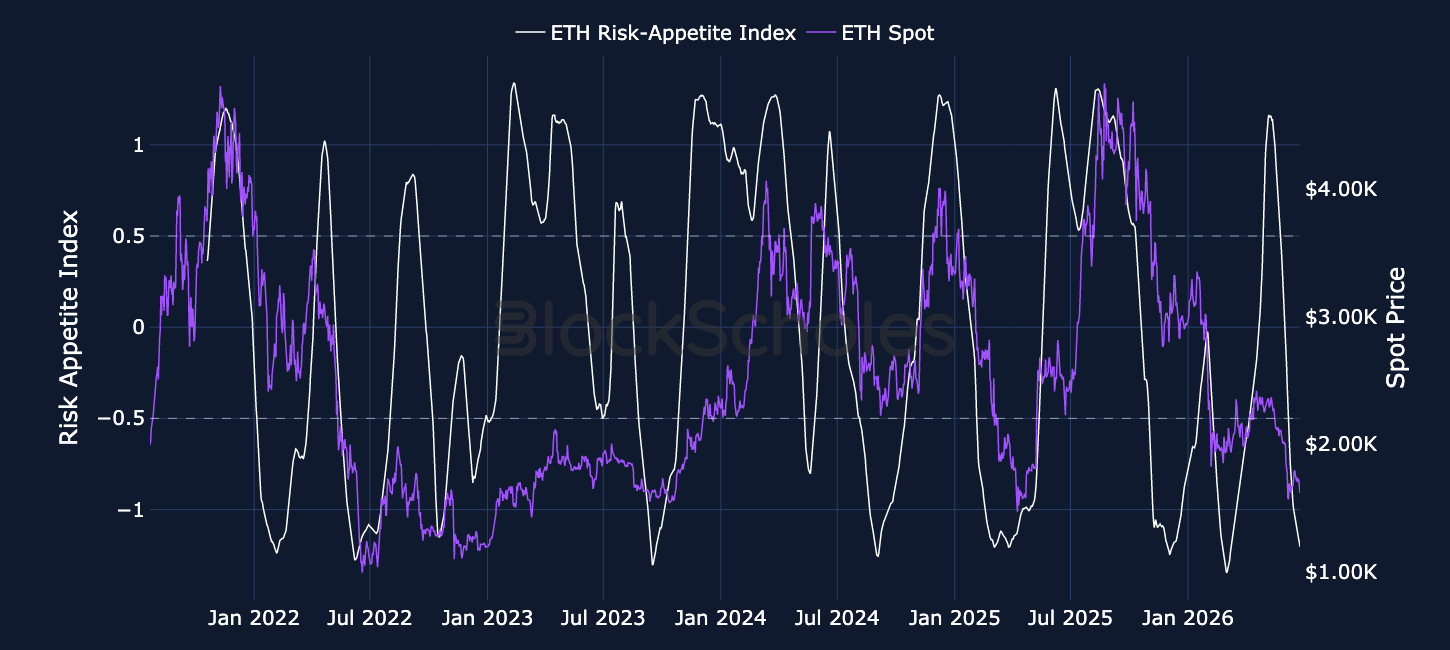
Figure 2. Block Scholes ETH Risk-Appetite Index (white, left-hand axis) and ETH spot price (purple, right-hand axis).
Block Scholes is an FCA-regulated institutional crypto derivatives analytics platform. Live data, IV surfaces, and backtesting available via blockscholes.com.
BTC fell back below $60K, with spot Bitcoin ETFs seeing their largest single-day outflow in a month and BTC/ETH implied volatility moving higher.
US equities were mixed despite tech weakness, as Apple dragged on the Magnificent Seven, while in-line PCE inflation and stronger revised Q1 GDP helped support sentiment.
Brent moved higher after fresh Strait of Hormuz disruption, while CLARITY Act timing tightened in the Senate, Invesco prepared a tokenised money market fund for stablecoin reserves, SharpLink reportedly bought ETH, Sophon moved to Base, and Base suffered a mainnet outage.
Market Snapshot: Overnight Moves
Macro & Markets
Another wave of volatility in major US tech equities coincided with BTC falling through $60K once again.
Bitcoin fell from $61K to $58K, while its spot ETFs saw outflows of $691.7M — the largest single-day outflow in a month.
Implied volatility for BTC and ETH options have jumped considerably higher since last week as spot price continues to struggle in finding upside momentum.
On Monday 15 June, 7-day ATM BTC IV was trading around 35% and has since increased 10pp to 45%. Similar-dated ETH implied vol has equally jumped 10-vol points, from 48% to 58%.
Volatility smiles have skewed further towards puts over the same period of time, with 25-delta OTM BTC puts trading at a 15-vol point premium to out-the-money calls.
Don't miss what's next
Upgrade your Block Scholes account to unlock this article and other exclusive insights
Block Scholes is an FCA-regulated institutional crypto derivatives analytics platform. Live data, IV surfaces, and backtesting available via blockscholes.com.
BTC fell back below $60K, with spot Bitcoin ETFs seeing their largest single-day outflow in a month and BTC/ETH implied volatility moving higher.
US equities were mixed despite tech weakness, as Apple dragged on the Magnificent Seven, while in-line PCE inflation and stronger revised Q1 GDP helped support sentiment.
Brent moved higher after fresh Strait of Hormuz disruption, while CLARITY Act timing tightened in the Senate, Invesco prepared a tokenised money market fund for stablecoin reserves, SharpLink reportedly bought ETH, Sophon moved to Base, and Base suffered a mainnet outage.
Market Snapshot: Overnight Moves
Macro & Markets
Another wave of volatility in major US tech equities coincided with BTC falling through $60K once again.
Bitcoin fell from $61K to $58K, while its spot ETFs saw outflows of $691.7M — the largest single-day outflow in a month.
Implied volatility for BTC and ETH options have jumped considerably higher since last week as spot price continues to struggle in finding upside momentum.
On Monday 15 June, 7-day ATM BTC IV was trading around 35% and has since increased 10pp to 45%. Similar-dated ETH implied vol has equally jumped 10-vol points, from 48% to 58%.
Volatility smiles have skewed further towards puts over the same period of time, with 25-delta OTM BTC puts trading at a 15-vol point premium to out-the-money calls.
Don't miss what's next
Upgrade your Block Scholes account to unlock this article and other exclusive insights
Premium
$30/mo
Access previous and future reports, market insights & deep dives.
US equities and long-dated Treasuries sold off together for a second session, sending the 30-year Treasury yield past 5.6%, its highest level since 2002, even as Brent crude fell back to around $96 a barrel. New York Fed President John Williams said there is no need for urgency on rates, and fed funds futures now price a 44.8% probability of a 25bps hike in October, down from 70.9% at the start of the week. The CFTC approved Coinbase Clearing as a derivatives clearing organization, while HSBC named its planned Hong Kong dollar stablecoin HSBC RedCoin.
US stocks fell as the Treasury selloff deepened, S&P 500 -0.77%, Nasdaq-100 -1.08%, with the 10Y yield briefly hitting 5.27% and the 30Y reaching 5.55%, its highest since 2004, as BTC held steady at $83.8K (+1.1%) and ETH rose 2.2% to $2,708. Strategy added 1,665 BTC to lift its holdings to 847,666 BTC and Bitmine bought 17,362 ETH to hold over 6M ETH.
DeepBook Predict, an onchain options product on Sui powered by Block Scholes’ volatility oracle, launched on mainnet. US stock futures slipped after President Trump rejected Iran’s latest peace proposal over the weekend, reversing Friday’s relief rally that lifted the S&P 500 +0.51%, while Brent crude rose around 2% to just under $107, the 2-year Treasury yield climbed 5 bps to 4.9% and the 10-year topped 5.20%, as BTC fell 2.2% to $82.9K and ETH dropped 2.4% to $2,650.