CLARITY Act Advances Crypto Market Structure
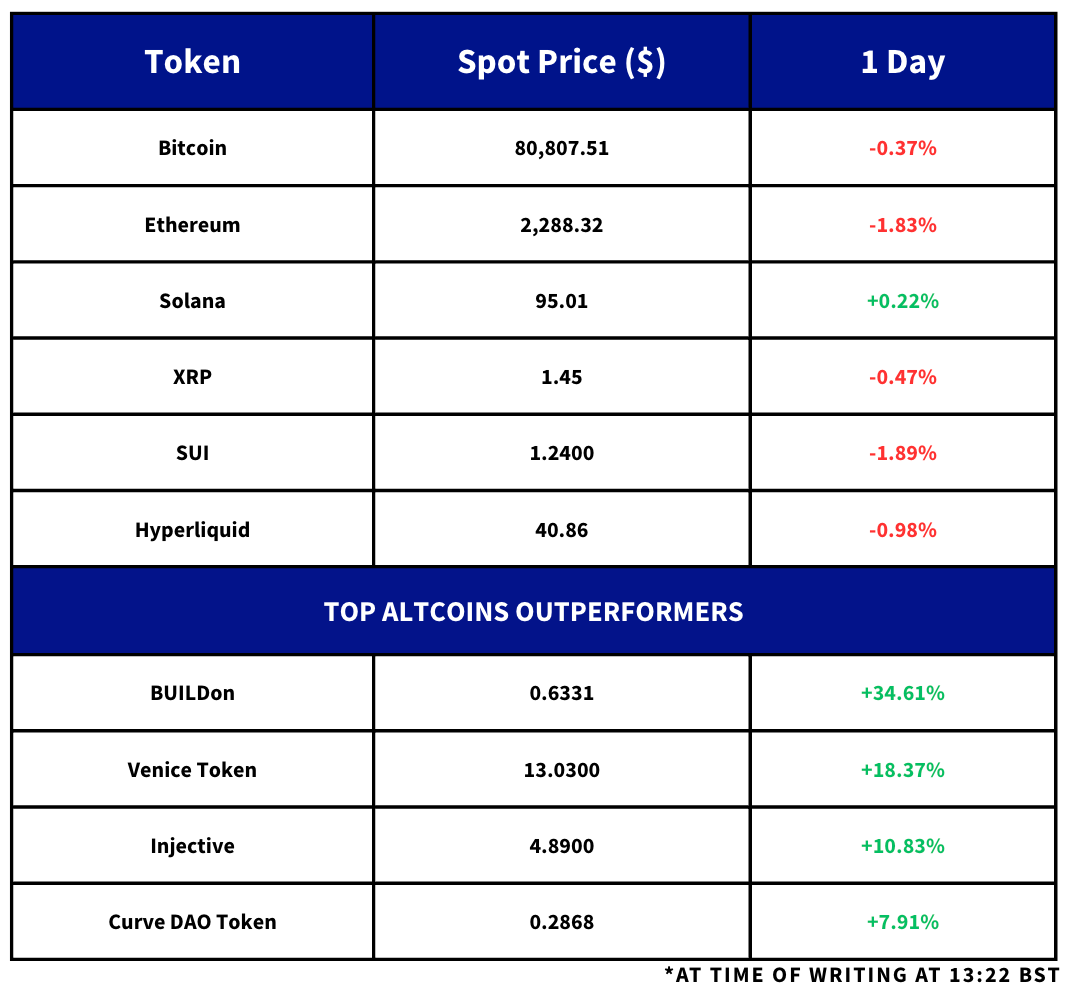
BTC and ETH remain range-bound despite a still-fragile geopolitical backdrop, with BTC holding between $80K–$82K and ETH between $2,200–$2,400 over the past 24 hours. The limited upside in crypto mirrors modest gains across US equities, where the S&P 500 rose 0.19% and the Nasdaq-100 gained 0.29%, even as Brent crude stabilised above $100 per barrel. ETF flows offered a more constructive signal at the margin, with spot XRP ETFs recording their largest single-day inflow since January at $25.8M across three US-listed funds.

Block Scholes is an FCA-regulated institutional crypto derivatives analytics platform. Live data, IV surfaces, and backtesting available via blockscholes.com.
Recent Research from Block Scholes
- Tokenised Markets on Bitget UEX: How Traders Are Utilising 24/7 Real-World Assets For Real Time Macro Hedging
- Block Scholes x Panoptic: Bridging The Onchain Convexity Gap
- Volatility Report: February 2026
- 2026 – the year of RWA perps?
In Today's Note
- Risk assets held up despite geopolitical pressure, with BTC and ETH range-bound and US equities modestly higher as Brent crude stayed above $100.
- US–Iran tensions remain unresolved, though Trump stopped short of renewed military action while shifting focus to fuel-price relief measures.
- DeFi & TradFi updates cover regulation, infrastructure and adoption, including the Senate crypto bill, MARA’s Q1 results, Ethereum upgrade preparations, Boundary’s stablecoin raise, TON’s Acton launch, Ondo’s HyperEVM bridge, Strategy’s BTC purchase and Crypto.com’s UAE licence.
Market Snapshot: Overnight Moves

Macro & Markets
- Despite the US-Iran ceasefire being in a particularly fragile state since the beginning of the week, risk-on assets have still seen some (albeit limited) upside.
- After sideways trading at $80K over the weekend, BTC has traded within a range of $80K and $82K over the past 24 hours. ETH has been stuck in a similar range of $2,200 and $2,400.
- The S&P 500 eked out gains of 0.19% and the Nasdaq-100 rose by 0.29% yesterday, in spite of Brent crude oil prices now settling firmly above $100 per barrel.
- After announcing Iran’s response to the US 14-point peace plan as “TOTALLY UNACCEPTABLE” on Sunday via Truth Social, yesterday President Trump described the current ceasefire as being on “massive life support”.
- Speaking to reporters in the Oval Office, Trump added that the ceasefire is at its “weakest right now” and that he “didn’t even finish” reading the “piece of garbage they sent us.”
- Despite his comments, the US president still fell short of signalling a resumption in military attacks as he had previously threatened and instead said that a diplomatic solution is still “very possible.”
- Iran’s response to Washington’s peace proposal included demands to lift the US naval blockade and sanctions, providing Iran a degree of control over traffic in the Strait of Hormuz, as well as insisting on an immediate end to the conflict.
- Esmail Baghae, Iran’s Foreign Ministry spokesman, said during a press conference on Monday that “Everything we proposed in the text was reasonable and generous”.
- President Trump told reporters at the White House yesterday that he plans to suspend the federal gas tax of 18.4 cents a gallon “until it’s appropriate”, something which will require approval from Congress.
- Trump acknowledged the savings for US consumers would be a fraction of the increase in prices due to the Middle East conflict, stating “It’s a small percentage but it’s still money”.
- In another effort to help alleviate the surge in prices, the US Strategic Petroleum Reserve said it’s releasing additional barrels of oil from its strategic reserve. The Energy Department said on Monday that 53.3M barrels were awarded to companies including oil trader Trafigura Group and US refiner Marathon Petroleum Corp. Under the department’s exchange scheme, participating firms are required to replenish the stockpile with new barrels at a later date.
- Spot XRP ETFs recorded their largest single-day inflow since January, drawing $25.8M across three US-listed funds on Monday, according to SoSoValue Data.
DeFi & TradFi
- The Senate Banking Committee has released updated text for its crypto market structure bill, a proposed framework for deciding how digital assets should be regulated and which federal agencies should oversee them.
- The bill attempts to resolve two major industry flashpoints – stablecoin rewards and DeFi developer protections.
- The new text would prevent firms from offering yield-like incentives simply for holding stablecoins, while also clarifying that non-custodial software developers should not be treated as money transmitters.
- For the crypto industry, the bill offers a clearer path towards federal regulation and stronger protections for infrastructure providers.
- Ahead of Thursday’s markup, Congressional leaders are expected to submit proposed amendments today.
- Publicly traded bitcoin miner, MARA, reported Q1 2026 revenue of $174.6M, down 18% year-on-year, while net losses widened to $1.26B primarily due to a $1.0B mark-to-market loss on its bitcoin holdings following BTC’s ~22% quarterly decline.
- The company mined 2,247 BTC during the quarter and ended March with 35,303 BTC worth roughly $2.4B, including 9,995 BTC that were loaned or pledged as collateral, while energized hashrate rose 33% year-on-year to a record 72.2 EH/s and fleet efficiency improved to 17.6 J/TH.
- MARA also outlined a broader strategic shift beyond bitcoin mining into AI and digital infrastructure, highlighting its planned acquisition of the 505 MW Long Ridge energy campus, expansion of its Starwood AI infrastructure partnership, and international private cloud growth through Exaion as it positions itself as an energy-backed compute infrastructure company rather than solely a bitcoin miner.
- Ethereum core developers and client teams met for a week-long interoperability event focused on preparing the network’s upcoming Glamsterdam upgrade, where teams aligned around a target 200M gas limit floor, stabilized ePBS infrastructure, a proposer-builder separation system designed to improve block production efficiency and reduce centralisation risks, and finalized EIP-8037 repricing changes, which adjust Ethereum’s state storage costs to better reflect network resource usage and support higher throughput.
- Developers also advanced groundwork for the later “Hegotá” upgrade, including FOCIL, a censorship-resistance mechanism for transaction inclusion, and native account abstraction, which would allow wallets to behave more like programmable smart accounts with automated gas payments, recovery systems, and batched transactions.
- The Ethereum Foundation simultaneously announced another restructuring of its Protocol cluster leadership, with Will Corcoran, Kev Wedderburn, and Fredrik taking over responsibilities as Barnabé Monnot and Tim Beiko prepare to leave the Foundation and Alex Stokes enters sabbatical following work on upgrades including Fusaka, PeerDAS, and gas limit expansion initiatives.
- Boundary Labs, a New York-based stablecoin infrastructure startup, has raised $2M in pre-seed funding led by Galaxy Ventures to launch USBD, a stablecoin protocol designed for institutional users with on-chain reserve verification and compliance-focused onboarding.
- The company said USBD is targeting the growing $300B+ stablecoin market by offering continuous on-chain auditability, institutional-only access through KYC/KYB-gated onboarding, and infrastructure aimed at treasury management with regulated wrappers.
- Boundary added that the protocol has completed a security audit by Cyfrin and is preparing a private placement campaign for institutional partners, while targeting $100M in total value locked during 2026 as competition intensifies around regulated and institution-focused stablecoin infrastructure.
- TON Core launched Acton, a new all-in-one CLI for building AI agents and smart contracts on the TON network.
- Built around Tolk, Acton brings the full smart contract workflow into one unified toolchain, including project creation, native testing, debugging, dApp integration, deployment and verification.
- The tool is designed to make TON development faster and more accessible, with native Tolk tests reportedly running far faster than TypeScript-based workflows.
- Acton also includes AI-agent-friendly manuals and skills, IDE integration, fuzz testing, gas profiling, fork testing, coverage reports and migration support from FunC to Tolk.
- Ondo announced yesterday that its tokenised stocks and ETFs can now be bridged to Hyperliquid’s HyperEVM via LayerZero.
- The move brings equity-linked assets into HyperEVM’s DeFi ecosystem, giving traders access to spot positions that can support more advanced strategies, including basis trades and delta-neutral hedging.
- Michael Saylor’s Strategy has added another 535 BTC to its balance sheet, spending roughly $43M at an average purchase price of about $80,340 per BTC.
- The latest buy takes Strategy’s total holdings to 818,869 BTC, worth approximately $66.4B.
- For comparison, a $1.5B annual dividend and interest burden would equate to roughly 18,700 BTC at the latest purchase price - around 35 times larger than this latest 535 BTC purchase.
- Crypto.com announced that its UAE entity has received a Stored Value Facilities licence from the Central Bank of the UAE, becoming the first Virtual Asset Service Provider (VASP) in the country to secure the approval.
- The licence allows Crypto.com to activate its partnership with the Dubai Department of Finance, enabling UAE residents to pay government fees using virtual assets, with settlement conducted in dirhams or approved dirham-backed stablecoins.
This Week's Calendar


Charts of the Day