Bitcoin Holds Firm and ETFs Keep Buying as Oil Breaks $90
US markets ended the week under pressure as semiconductor stocks led a broad selloff after China's Moonshot launched its Kimi K3 model, pushing the Philadelphia Semiconductor Index into bear market territory, more than 20% below its June high. Geopolitical tensions also intensified, with Brent crude briefly topping $90 amid a ninth straight night of US-Iran strikes. In digital assets, Bitcoin rebounded to around $64K after briefly falling to $62K, while US spot Bitcoin ETFs recorded a second consecutive week of net inflows. Crypto headlines included Hyperliquid outlining permissionless HIP-4 market deployment, Michael Saylor opposing BIP-110, France seeking to block Polymarket ahead of the World Cup final, and US regulators missing the deadline to finalize GENIUS Act stablecoin rules.
Block Scholes is an FCA-regulated institutional crypto derivatives analytics platform. Live data, IV surfaces, and backtesting available via blockscholes.com.
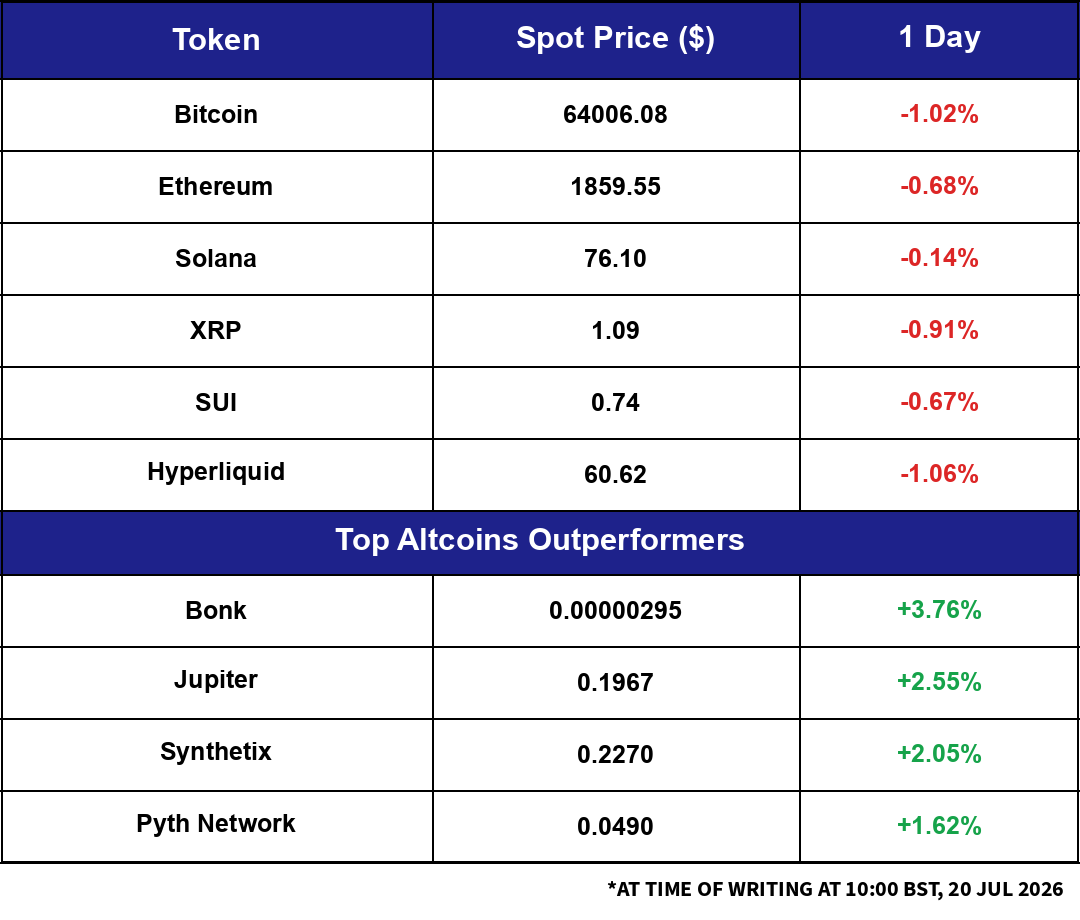
A sharp selloff in chipmakers dragged US benchmarks lower into the weekend, with the Philadelphia Semiconductor index posting its worst week since the April Liberation Day selloff and falling more than 20% from its June peak, into a bear market. The Nasdaq-100 closed Friday down 1.5% and 3% on the week, while the S&P 500 fell 1.0% on the day, the sector jolted by Chinese AI startup Moonshot's new Kimi K3 model. Brent crude briefly surged past $90, now up 30% from its July lows, as the US and Iran traded a ninth consecutive night of strikes and two American service members were killed in Jordan. BTC briefly fell to $62K before recovering to $64.0K, down 1.0% over 24 hours, with ETH at $1.86K, as US spot Bitcoin ETFs booked a second straight week of net inflows at $75.7M.
Hyperliquid said a future upgrade will introduce permissionless deployment for HIP-4 outcome markets, with deployers required to stake 500,000 HYPE (around $30M) and facing slashing for poorly managed markets. Michael Saylor urged Bitcoin users to reject BIP-110, a proposed temporary soft fork restricting data-heavy transactions, ahead of its mandatory miner-signaling period expected around August 7. France's gambling authority ordered internet providers to block Polymarket just before the World Cup final, its largest-ever market. US regulators missed the one-year deadline to finalize GENIUS Act stablecoin rules, though the Act still takes effect on January 18, 2027, while Bank of America appointed new leaders for its digital assets and AI initiatives.
Market Snapshot: Overnight Moves
Macro & Markets
A sharp selloff in chipmakers and semiconductor stocks dragged major US benchmark indices down last Friday, while BTC briefly fell to $62K before modestly rising over the weekend.
The Philadelphia Semiconductor index, the major gauge for US semiconductor stocks, posted its worst week since the “Liberation Day” selloff back in April 2025. The index fell 1.6% on Friday alone, taking its losses for the week to almost 10%.
Importantly, the index is now down more than 20% from its peak in June, officially putting it into a bear market.
That dragged the Nasdaq-100 lower which closed on Friday at -1.5%, and down 3% on the week, while the S&P 500 declined 1.0% on the day.
The sector was jolted by the release of Chinese AI-startup Moonshot’s newest large language model, Kimi K3, which reportedly has capabilities on par with US-based models such as Anthropic’s Claude Opus 4.8 and OpenAI’s strongest models.
Some signs of improving sentiment are apparent in crypto markets as US-listed spot Bitcoin ETFs recorded their second consecutive week of net positive inflows last week, breaking the almost two-months of capital outflows between May and June.
The ETF products saw modest inflows of $75.7M last week, following from the $197.4M of buying in the week prior.
The US and Iran continued to trade attacks on Friday and over the weekend, putting further pressure on oil prices and weighing on risk sentiment.
Brent crude briefly surged past $90 per barrel at the market open, now up 30% from its July lows.
The American military launched its ninth consecutive night of strikes, with the series of tit-for-tat attacks now expanding beyond strictly military targets to include bridges, surveillance sites, underground weapons storage and port facilities.
The US Central Command confirmed that it had destroyed a surveillance tower at an Iranian port that Iran had reportedly been using to track and target commercial vessels along the Gulf of Oman.
On Friday Axios News also reported that the Trump administration notified Israel that it is sending more refueling planes to the country ahead of a potential expansion of military operations against Iran.
Two American service members were killed in Jordan on Friday, prompting US forces to strike Qeshm Island in the Persian Gulf as well as a number of southern cities in Iran.
US Central Command said the American strikes sought to degrade Iran's ability to threaten commercial shipping and "swiftly punish" Islamic Revolutionary Guard Corps forces behind the Jordan attack.
The state-run IRIB News reported that Iran's army retaliated early Sunday with drone strikes targeting US forces in Kuwait.
President Trump told reporters on Sunday that “those great patriots were out there fighting so that Iran cannot have a nuclear weapon” and that the US hit Iran “very hard again tonight, and we did that in honour” of the personnel killed.
Tehran announced Saturday it would no longer be acting in accordance with the terms of the interim peace deal negotiated in June. In a statement, Iranian Supreme Leader Mojtaba Khamenei claimed the US had violated the memorandum and warned of "unforgettable lessons" for the US.
DeFi / Web3 / Altcoins / Crypto
Hyperliquid, a Layer 1 blockchain and decentralized trading platform, said a future upgrade will introduce permissionless deployment for HIP-4 outcome markets, allowing users to create prediction markets using validator-approved templates.
Validators will vote on standardized templates stored onchain, while deployers will define and settle individual markets, with permissionless deployment launching on testnet before mainnet.
To create markets, deployers will be required to stake 500,000 HYPE (~$30M), face slashing for poorly managed or unresolved markets, and will initially be able to launch up to 100 outcomes while charging fees of up to 50%.
Michael Saylor, executive chairman of Strategy, urged Bitcoin users to reject BIP-110, a proposed temporary soft fork that would restrict data-heavy transactions for one-year if activated, publishing on X: 110 Reasons BIP 110 Is a Bad Idea.
Saylor’s objections include BIP-110’s use of consensus rules to restrict currently valid transactions, its broad limits on script functionality and future upgrade paths, and the risk that its aggressive activation design could trigger coordination failures or a minority-chain split.
He also argues that the proposal has not quantified its claimed benefits for node costs, decentralization or payment fees, while potentially weakening miner revenue, discouraging innovation and creating a lasting precedent for excluding disfavored uses of Bitcoin.
His criticism comes ahead of BIP-110's mandatory miner-signaling period, expected to begin around Aug. 7, when miners will signal support for the proposal.
BIP-110 lowers the activation threshold to 55% miner signaling, below Bitcoin's typical 95% threshold for soft forks, and with support currently at just 0.86%, opponents warn the proposal could split off into a minority chain if only a small share of the network enforces the new rules.
France’s National Gambling Authority (ANJ) ordered internet providers to block Polymarket, a crypto-based prediction market platform, after concluding that the site promotes unauthorized gambling and may expose users to manipulated wagers.
The July 16 order expands restrictions first imposed in 2024 and will remain in place until Polymarket complies with French law, with the regulator noting that the platform still attracted more than 205,000 unique French visitors in June.
The block comes just before the World Cup final, which will settle Polymarket’s largest-ever market after generating more than $4B in trading volume, surpassing the 2024 U.S. presidential election, which settled around $3.69B volume, by roughly $300M.
US regulators have missed the one-year deadline to finalize the rules needed to implement the GENIUS Act, leaving several key stablecoin regulations unfinished. Important proposals covering reserves, anti-money laundering, customer verification, and state oversight are still under review, creating uncertainty for issuers preparing for the new framework.
Despite the delay, the GENIUS Act will still take effect on January 18, 2027. With no extension to the implementation timeline, stablecoin issuers will now face a tighter window to comply once the final regulations are released.
Bank of America has appointed new leaders to accelerate its digital assets and artificial intelligence initiatives, highlighting the growing convergence of crypto, AI, and traditional finance. Sonali Theisen will lead the bank's global digital assets platform, overseeing blockchain integration, while Kevin Milsom will head AI transformation across its global markets business.
The move reflects a broader trend among major financial institutions investing in emerging technologies.
With a focus on stablecoins, tokenized deposits, digital custody, and AI-driven market infrastructure, Bank of America is positioning itself to modernize its financial services as digital assets become increasingly integrated into mainstream finance.
Bitcoin Japan, a Tokyo-listed investment company, has approved a financing deal with EVO Fund that could raise about $59.5M, including $4.1M earmarked for its first BTC purchase.
Only a $9.2M convertible bond is committed upfront, while the rest depends on warrant exercises over roughly 12 months, meaning the bitcoin allocation may never be fully funded.
This Week's Calendar
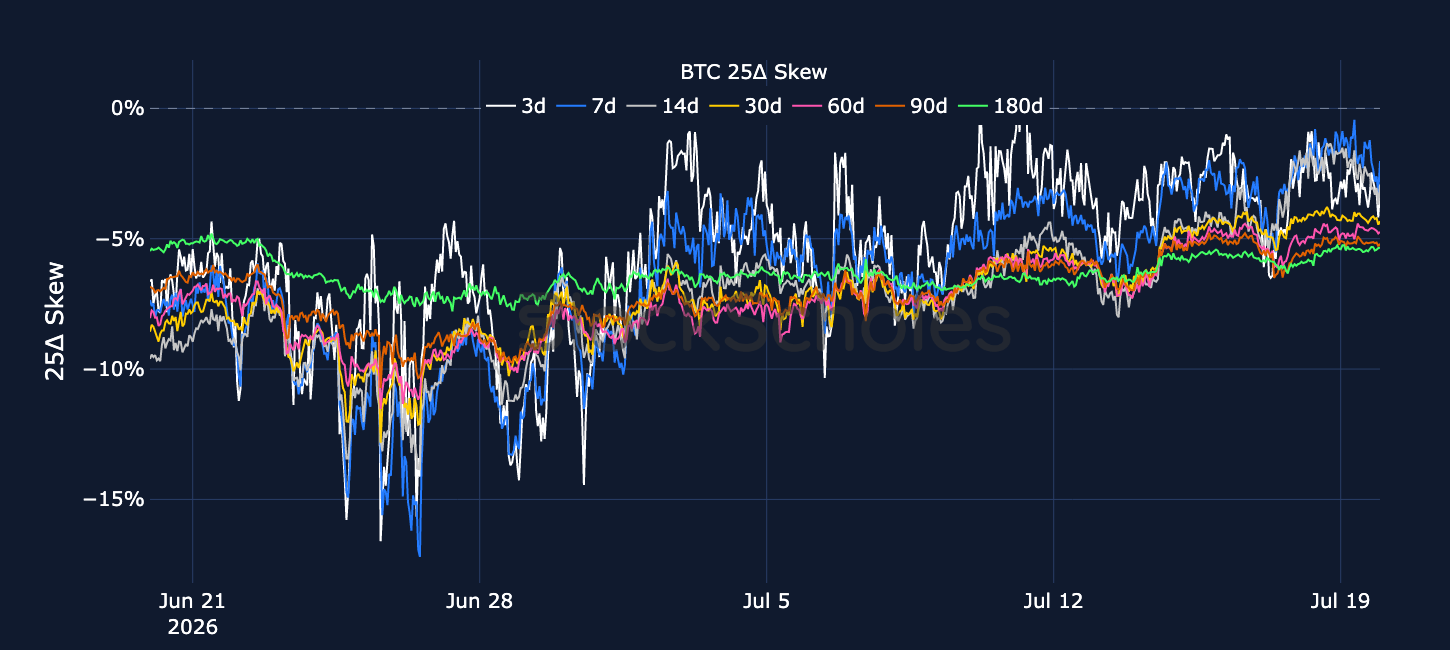
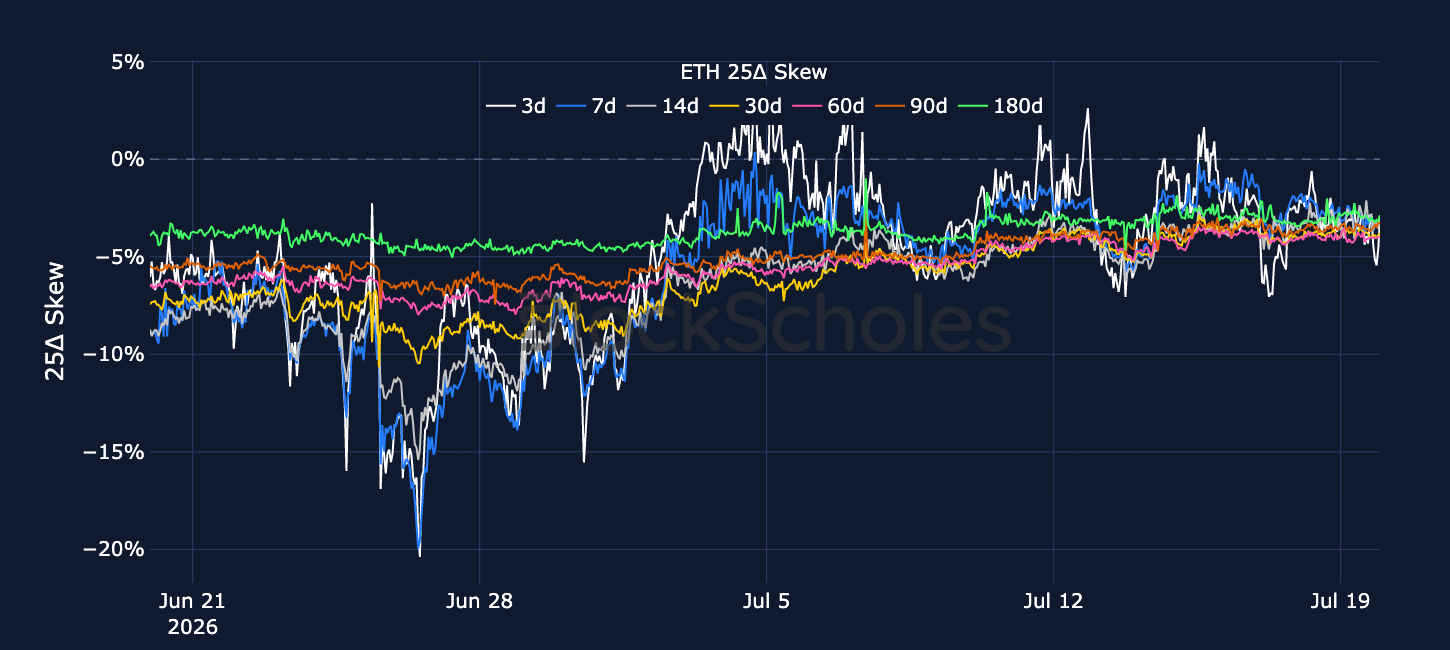
Charts of the Day
Figure 1. Block Scholes BTC Risk-Appetite Index (white, left-hand axis) and BTC spot price (orange, right-hand axis).
Figure 2. Block Scholes ETH Risk-Appetite Index (white, left-hand axis) and ETH spot price (purple, right-hand axis).
Block Scholes is an FCA-regulated institutional crypto derivatives analytics platform. Live data, IV surfaces, and backtesting available via blockscholes.com.
A sharp selloff in chipmakers dragged US benchmarks lower into the weekend, with the Philadelphia Semiconductor index posting its worst week since the April Liberation Day selloff and falling more than 20% from its June peak, into a bear market.
Hyperliquid said a future upgrade will introduce permissionless deployment for HIP-4 outcome markets, with deployers required to stake 500,000 HYPE (around $30M) and facing slashing for poorly managed markets. Michael Saylor urged Bitcoin users to reject BIP-110, a proposed temporary soft fork restricting data-heavy transactions, ahead of its mandatory miner-signaling period expected around August 7.
Market Snapshot: Overnight Moves
Macro & Markets
A sharp selloff in chipmakers and semiconductor stocks dragged major US benchmark indices down last Friday, while BTC briefly fell to $62K before modestly rising over the weekend.
The Philadelphia Semiconductor index, the major gauge for US semiconductor stocks, posted its worst week since the “Liberation Day” selloff back in April 2025. The index fell 1.6% on Friday alone, taking its losses for the week to almost 10%.
Importantly, the index is now down more than 20% from its peak in June, officially putting it into a bear market.
That dragged the Nasdaq-100 lower which closed on Friday at -1.5%, and down 3% on the week, while the S&P 500 declined 1.0% on the day.
Don't miss what's next
Upgrade your Block Scholes account to unlock this article and other exclusive insights
Block Scholes is an FCA-regulated institutional crypto derivatives analytics platform. Live data, IV surfaces, and backtesting available via blockscholes.com.
A sharp selloff in chipmakers dragged US benchmarks lower into the weekend, with the Philadelphia Semiconductor index posting its worst week since the April Liberation Day selloff and falling more than 20% from its June peak, into a bear market.
Hyperliquid said a future upgrade will introduce permissionless deployment for HIP-4 outcome markets, with deployers required to stake 500,000 HYPE (around $30M) and facing slashing for poorly managed markets. Michael Saylor urged Bitcoin users to reject BIP-110, a proposed temporary soft fork restricting data-heavy transactions, ahead of its mandatory miner-signaling period expected around August 7.
Market Snapshot: Overnight Moves
Macro & Markets
A sharp selloff in chipmakers and semiconductor stocks dragged major US benchmark indices down last Friday, while BTC briefly fell to $62K before modestly rising over the weekend.
The Philadelphia Semiconductor index, the major gauge for US semiconductor stocks, posted its worst week since the “Liberation Day” selloff back in April 2025. The index fell 1.6% on Friday alone, taking its losses for the week to almost 10%.
Importantly, the index is now down more than 20% from its peak in June, officially putting it into a bear market.
That dragged the Nasdaq-100 lower which closed on Friday at -1.5%, and down 3% on the week, while the S&P 500 declined 1.0% on the day.
Don't miss what's next
Upgrade your Block Scholes account to unlock this article and other exclusive insights
Premium
$30/mo
Access previous and future reports, market insights & deep dives.
The selloff in US tech shares extended last Friday, sending the Nasdaq-100 to its worst week (-5.5%) since April 2025 as chipmakers fell for an eighth consecutive day, their longest slide since 2008. US Treasuries showed tentative signs of reclaiming their safe-haven status, with 10-year yields down around 16bps and 30-year yields close to 20bps, while BTC fell to $80K before reclaiming $82K in Asian trading hours. Coinbase and Marqeta are expanding their partnership to let businesses offer payment cards backed by customers’ stablecoin balances, with settlement on Coinbase’s Base network.
Dip buying helped US equities recover from a week-long selloff in risk assets, with the S&P 500 ending a three-day decline 0.33% higher, while credit stress at AI cloud provider CoreWeave kept concerns about the AI trade in focus. Fed Chair Kevin Warsh told the IMF and World Bank meetings in Bangkok that an AI-led investment surge is putting upward pressure on inflation, and market-implied odds of an October pause rose to 85% from 72% after his comments. BTC briefly fell below $80K before recovering to $82.1K, while ETH rose 3.4% overnight to $2,450.