Back to Research
Last Updated:  
February 16, 2026
9 mins

No Consensus Post-Consensus

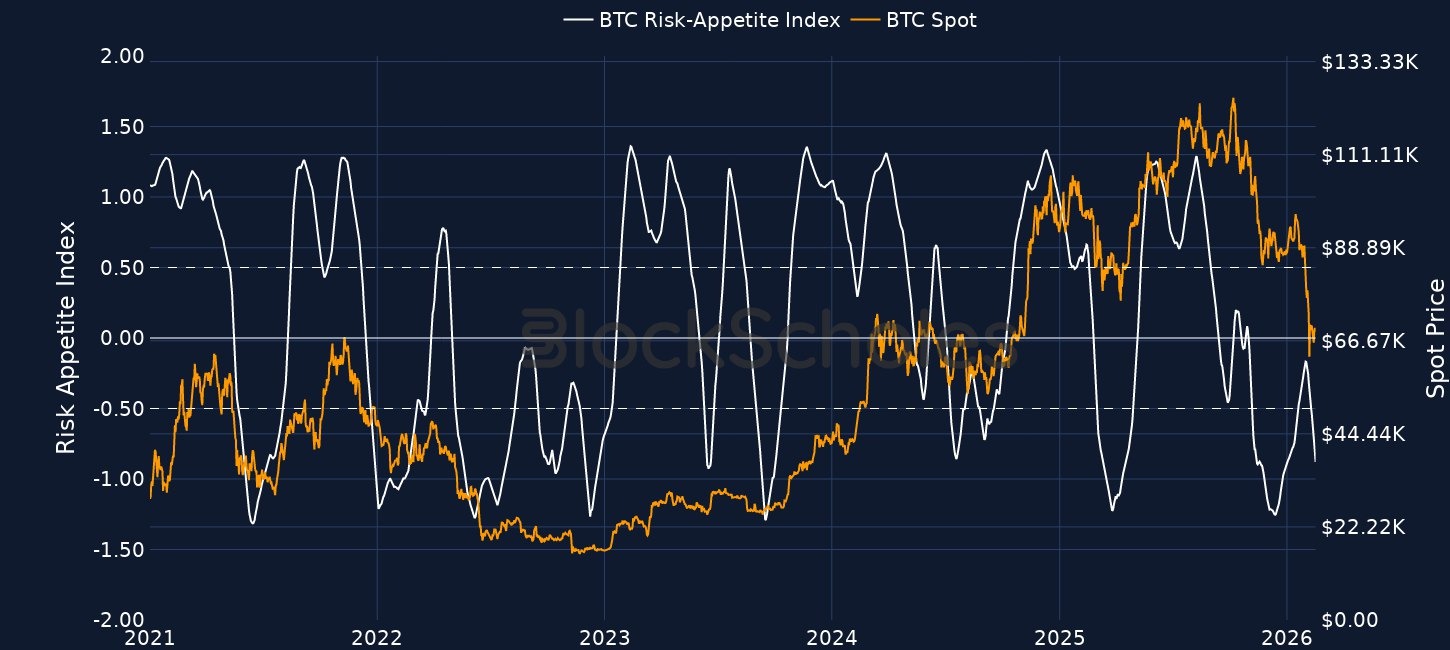
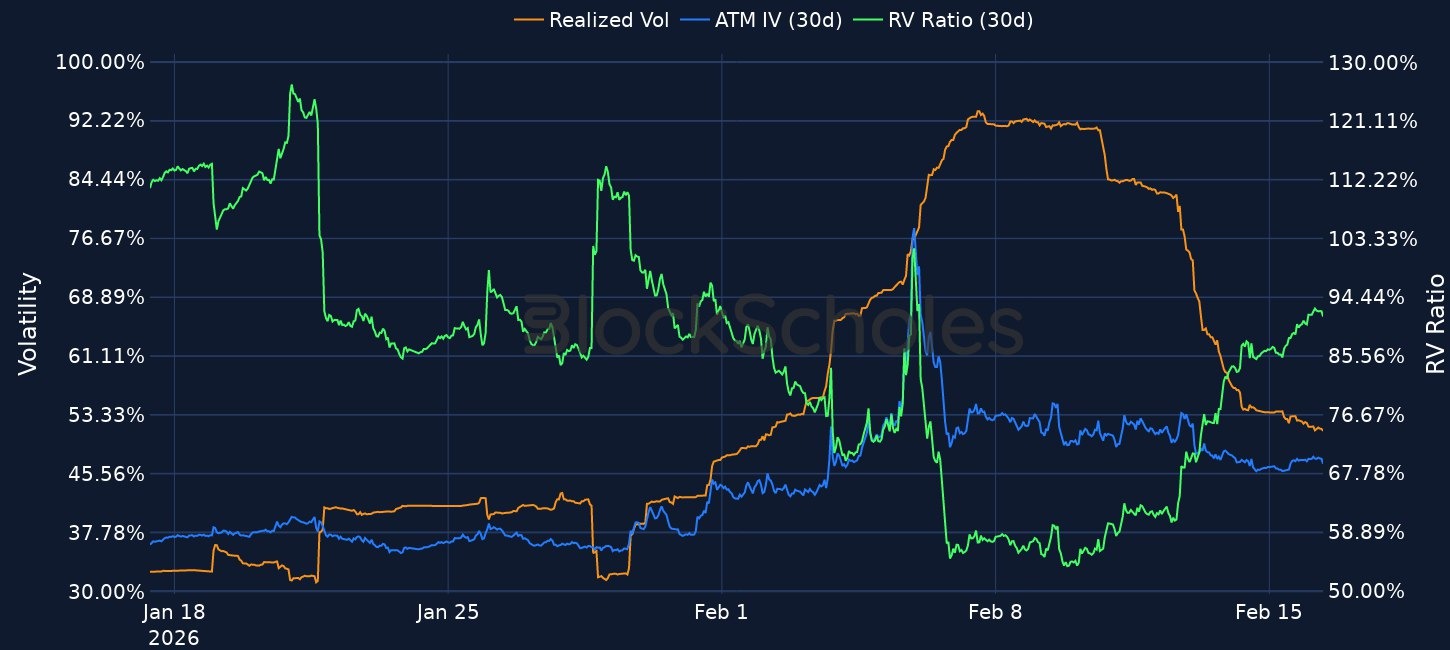
Sentiment coming out of Consensus Hong Kong was surprisingly constructive, even as BTC remains range-bound between $65,000 and $70,000 and the post-selloff narrative remains unclear. The sideways tape has coincided with Block Scholes’ Risk Appetite index reversing sharply lower after nearing the zero line that has historically aligned with broader crypto upside, making current price action a notable outlier. Derivatives positioning is defensive but unusually complacent, with BTC 30-day implied volatility at 45–46% versus realised near 50%, alongside a persistent put skew, while ETH implied volatility tracks realised more closely. ETF flows reinforce the cautious tone, with $360M in BTC outflows and $161.2M in ETH outflows last week.

Find out our latest reports, listed below:

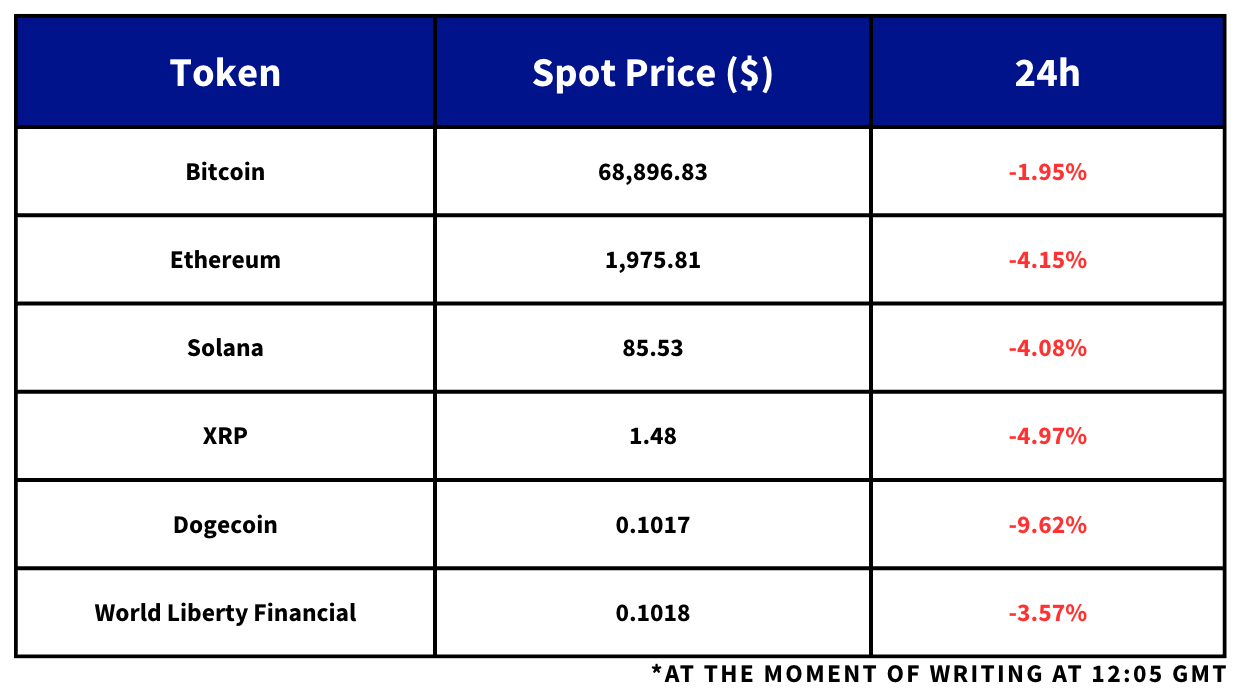
Market Snapshot: Overnight Moves

Daily Updates:

  • The Block Scholes team has just returned from Consensus Hong Kong, where we spoke to more than 150 market participants, partners, and clients.
  • We found sentiment surprisingly bullish despite price action, with the focus skewed toward building and utility rather than token prices (though with its fair share of rumours as to the cause).
  • Key themes include tokenisation of RWA (and decentralised derivatives on those same RWAs!), integrating agentic tools to blockchain technology, and prediction markets.
  • Despite the bullishness we felt, BTC spot continues in the $65K – $70K range that it has traded in since the Feb 6 capitulation, with the post-selloff narrative still unclear and no clear consensus on the next driver of price action.
  • Continuing sideways at these levels has seen Block Scholes’ Risk Appetite index reverse direction (now sharply downward) after approaching zero from below in the early part of 2026. This crossing has historically been an indicator of bullish momentum across most crypto currencies, but current price action is a clear outlier to that pattern.
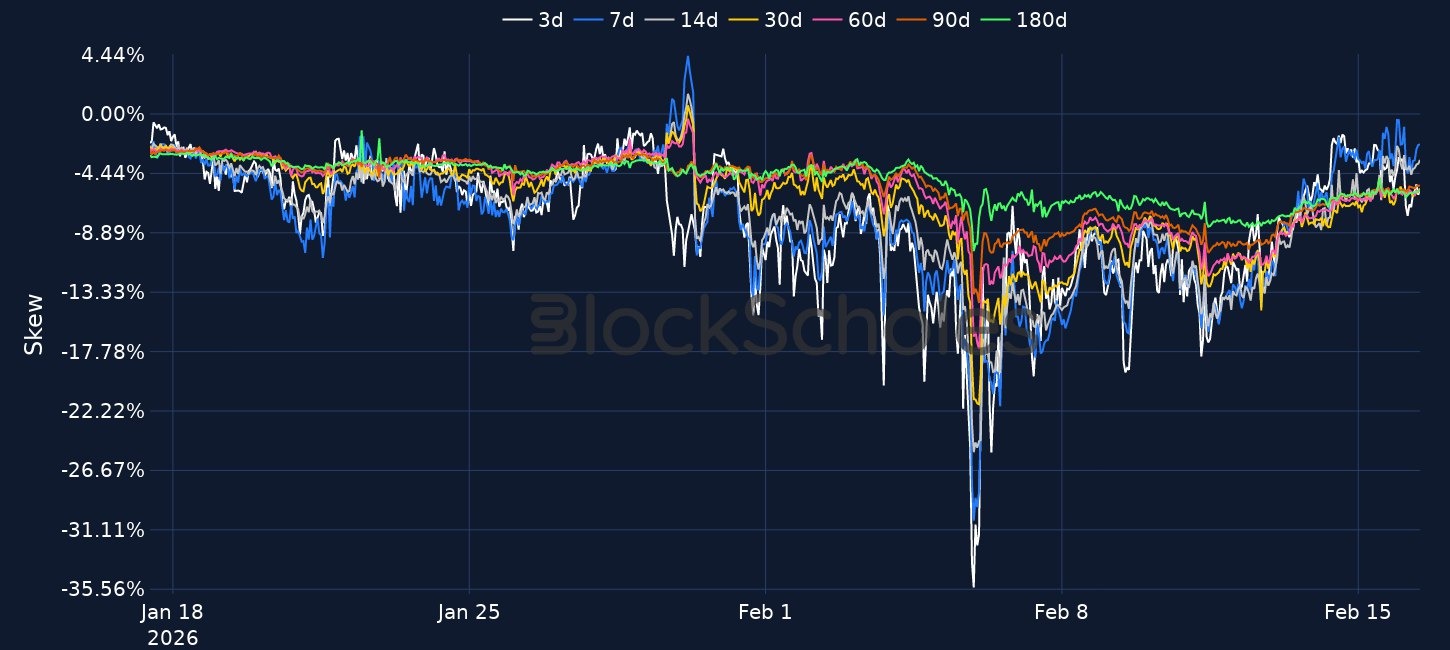
  • Options market positioning can be summarised quickly: low volatility and a skew towards puts. While a skew towards puts isn’t surprising (traders want protection against further downside, plus some speculation of traders getting caught short puts), the low level of implied volatility is.
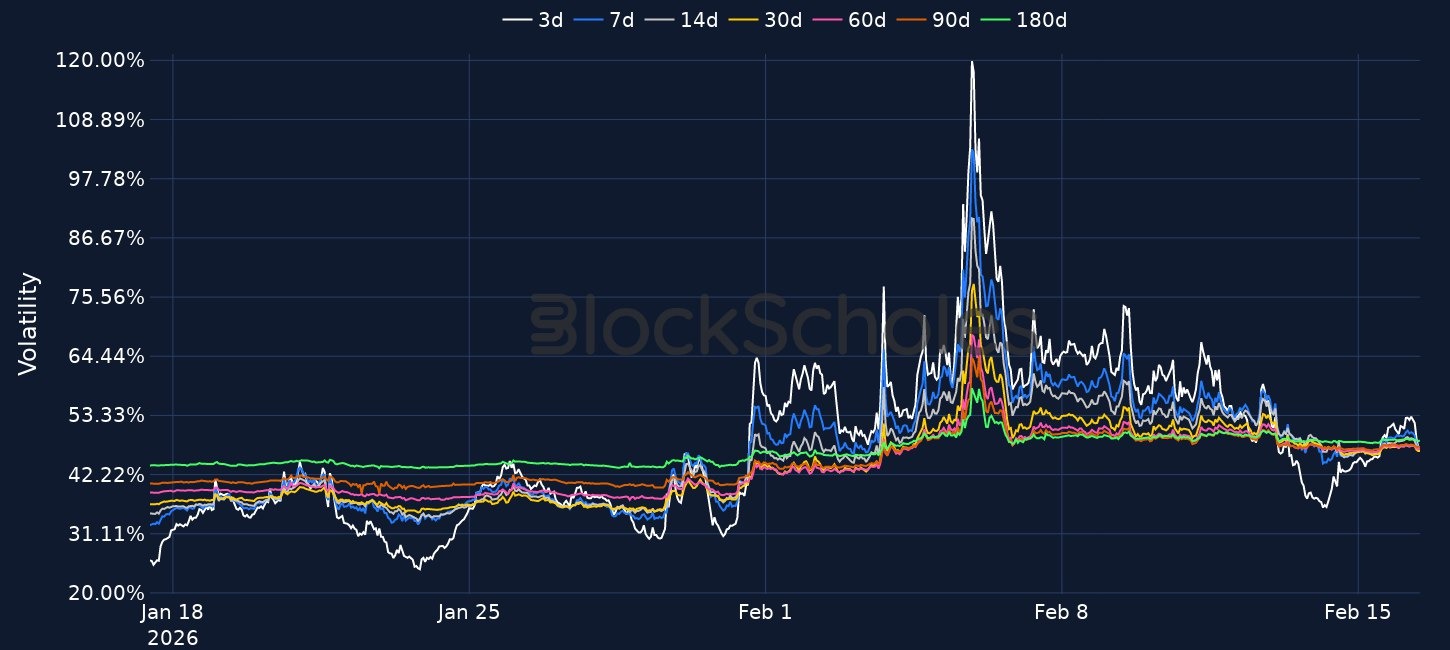
  • Relative to the (still high) level of realised volatility, implied volatility snapped lower almost immediately after the sell-off on Feb 5, 2026. The 30D tenor of BTC now trades at 45-46%, while realised continues to range closer to 50%.
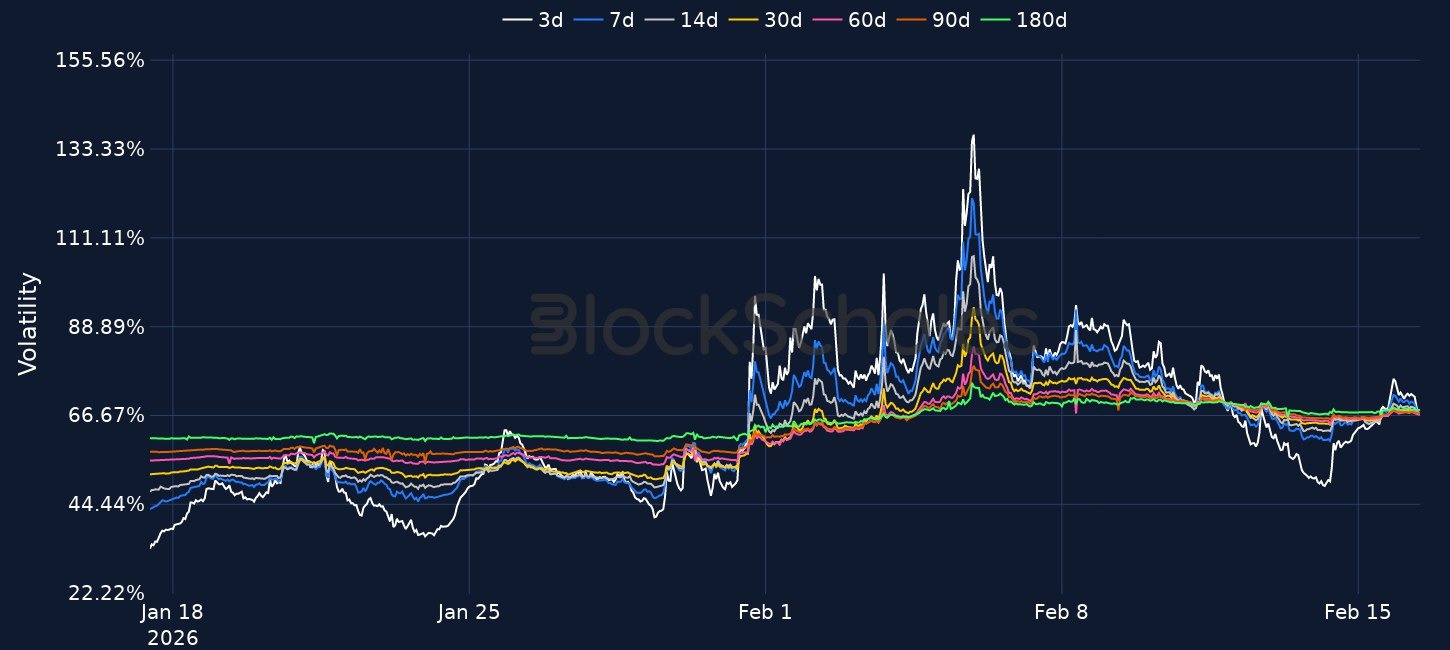
  • In contrast ETH’s options markets prices implied volatility far closer to the level of realised volatility over the last 30 days.
  • BTC Spot ETFs saw net outflows of $360M in bitcoins last week. Similarly, ETH Spot ETFs saw net outflows of $161.2M.
  • A partial U.S. government shutdown began Saturday after congressional Democrats and the White House failed to reach an agreement to fund the Department of Homeland Security through September, with neither side signalling compromise as of Sunday.
  • Democrats are demanding changes to oversight and the conduct of federal immigration operations.
    With Congress in recess until 23 February, the standoff is set to continue, affecting agencies including the TSA, FEMA, the Coast Guard, the Secret Service, ICE and CBP.
  • Bank of England Chief Economist Huw Pill said on 13 February that underlying inflation in Britain appears to be settling around 2.5%, above the Bank’s 2% target, arguing that further interest-rate cuts would be inappropriate.
  • Pill, who has voted against the past four rate cuts, said borrowing costs are now “a little bit too low”, though still just high enough to apply downward pressure on inflation.
  • Speaking at a Santander-hosted event in London, he added that policy remains “sufficiently restrictive” and should be held steady while proceeding cautiously.
  • Iran’s foreign minister traveled Sunday for a second round of indirect nuclear talks with the US (in Geneva), keeping a key geopolitical risk channel open for energy markets.
  • Separately, Trump and Netanyahu agreed to intensify pressure targeting Iran’s oil exports (notably flows to China), raising the odds of tighter enforcement and higher policy-driven supply risk premia.
  • Animoca Brands announced today it has received a Virtual Asset Service Provider (VASP) licence from Dubai’s Virtual Assets Regulatory Authority (VARA), allowing it to offer broker-dealer, asset management and investment services to institutional and qualified investors in and from Dubai (excluding the DIFC).
  • The Morpho Association said it signed a partnership agreement today with affiliates of Apollo Global Management to support onchain lending markets on Morpho.
  • The deal allows Apollo to acquire up to 90M MORPHO over 48 months via open-market, OTC and other arrangements, subject to transfer and trading restrictions.
  • Galaxy Digital UK Limited acted as Morpho’s exclusive financial adviser.
  • Trump Media & Technology Group is re-filing to list a Bitcoin and Ethereum ETF, and is also seeking to launch a Truth Social Cronos Yield Maximizer ETF linked to Crypto.com’s CRO token which will provide access to staking rewards
  • The move follows the company’s first push into crypto ETFs last June—partnering with Crypto.com and Yorkville on an “American Exceptionalism” suite including BTC/ETH and a “Crypto Blue Chip” basket—which the SEC delayed in August.
  • Digital currency asset management company Grayscale, filed on Friday, February 13, with the SEC to convert its closed-end fund (CEF) AAVE Trust into an ETF that would list on NYSE Arca.
  • Solana Company (NASDAQ: HSDT) shares jumped about 17% on Friday after the firm announced a new structure that lets institutions borrow against natively staked SOL while keeping the assets in custody.
  • The Nasdaq-listed company partnered with Anchorage Digital and Solana lending protocol Kamino to enable loans backed by SOL that remain staked and held in segregated custody accounts at Anchorage, allowing holders to unlock liquidity without unstaking or selling and while still earning staking rewards.
  • Pressure on Trump-linked crypto firm World Liberty Financial is escalating as members of the Senate Banking Committee, Elizabeth Warren and Andy Kim have asked Treasury Secretary Scott Bessent to assess whether the Committee on Foreign Investment in the United States (CFIUS) should review a reported 49% stake in WLF held by a UAE-backed entity, setting a March 5 deadline for a response. 
  • Their request follows a separate House inquiry led by Rep. Ro Khanna, intensifying congressional scrutiny of the venture and its foreign ties. 
  • The Wall Street Journal reported that G42—backed by Sheikh Tahnoon bin Zayed Al Nahyan, the UAE’s national security adviser and head of its largest sovereign wealth fund—acquired the stake, reportedly worth $500 million, shortly before Trump’s second inauguration in January 2025.

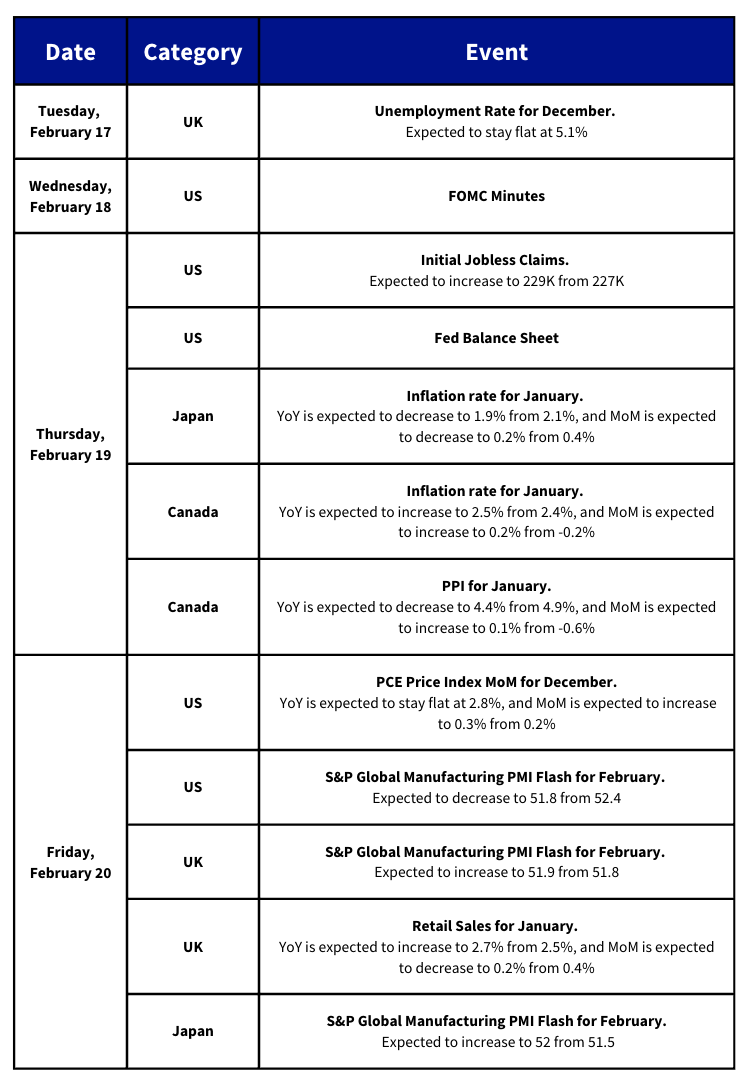
This Week’s Calendar:

Charts of the Day:

Figure 1. Block Scholes BTC Risk-Appetite Index (white, left-hand axis) and BTC spot price (orange, right-hand axis)
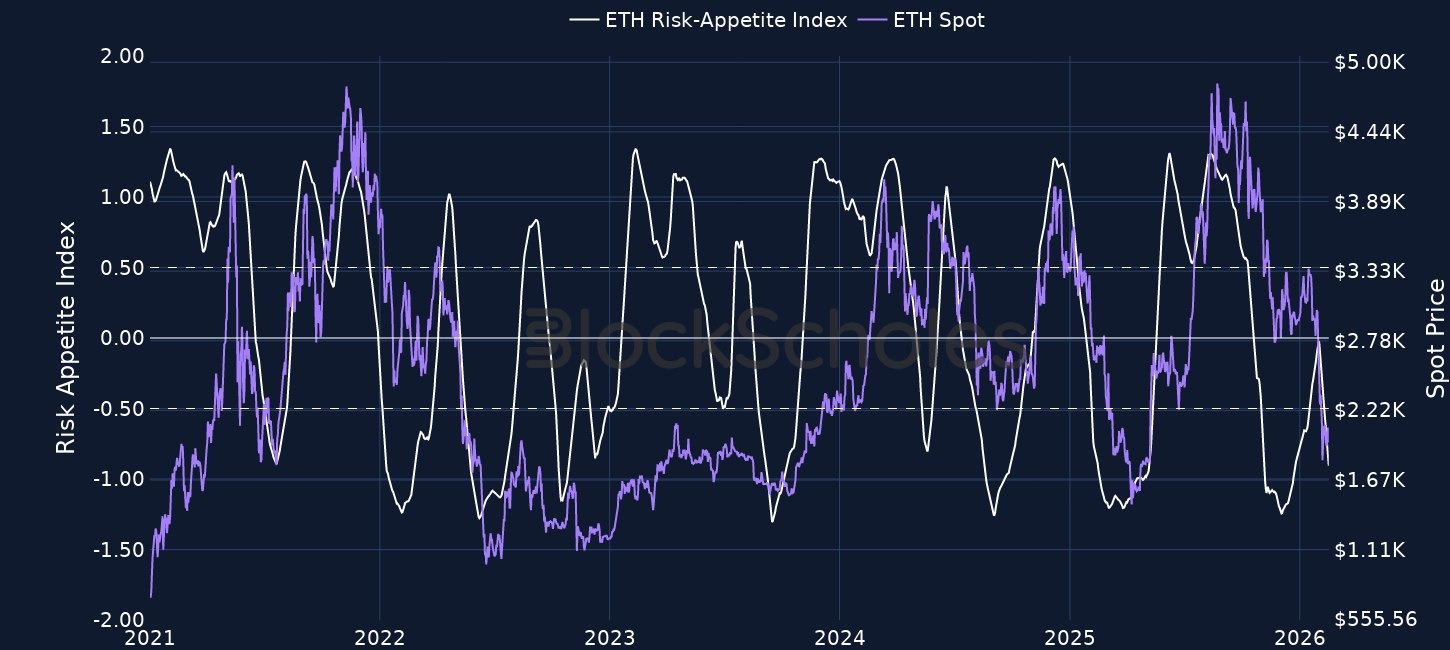
Figure 2. Block Scholes ETH Risk-Appetite Index (white, left-hand axis) and ETH spot price (purple, right-hand axis)
Figure 3. BTC at-the-money implied volatility across selected tenors. Source: Deribit, Block Scholes
Figure 4. ETH at-the-money implied volatility across selected tenors. Source: Deribit, Block Scholes
Figure 5. BTC 25-delta put-call skew ratio across selected tenors. Source: Deribit, Block Scholes
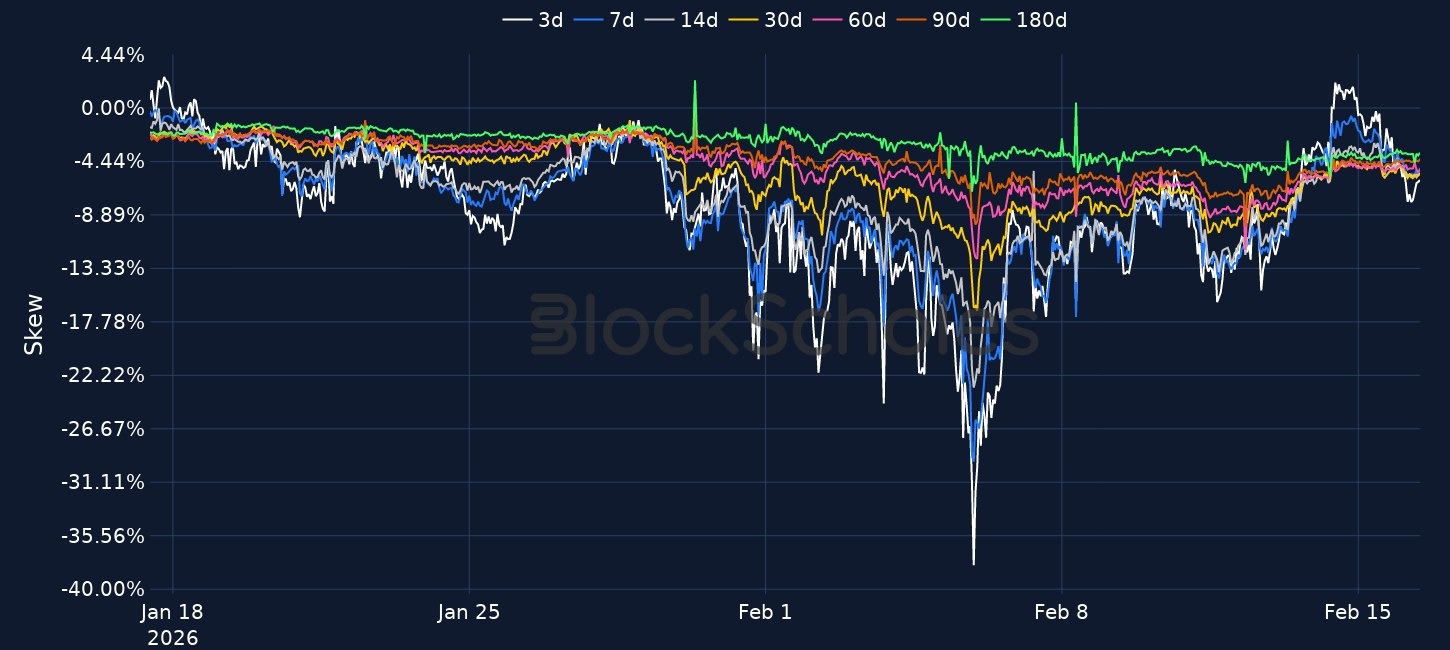
Figure 6. ETH 25-delta put-call skew ratio across selected tenors. Source: Deribit, Block Scholes
Share this post
Copy URL
www.blockscholes.com/premium-research/no-consensus-post-consensus

Find out our latest reports, listed below:

Daily Updates:

  • The Block Scholes team has just returned from Consensus Hong Kong, where we spoke to more than 150 market participants, partners, and clients.
  • We found sentiment surprisingly bullish despite price action, with the focus skewed toward building and utility rather than token prices (though with its fair share of rumours as to the cause).
  • Key themes include tokenisation of RWA (and decentralised derivatives on those same RWAs!), integrating agentic tools to blockchain technology, and prediction markets.
  • Despite the bullishness we felt, BTC spot continues in the $65K – $70K range that it has traded in since the Feb 6 capitulation, with the post-selloff narrative still unclear and no clear consensus on the next driver of price action.
  • Continuing sideways at these levels has seen Block Scholes’ Risk Appetite index reverse direction (now sharply downward) after approaching zero from below in the early part of 2026. This crossing has historically been an indicator of bullish momentum across most crypto currencies, but current price action is a clear outlier to that pattern.
  • Options market positioning can be summarised quickly: low volatility and a skew towards puts. While a skew towards puts isn’t surprising (traders want protection against further downside, plus some speculation of traders getting caught short puts), the low level of implied volatility is.
  • Relative to the (still high) level of realised volatility, implied volatility snapped lower almost immediately after the sell-off on Feb 5, 2026. The 30D tenor of BTC now trades at 45-46%, while realised continues to range closer to 50%.

Market Snapshot: Overnight Moves

Find out our latest reports, listed below:

Daily Updates:

  • The Block Scholes team has just returned from Consensus Hong Kong, where we spoke to more than 150 market participants, partners, and clients.
  • We found sentiment surprisingly bullish despite price action, with the focus skewed toward building and utility rather than token prices (though with its fair share of rumours as to the cause).
  • Key themes include tokenisation of RWA (and decentralised derivatives on those same RWAs!), integrating agentic tools to blockchain technology, and prediction markets.
  • Despite the bullishness we felt, BTC spot continues in the $65K – $70K range that it has traded in since the Feb 6 capitulation, with the post-selloff narrative still unclear and no clear consensus on the next driver of price action.
  • Continuing sideways at these levels has seen Block Scholes’ Risk Appetite index reverse direction (now sharply downward) after approaching zero from below in the early part of 2026. This crossing has historically been an indicator of bullish momentum across most crypto currencies, but current price action is a clear outlier to that pattern.
  • Options market positioning can be summarised quickly: low volatility and a skew towards puts. While a skew towards puts isn’t surprising (traders want protection against further downside, plus some speculation of traders getting caught short puts), the low level of implied volatility is.
  • Relative to the (still high) level of realised volatility, implied volatility snapped lower almost immediately after the sell-off on Feb 5, 2026. The 30D tenor of BTC now trades at 45-46%, while realised continues to range closer to 50%.

Market Snapshot: Overnight Moves