Crypto and US equities weakened as US-Iran tensions escalated, with the S&P 500 down 0.26% after a 2.3% intraday drop and the Nasdaq-100 down 1.12%. BTC traded between $60K and $64K as spot ETF outflows continued and derivatives markets stayed bearish, while Aave weighed a new risk framework and Botanix said it will shut down by July 9, 2026.
Block Scholes is an FCA-regulated institutional crypto derivatives analytics platform. Live data, IV surfaces, and backtesting available via blockscholes.com.
Crypto and US equities weakened as US-Iran tensions escalated, with the S&P 500 down 0.26% after a 2.3% intraday drop and the Nasdaq-100 down 1.12%.
BTC traded between $60K and $64K as spot ETF outflows continued and derivatives markets stayed bearish, while Aave weighed a new risk framework and Botanix said it will shut down by July 9, 2026.
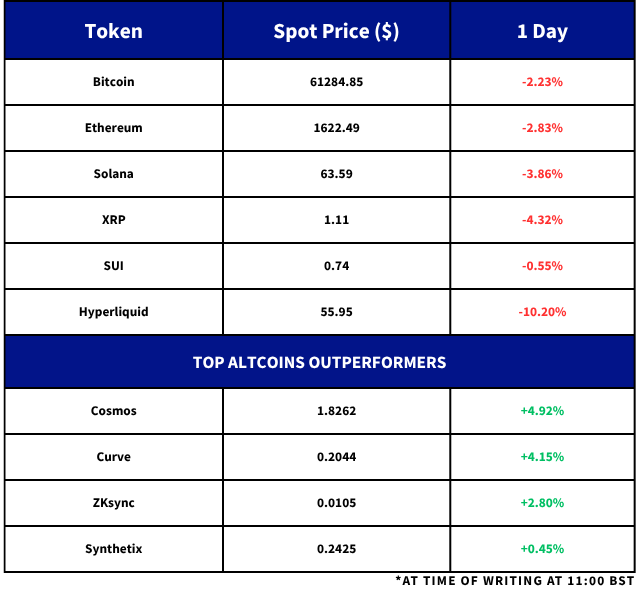
Market Snapshot: Overnight Moves
Macro & Markets
Both crypto and US equities showed weakness over the past 24 hours as geopolitical tensions between the US and Iran escalated.
The S&P 500 closed the session down 0.26%, though that masked greater losses earlier in the day when the index fell as much as 2.3% intraday.
While most companies in the index actually rose (nine out of eleven S&P 500 sectors traded higher), tech-stocks — which make up the largest portion of the index — sold off once again.
Similarly, the technology-heavy Nasdaq 100 lost 1.12% after being down more than 4% earlier in the session. The Philadelphia Semiconductor Index, which contains chip bellwethers such as Nvidia Corp., ended down 1.9% following a 5.6% rally on Monday.
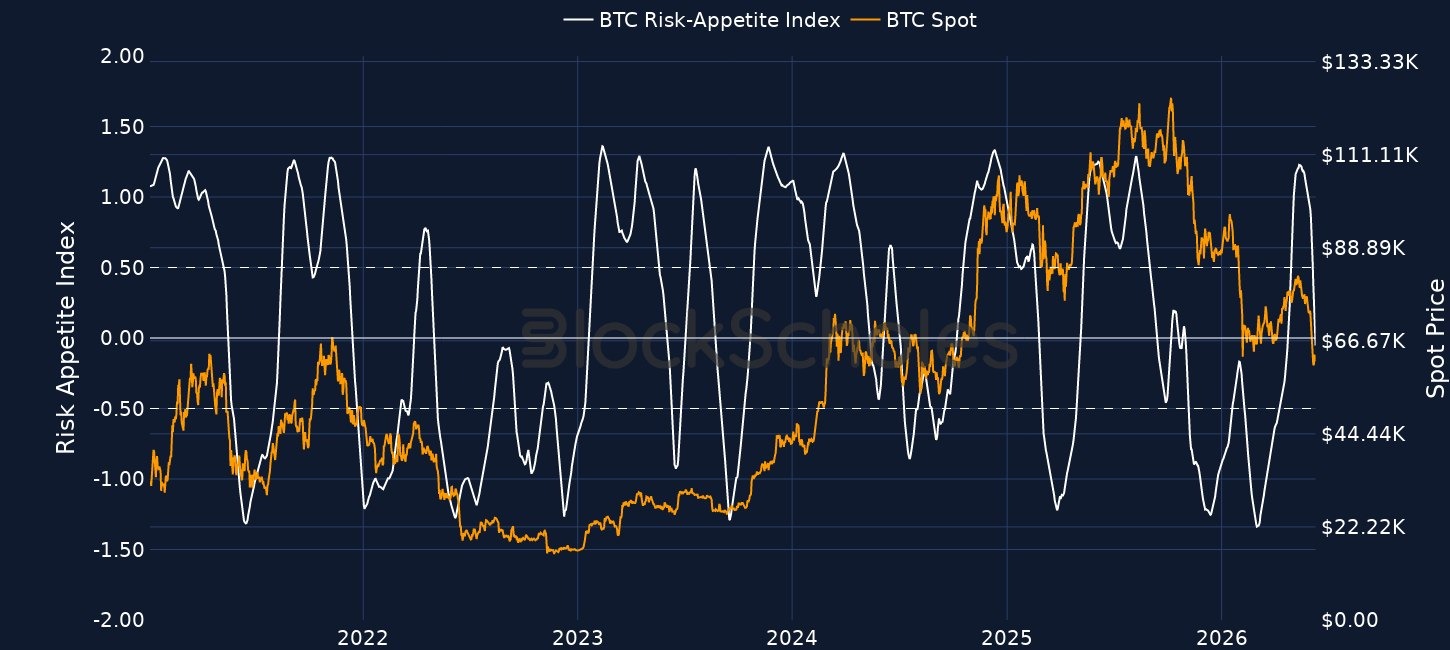
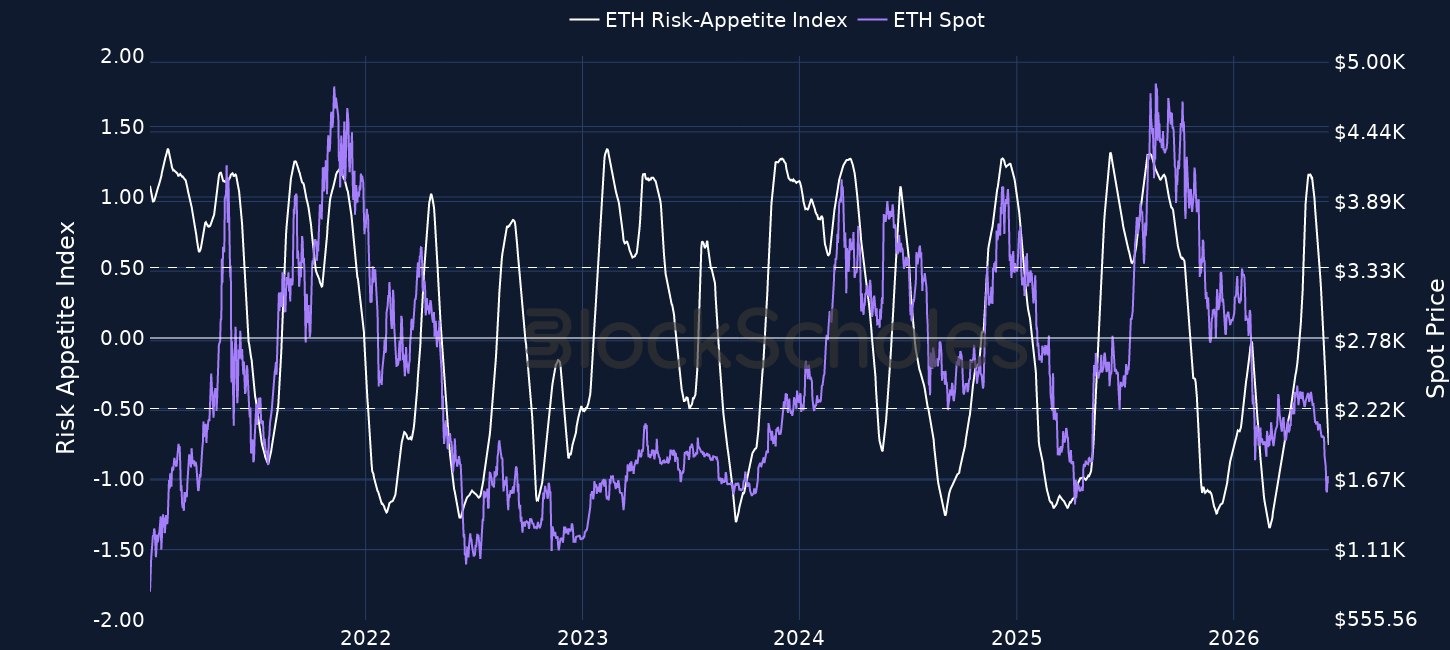
BTC traded between $60K and $64K, as spot Bitcoin ETFs continued a third day of outflows. Sentiment continues to remain extremely fragile as our Risk Appetite Indexes for both BTC and ETH continue to point towards bearish momentum.
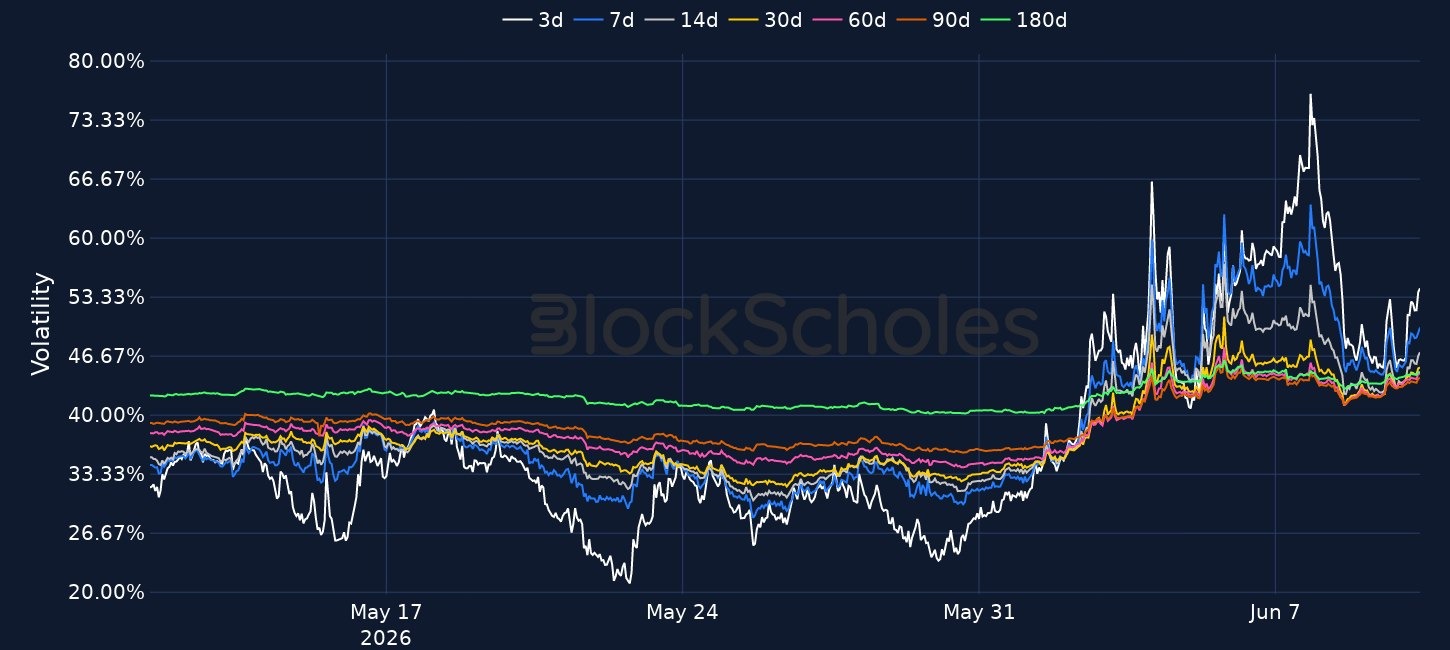
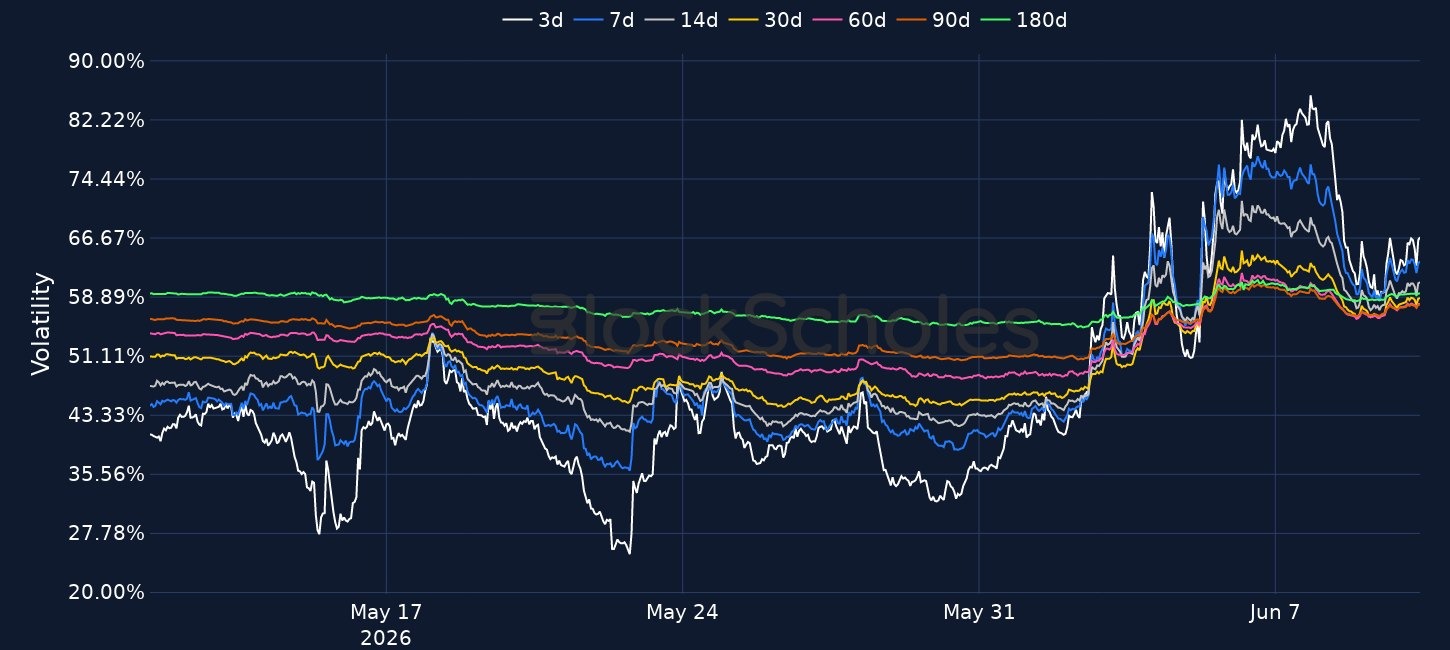
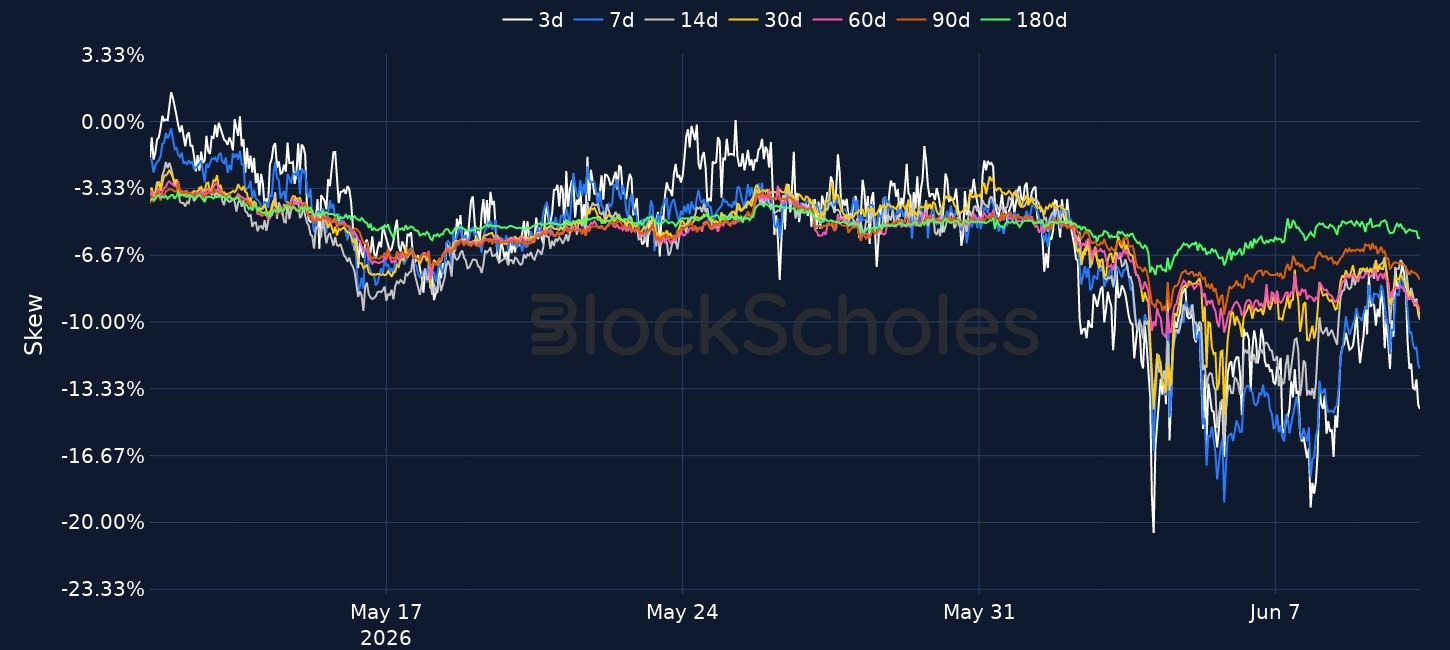
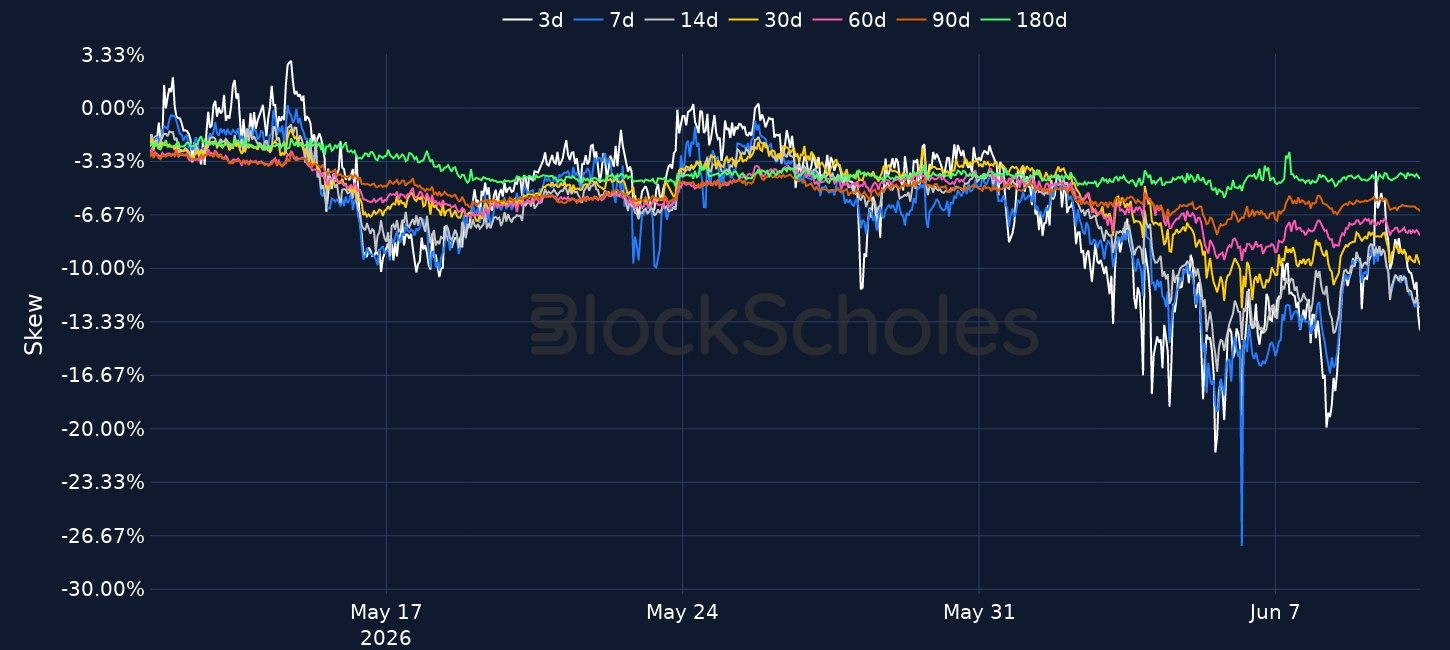
That’s also reflected in options markets where term structures of at-the-money implied volatility remain inverted and volatility smiles continue to tilt towards put options across all tenors.
The US and Iran exchanged fresh airstrikes overnight with one another after President Donald Trump promised to retaliate for the shooting down of an American military helicopter around the coast of Oman.
The US Central Command said that it “began launching self-defense strikes against Iran, at 5 pm ET today at the Commander in Chief’s direction, in response to yesterday’s downing of a US Army Apache helicopter”.
The forces of the US Central Command "struck Iranian air defense, ground control stations, and surveillance radar sites near the Strait of Hormuz with precision munitions" as part of their operation and described the mission as a "proportional response to recent attacks on U.S. forces and international commercial ships transiting regional waters."
On the other hand, Iran's military said it had attacked "several US bases in the region", including Bahrain, Jordan and Kuwait.
The escalations add a new obstacle to President Trump’s repeated claim that a peace agreement is imminent — it was only Monday this week that both Iran and Israel agreed to halt strikes against one another, in an effort to move closer towards a permanent ceasefire.
DeFi / Web3 / Altcoins / Crypto3
Decentralized lending protocol, Aave, is considering a new risk management framework proposed by LlamaRisk that would introduce standardized assessments for asset, bridge and blockchain risks, alongside automated monitoring tools across the protocol.
The proposal follows the $292M KelpDAO rsETH bridge exploit in April, which spilled into Aave after stolen assets were deposited as collateral and used to borrow funds, raising concerns about potential bad debt and cross-protocol contagion.
Aave founder Stani Kulechov said the framework would establish a new risk standard across Aave V3, V4 and Horizon, adding that assets failing to meet the updated requirements could be removed from the protocol in the coming weeks.
Sen. Elizabeth Warren sent a letter to CFTC Chairman Michael S. Selig accusing the agency of failing to effectively oversee the rapidly growing crypto and prediction markets sectors, while warning that staff reductions and declining enforcement activity could leave investors and markets more exposed to risk.
Warren cited reports that the CFTC's workforce has shrunk by roughly 25% and noted that enforcement actions have fallen sharply, arguing the agency is being asked to take on greater responsibilities just as Congress considers legislation that would expand the CFTC’s oversight of digital assets.
The senator also questioned the agency’s dealings with firms including Polymarket, Gemini and Crypto.com, requested records related to staff removals and communications with industry participants, and raised concerns that political influence and conflicts tied to President Trump’s crypto-related business interests could be affecting regulatory decisions.
Kalshi, the CFTC-regulated prediction market platform, announced a series of new market integrity measures following recommendations from its independent Surveillance Audit Committee, including risk scoring, employment verification and enhanced whistleblower tools.
Under the new framework, markets will be assessed for factors such as insider trading risk, outcome concentration, national security concerns and market importance, while traders in higher-risk markets may be required to provide employment information to identify potential insiders before they can participate.
MUFG Bank, Mizuho Bank and SMBC said they are targeting the launch of live commercial transactions using a jointly issued stablecoin in fiscal 2026, building on a blockchain payments pilot selected by Japan’s Financial Services Agency FinTech Proof-of-Concept Hub.
The three banks have also agreed to establish a joint council to develop the stablecoin’s governance, operational framework and issuance infrastructure, while exploring future participation from other financial institutions and industry stakeholders.
Starknet, an Ethereum zk-rollup scaling network, has launched STRK20, a zero-knowledge privacy framework that enables shielded ERC20 balances and private transfers while allowing developers to integrate privacy features directly into applications.
The framework allows users to keep token balances and transaction amounts hidden from public view, while still enabling legally required disclosures through viewing keys; it launched with strkBTC and can be used across applications including payments, swaps, lending and staking without relying on traditional crypto mixers.
Botanix Labs announced it is winding down operations and will shut down the Botanix network, urging users to withdraw all Bitcoin and other assets before July 9, 2026.
Despite highlighting a year of mainnet operation with no security incidents, more than 25M transactions, 200,000 wallets, and integrations with firms including Chainlink, Morpho, GMX, Fireblocks and Alchemy, the team said it failed to find sustainable product-market fit for a Bitcoin-focused application platform without relying on token incentives.
The company said demand for Bitcoin DeFi has largely consolidated around existing wrapped-Bitcoin solutions and major trading venues, while network fee generation never matched infrastructure costs, concluding that “the honest answer we have arrived at... is that it did not work, at least not in this market and not on this timeline.”
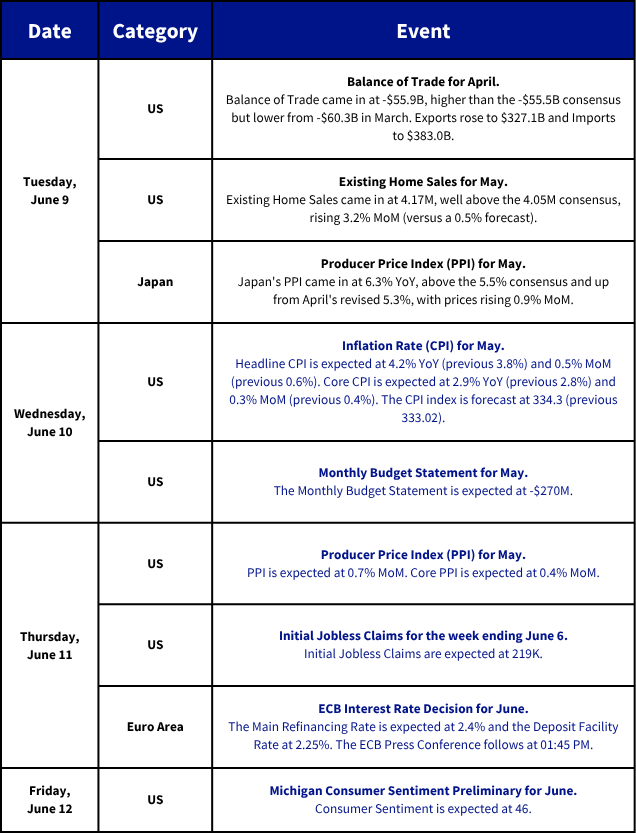
This Week's Calendar
Charts of the Day
Figure 1. Block Scholes BTC Risk-Appetite Index (white, left-hand axis) and BTC spot price (orange, right-hand axis).
Figure 2. Block Scholes ETH Risk-Appetite Index (white, left-hand axis) and ETH spot price (purple, right-hand axis).
Block Scholes is an FCA-regulated institutional crypto derivatives analytics platform. Live data, IV surfaces, and backtesting available via blockscholes.com.
Crypto and US equities weakened as US-Iran tensions escalated, with the S&P 500 down 0.26% after a 2.3% intraday drop and the Nasdaq-100 down 1.12%.
BTC traded between $60K and $64K as spot ETF outflows continued and derivatives markets stayed bearish, while Aave weighed a new risk framework and Botanix said it will shut down by July 9, 2026.
Market Snapshot: Overnight Moves
Macro & Markets
Both crypto and US equities showed weakness over the past 24 hours as geopolitical tensions between the US and Iran escalated.
The S&P 500 closed the session down 0.26%, though that masked greater losses earlier in the day when the index fell as much as 2.3% intraday.
While most companies in the index actually rose (nine out of eleven S&P 500 sectors traded higher), tech-stocks — which make up the largest portion of the index — sold off once again.
Similarly, the technology-heavy Nasdaq 100 lost 1.12% after being down more than 4% earlier in the session. The Philadelphia Semiconductor Index, which contains chip bellwethers such as Nvidia Corp., ended down 1.9% following a 5.6% rally on Monday.
Don't miss what's next
Upgrade your Block Scholes account to unlock this article and other exclusive insights
Block Scholes is an FCA-regulated institutional crypto derivatives analytics platform. Live data, IV surfaces, and backtesting available via blockscholes.com.
Crypto and US equities weakened as US-Iran tensions escalated, with the S&P 500 down 0.26% after a 2.3% intraday drop and the Nasdaq-100 down 1.12%.
BTC traded between $60K and $64K as spot ETF outflows continued and derivatives markets stayed bearish, while Aave weighed a new risk framework and Botanix said it will shut down by July 9, 2026.
Market Snapshot: Overnight Moves
Macro & Markets
Both crypto and US equities showed weakness over the past 24 hours as geopolitical tensions between the US and Iran escalated.
The S&P 500 closed the session down 0.26%, though that masked greater losses earlier in the day when the index fell as much as 2.3% intraday.
While most companies in the index actually rose (nine out of eleven S&P 500 sectors traded higher), tech-stocks — which make up the largest portion of the index — sold off once again.
Similarly, the technology-heavy Nasdaq 100 lost 1.12% after being down more than 4% earlier in the session. The Philadelphia Semiconductor Index, which contains chip bellwethers such as Nvidia Corp., ended down 1.9% following a 5.6% rally on Monday.
Don't miss what's next
Upgrade your Block Scholes account to unlock this article and other exclusive insights
Premium
$30/mo
Access previous and future reports, market insights & deep dives.
The selloff in AI-related shares returned on Thursday after disappointing earnings from Meta, Tesla and Lam Research, with the Philadelphia Semiconductor index plunging 6.72% and all 30 of its members ending lower. The 10-year US Treasury yield fell around 17bps to 4.96%, its biggest one-day decline since March 2023, even as Brent crude rose 4.0% to its highest close since May. Uniswap launched aggregator hooks that let v4 route trades through liquidity on Fluid, Curve and PancakeSwap, while SoFi launched a tokenised bank deposit paying 4.4% APY.